

Renee Cosmetics
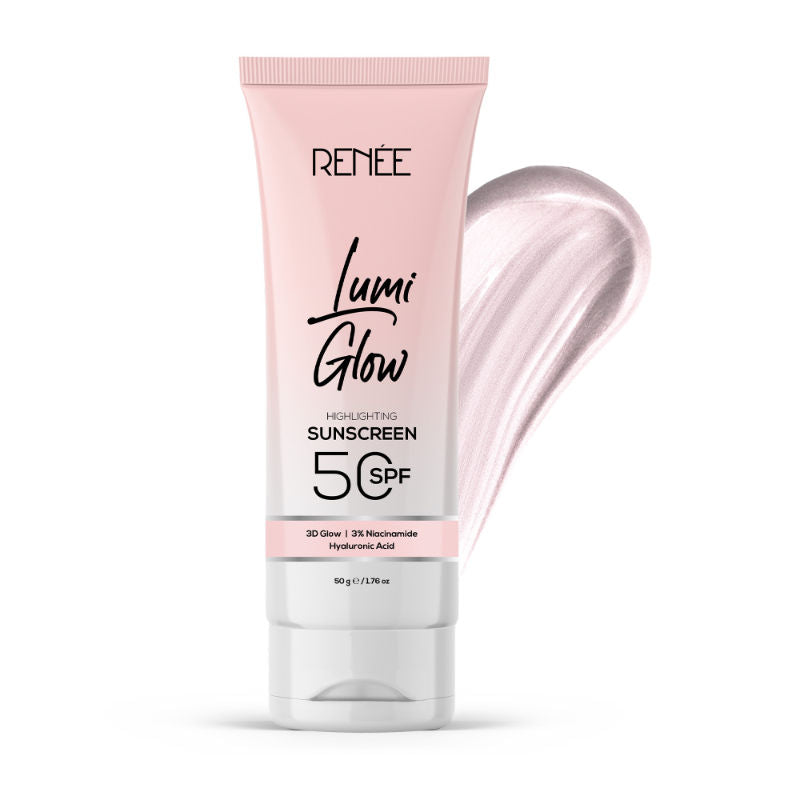
Renee Cosmetics Lumi Glow Highlighting SPF 50 Sunscreen

Renee Cosmetics Lumi Glow Highlighting SPF 50 Sunscreen
Renee Cosmetics
renee-cosmetics-lumi-glow-highlighting-spf-50-sunscreen
Suncare
10084778803493
Morning or Evening?
How often will you use this product?
Notes


Highlights
WHAT IS IT?
SPF 50 Sunscreen, 14 ingredients
FEATURES
Broad-spectrum SPF protection, Niacinamide to protect from redness and inflammation, Hyaluronic acid hydration, Lightweight and smooth texture, Illuminating glow, Cruelty-free
BEST FOR
sensitive
CHECKS
Paraben-Free, Alcohol-free, Silicone-free
Who Is It For?
All Genders Adult Women Mainly (implied Modern Indian Woman)What Does It Help With?
Sun Protection Preventing Sun Damage And Tanning Skin Hydration And GlowBudget
Affordable (under $30)How To Use
Which routine should it be used in?
Instructions:
Key Information


What Renee Cosmetics Says
Product Description:
SPF on, tan out! Save that precious skin of yours from harmful UV rays with RENEE Lumi Glow Highlighting Sunscreen. A perfect solution for sun protection, it offers broad-spectrum activity. Infused with the ultra-goodness of niacinamide and hyaluronic acid, this sunscreen powerfully shields your skin from unwanted sun rays along with nourishing it and giving it an illuminating, radiant kiss. Protect, nourish, and glow - make RENEE Lumi Glow Highlighting Sunscreen your everyday essential. Features: Sunscreen that protects the skin from sun damage and tanning, Infused with niacinamide and hyaluronic acid, Lightweight formula with a smooth texture, Gives a luminous glow to the skin, Cruelty-free.
About the Brand:
Ingredients Overview
Ingredients List
Water, Caprylic/Capric Triglyceride, Dimethicone, Phenyl Trimethicone, Ethylhexyl Methoxycinnamate, Butyl Methoxydibenzoylmethane, Benzophenone-3, Phospholipids, Acrylates Copolymer, Ceto Stearyl Alcohol, Pearl Powder, Niacinamide, Hyaluronic Acid, Phenoxyethanol & Ethylhexylglycerin
Key Ingredients
Niacinamide, Hyaluronic Acid
Ingredients Details
Acrylates Copolymer
Common Name(s): Acrylic copolymer,carbopol ez,flexible film former
CAS Number: 25133-97-5
DESCRIPTION
What It Does: Provides versatile acrylic film formation and thickening across broad ph range.
Why It's Used: Versatile workhorse polymer for film formation and thickening across diverse cosmetic product types from acidic aha serums to alkaline cleansers.
How It Works: Copolymer of acrylic acid and methacrylic acid esters. thickens via polymer chain entanglement and electrostatic repulsion. film formation from chain entanglement on water evaporation. broad ph stability from balanced acid/neutral monomer composition.
Typically Found In: Serums,lotions,sunscreens — versatile across formulation types
TECHNICAL DETAILS
Primary Category: Functional ingredient – acrylic film former
Secondary Functions: Skin conditioning
Application Areas:

Facial Skincare

Body Care
Hair Care
Beard Care
Color Cosmetics (Makeup)
Dietary/Oral Supplements
Typical Concentration Range: 0.1%–3%
SOURCING & ETHICS
Vegan Status: Conditional - supplier confirmation required
Halal Status: Unverified - supplier confirmation required
Source Notes: Commercially produced for cosmetic use. verify vegan/halal status with supplier. [audit 2026-07-29 rev2: the record's own source_notes does not assert a non-animal origin, or instructs the reader to verify with the supplier; "yes" asserts knowledge the record does not hold. determination requires shariah-panel sign-off.]
SKIN COMPATIBILITY
Irritancy Rating: 1/5 – very low
Comedogenicity Rating: 0/5 – non-comedogenic
Sensitivity Concerns: Well-tolerated by most skin types.
Safe for Sensitive Skin: Yes
SAFETY & COMPATIBILITY
Safety Profile: Good safety profile at recommended concentrations. ewg score: 1–2.
Works Well With: Standard skincare actives
Avoid Combining With: No known significant incompatibilities
SCIENTIFIC NOTE
Acrylates copolymers' broad ph thickening stability (vs carbomer's ph-sensitive thickening, requiring neutralisation for viscosity) enables thickening of acidic aha serums (ph 3-4) without neutralisation — maintaining the low ph required for aha efficacy while providing viscosity control. this acid-stable thickening is impossible with conventional carbomers.
Last Verified:
Benzophenone-3
Common Name(s): Oxybenzone,2-hydroxy-4-methoxybenzophenone,uva+uvb filter
CAS Number: 131-57-7
DESCRIPTION
What It Does: Provides combined uva and uvb filtration in a single chemical uv filter molecule.
Why It's Used: Combined uva+uvb filter historically used for broad-spectrum coverage in a single ingredient, now increasingly restricted.
How It Works: Benzophenone chromophore absorbs uvb (305nm) and uva-ii (326nm) via two separate n→π* transitions. water-soluble allows aqueous phase formulation. single filter providing partial broad-spectrum coverage.
Typically Found In: Sunscreens (being phased out in many markets)
TECHNICAL DETAILS
Primary Category: Active ingredient – chemical uva/uvb filter
Secondary Functions: Skin conditioning
Application Areas:
Facial Skincare
Body Care
Hair Care
Beard Care
Color Cosmetics (Makeup)
Dietary/Oral Supplements
Typical Concentration Range: Up to 6% (eu), 6% (us fda)
SOURCING & ETHICS
Vegan Status: Conditional - supplier confirmation required
Halal Status: Unverified - supplier confirmation required
Source Notes: Commercially produced for cosmetic use. verify vegan/halal status with supplier. [audit 2026-07-29 rev2: the record's own source_notes does not assert a non-animal origin, or instructs the reader to verify with the supplier; "yes" asserts knowledge the record does not hold. determination requires shariah-panel sign-off.]
SKIN COMPATIBILITY
Irritancy Rating: 1/5 – very low
Comedogenicity Rating: 0/5 – non-comedogenic
Sensitivity Concerns: Well-tolerated by most skin types.
Safe for Sensitive Skin: Yes
SAFETY & COMPATIBILITY
Safety Profile: Eu max 6%. coral reef/aquatic toxicity — banned hawaii, palau, some us states. potential endocrine activity at high systemic exposure. ewg score: 7. use declining due to regulatory pressure.
Works Well With: Standard skincare actives
Avoid Combining With: No known significant incompatibilities
SCIENTIFIC NOTE
Benzophenone-3's declining use reflects evolving understanding of environmental and endocrine impacts: discovered in coral bleaching studies, its restriction in hawaii (2018) sparked a global trend in marine-safe sunscreen formulations that is reshaping the industry away from bp-3 toward mineral filters and marine-safer organic alternatives.
Last Verified: 2026-03-12
Primary Sources: Cosing database,fda uv filter otc monograph,hawaii bp-3 restriction law
Butyl Methoxydibenzoylmethane
Common Name(s): Butyl methoxydibenzoylmethane,organic uv filter,photostabilising sunscreen active
CAS Number: N/a
DESCRIPTION
What It Does: Absorbs uv radiation at specific wavelengths (uva 320–400 nm, uvb 290–320 nm) and dissipates photon energy as heat rather than skin-damaging photochemical reactions.
Why It's Used: Organic uv filters are chosen for their high molar extinction coefficient, specific spectral coverage, and formulation compatibility — individual filters are combined to provide broad-spectrum coverage across uva+uvb.
How It Works: Uv photon absorption by the aromatic chromophore π-system excites the molecule from s₀ ground state to s₁ excited state. rapid internal conversion or photoisomerisation dissipates energy as vibrational heat before it can initiate skin photodamage.
Typically Found In: Sunscreens,photoprotective products
TECHNICAL DETAILS
Primary Category: Active ingredient – cosmetic active
Secondary Functions: Skin conditioning
Application Areas:
Facial Skincare
Body Care
Hair Care
Beard Care
Color Cosmetics (Makeup)
Dietary/Oral Supplements
Typical Concentration Range: Check local sunscreen regulations
SOURCING & ETHICS
Vegan Status: Conditional - supplier confirmation required
Halal Status: Unverified - supplier confirmation required
Source Notes: Commercially produced for cosmetic use. verify vegan/halal status with supplier. [audit 2026-07-29 rev2: the record's own source_notes does not assert a non-animal origin, or instructs the reader to verify with the supplier; "yes" asserts knowledge the record does not hold. determination requires shariah-panel sign-off.]
SKIN COMPATIBILITY
Irritancy Rating: 1/5 – very low
Comedogenicity Rating: 0/5 – non-comedogenic
Sensitivity Concerns: Well-tolerated by most skin types.
Safe for Sensitive Skin: Yes
SAFETY & COMPATIBILITY
Safety Profile: Good safety profile at recommended concentrations. ewg score: 1–2.
Works Well With: Standard skincare actives
Avoid Combining With: No known significant incompatibilities
SCIENTIFIC NOTE
Organic uv filters require photostabilisation (by avobenzone-octocrylene pairing, or triazine stabilisers) as some absorbers degrade on uv exposure — formulator must verify photostability of the chosen filter combination.
Last Verified: 2026-03-12
Primary Sources: Cosing database,butyl methoxydibenzoylmethane organic uv filter review
Caprylic/capric Triglyceride
Common Name(s): Mct oil,fractionated coconut oil,c8/c10 triglyceride
CAS Number: 73398-61-5
DESCRIPTION
What It Does: Lightweight, stable emollient that solubilizes oil-soluble actives for excellent delivery without greasy feel.
Why It's Used: Universal lightweight emollient base and solubilizer for oil-soluble actives in serums and low-viscosity formulations where mineral oil or petrolatum would be too heavy.
How It Works: Medium-chain length provides ideal balance of spreading coefficient, penetration rate, and barrier-sealing properties. excellent solubilizer for vitamin e, retinoids, and other lipophilic actives.
Typically Found In: Serums,facial oils,sunscreens,anti-aging products,hair products
TECHNICAL DETAILS
Primary Category: Active ingredient – medium-chain triglyceride emollient
Secondary Functions: Active solubilizer,spreading agent
Application Areas:
Facial Skincare
Body Care
Hair Care
Beard Care
Color Cosmetics (Makeup)
Dietary/Oral Supplements
Typical Concentration Range: 1%–50%
SOURCING & ETHICS
Vegan Status: Conditional - feedstock declaration required
Halal Status: Unverified - feedstock declaration required (plant, animal and petrochemical routes all exist)
Source Notes: Fractionated by hydrolysis and re-esterification of coconut oil. only c8 and c10 fatty acids retained. [audit 2026-07-29 rev2: origin-dependent: the same inci exists in plant, animal and petrochemical versions and the name does not discriminate. determination requires shariah-panel sign-off.]
SKIN COMPATIBILITY
Irritancy Rating: 1/5 – very low
Comedogenicity Rating: 1/5 – very low; medium-chain length generally non-comedogenic
Sensitivity Concerns: Non-irritating.
Safe for Sensitive Skin: Yes
SAFETY & COMPATIBILITY
Safety Profile: Excellent safety profile. ewg score: 1.
Works Well With: Humectants,ceramides,actives as carrier
Avoid Combining With: No significant incompatibilities
SCIENTIFIC NOTE
Mct oil's medium-chain length (c8/c10) provides superior oxidative stability vs longer polyunsaturated chains and better skin aesthetics (lighter, less greasy) vs longer chain emollients (c16/c18). excellent solubilizer for retinoic acid, tocopheryl esters, and other lipophilic actives.
Last Verified: 2026-03-12
Primary Sources: Cosing database,cir safety assessment,ewg skin deep