

Odacité
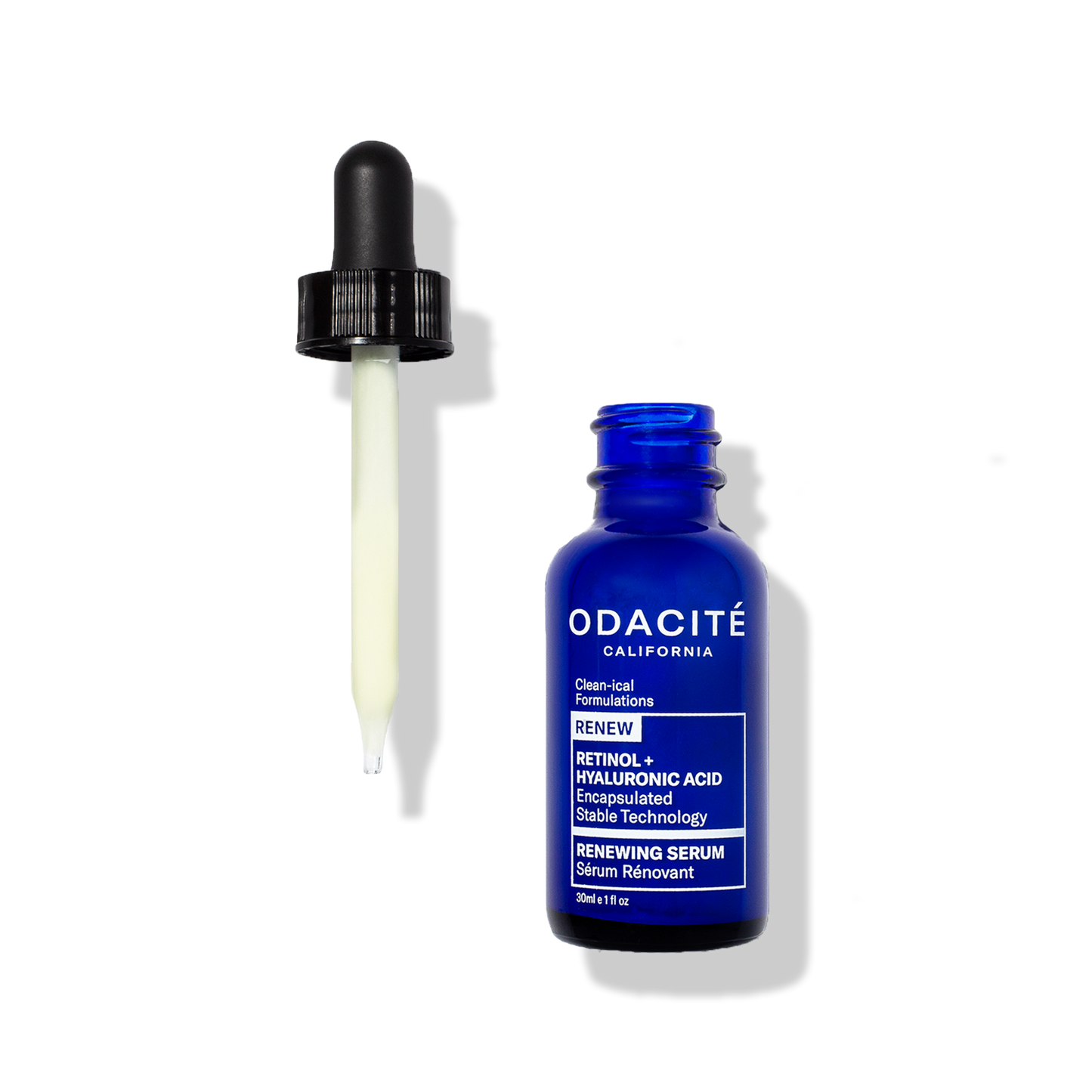
Renewing Serum Retinol + Hyaluronic Acid

Renewing Serum Retinol + Hyaluronic Acid
Odacité
renewing-serum-retinol-hyaluronic-acid
Serum
9706787373349
Morning or Evening?
How often will you use this product?
Notes


Highlights
WHAT IS IT?
Retinol and Hyaluronic Acid serum
FEATURES
Clean-ical Formulation, Advanced Encapsulation Technology
BEST FOR
All skin types, especially those prone to signs of aging and blemishes
CHECKS
Free of parabens, fillers, nanoparticles, petrochemicals, PEG, synthetic perfumes, dyes, phenoxyethanol
Who Is It For?
Adults (18+) Both Women And MenWhat Does It Help With?
Fine Lines Wrinkles Uneven Skin Texture Congested Pores Loss Of FirmnessBudget
PremiumHow To Use
Which routine should it be used in?
Instructions:
Key Information


What Odacité Says
Product Description:
A youth-restoring Retinol Serum expertly formulated with Advanced Encapsulation Technology to visibly minimize signs of aging & blemishes. Paired with Hyaluronic Acid in this Clean-ical Formulation, Encapsulated Retinol delivers maximum benefits, while minimizing any risk of irritation.
About the Brand:
Ingredients Overview
Ingredients List
Rosa Damascena (Rose) Water, Squalane, Glycerin, Bakuchiol, Lauryl Glucoside, Polyglyceryl-2 Dipolyhydroxystearate, Lonicera caprifolium flower extract, Sodium Hyaluronate, Amorphophallus konjac, Retinol, Cellulose Acetate Butyrate, Tricaprylin, Pentaerythrityl Tetra-di-tbutyl Hydroxyhydrocinnamate, Lonicera japonica flower extract, Aqua, Pelargonium Roseum Leaf Oil, Aloe Barbadensis, (Aloe) Leaf / flower Extract, Phospholipids, Tocopheryl Acetate ( Vitamin E) , Retinyl Palmitate (Vitamin A), Pantothenic Acid (Vitamin B5), Ascorbyl Palmitate (Vitamin C), Cholecalciferol(Vitamin D3), Melia Azadirachta (Neem) Leaf/ Flower Extract, Corallina Officinalis (Seaweed) Extract, Curcuma Longa (Turmeric) Root Extract, Ocimum Basilicum (Basil) Flower/Leaf Extract, Ocimum Sanctum Leaf Extract, Sodium Benzoate
Key Ingredients
Retinol, Hyaluronic Acid, Bakuchiol, Squalane, Vitamin Complex (A, B, D, E)
Ingredients Details
Bakuchiol
Common Name(s): Bakuchiol,(s)-bakuchiol
CAS Number: 10309-37-2
DESCRIPTION
What It Does: Provides retinol-equivalent anti-aging gene expression from a natural plant compound without retinol's limitations.
Why It's Used: The natural retinol alternative — the first plant compound with rct evidence for equivalent anti-aging results to retinol with better safety and photostability.
How It Works: Bakuchiol activates rar beta and retinoid x receptors via allosteric binding mechanism. upregulates type i, iii, and iv collagen synthesis genes. downregulates mmp-1 and mmp-9. antioxidant via phenol radical scavenging. photostable — stable to uv exposure unlike retinol.
Typically Found In: Natural anti-aging serums,pregnancy-safe retinol alternative,photostable anti-aging
TECHNICAL DETAILS
Primary Category: Active ingredient – natural retinol alternative
Secondary Functions: Free radical scavenging,anti-aging
Application Areas:

Facial Skincare
Body Care

Hair Care
Beard Care
Color Cosmetics (Makeup)
Dietary/Oral Supplements
Typical Concentration Range: 0.5%–2%
SOURCING & ETHICS
Vegan Status: Conditional - supplier confirmation required
Halal Status: Unverified - supplier confirmation required
Source Notes: Plant-derived extract or synthetic. [audit 2026-07-29 rev2: status downgraded on audit. determination requires shariah-panel sign-off.]
SKIN COMPATIBILITY
Irritancy Rating: 1/5 – very low
Comedogenicity Rating: 0/5 – non-comedogenic
Sensitivity Concerns: Non-irritating; well-tolerated.
Safe for Sensitive Skin: Yes
SAFETY & COMPATIBILITY
Safety Profile: Excellent safety profile. ewg score: 1.
Works Well With: Vitamin c,vitamin e,ferulic acid,spf,other antioxidants
Avoid Combining With: No significant incompatibilities
SCIENTIFIC NOTE
The dhaliwal et al. (2019, british journal of dermatology) split-face rct directly compared 0.5% bakuchiol vs 0.5% retinol twice daily for 12 weeks — both groups showed equivalent reduction in fine lines and wrinkles, but bakuchiol showed significantly less scaling, stinging, and burning. this is the strongest evidence that bakuchiol provides retinol-equivalent anti-aging with better tolerability.
Last Verified: 2026-03-12
Primary Sources: Cosing database,dhaliwal et al. bakuchiol vs retinol rct
Glycerin
Common Name(s): Glycerol,glycerine,1,2,3-propanetriol
CAS Number: 56-81-5
DESCRIPTION
What It Does: Glycerin pulls water from the environment and deeper skin layers into the outer skin layer (epidermis), boosting moisture levels and keeping skin soft, smooth, and plump.
Why It's Used: It is used in virtually every moisturizer, serum, and cleanser because it is highly effective at hydrating skin, is well-tolerated by all skin types, and enhances the texture and spreadability of formulations.
How It Works: As a humectant, glycerin forms hydrogen bonds with water molecules, trapping them in the skin. it also reinforces the skin barrier by integrating into lipid structures between skin cells.
Typically Found In: Moisturizers,serums,cleansers,toners,sheet masks,sunscreens,body lotions,shampoos,conditioners
TECHNICAL DETAILS
Primary Category: Humectant
Secondary Functions: Skin barrier support,emollient,solvent
Application Areas:
Facial Skincare
Body Care
Hair Care
Beard Care
Color Cosmetics (Makeup)
Dietary/Oral Supplements
Typical Concentration Range: 1%–30% (typical: 3–10%)
SOURCING & ETHICS
Vegan Status: Conditional - feedstock declaration required
Halal Status: Unverified - feedstock declaration required (plant, animal and petrochemical routes all exist)
Source Notes: Derived from plant oils via hydrolysis or saponification; synthetic versions also available. palm-derived glycerin carries sustainability concerns. [audit 2026-07-29 rev2: origin-dependent: the same inci exists in plant, animal and petrochemical versions and the name does not discriminate. determination requires shariah-panel sign-off.]
SKIN COMPATIBILITY
Irritancy Rating: 1/5 – very low; non-irritating at all standard concentrations
Comedogenicity Rating: 0/5 – non-comedogenic
Sensitivity Concerns: Extremely rare allergic reactions; generally safe for all skin types including sensitive and baby skin
Safe for Sensitive Skin: Yes
SAFETY & COMPATIBILITY
Safety Profile: Widely recognized as safe. ewg hazard score: 1. no significant concerns for irritation, sensitization, or toxicity at typical concentrations (up to 50%).
Works Well With: Hyaluronic acid,ceramides,niacinamide,panthenol,urea,peptides,retinol,ahas/bhas
Avoid Combining With: No known incompatibilities at standard concentrations
SCIENTIFIC NOTE
Glycerin is an endogenous skin component found naturally in the stratum corneum. aquaporin-3 channels in keratinocytes facilitate glycerin transport, making it integral to natural skin hydration pathways.
Last Verified: 2026-03-12
Primary Sources: Cosing database,cir safety assessment,ewg skin deep,inci decoder
Lauryl Glucoside
Common Name(s): C12 glucoside,dodecyl glucoside,apg surfactant
CAS Number: 110615-47-9
DESCRIPTION
What It Does: Provides mild, naturally-derived cleansing with excellent biodegradability from glucose and lauryl alcohol.
Why It's Used: The natural cleansing standard — lauryl glucoside's combination of renewability, biodegradability, mildness, and foaming makes it the benchmark natural surfactant for clean beauty facial cleansers.
How It Works: C12 alkyl chain provides cmc and foaming. glucose head group provides mild non-ionic/weakly anionic character from hydroxyl groups. very low irritation potential from polyol head group. excellent biodegradability >95% bod28 from glucoside hydrolysis. cosmos approved.
Typically Found In: Natural facial cleansers,baby shampoos,cosmos certified products
TECHNICAL DETAILS
Primary Category: Functional ingredient – alkyl glucoside surfactant
Secondary Functions: Skin conditioning
Application Areas:
Facial Skincare
Body Care
Hair Care
Beard Care
Color Cosmetics (Makeup)
Dietary/Oral Supplements
Typical Concentration Range: 2%–15%
SOURCING & ETHICS
Vegan Status: Conditional - supplier confirmation required
Halal Status: Unverified - supplier confirmation required
Source Notes: Commercially produced for cosmetic use. verify vegan/halal status with supplier. [audit 2026-07-29 rev2: the record's own source_notes does not assert a non-animal origin, or instructs the reader to verify with the supplier; "yes" asserts knowledge the record does not hold. determination requires shariah-panel sign-off.]
SKIN COMPATIBILITY
Irritancy Rating: 1/5 – very low
Comedogenicity Rating: 0/5 – non-comedogenic
Sensitivity Concerns: Well-tolerated by most skin types.
Safe for Sensitive Skin: Yes
SAFETY & COMPATIBILITY
Safety Profile: Good safety profile at recommended concentrations. ewg score: 1–2.
Works Well With: Standard skincare actives
Avoid Combining With: No known significant incompatibilities
SCIENTIFIC NOTE
Lauryl glucoside's mildness vs sls at equivalent foam performance is measurable by draize eye score: sls scores approximately 55 (mild irritant) while lauryl glucoside scores <15 (essentially non-irritant) in identical eye irritation testing. this quantitative mildness advantage explains why apg surfactants command premium pricing despite renewable/natural origin — actual performance superiority justifies the cost.
Last Verified: 2026-03-12
Primary Sources: Cosing database,cosmos standard,cir safety assessment
Lonicera Caprifolium Flower Extract
Common Name(s): Lonicera caprifolium flower extract,botanical extract,phytochemical active
CAS Number: N/a
DESCRIPTION
What It Does: Provides antioxidant protection from reactive oxygen species, reduces inflammatory cytokine production in skin, and conditions skin through the plant's phytochemical complex.
Why It's Used: Natural origin narrative, traditional use heritage, and multi-functional phytochemical profile supporting concurrent skin care claims from one ingredient.
How It Works: Polyphenols, terpenoids, and alkaloids scavenge ros via h• donation, inhibit nf-kb or cox-2 inflammatory pathways, and interact with skin surface proteins for conditioning.
Typically Found In: Botanical skin care,natural products
TECHNICAL DETAILS
Primary Category: Active ingredient – antioxidant
Secondary Functions: Free radical scavenging,anti-aging
Application Areas:
Facial Skincare
Body Care
Hair Care
Beard Care
Color Cosmetics (Makeup)
Dietary/Oral Supplements
Typical Concentration Range: 0.1%–10%
SOURCING & ETHICS
Vegan Status: Conditional - supplier confirmation required
Halal Status: Yes
Source Notes: Plant-derived extract or synthetic. [audit 2026-07-29 rev2: status downgraded on audit. determination requires shariah-panel sign-off.]
SKIN COMPATIBILITY
Irritancy Rating: 1/5 – very low
Comedogenicity Rating: 0/5 – non-comedogenic
Sensitivity Concerns: Non-irritating; well-tolerated.
Safe for Sensitive Skin: Yes
SAFETY & COMPATIBILITY
Safety Profile: Excellent safety profile. ewg score: 1.
Works Well With: Vitamin c,vitamin e,ferulic acid,spf,other antioxidants
Avoid Combining With: No significant incompatibilities
SCIENTIFIC NOTE
Plant secondary metabolites evolved as photoprotectants and antimicrobials — mechanisms directly applicable to cosmetic antioxidant and anti-inflammatory activity in human skin.
Last Verified: 2026-03-12
Primary Sources: Cosing database,lonicera caprifolium flower extract botanical review