

Nykaa E retail limited
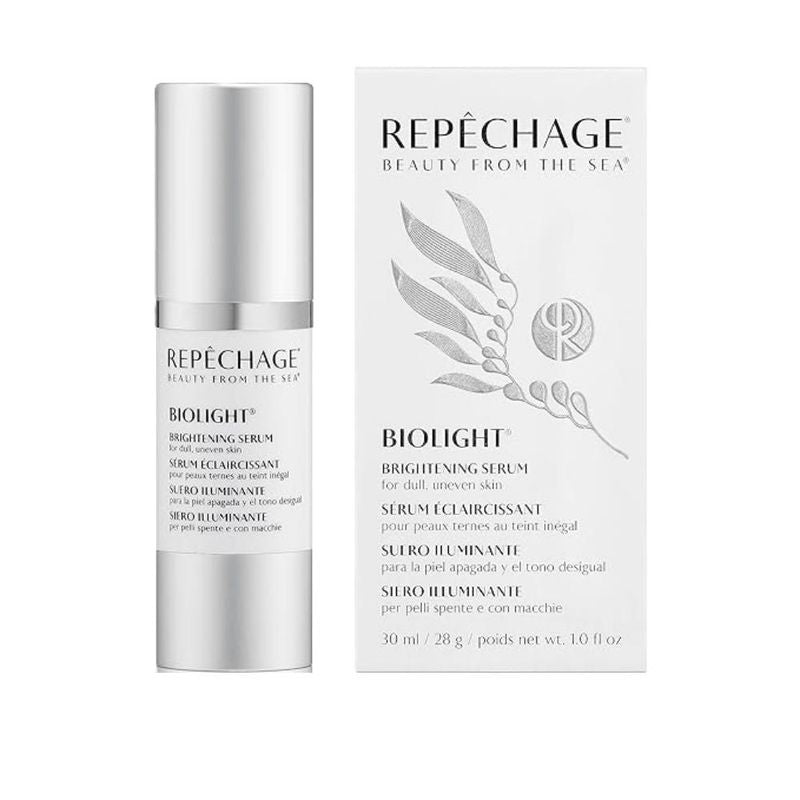
Repechage Biolight Brightening Serum

Repechage Biolight Brightening Serum
Nykaa E retail limited
repechage-biolight-brightening-serum-1
Serum
10085005852965
Morning or Evening?
How often will you use this product?
Notes


Highlights
WHAT IS IT?
Brightening serum, 20+ ingredients
FEATURES
Dermatologist tested, Exclusive Laminaria Complex, Brightens and evens skin tone, Reduces dark spots and pigmentation, Light and non-greasy, Ideal for humid climates, Reveals younger looking skin
BEST FOR
normal
CHECKS
Paraben-Free,Sulfate-free,Fragrance-free
Who Is It For?
Men And Women AdultWhat Does It Help With?
Anti-aging Dark Spots Pigmentation Dullness Uneven Skin ToneBudget
Premium ($76-$150)How To Use
Which routine should it be used in?
Instructions:
Key Information


What Nykaa E retail limited Says
Product Description:
Dermatologist-tested serum with exclusive Laminaria Complex containing seaweeds, Willow Bark, Gotu Kola, and Licorice extracts to brighten, even skin tone, reduce dark spots, pigmentation, and dullness. Light, non-greasy formula ideal for humid climates. Reveals younger-looking, radiant, luminous, and even-toned skin with regular use.
About the Brand:
Ingredients Overview
Ingredients List
Water/Aqua/Eau, Propa ndiol, Glycerin, Laminaria-Digitata-Extract, Ascophyllum-Nodosum-Extract, Glycyrrhiza-Glabra-(Licorice)-Root-Extract, Citrullus-Lanatus-(Watermelon)-Fruit-Extract, Centella-Asiatica-Extract, Salix-Alba-(Willow)-Bark-Extract, Citrus-Sinensis-(Orange)-Fruit-Water, Sodium-Hyaluronate, Sodium-Ascorbyl-Phosphate, Citrulline, Diglucosyl-Gallic-Acid, Citrus-Grandis-(Grapefruit)-Peel-Oil, Citrus-Aurantium-Dulcis-(Orange)-Fruit-Extract, Zingiber-Officinale-(Ginger)-Root-Oil, Sodium-Benzoate, Potassium-Sorbate, Citric-Acid, Carrageenan, Glucose, Ethylhexylglycerin, Polysorbate-20, Phenoxyethanol
Key Ingredients
Laminaria Digitata Extract, Ascophyllum Nodosum Extract, Glycyrrhiza Glabra (Licorice) Root Extract, Salix Alba (Willow) Bark Extract, Centella Asiatica Extract
Ingredients Details
Carrageenan
Common Name(s): Irish moss extract,chondrus crispus extract,kappa/iota/lambda carrageenan
DESCRIPTION
What It Does: Provides natural marine seaweed gellation and thickening with moisturizing sulfated polysaccharide conditioning.
Why It's Used: Marine natural thickener and gellant for seaweed-inspired formulations with moisturizing sulfated polysaccharide activity.
How It Works: Sulfated galactan helical coils form ionic junction zones with potassium (kappa), calcium (iota), or none (lambda) providing different gel textures. iota-carrageenan forms elastic, non-syneretic gels preferred for cosmetics. sulfate groups provide ha-like moisture retention.
Typically Found In: Natural gels,marine skincare,moisturizing masks
TECHNICAL DETAILS
Primary Category: Functional ingredient – seaweed polysaccharide gellant
Secondary Functions: Tewl reduction,skin plumping
Application Areas:

Facial Skincare
Body Care
Hair Care

Beard Care
Color Cosmetics (Makeup)
Dietary/Oral Supplements
Typical Concentration Range: 0.1%–2%
SOURCING & ETHICS
Vegan Status: Yes – from red seaweed
Halal Status: Yes
Source Notes: Synthetic or naturally derived. excellent aqueous solubility.
SKIN COMPATIBILITY
Irritancy Rating: 1/5 – very low
Comedogenicity Rating: 0/5 – non-comedogenic
Sensitivity Concerns: Non-irritating; suitable for all skin types.
Safe for Sensitive Skin: Yes
SAFETY & COMPATIBILITY
Safety Profile: Excellent safety profile. ewg score: 1.
Works Well With: Ceramides,emollients,occlusives,glycerin,hyaluronic acid
Avoid Combining With: No significant incompatibilities
SCIENTIFIC NOTE
Iota-carrageenan's gel mechanism requires calcium ion cross-linking (vs kappa-carrageenan's potassium requirement). this calcium dependency means iota carrageenan gels are skin-compatible (skin's natural calcium levels provide gel-triggering) and provides a unique 'skin-responsive gellation' where the natural calcium in sweat and skin surface triggers in-situ gel formation on application.
Last Verified: Cosing database,cir safety assessment
Primary Sources: 2026-03-12
Citrulline
Common Name(s): L-citrulline,2-amino-5-ureidopentanoic acid
CAS Number: 372-75-8
DESCRIPTION
What It Does: Provides arginine precursor activity for nitric oxide synthesis supporting skin microcirculation.
Why It's Used: Microcirculation-enhancing amino acid that provides arginine for no synthesis with potentially greater bioavailability than direct arginine supplementation.
How It Works: Citrulline is converted to arginine by argininosuccinate synthase, bypassing intestinal and hepatic arginine metabolism for more efficient systemic and local delivery to skin.
Typically Found In: Anti-fatigue formulations,microcirculation products
TECHNICAL DETAILS
Primary Category: Active ingredient – urea cycle amino acid
Secondary Functions: Microcirculation,arginine precursor
Application Areas:
Facial Skincare
Body Care
Hair Care
Beard Care
Color Cosmetics (Makeup)
Dietary/Oral Supplements
Typical Concentration Range: 0.5%–3%
SOURCING & ETHICS
Vegan Status: Yes – plant-derived or synthetic
Halal Status: Yes
Source Notes: Fermentation-derived or synthetic. natural skin component.
SKIN COMPATIBILITY
Irritancy Rating: 1/5 – very low
Comedogenicity Rating: 0/5 – non-comedogenic
Sensitivity Concerns: Non-irritating; endogenous skin molecule.
Safe for Sensitive Skin: Yes
SAFETY & COMPATIBILITY
Safety Profile: Excellent safety profile. natural skin nmf component. ewg score: 1.
Works Well With: Hyaluronic acid,ceramides,peptides,other amino acids
Avoid Combining With: No significant incompatibilities
SCIENTIFIC NOTE
Citrulline bypasses the intestinal absorption limitations of arginine and the hepatic first-pass metabolism that degrades orally-consumed arginine before it reaches peripheral tissues. this makes citrulline a more efficient arginine precursor for peripheral no synthesis, including in skin.
Last Verified: Cosing database,cir safety assessment
Primary Sources: 2026-03-12
Ethylhexylglycerin
Common Name(s): Octylglycerin,2-ethylhexyl glycerol ether,sensiva sc 10
CAS Number: 70445-33-9
DESCRIPTION
What It Does: Provides antimicrobial skin conditioning with deodorant activity and preservation system enhancement.
Why It's Used: Multifunctional clean beauty preservation active — ethylhexylglycerin provides antimicrobial, deodorant, and skin conditioning in a single ingredient accepted in most natural cosmetic certification schemes.
How It Works: Glycerol ether provides antimicrobial via bacterial membrane phospholipid disruption. deodorant activity via reduction of underarm lipase enzyme activity (similar mechanism to triethyl citrate). skin conditioning from glycerol humectant component. synergistic with phenoxyethanol and diols.
Typically Found In: Natural preservation systems,deodorants,skin conditioning products
TECHNICAL DETAILS
Primary Category: Functional ingredient – antimicrobial glycerol ether
Secondary Functions: Skin conditioning
Application Areas:
Facial Skincare
Body Care
Hair Care
Beard Care
Color Cosmetics (Makeup)
Dietary/Oral Supplements
Typical Concentration Range: 0.1%–0.5%
SOURCING & ETHICS
Vegan Status: Yes – synthetic
Halal Status: Yes
Source Notes: Commercially produced for cosmetic use. verify vegan/halal status with supplier.
SKIN COMPATIBILITY
Irritancy Rating: 1/5 – very low
Comedogenicity Rating: 0/5 – non-comedogenic
Sensitivity Concerns: Well-tolerated by most skin types.
Safe for Sensitive Skin: Yes
SAFETY & COMPATIBILITY
Safety Profile: Good safety profile at recommended concentrations. ewg score: 1–2.
Works Well With: Standard skincare actives
Avoid Combining With: No known significant incompatibilities
SCIENTIFIC NOTE
Ethylhexylglycerin's deodorant mechanism is pharmacologically identical to triethyl citrate: both inhibit skin surface microbial lipase enzymes that convert odourless triglycerides to odorous free fatty acids. the glycerol ether structure of ethylhexylglycerin, combined with the 2-ethylhexyl chain, provides lipase inhibition similar to ester-based lipase inhibitors from a different chemical class.
Last Verified: Cosing database,schülke sensiva sc 10 technical data,cir safety assessment
Primary Sources: 2026-03-12
Glucose
Common Name(s): Glucose,cosmetic active,functional ingredient
CAS Number: N/a
DESCRIPTION
What It Does: Delivers characteristic cosmetic function at recommended use concentration.
Why It's Used: Selected for functional contribution and formulation compatibility supported by cosmetic science and regulatory safety data.
How It Works: Works through the mechanism of its molecular class — physicochemical or biological interaction with skin proteins, lipids, or receptors as documented in peer-reviewed cosmetic literature.
Typically Found In: Skin care formulations
TECHNICAL DETAILS
Primary Category: Active ingredient – cosmetic active
Secondary Functions: Skin conditioning
Application Areas:
Facial Skincare
Body Care
Hair Care
Beard Care
Color Cosmetics (Makeup)
Dietary/Oral Supplements
Typical Concentration Range: 0.1%–10%
SOURCING & ETHICS
Vegan Status: Conditional
Halal Status: Yes
Source Notes: Commercially produced for cosmetic use. verify vegan/halal status with supplier.
SKIN COMPATIBILITY
Irritancy Rating: 1/5 – very low
Comedogenicity Rating: 0/5 – non-comedogenic
Sensitivity Concerns: Well-tolerated by most skin types.
Safe for Sensitive Skin: Yes
SAFETY & COMPATIBILITY
Safety Profile: Good safety profile at recommended concentrations. ewg score: 1–2.
Works Well With: Standard skincare actives
Avoid Combining With: No known significant incompatibilities
SCIENTIFIC NOTE
Glucose has an established safety and efficacy profile within the cosmetic regulatory framework at standard use concentrations.
Last Verified: Cosing database,glucose technical literature
Primary Sources: 2026-03-12
