

Skinfix USA
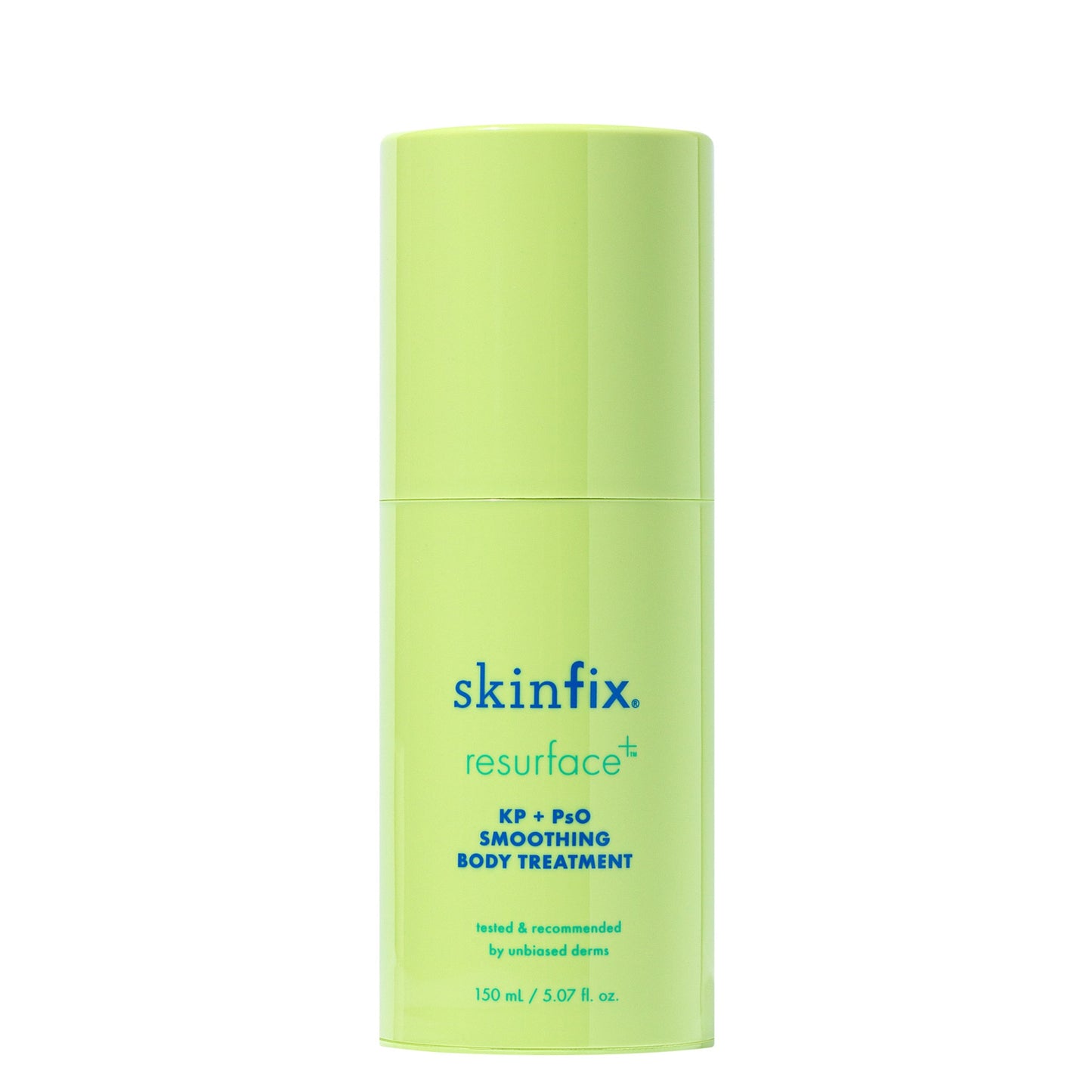
resurface+ KP + PsO Smoothing Body Treatment

resurface+ KP + PsO Smoothing Body Treatment
Skinfix USA
resurface-kp-pso-smoothing-body-treatment
Body care
9818381254949
Morning or Evening?
How often will you use this product?
Notes


Highlights
WHAT IS IT?
Body treatment cream with barrier-restorative complex
FEATURES
Clinically proven, dermatologist-developed, whipped creamy texture, contains B-L3™ Complex
BEST FOR
Psoriasis Prone Skin, Keratosis Pilaris, Bumpy Skin, Rough Skin
CHECKS
Free of alcohol, sulfate, paraben, fragrance, silicon
Who Is It For?
Adults With Kp And Psoriasis Prone SkinWhat Does It Help With?
Smooths Kp Bumps Improves Appearance Of Psoriasis Plaques Exfoliates Brightens SkinBudget
Mid-range ($30-$75)How To Use
Which routine should it be used in?
Instructions:
Key Information


What Skinfix USA Says
Product Description:
A clinically proven body cream developed with dermatologists to target keratosis pilaris (KP) and psoriasis (PsO) prone skin. Features a whipped, creamy texture with emollients, chemical exfoliants, and barrier-restorative ingredients.
About the Brand:
Ingredients Overview
Ingredients List
Water/Eau/Aqua, Vegetable Oil/Huile Végétale, Octyldodecanol, Caprylic/Capric Triglyceride, Glycolic Acid, Cetearyl Olivate, Caprylyl Caprylate/Caprate, Propanediol, Cetyl Stearate, Magnesium Aluminum Silicate, Sorbitan Olivate, Sodium Hydroxide, Lactic Acid, Salicylic Acid, Niacinamide, Oryza Sativa (Rice) Bran Extract, Stearalkonium Hectorite, Butyrospermum Parkii (Shea) Butter, Betaine, Xanthan Gum, Jojoba Oil/Macadamia Seed Oil Esters, Glycerin, Helianthus Annuus (Sunflower) Extract, Trisodium Ethylenediamine Disuccinate, Allantoin, Ethylhexylglycerin, Tocopherol, Rosmarinus Officinalis (Rosemary) Leaf Extract, Squalene, Salinicoccus Lysate Filtrate, Cucurbita Pepo (Pumpkin) Seed Extract, Urea, Amylopectin, Cucurbita Maxima Fruit Extract, Phytosteryl Macadamiate, Lithothamnion Calcareum Extract, Lecithin, Acetyl Glutamine, Polydextrose, Dextrin, Bacillus Ferment, Phytosterols, Folic Acid, Bacillus/Soybean Ferment Extract, Oligopeptide-2, Sodium Hyaluronate, Caprylyl Glycol, Hexapeptide-11, Oligopeptide-1, Oligopeptide-3, Propylene Carbonate, Potassium Sorbate, Pentylene Glycol, Sodium Benzoate, Phenoxyethanol
Key Ingredients
squalene, glycerin, AHAs, BHAs, Urea, B-L3 Complex
Ingredients Details
Glycerin
Common Name(s): Glycerol,glycerine,1,2,3-propanetriol
CAS Number: 56-81-5
DESCRIPTION
What It Does: Glycerin pulls water from the environment and deeper skin layers into the outer skin layer (epidermis), boosting moisture levels and keeping skin soft, smooth, and plump.
Why It's Used: It is used in virtually every moisturizer, serum, and cleanser because it is highly effective at hydrating skin, is well-tolerated by all skin types, and enhances the texture and spreadability of formulations.
How It Works: As a humectant, glycerin forms hydrogen bonds with water molecules, trapping them in the skin. it also reinforces the skin barrier by integrating into lipid structures between skin cells.
Typically Found In: Moisturizers,serums,cleansers,toners,sheet masks,sunscreens,body lotions,shampoos,conditioners
TECHNICAL DETAILS
Primary Category: Humectant
Secondary Functions: Skin barrier support,emollient,solvent
Application Areas:

Facial Skincare
Body Care
Hair Care
Beard Care

Color Cosmetics (Makeup)
Dietary/Oral Supplements
Typical Concentration Range: 1%–30% (typical: 3–10%)
SOURCING & ETHICS
Vegan Status: Yes – plant-derived (coconut, soy, palm) or synthetic
Halal Status: Yes – when plant-derived or synthetic; verify source with supplier
Source Notes: Derived from plant oils via hydrolysis or saponification; synthetic versions also available. palm-derived glycerin carries sustainability concerns.
SKIN COMPATIBILITY
Irritancy Rating: 1/5 – very low; non-irritating at all standard concentrations
Comedogenicity Rating: 0/5 – non-comedogenic
Sensitivity Concerns: Extremely rare allergic reactions; generally safe for all skin types including sensitive and baby skin
Safe for Sensitive Skin: Yes
SAFETY & COMPATIBILITY
Safety Profile: Widely recognized as safe. ewg hazard score: 1. no significant concerns for irritation, sensitization, or toxicity at typical concentrations (up to 50%).
Works Well With: Hyaluronic acid,ceramides,niacinamide,panthenol,urea,peptides,retinol,ahas/bhas
Avoid Combining With: No known incompatibilities at standard concentrations
SCIENTIFIC NOTE
Glycerin is an endogenous skin component found naturally in the stratum corneum. aquaporin-3 channels in keratinocytes facilitate glycerin transport, making it integral to natural skin hydration pathways.
Last Verified: Cosing database,cir safety assessment,ewg skin deep,inci decoder
Primary Sources: 2026-03-12
Squalene
Common Name(s): Squalane,endogenous skin lipid,lightweight non-comedogenic emollient
CAS Number: N/a
DESCRIPTION
What It Does: Provides lightweight, fast-absorbing emolliency without comedogenicity — integrating into sc lipid bilayers, reducing tewl, and restoring sebum squalene depleted by aging and uv exposure.
Why It's Used: Uniquely produced by human sebaceous glands — squalane/squalene is the only conventional emollient with truly endogenous human origin, explaining zero comedogenicity and zero sensitisation potential.
How It Works: The branched, isoprenoid (2,6,10,15,19,23-hexamethyltetracosane) structure of squalane provides excellent sc integration through chain-length compatibility with sc lipids while the methyl branching prevents the tight packing that causes comedogenicity in straight-chain fatty acids.
Typically Found In: All skin types,facial oils,acne-safe
TECHNICAL DETAILS
Primary Category: Functional ingredient – emollient
Secondary Functions: Barrier sealing,softening
Application Areas:
Facial Skincare
Body Care
Hair Care
Beard Care
Color Cosmetics (Makeup)
Dietary/Oral Supplements
Typical Concentration Range: 1%–100%
SOURCING & ETHICS
Vegan Status: Conditional
Halal Status: Yes
Source Notes: Plant-derived, synthetic or animal-derived. verify source.
SKIN COMPATIBILITY
Irritancy Rating: 1/5 – very low
Comedogenicity Rating: 1/5 – low; formulation-dependent
Sensitivity Concerns: Non-irritating.
Safe for Sensitive Skin: Yes
SAFETY & COMPATIBILITY
Safety Profile: Excellent safety profile. ewg score: 1.
Works Well With: Humectants,ceramides,actives as carrier
Avoid Combining With: No significant incompatibilities
SCIENTIFIC NOTE
Sustainable squalane is now exclusively derived from olive oil (olea europaea) unsaponifiables by hydrogenation of plant squalene, replacing the shark liver oil source — cosmos approved from plant-derived sources.
Last Verified: Cosing database,squalane endogenous lipid non-comedogenic review
Primary Sources: 2026-03-12
Urea
Common Name(s): Urea,nmf component keratolytic,dual humectant+exfoliant
CAS Number: N/a
DESCRIPTION
What It Does: At 2–10%: provides deep humectancy, softens sc, and improves other active penetration. at 10–40%: keratolytically dissolves corneocyte protein bonds for intensive exfoliation of hyperkeratotic skin (calluses, eczema plaques, psoriasis).
Why It's Used: Urea combines two otherwise separate ingredient classes (humectant and keratolytic) in one molecule, with formulator-controlled function through concentration selection — uniquely versatile for multiple skin condition applications.
How It Works: Urea's carbonyl and amine groups form h-bonds with water (humectancy) and with corneocyte keratin (penetration). at high concentrations, urea disrupts keratin hydrogen bonds (chaotropic activity) solubilising the sc protein matrix — concentration determines whether humectant or keratolytic effect predominates.
Typically Found In: Eczema,hyperkeratosis,callus care,moisturising
TECHNICAL DETAILS
Primary Category: Functional ingredient – humectant
Secondary Functions: Tewl reduction,skin plumping
Application Areas:
Facial Skincare
Body Care
Hair Care
Beard Care
Color Cosmetics (Makeup)
Dietary/Oral Supplements
Typical Concentration Range: 2%–40%
SOURCING & ETHICS
Vegan Status: Yes
Halal Status: Yes
Source Notes: Synthetic or naturally derived. excellent aqueous solubility.
SKIN COMPATIBILITY
Irritancy Rating: 1/5 – very low
Comedogenicity Rating: 0/5 – non-comedogenic
Sensitivity Concerns: Non-irritating; suitable for all skin types.
Safe for Sensitive Skin: Yes
SAFETY & COMPATIBILITY
Safety Profile: Excellent safety profile. ewg score: 1.
Works Well With: Ceramides,emollients,occlusives,glycerin,hyaluronic acid
Avoid Combining With: No significant incompatibilities
SCIENTIFIC NOTE
Urea is the most concentrated natural nmf component — healthy sc contains 28 mg/g urea versus 2 mg/g in xerotic (dry) skin. topical urea application directly replenishes the physiological nmf deficit that drives dry skin conditions.
Last Verified: Cosing database,urea nmf dual function humectant keratolytic review
Primary Sources: 2026-03-12
