
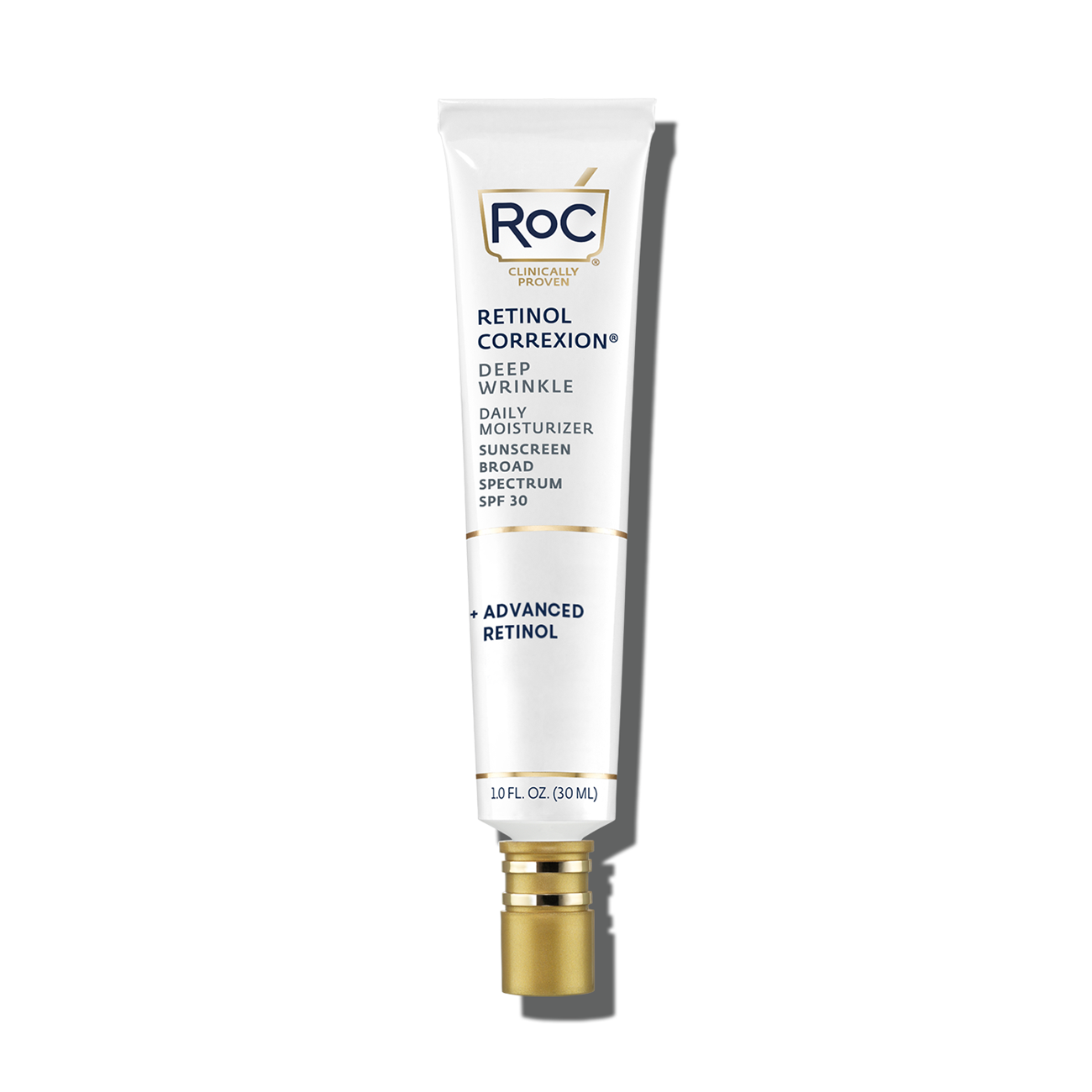

RoC
RETINOL CORREXION® Deep Wrinkle Daily Moisturizer SPF 30

RETINOL CORREXION® Deep Wrinkle Daily Moisturizer SPF 30
RoC
retinol-correxion-r-deep-wrinkle-daily-moisturizer-spf-30
Moisturize
9818310344997
Morning or Evening?
How often will you use this product?
Notes


Highlights
WHAT IS IT?
Daily moisturizer with SPF 30 and Retinol
FEATURES
Contains Advanced RoC® Retinol, SPF 30 protection, Deep wrinkle reduction, Continuous moisturization
BEST FOR
combination
CHECKS
Paraben-free, Lactose-free
Who Is It For?
Ages 35-65+ All GendersWhat Does It Help With?
Deep Wrinkles Fine Lines Sun Protection Photoaging Skin SmoothingBudget
Affordable (under $30)How To Use
Which routine should it be used in?
Instructions:
Key Information


What RoC Says
Product Description:
A daily face cream formulated with Advanced RoC® Retinol to target deep wrinkles and protect from signs of photoaging. Instantly hydrates and protects skin while visibly reducing deep wrinkles. Clinically proven with 100% showing visibly reduced deep wrinkles in 12 weeks.
About the Brand:
Ingredients Overview
Ingredients List
Water, Glycerin, Diethylhexyl 2,6-Naphthalate, Dimethicone, Isododecane, Tetrahydroxypropyl Ethylenediamine, Cetyl Alcohol, Butylene Glycol, Butyrospermum Parkii (Shea) Butter, PPG-2 Myristyl Ether Propionate, Squalane, Styrene/Acrylates Copolymer, Glyceryl Stearate, Aluminum Starch Octenylsuccinate, Propanediol, Retinol, Allantoin, Aloe Barbadensis Leaf Juice, Glycolic Acid, Ceteth-20, p-Anisic Acid, Polyacrylamide, Ammonium Acryloyldimethyltaurate/VP Copolymer, C13-14 Isoparaffin, Steareth-20, Tocopheryl Acetate, PEG-8 Laurate, Laureth-7, BHT, Polysorbate 20, Ascorbic Acid, Potassium Sorbate, Disodium EDTA, 1,2-Hexanediol, Sodium Hydroxide, Citric Acid, Caprylhydroxamic Acid, Sodium Benzoate, Fragrance.
Key Ingredients
Retinol, SPF 30 sunscreen
Ingredients Details
Retinol
Common Name(s): Vitamin a,all-trans retinol,(all-e)-3,7-dimethyl-9-(2,6,6-trimethyl-1-cyclohexen-1-yl)-2,4,6,8-nonatetraen-1-ol
CAS Number: 68-26-8
DESCRIPTION
What It Does: Retinol accelerates skin cell turnover, stimulates collagen production, reduces fine lines and wrinkles, fades hyperpigmentation, and helps normalize pore size.
Why It's Used: It is the most evidence-backed anti-aging ingredient available without a prescription. it provides comprehensive skin renewal benefits that no other single cosmetic ingredient can match.
How It Works: Retinol is converted in the skin to retinoic acid, which binds to retinoid receptors in cell nuclei. this activates gene expression changes that accelerate cell turnover, boost collagen synthesis, and inhibit matrix metalloproteinases (collagen-degrading enzymes).
Typically Found In: Night creams,serums,eye creams,targeted treatment products,anti-aging formulations
TECHNICAL DETAILS
Primary Category: Active ingredient – vitamin a derivative
Secondary Functions: Exfoliating,anti-acne,brightening
Application Areas:

Facial Skincare
Body Care

Hair Care
Beard Care
Color Cosmetics (Makeup)
Dietary/Oral Supplements
Typical Concentration Range: 0.025%–1% (otc); start at low concentrations and build up slowly
SOURCING & ETHICS
Vegan Status: Conditional – can be animal-derived (fish liver, egg yolk) or synthetic; verify source
Halal Status: Conditional – verify source; synthetic retinol is halal
Source Notes: Cosmetic retinol is predominantly synthetically manufactured. some natural sources include fish liver oils. synthetic is preferred for purity and sustainability.
SKIN COMPATIBILITY
Irritancy Rating: 3/5 – moderate; can cause dryness, peeling, redness, especially during adjustment period (retinization)
Comedogenicity Rating: 0/5 – non-comedogenic; actually helps clear pores
Sensitivity Concerns: Retinization period: 2–6 weeks of potential dryness, flaking, and sensitivity. photosensitizing – must use spf when using retinol. avoid during pregnancy.
Safe for Sensitive Skin: Use with caution – start at 0.025%, buffer with moisturizer, use every 2–3 nights initially
SAFETY & COMPATIBILITY
Safety Profile: Safe for general use at otc concentrations. not recommended during pregnancy. avoid with waxing. use spf daily. ewg hazard score: varies by concentration.
Works Well With: Niacinamide (soothes irritation),peptides,ceramides,hyaluronic acid,spf (mandatory)
Avoid Combining With: Benzoyl peroxide (may inactivate retinol),ahas/bhas (when new to retinol – overexfoliation risk),vitamin c (use at different times)
SCIENTIFIC NOTE
Retinol is approximately 20 times less potent than prescription tretinoin (retinoic acid) but significantly better tolerated. the conversion rate of retinol to retinoic acid in skin is the rate-limiting step in its efficacy.
Last Verified: Cosing database,cir safety assessment,journal of investigative dermatology,kligman et al. studies
Primary Sources: 2026-03-12
Water
Common Name(s): Water,purified water,deionised water,inci water
CAS Number: 7732-18-5
DESCRIPTION
What It Does: Provides the universal solvent and vehicle for water-soluble actives and the continuous phase of all o/w emulsions.
Why It's Used: The most essential cosmetic ingredient — aqua (water) is listed first on virtually all water-containing cosmetic inci labels as the highest-concentration ingredient, serving as the foundation of the global cosmetics industry.
How It Works: Acts as solvent for all water-soluble ingredients (glycols, amino acids, water-soluble actives). forms the continuous external phase of o/w emulsions (lotions, creams, serums). provides aqueous environment for enzymatic and chemical reactions between actives. ph adjustment medium.
Typically Found In: Virtually all cosmetic products — the most universal cosmetic ingredient globally
TECHNICAL DETAILS
Primary Category: Functional ingredient – water
Secondary Functions: Skin conditioning
Application Areas:
Facial Skincare
Body Care
Hair Care
Beard Care
Color Cosmetics (Makeup)
Dietary/Oral Supplements
Typical Concentration Range: Varies widely — up to 95% in some toners and serums
SOURCING & ETHICS
Vegan Status: Yes – water (deionised/purified)
Halal Status: Yes
Source Notes: Cosmetic-grade water is purified (deionised, distilled, or ro filtered) to prevent mineral content interference with formulation stability. european pharmacopoeial water (aqua purificata ph. eur.) is the quality standard for pharmaceutical and high-end cosmetic formulations.
SKIN COMPATIBILITY
Irritancy Rating: 1/5 – non-irritant
Comedogenicity Rating: 0/5 – non-comedogenic
Sensitivity Concerns: Well-tolerated by most skin types.
Safe for Sensitive Skin: Yes
SAFETY & COMPATIBILITY
Safety Profile: Good safety profile at recommended concentrations. ewg score: 1–2.
Works Well With: Standard skincare actives
Avoid Combining With: No known significant incompatibilities
SCIENTIFIC NOTE
Water's position as the first inci ingredient on most cosmetic labels reflects the regulatory requirement to list ingredients in descending concentration order — meaning water is the most abundant ingredient in the majority of cosmetic products. the fundamental role of water as the universal cosmetic solvent and vehicle makes it simultaneously the most important cosmetic ingredient and the one that requires the most sophisticated formulation chemistry to control — every emulsifier, thickener, preservative, and ph adjuster exists primarily to manage water's interaction with other ingredients in formulation.
Last Verified: Cosing database,eu cosmetics regulation 1223/2009 inci requirements,ph. eur. aqua purificata monograph
Primary Sources: 2026-03-12
