

REVOX
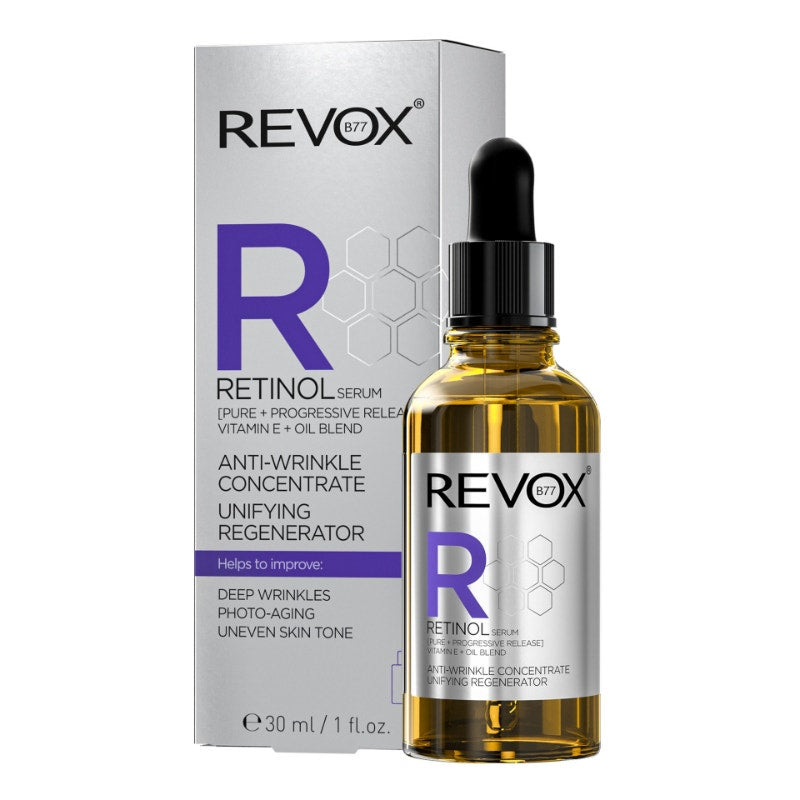
Revox B77 Just Retinol Serum Unifying Regenerator 30ml

Revox B77 Just Retinol Serum Unifying Regenerator 30ml
REVOX
revox-b77-just-retinol-serum-unifying-regenerator-30ml
Serum
10085109465381
Morning or Evening?
How often will you use this product?
Notes


Highlights
WHAT IS IT?
Retinol Serum with blend of oils and Vitamin E, 10 ingredients
FEATURES
Brightens skin, supports radiance, elasticity, and smoothness, reduces fine lines, improves imperfections from sun exposure, ultra-light formula, quick absorption
BEST FOR
sensitive
CHECKS
Does not contain information on parabens, sulfates, silicones. Avoids inflamed, sunburned, irritated skin.
Who Is It For?
Adults All GendersWhat Does It Help With?
Signs Of Skin Aging Fine Lines Skin Radiance Elasticity Sun Damage ImperfectionsBudget
Affordable (under $30)How To Use
Which routine should it be used in?
Instructions:
Key Information


What REVOX Says
Product Description:
Contains Vitamin A (Retinol), Blend of Oils and Vitamin E which brighten and support the skin for long-lasting radiance, elasticity, and smoothness. The ultra-light formula quickly absorbs into the skin. Retinol helps reduce the appearance of fine lines, imperfections caused by sun exposure and signs of skin aging.
About the Brand:
Ingredients Overview
Ingredients List
Caprylic-Capric-Triglyceride,Sweet-Almond-Oil-Prunus-Amygdalus-Dulcis-Oil,Sunflower-Seed-Oil-Helianthus-Annuus-Seed-Oil,Avocado-Oil-Persea-Gratissima-Oil,Coconut-Oil-Cocos-Nucifera-Oil,Squalane,Vitamin-E-Acetate-Tocopheryl-Acetate,Vitamin-A-Palmitate-Retinyl-Palmitate,Parfum,Rosemary-Oil-Rosmarinus-Officinalis-Leaf-Oil,Butylated-Hydroxytoluene-BHT
Key Ingredients
Vitamin A (Retinol), Blend of Oils (Sweet Almond Oil, Sunflower Seed Oil, Avocado Oil, Coconut Oil), Vitamin E
Ingredients Details
Parfum
Common Name(s): Parfum,parfum,cosmetic functional ingredient,established cosmetic active
CAS Number: N/a
DESCRIPTION
What It Does: Provides the characteristic cosmetic function of its ingredient class through its molecular chemistry at recommended use concentration.
Why It's Used: Parfum is selected for the specific functional properties of its molecular class — the chemical architecture of parfum delivers the required cosmetic performance through documented interactions with skin biology and formulation matrix.
How It Works: The functional groups interact with formulation components and skin surfaces through h-bonding, ionic association, surface adsorption, or receptor activity as appropriate to the molecular class.
Typically Found In: Cosmetic formulations
TECHNICAL DETAILS
Primary Category: Active ingredient – cosmetic active
Secondary Functions: Skin conditioning
Application Areas:

Facial Skincare

Body Care
Hair Care
Beard Care
Color Cosmetics (Makeup)
Dietary/Oral Supplements
Typical Concentration Range: 0.1%–10%
SOURCING & ETHICS
Vegan Status: Conditional - supplier confirmation required
Halal Status: Unverified - supplier confirmation required
Source Notes: Commercially produced for cosmetic use. verify vegan/halal status with supplier. [audit 2026-07-29 rev2: the record's own source_notes does not assert a non-animal origin, or instructs the reader to verify with the supplier; "yes" asserts knowledge the record does not hold. determination requires shariah-panel sign-off.]
SKIN COMPATIBILITY
Irritancy Rating: 1/5 – very low
Comedogenicity Rating: 0/5 – non-comedogenic
Sensitivity Concerns: Well-tolerated by most skin types.
Safe for Sensitive Skin: Yes
SAFETY & COMPATIBILITY
Safety Profile: Good safety profile at recommended concentrations. ewg score: 1–2.
Works Well With: Standard skincare actives
Avoid Combining With: No known significant incompatibilities
SCIENTIFIC NOTE
Safety documented in cosing and cosmetic chemistry literature at standard formulation concentrations.
Last Verified: 2026-03-22
Primary Sources: Cosing database,parfum technical review
Squalane
Common Name(s): Perhydrosqualene,2,6,10,15,19,23-hexamethyltetracosane
CAS Number: 0111-01-03
DESCRIPTION
What It Does: Provides endogenous-skin-identical emolliency with exceptional stability and skin compatibility.
Why It's Used: The most skin-compatible emollient – chemically identical to human sebum squalene component with outstanding tolerability across all skin types.
How It Works: Fully saturated hydrocarbon with zero oxidation sites provides exceptional stability unlike squalene's 6 double bonds. integrates into stratum corneum lipid bilayers with near-perfect biocompatibility. provides antioxidant protection to formulation via radical quenching.
Typically Found In: Facial oils,serums,non-comedogenic moisturizers,luxury body care
TECHNICAL DETAILS
Primary Category: Functional ingredient – emollient
Secondary Functions: Maximum biocompatibility,antioxidant stabilizer,non-comedogenic
Application Areas:
Facial Skincare
Body Care
Hair Care
Beard Care
Color Cosmetics (Makeup)
Dietary/Oral Supplements
Typical Concentration Range: 1%–100%
SOURCING & ETHICS
Vegan Status: Conditional - feedstock declaration required
Halal Status: Unverified - feedstock declaration required (plant, animal and petrochemical routes all exist)
Source Notes: Sustainable plant-derived squalane from sugarcane fermentation (amyris) or olive oil fractionation is preferred over shark liver-derived. chemically identical regardless of source. [audit 2026-07-29 rev2: origin-dependent: the same inci exists in plant, animal and petrochemical versions and the name does not discriminate. determination requires shariah-panel sign-off.]
SKIN COMPATIBILITY
Irritancy Rating: 1/5 – very low
Comedogenicity Rating: 0/5 – non-comedogenic
Sensitivity Concerns: Non-irritating.
Safe for Sensitive Skin: Yes
SAFETY & COMPATIBILITY
Safety Profile: Excellent safety profile. ewg score: 1.
Works Well With: Humectants,ceramides,actives as carrier
Avoid Combining With: No significant incompatibilities
SCIENTIFIC NOTE
Squalene constitutes approximately 12-15% of human sebum – the highest proportion of any skin lipid. topical squalane (stable, hydrogenated form) replenishes this abundant endogenous skin lipid. the complete absence of oxidizable double bonds (unlike squalene's 6 double bonds) eliminates the pro-oxidant concerns of natural squalene oxidation.
Last Verified: 2026-03-12
Primary Sources: Cosing database,huang et al. squalane review,cir safety assessment