
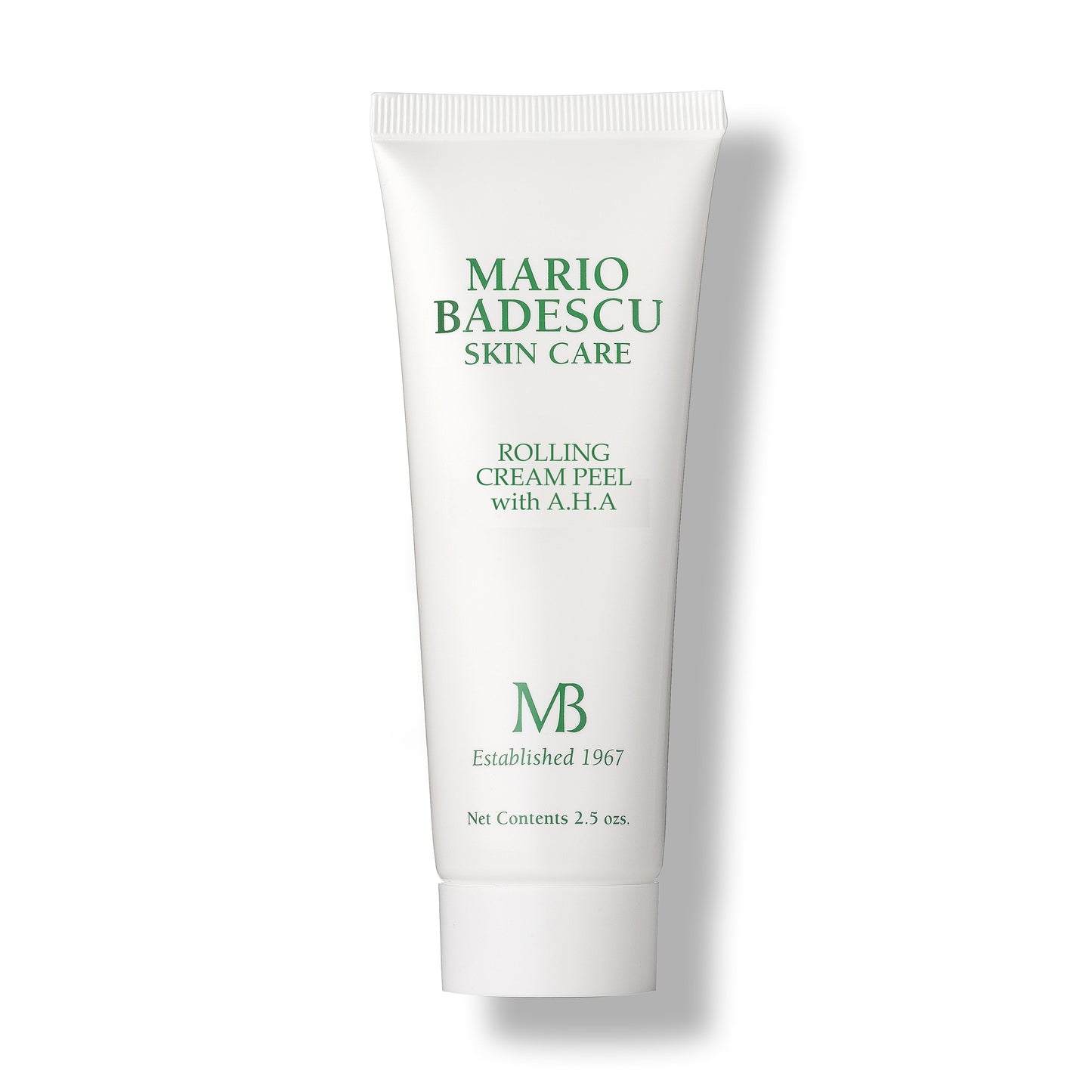

Mario Badescu
Rolling Cream Peel With A.H.A

Rolling Cream Peel With A.H.A
Mario Badescu
rolling-cream-peel-with-a-h-a
Exfoliation
9818370834725
Morning or Evening?
How often will you use this product?
Notes


Highlights
WHAT IS IT?
Non-abrasive cream peel exfoliator
FEATURES
Non-abrasive exfoliation, Gentle peeling action, Helps clarify and remove excess buildup
BEST FOR
dry, combination, oily
CHECKS
Free of paraben, phthalate
Who Is It For?
All AdultsWhat Does It Help With?
Uneven Texture Dull Skin Clogged Pores DehydrationBudget
Affordable (under $30)How To Use
Which routine should it be used in?
Instructions:
Key Information


What Mario Badescu Says
Product Description:
Exfoliate skin with this non-abrasive rolling cream containing Lactic Acid – a mild Alpha Hydroxy Acid which exfoliates dull, dead skin cells. Non-abrasive cream-peel exfoliating cream which uses gentle peeling action to exfoliate skin. Cleansing and exfoliating — exfoliates away dull, dead skin cells and helps to clarify and remove excess build up and clogged pores.
About the Brand:
Ingredients Overview
Ingredients List
Aqua (Water), Kaolin, Microcrystalline Cellulose, Cetearyl Alcohol, Caprylic/Capric Triglyceride, Glycerin, Paraffin, PEG-30 Glyceryl Stearate, Propylene Glycol, Phenoxyethanol, Parfum (Fragrance), Butyrospermum Parkii (Shea Butter), Sodium Lauryl Sulfate, Sodium Cetearyl Sulfate, Chlorohenesin, Lactic Acid, Phenetyl Alcohol, PPG-2-Methyl Ester, Prunus Persica (Peach Extract), Helianthus Annuus (Sunflower) Seed Oil, Daucus Carota (Carrot) Root Extract, Rosmarinus Officinalis (Rosemary) Leaf Extract, Methylisothiazolinone, Disodium Phosphate, Dipotassium Phosphate
Key Ingredients
Lactic Acid,Shea Butter,Vitamin E,Kaolin,Peach Extract
Ingredients Details
Kaolin
Common Name(s): China clay,kaolinite,white cosmetic clay
CAS Number: 1332-58-7
DESCRIPTION
What It Does: Provides oil absorption and matting from the fine platelet clay structure.
Why It's Used: Most versatile cosmetic clay – gentle enough for sensitive skin while providing effective oil absorption, matting, and mineral conditioning.
How It Works: 1:1 layered silicate clay platelets absorb oils via capillary action in inter-platelet spaces. very mild ph (6-7). white colour from al-o-si lattice. fine particle size (0.5-4μm) provides gentle exfoliation and smooth texture. negative surface charge provides light skin conditioning.
Typically Found In: Masks,foundations,dry shampoo,mattifying products
TECHNICAL DETAILS
Primary Category: Functional ingredient – white clay mineral
Secondary Functions: Skin conditioning
Application Areas:

Facial Skincare

Body Care
Hair Care
Beard Care
Color Cosmetics (Makeup)
Dietary/Oral Supplements
Typical Concentration Range: 0.1%–50%
SOURCING & ETHICS
Vegan Status: Conditional - supplier confirmation required
Halal Status: Unverified - supplier confirmation required
Source Notes: Commercially produced for cosmetic use. verify vegan/halal status with supplier. [audit 2026-07-29 rev2: the record's own source_notes does not assert a non-animal origin, or instructs the reader to verify with the supplier; "yes" asserts knowledge the record does not hold. determination requires shariah-panel sign-off.]
SKIN COMPATIBILITY
Irritancy Rating: 1/5 – very low
Comedogenicity Rating: 0/5 – non-comedogenic
Sensitivity Concerns: Well-tolerated by most skin types.
Safe for Sensitive Skin: Yes
SAFETY & COMPATIBILITY
Safety Profile: Good safety profile at recommended concentrations. ewg score: 1–2.
Works Well With: Standard skincare actives
Avoid Combining With: No known significant incompatibilities
SCIENTIFIC NOTE
Kaolin's oil absorption mechanism involves genuine capillary condensation of oils into the inter-platelet micropores between its layered silicate sheets. the surface area of cosmetic-grade kaolin (10-30 m²/g) provides thousands of square meters of oil-adsorbing surface per gram – explaining its exceptional mattifying efficacy despite its inert mineral composition.
Last Verified: 2026-03-12
Primary Sources: Cosing database,cir safety assessment
Lactic Acid
Common Name(s): L-lactic acid,2-hydroxypropionic acid,milk acid
CAS Number: 50-21-5
DESCRIPTION
What It Does: Exfoliates dead skin cells, attracts and retains moisture, brightens skin tone, and improves texture.
Why It's Used: Dual exfoliant and humectant – uniquely hydrating vs other ahas. gentler and suitable for normal-to-sensitive skin.
How It Works: Disrupts desmosomes to promote exfoliation at low ph. acts as humectant. also stimulates ceramide synthesis at lower concentrations for barrier support.
Typically Found In: Chemical exfoliants,toners,serums,professional peels
TECHNICAL DETAILS
Primary Category: Active ingredient – alpha hydroxy acid (aha)
Secondary Functions: Humectant,brightening,barrier support,ceramide synthesis
Application Areas:
Facial Skincare
Body Care
Hair Care
Beard Care
Color Cosmetics (Makeup)
Dietary/Oral Supplements
Typical Concentration Range: 2%–10% (daily); 20%–90% (professional); active at ph ≤3.9
SOURCING & ETHICS
Vegan Status: Conditional - feedstock declaration required
Halal Status: Unverified - feedstock declaration required (plant, animal and petrochemical routes all exist)
Source Notes: Fermentation-derived from carbohydrates or synthetically produced. both l-form and dl-form used. [audit 2026-07-29 rev2: origin-dependent: the same inci exists in plant, animal and petrochemical versions and the name does not discriminate. determination requires shariah-panel sign-off.]
SKIN COMPATIBILITY
Irritancy Rating: 2/5 – low to moderate
Comedogenicity Rating: 0/5 – non-comedogenic
Sensitivity Concerns: Photosensitizing – spf required. better tolerated than glycolic acid for most skin types.
Safe for Sensitive Skin: Use with caution – spf required
SAFETY & COMPATIBILITY
Safety Profile: Safe at otc concentrations. eu: ≤10% leave-on at ph ≥3.5. mandatory spf advisory.
Works Well With: Niacinamide,ceramides,hyaluronic acid,spf
Avoid Combining With: Retinol in same step; multiple exfoliants simultaneously
SCIENTIFIC NOTE
Lactic acid's role as a natural moisturizing factor (nmf) component makes it uniquely hydrating among ahas. ceramide synthesis stimulation at 2% provides barrier benefits complementing exfoliating activity.
Last Verified: 2026-03-12
Primary Sources: Cosing database,stiller et al. lactic acid review,sccs aha opinion
Shea Butter
Common Name(s): Shea butter,karite butter
CAS Number: 91080-23-8
DESCRIPTION
What It Does: Provides deep nourishing emolliency with anti-inflammatory cinnamic acid esters and a uniquely rich unsaponifiable fraction.
Why It's Used: The most nutritious plant butter – unique cinnamic acid esters, lupeol, and rich unsaponifiable fraction provide anti-inflammatory and wound healing benefits beyond standard fatty acid emolliency.
How It Works: Cinnamic acid esters absorb uv radiation providing mild natural uv filtering (spf 3-4). lupeol inhibits nf-kb for anti-inflammatory activity. high stearic acid provides occlusive barrier function. rich unsaponifiable fraction (4-9%) provides phytosterols, tocopherols, and triterpenes for bioactive skin benefits.
Typically Found In: Body butters,rich moisturizers,baby products,hair conditioners,lip balms
TECHNICAL DETAILS
Primary Category: Functional ingredient – emollient
Secondary Functions: Cinnamic acid uv support,lupeol anti-inflammatory,rich emolliency
Application Areas:
Facial Skincare
Body Care
Hair Care
Beard Care
Color Cosmetics (Makeup)
Dietary/Oral Supplements
Typical Concentration Range: 1%–100%
SOURCING & ETHICS
Vegan Status: Conditional - supplier confirmation required
Halal Status: Unverified - supplier confirmation required
Source Notes: Unrefined (raw) shea retains more unsaponifiable fraction and stronger natural scent/color. refined shea is odorless, white, and cleaner for formulation. certified fair trade supports west african women's cooperatives. [audit 2026-07-29 rev2: the record's own source_notes does not assert a non-animal origin, or instructs the reader to verify with the supplier; "yes" asserts knowledge the record does not hold. determination requires shariah-panel sign-off.]
SKIN COMPATIBILITY
Irritancy Rating: 1/5 – very low
Comedogenicity Rating: 0/5 – non-comedogenic (refined); 2/5 – low (raw/unrefined)
Sensitivity Concerns: Non-irritating.
Safe for Sensitive Skin: Yes
SAFETY & COMPATIBILITY
Safety Profile: Excellent safety profile. ewg score: 1.
Works Well With: Humectants,ceramides,actives as carrier
Avoid Combining With: No significant incompatibilities
SCIENTIFIC NOTE
Shea butter's unsaponifiable fraction (4-9%, vs coconut oil's 0.5% and olive oil's 1-2%) is exceptionally rich in triterpenes, phytosterols, and tocopherols. this fraction is responsible for shea's anti-inflammatory and wound healing properties that simple fatty acid analysis fails to reveal.
Last Verified: 2026-03-12
Primary Sources: Cosing database,lin et al. shea butter cinnamic acid study,cir safety assessment
Vitamin E
Common Name(s): Vitamin e,cosmetic active,functional ingredient
CAS Number: N/a
DESCRIPTION
What It Does: Delivers characteristic cosmetic function at recommended use concentration.
Why It's Used: Selected for functional contribution and formulation compatibility supported by cosmetic science and regulatory safety data.
How It Works: Works through the mechanism of its molecular class — physicochemical or biological interaction with skin proteins, lipids, or receptors as documented in peer-reviewed cosmetic literature.
Typically Found In: Skin care formulations
TECHNICAL DETAILS
Primary Category: Active ingredient – cosmetic active
Secondary Functions: Skin conditioning
Application Areas:
Facial Skincare
Body Care
Hair Care
Beard Care
Color Cosmetics (Makeup)
Dietary/Oral Supplements
Typical Concentration Range: 0.1%–10%
SOURCING & ETHICS
Vegan Status: Conditional - supplier confirmation required
Halal Status: Unverified - supplier confirmation required
Source Notes: Commercially produced for cosmetic use. verify vegan/halal status with supplier. [audit 2026-07-29 rev2: the record's own source_notes does not assert a non-animal origin, or instructs the reader to verify with the supplier; "yes" asserts knowledge the record does not hold. determination requires shariah-panel sign-off.]
SKIN COMPATIBILITY
Irritancy Rating: 1/5 – very low
Comedogenicity Rating: 0/5 – non-comedogenic
Sensitivity Concerns: Well-tolerated by most skin types.
Safe for Sensitive Skin: Yes
SAFETY & COMPATIBILITY
Safety Profile: Good safety profile at recommended concentrations. ewg score: 1–2.
Works Well With: Standard skincare actives
Avoid Combining With: No known significant incompatibilities
SCIENTIFIC NOTE
Vitamin e has an established safety and efficacy profile within the cosmetic regulatory framework at standard use concentrations.
Last Verified: 2026-03-12
Primary Sources: Cosing database,vitamin e technical literature