
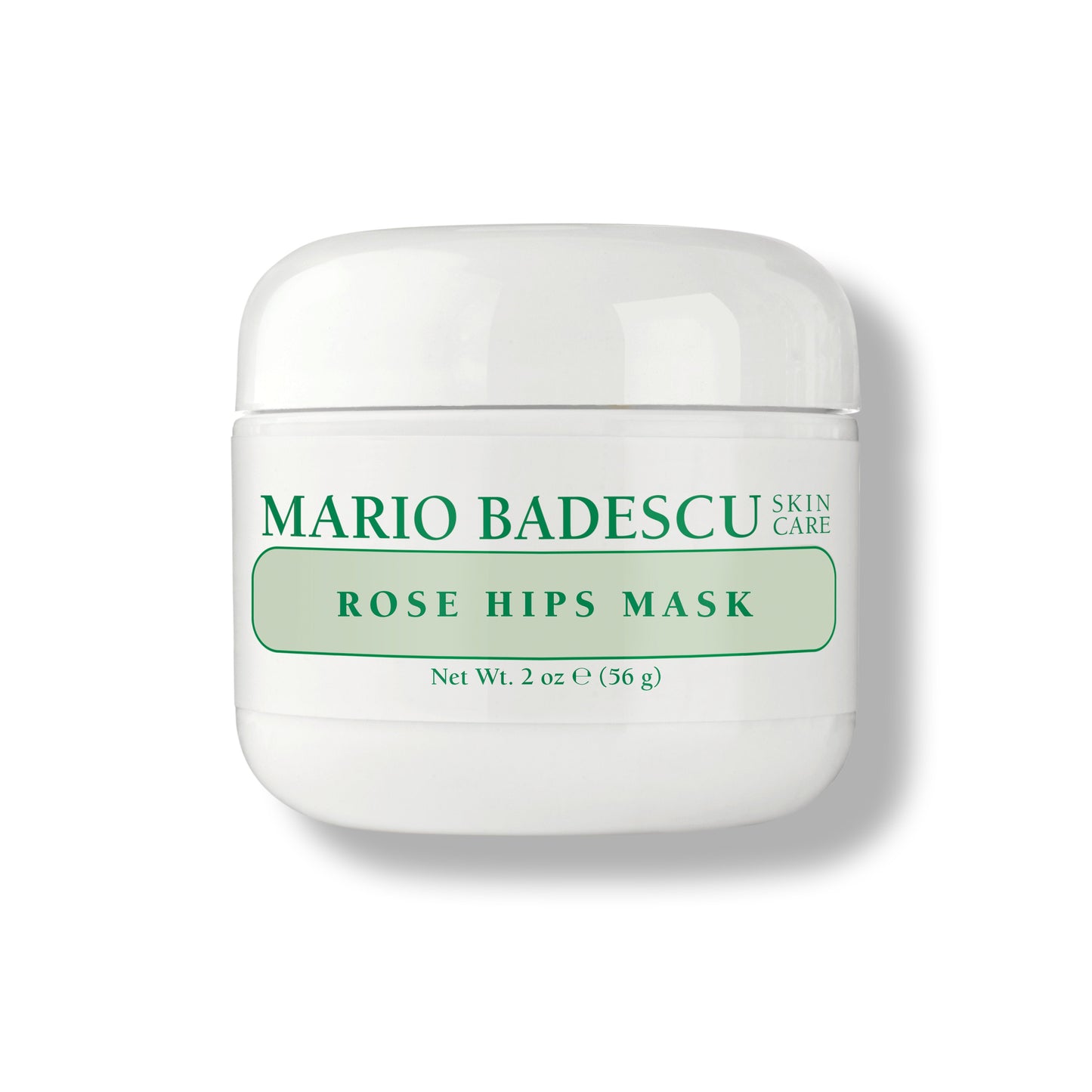

Mario Badescu
Rose Hips Mask

Rose Hips Mask
Mario Badescu
rose-hips-mask
Face Mask
9818370277669
Morning or Evening?
How often will you use this product?
Notes


Highlights
WHAT IS IT?
Moisturizing face mask with rosehip extracts and clay
FEATURES
Moisturizes, comforts dry skin, restores glow, evens skin tone, improves fine lines and wrinkles, purifies pores
BEST FOR
dry, combination, sensitive
CHECKS
Free of alcohol, sulfate, phthalate
Who Is It For?
All Ages All GendersWhat Does It Help With?
Dryness Dehydration Uneven Skin Tone Fine Lines Wrinkles Minor DiscolorationBudget
Affordable (under $30)How To Use
Which routine should it be used in?
Instructions:
Key Information


What Mario Badescu Says
Product Description:
Moisturize skin with this comforting and moisturizing face mask containing Rosehip Extracts and Rosehip Oil — two ingredients rich in Antioxidant Vitamin C. Moisturizing and comforting facial mask with kaolin clay and rosehip extracts. Moisturizes and comforts dry and dehydrated skin. Restores a healthy glow for dewy skin. Visibly evens out skin tone. Improves the look of fine lines, wrinkles, and minor discoloration. Lifts impurities, dirts, and oils from pores.
About the Brand:
Ingredients Overview
Ingredients List
Deionized Water (Aqua), Rose Hips (Rosa Mosqueta Fruit) Oil, Seamollient, Balsam (Myroxylon Pereirae Resin) Peru, Wheat (Triticum Vulgare) Starch, Actiphye of Rose Hips (Rosa Canina Fruit) Extract, Actiphyte of Lemongrass (Cymopogon Schoenanthus Extract)
Key Ingredients
Rosehip Extracts, Rosehip Oil, Kaolin Clay, Zinc Oxide, Vitamin C, Lemongrass Extract
Ingredients Details
Kaolin
Common Name(s): China clay,kaolinite,white cosmetic clay
CAS Number: 1332-58-7
DESCRIPTION
What It Does: Provides oil absorption and matting from the fine platelet clay structure.
Why It's Used: Most versatile cosmetic clay – gentle enough for sensitive skin while providing effective oil absorption, matting, and mineral conditioning.
How It Works: 1:1 layered silicate clay platelets absorb oils via capillary action in inter-platelet spaces. very mild ph (6-7). white colour from al-o-si lattice. fine particle size (0.5-4μm) provides gentle exfoliation and smooth texture. negative surface charge provides light skin conditioning.
Typically Found In: Masks,foundations,dry shampoo,mattifying products
TECHNICAL DETAILS
Primary Category: Functional ingredient – white clay mineral
Secondary Functions: Skin conditioning
Application Areas:

Facial Skincare

Body Care
Hair Care
Beard Care
Color Cosmetics (Makeup)
Dietary/Oral Supplements
Typical Concentration Range: 0.1%–50%
SOURCING & ETHICS
Vegan Status: Yes – natural mineral
Halal Status: Yes
Source Notes: Commercially produced for cosmetic use. verify vegan/halal status with supplier.
SKIN COMPATIBILITY
Irritancy Rating: 1/5 – very low
Comedogenicity Rating: 0/5 – non-comedogenic
Sensitivity Concerns: Well-tolerated by most skin types.
Safe for Sensitive Skin: Yes
SAFETY & COMPATIBILITY
Safety Profile: Good safety profile at recommended concentrations. ewg score: 1–2.
Works Well With: Standard skincare actives
Avoid Combining With: No known significant incompatibilities
SCIENTIFIC NOTE
Kaolin's oil absorption mechanism involves genuine capillary condensation of oils into the inter-platelet micropores between its layered silicate sheets. the surface area of cosmetic-grade kaolin (10-30 m²/g) provides thousands of square meters of oil-adsorbing surface per gram – explaining its exceptional mattifying efficacy despite its inert mineral composition.
Last Verified: Cosing database,cir safety assessment
Primary Sources: 2026-03-12
Lemongrass Extract
Common Name(s): Essential oil,concentrated volatile aromatic,bioactive fragrance active
CAS Number: N/a
DESCRIPTION
What It Does: Provides aromatic sensory benefit alongside bioactive skin activity from concentrated plant volatile compounds — including antimicrobial activity (tea tree, thyme, clove), anti-inflammatory activity (lavender, chamomile), or circulatory stimulation (peppermint, rosemary).
Why It's Used: Essential oils provide authentic 'aromatherapy' narrative with genuine bioactive chemistry — the concentrated terpenoid constituents have documented biological activity in addition to olfactory benefit, justifying ingredient claims beyond pure fragrance.
How It Works: Essential oil complexity: steam distillation concentrates volatile terpenes (monoterpenes, sesquiterpenes), phenylpropanoids, and other volatiles. antimicrobial activity from terpenoid membrane disruption (terpinen-4-ol, eugenol, thymol disrupt bacterial membranes); anti-inflammatory from sesquiterpene nf-kb inhibition; sensitisation risk from electrophilic monoterpene oxides and aldehydes.
Typically Found In: Aromatherapy,bioactive skin care,fragrance
TECHNICAL DETAILS
Primary Category: Active ingredient – cosmetic active
Secondary Functions: Skin conditioning
Application Areas:
Facial Skincare
Body Care
Hair Care
Beard Care
Color Cosmetics (Makeup)
Dietary/Oral Supplements
Typical Concentration Range: 0.01%–2%
SOURCING & ETHICS
Vegan Status: Yes
Halal Status: Yes
Source Notes: Commercially produced for cosmetic use. verify vegan/halal status with supplier.
SKIN COMPATIBILITY
Irritancy Rating: 1/5 – very low
Comedogenicity Rating: 0/5 – non-comedogenic
Sensitivity Concerns: Well-tolerated by most skin types.
Safe for Sensitive Skin: Yes
SAFETY & COMPATIBILITY
Safety Profile: Good safety profile at recommended concentrations. ewg score: 1–2.
Works Well With: Standard skincare actives
Avoid Combining With: No known significant incompatibilities
SCIENTIFIC NOTE
Essential oil concentration in cosmetics must respect ifra (international fragrance association) guidelines — each oil has category-specific maximum use levels based on skin sensitisation quantitative risk assessment (qra). tea tree oil maximum 0.5% (rinse-off), lavender oil 2% (leave-on skin) as examples.
Last Verified: Cosing database,ifra standards,essential oil bioactive fragrance review
Primary Sources: 2026-03-12
Olive Oil
Common Name(s): Olive oil oil
DESCRIPTION
What It Does: Nourishes and softens skin through its balanced fatty acid profile, while antioxidant compounds protect against oxidative skin damage.
Why It's Used: Plant oils provide physiologically compatible lipid structures that integrate into the skin barrier and deliver fat-soluble antioxidants directly to skin cells.
How It Works: Fatty acids integrate into stratum corneum lipid lamellae, reinforcing the lipid barrier. antioxidants (tocopherols, carotenoids, polyphenols) neutralize ros through electron donation or singlet oxygen quenching.
Typically Found In: Face oils,serums,moisturizers,hair treatments,body oils
TECHNICAL DETAILS
Primary Category: Plant oils
Secondary Functions: Emollient,antioxidant
Application Areas:
Facial Skincare
Body Care
Hair Care
Beard Care
Color Cosmetics (Makeup)
Dietary/Oral Supplements
Typical Concentration Range: 0.5–30%
SOURCING & ETHICS
Vegan Status: Yes
Halal Status: Yes
Source Notes: Cold-pressed or solvent-extracted plant oil; no animal components.
SKIN COMPATIBILITY
Irritancy Rating: 1899-12-31 00:00:00 -0800
Comedogenicity Rating: 1900-01-01 00:00:00 -0800
Sensitivity Concerns: Low sensitization potential at recommended use concentrations.
Safe for Sensitive Skin: Yes
SAFETY & COMPATIBILITY
Safety Profile: Well-characterized cosmetic ingredient with established safety profile. generally non-irritating at typical use concentrations. suitable for leave-on and rinse-off cosmetics.
Works Well With: Vitamin e,ceramides,other plant oils,squalane
Avoid Combining With: Strong oxidizers (accelerate rancidity)
SCIENTIFIC NOTE
Vegetable oils are triglyceride matrices where the fatty acid composition determines skin compatibility, barrier function, and comedogenicity. oleic acid-rich oils (>60%) soften barrier lipids and enhance penetration; linoleic acid-rich oils reinforce ceramide-poor stratum corneum; saturated fatty acid-rich oils provide occlusion without skin penetration.
Last Verified: Cosing eu database; pcpc cosmetic ingredient safety reviews; aocs plant oil composition databases; fatty acid pharmacology reviews
Primary Sources: 2025-01-15
Zinc Oxide
Common Name(s): Zinc white,chinese white,calamine component
CAS Number: 1314-13-2
DESCRIPTION
What It Does: Physically reflects and scatters uv radiation while providing antimicrobial, anti-inflammatory, and wound healing benefits.
Why It's Used: Multi-action mineral uv filter that simultaneously provides sun protection and skin-therapeutic benefits – the cornerstone of physical sunscreen formulations.
How It Works: Wide bandgap semiconductor physically reflects and scatters uv radiation (uva 320–400nm and uvb 280–320nm). dissolves to zn²⁺ providing antimicrobial activity, inhibiting bacterial and fungal growth. anti-inflammatory via inhibition of 5-lipoxygenase and il-8 production.
Typically Found In: Sunscreens,baby products,diaper creams,wound care,anti-acne formulations
TECHNICAL DETAILS
Primary Category: Active ingredient – mineral uv filter / antimicrobial
Secondary Functions: Broad-spectrum uv filter,anti-acne,diaper rash treatment
Application Areas:
Facial Skincare
Body Care
Hair Care
Beard Care
Color Cosmetics (Makeup)
Dietary/Oral Supplements
Typical Concentration Range: 1%–25% (spf products: 10–25%; eu max 25%)
SOURCING & ETHICS
Vegan Status: Yes – mineral/inorganic
Halal Status: Yes
Source Notes: Produced from zinc metal oxidation or chemical synthesis. nano zinc oxide (<100nm) improves aesthetics.
SKIN COMPATIBILITY
Irritancy Rating: 1/5 – very low
Comedogenicity Rating: 0/5 – non-comedogenic
Sensitivity Concerns: Non-irritating; recommended for sensitive, baby, and rosacea-prone skin.
Safe for Sensitive Skin: Yes at recommended concentrations
SAFETY & COMPATIBILITY
Safety Profile: Excellent safety profile. fda category i generally recognized as safe and effective (grase) for sunscreen. eu cosmetics regulation: max 25%. ewg sunscreen score: 1.
Works Well With: Niacinamide,salicylic acid,other actives
Avoid Combining With: No significant incompatibilities at standard concentrations
SCIENTIFIC NOTE
Zinc oxide's broad-spectrum uv coverage extends into the uva1 region (360–400nm) more effectively than titanium dioxide, making it preferred for photoaging protection. nano zinc oxide (<100nm) achieves transparency on skin while maintaining uv protection efficiency.
Last Verified: Cosing database,fda sunscreen grase ruling,ewg sunscreen database,eu cosmetics regulation
Primary Sources: 2026-03-12
