

Sunday Riley
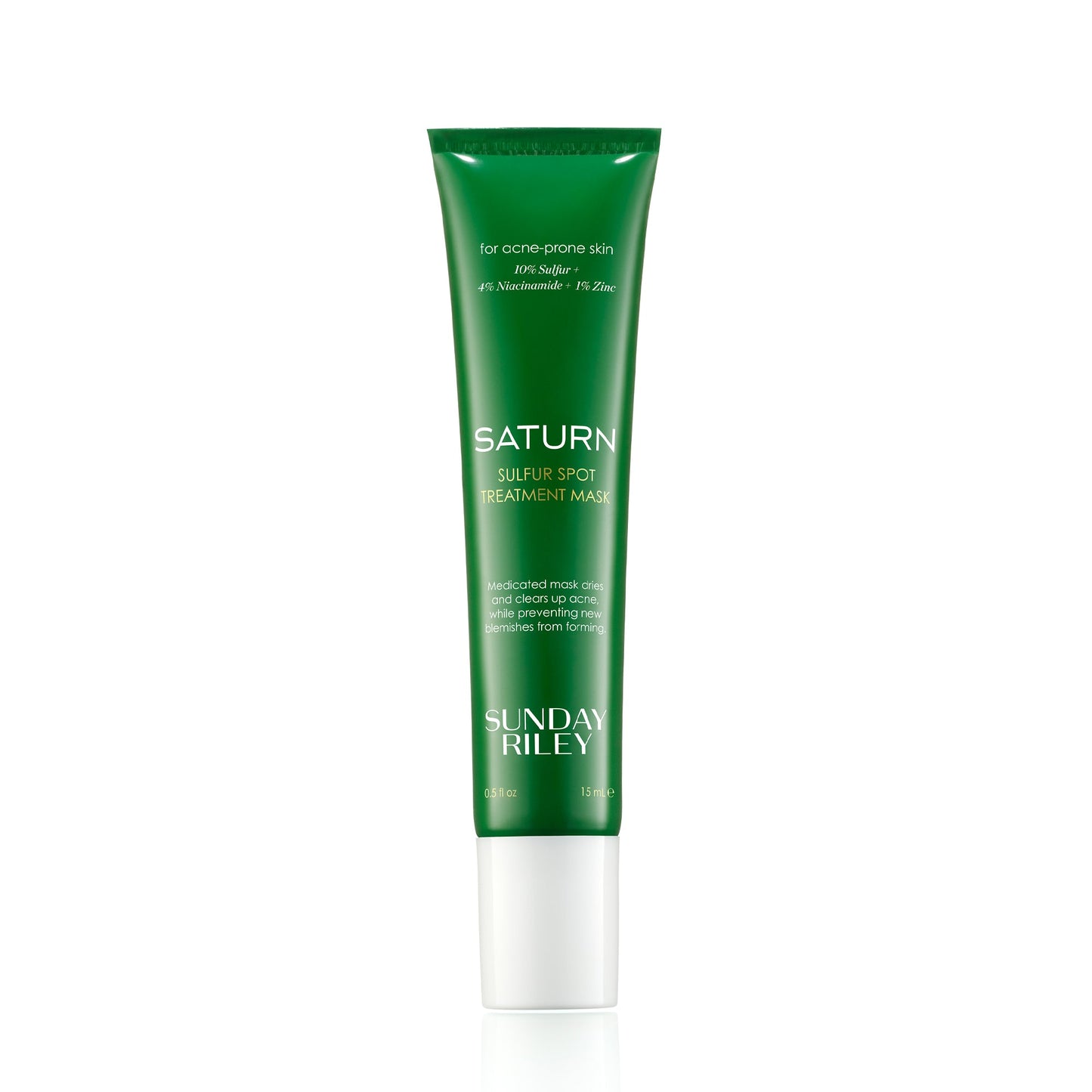
Saturn Sulfur Spot Treatment Mask

Saturn Sulfur Spot Treatment Mask
Sunday Riley
saturn-sulfur-spot-treatment-mask
Face Mask
9784781799717
Morning or Evening?
How often will you use this product?
Notes


Highlights
WHAT IS IT?
Sulfur spot treatment mask with 10% Sulfur
FEATURES
Clears acne, prevents breakouts, reduces excess oil, soothes redness
BEST FOR
oily
CHECKS
Sulfate-free, Paraben-free, Gluten-free, Soy-free, Phthalate-free, Fragrance-free
Who Is It For?
All Ages With Acne-prone SkinWhat Does It Help With?
Acne Excess Oil Blemishes Pore-cloggingBudget
Affordable (under $30)How To Use
Which routine should it be used in?
Instructions:
Key Information


What Sunday Riley Says
Product Description:
A medicated spot treatment mask that clears up acne while preventing new blemishes from forming. Formulated with 10% Sulfur, this acne-fighting spot treatment mask clears up blemishes and targets causes that lead to future breakouts.
About the Brand:
Ingredients Overview
Ingredients List
WATER/EAU/AQUA, CETYL ETHYLHEXANOATE, ISOAMYL LAURATE, NIACINAMIDE, GUM ARABIC, HYDROXYETHYL ACRYLATE/SODIUM ACRYLOYLDIMETHYL TAURATE COPOLYMER, BENTONITE, OLIVE OIL GLYCERETH-8 ESTERS, POLYGLYCERYL-2 CAPRATE, ZINC PCA, POLYSORBATE 20, LEPTOSPERMUM SCOPARIUM BRANCH/LEAF OIL, DIPOTASSIUM GLYCYRRHIZATE, ALLANTOIN, PEG-40 HYDROGENATED CASTOR OIL, TOCOPHEROL, ALCOHOL DENAT., MELIA AZADIRACHTA LEAF EXTRACT, AMBER POWDER, MELIA AZADIRACHTA FLOWER EXTRACT, COCCINIA INDICA FRUIT EXTRACT, OCIMUM BASILICUM (BASIL) FLOWER/LEAF EXTRACT, SOLANUM MELONGENA (EGGPLANT) FRUIT EXTRACT, CURCUMA LONGA (TURMERIC) ROOT EXTRACT, CORALLINA OFFICINALIS EXTRACT, PHENOXYETHANOL, CAPRYLYL GLYCOL, CHLORPHENESIN, 4-TERPINEOL.
Key Ingredients
Sulfur, Niacinamide, Zinc PCA, Bentonite, Tea Tree Oil, Manuka Oil
Ingredients Details
Bentonite
Common Name(s): Montmorillonite,volcanic ash clay,swelling clay
CAS Number: 1302-78-9
DESCRIPTION
What It Does: Provides thixotropic clay gellation and deep oil absorption from swelling smectite clay.
Why It's Used: Strongest adsorbing clay for deep cleansing masks – bentonite's high cation exchange capacity and swelling capacity provide the deepest oil and toxin adsorption of common cosmetic clays.
How It Works: Montmorillonite 2:1 layered silicate swells up to 15× in water via interlayer water absorption. very high cation exchange capacity (cec: 80-150 meq/100g) provides exceptional adsorption of cations, oils, and toxins. thixotropic gel provides 'mask that hardens' sensory experience.
Typically Found In: Clay masks,deep cleansing products,detoxifying formulas
TECHNICAL DETAILS
Primary Category: Functional ingredient – swelling clay mineral
Secondary Functions: Skin conditioning
Application Areas:

Facial Skincare

Body Care
Hair Care
Beard Care
Color Cosmetics (Makeup)
Dietary/Oral Supplements
Typical Concentration Range: 1%–25%
SOURCING & ETHICS
Vegan Status: Conditional - supplier confirmation required
Halal Status: Unverified - supplier confirmation required
Source Notes: Commercially produced for cosmetic use. verify vegan/halal status with supplier. [audit 2026-07-29 rev2: the record's own source_notes does not assert a non-animal origin, or instructs the reader to verify with the supplier; "yes" asserts knowledge the record does not hold. determination requires shariah-panel sign-off.]
SKIN COMPATIBILITY
Irritancy Rating: 1/5 – very low
Comedogenicity Rating: 0/5 – non-comedogenic
Sensitivity Concerns: Well-tolerated by most skin types.
Safe for Sensitive Skin: Yes
SAFETY & COMPATIBILITY
Safety Profile: Good safety profile at recommended concentrations. ewg score: 1–2.
Works Well With: Standard skincare actives
Avoid Combining With: No known significant incompatibilities
SCIENTIFIC NOTE
Bentonite's extraordinary swelling (up to 15× dry volume) arises from its 2:1 layer structure: sodium bentonite's inter-layer sodium cations attract very thick water shells, forcing the silicate layers apart by electrostatic repulsion. calcium bentonite swells only 2-3× by comparison, explaining why sodium-exchanged bentonite is the industrial standard for swelling applications.
Last Verified: 2026-03-12
Primary Sources: Cosing database,cir safety assessment
Cetyl Ethylhexanoate
Common Name(s): Cetyl ethylhexanoate,cetyl ethylhexanoate,cosmetic functional ingredient,established active
CAS Number: N/a
DESCRIPTION
What It Does: Provides the characteristic cosmetic function of its ingredient class through molecular chemistry at recommended use concentration.
Why It's Used: Cetyl ethylhexanoate is selected for the specific functional properties of its molecular class — the chemical architecture of cetyl ethylhexanoate delivers the required cosmetic performance through documented interactions with skin biology and formulation matrix.
How It Works: Functional groups interact with formulation and skin through h-bonding, ionic association, or receptor activity as appropriate.
Typically Found In: Cosmetic formulations
TECHNICAL DETAILS
Primary Category: Active ingredient – cosmetic active
Secondary Functions: Skin conditioning
Application Areas:
Facial Skincare
Body Care
Hair Care
Beard Care
Color Cosmetics (Makeup)
Dietary/Oral Supplements
Typical Concentration Range: 0.1%–10%
SOURCING & ETHICS
Vegan Status: Conditional - supplier confirmation required
Halal Status: Unverified - supplier confirmation required
Source Notes: Commercially produced for cosmetic use. verify vegan/halal status with supplier. [audit 2026-07-29 rev2: the record's own source_notes does not assert a non-animal origin, or instructs the reader to verify with the supplier; "yes" asserts knowledge the record does not hold. determination requires shariah-panel sign-off.]
SKIN COMPATIBILITY
Irritancy Rating: 1/5 – very low
Comedogenicity Rating: 0/5 – non-comedogenic
Sensitivity Concerns: Well-tolerated by most skin types.
Safe for Sensitive Skin: Yes
SAFETY & COMPATIBILITY
Safety Profile: Good safety profile at recommended concentrations. ewg score: 1–2.
Works Well With: Standard skincare actives
Avoid Combining With: No known significant incompatibilities
SCIENTIFIC NOTE
Safety documented in cosing at standard formulation concentrations.
Last Verified: 2026-03-22
Primary Sources: Cosing database,cetyl ethylhexanoate technical review
Hydroxyethyl Acrylate/sodium Acryloyldimethyl Taurate Copolymer
Common Name(s): Hydroxyethyl acrylate/sodium acryloyldimethyl taurate copolymer
DESCRIPTION
What It Does: Provides antioxidant protection, soothing anti-inflammatory effects, and skin-conditioning benefits through plant-derived polyphenols and phytochemicals.
Why It's Used: Plant extracts concentrate bioactive phytochemicals evolved for environmental protection — uv, microbial, and oxidative stressors — that translate to skin benefits.
How It Works: Polyphenols (flavonoids, phenolic acids) inhibit nf-κb-mediated inflammatory signaling, scavenge reactive oxygen species through electron donation, and chelate pro-oxidant metal ions to reduce oxidative skin damage.
Typically Found In: Lotions,creams,serums,masks
TECHNICAL DETAILS
Primary Category: Minerals
Secondary Functions: Skin-conditioning
Application Areas:
Facial Skincare
Body Care
Hair Care
Beard Care
Color Cosmetics (Makeup)
Dietary/Oral Supplements
Typical Concentration Range: 0.1–10%
SOURCING & ETHICS
Vegan Status: Conditional - feedstock declaration required
Halal Status: Unverified - feedstock declaration required (plant, animal and petrochemical routes all exist)
Source Notes: Mineral-derived ingredient; no biological origin. [audit 2026-07-29 rev2: origin-dependent: the same inci exists in plant, animal and petrochemical versions and the name does not discriminate. determination requires shariah-panel sign-off.]
SKIN COMPATIBILITY
Irritancy Rating: 1
Comedogenicity Rating: 0
Sensitivity Concerns: Low sensitization potential at recommended use concentrations.
Safe for Sensitive Skin: Yes
SAFETY & COMPATIBILITY
Safety Profile: Well-characterized cosmetic ingredient with established safety profile. generally non-irritating at typical use concentrations. suitable for leave-on and rinse-off cosmetics.
Works Well With: Plant extracts,peptides,vitamins
Avoid Combining With: Strong chelating agents (reduce mineral availability)
SCIENTIFIC NOTE
Plant secondary metabolites (flavonoids, terpenes, phenolic acids) are biosynthesized as defense compounds against uv, herbivores, and pathogens. their anti-inflammatory activity typically derives from competitive inhibition of cox-2 and 5-lox enzymes (ic50 1–50 µm), while antioxidant activity involves single electron transfer (set) and hydrogen atom transfer (hat) mechanisms with structure-dependent rate constants.
Last Verified: 2025-01-15
Primary Sources: Cosing eu database; pcpc cosmetic ingredient safety reviews; ingredient-specific safety and efficacy literature
Isoamyl Laurate
Common Name(s): Isoamyl laurate,isoamyl alcohol (branched c5) lauric acid (c12) ester
DESCRIPTION
What It Does: Softens and conditions skin with a light, non-greasy feel.
Why It's Used: Used for its lightweight branched ester; mild antimicrobial from c12; non-greasy; fast-absorbing emollient properties; suitable for lightweight skin care where non-greasy texture is key.
How It Works: Ester of isoamyl alcohol (branched c5) (branched or specialty alcohol) with lauric acid (c12); branching reduces crystallinity and greasiness; provides smooth, dry-oil skin feel.
Typically Found In: Lightweight moisturizers,sunscreens,skin serums,body lotions
TECHNICAL DETAILS
Primary Category: Functional ingredient – emollient
Secondary Functions: Skin conditioning,texture modification,spreading agent
Application Areas:
Facial Skincare
Body Care
Hair Care
Beard Care
Color Cosmetics (Makeup)
Dietary/Oral Supplements
Typical Concentration Range: 0.5%–10%
SOURCING & ETHICS
Vegan Status: Conditional - feedstock declaration required
Halal Status: Unverified - feedstock declaration required (plant, animal and petrochemical routes all exist)
Source Notes: Isoamyl alcohol (branched c5) and lauric acid (c12); plant or synthetic origin. [audit 2026-07-29 rev2: origin-dependent: the same inci exists in plant, animal and petrochemical versions and the name does not discriminate. determination requires shariah-panel sign-off.]
SKIN COMPATIBILITY
Irritancy Rating: 1/5 – very low
Comedogenicity Rating: 1/5 – low
Sensitivity Concerns: Generally well tolerated.
Safe for Sensitive Skin: Yes
SAFETY & COMPATIBILITY
Safety Profile: Good safety profile. ewg score: 1.
Works Well With: Other emollients,silicones,natural oils,humectants
Avoid Combining With: No significant incompatibilities
SCIENTIFIC NOTE
Isoamyl laurate: branched c5 isoamyl + c12 laurate; lightweight emollient with mild antimicrobial potential from lauric acid; non-greasy, fast-absorbing; suitable for leave-on and rinse-off systems.
Last Verified: 2026-03-28
Primary Sources: Cosing database,inci dictionary