

Schwarzkopf Professional
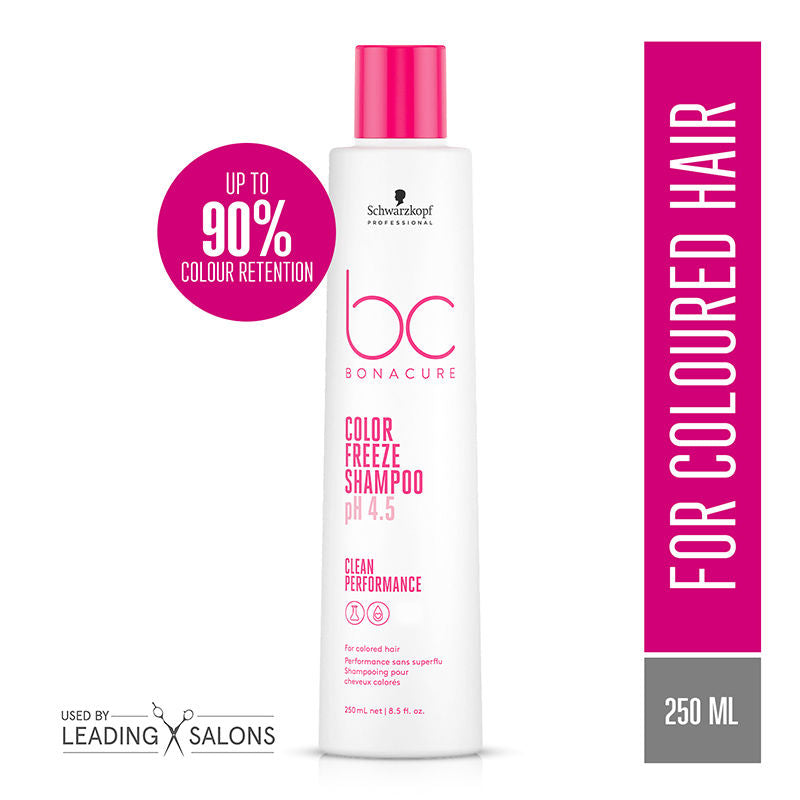
Schwarzkopf Professional Bonacure Color Freeze shampoo pH 4.5
Sulfate-free micellar shampoo designed to protect and preserve hair color with pH 4.5. It cleanses gently while maintaining color vibrancy.
Sulfate-free
Color-safe
Color Fading
Dullness
Color-treated
Chemically Treated
Optimized for Your Environment & Lifestyle
Nykaa
In stock
Recommended

Schwarzkopf Professional Bonacure Color Freeze shampoo pH 4.5
Schwarzkopf Professional
schwarzkopf-professional-bonacure-color-freeze-shampoo-ph-4-5
Shampoo
10202961412389
Morning or Evening?
How often will you use this product?
Notes


Secure payment protection
Your Biodata Compatibility Analysis
Based on your 6 hair health indices and environmental factors
Poor Match
Significant incompatibilities
Growth Cycle Health Index
Hair Match
Hair Health Index Alignment
Optimal for OSI, SSI, DI, HSI
Ingredient Efficacy
Matching Ingredient Score
Environment Compatibility
Current UV, Air Quality & Humidity
Why This Works for Your Specific Profile
Damage Index:
Damage levels outside specified range may not benefit optimally from product formulation
Water Quality:
Soft or moderately hard water does not require intensive treatment causing over-cleansing and dryness
Hair:
Closed cuticles resist product penetration causing surface buildup without internal benefits
Active Lifestyle:
High activity and frequent washing rapidly strip product benefits requiring excessive reapplication
Your Hair Profile Integration
Your Hair Archetype

Density Level

Washing Frequency

Shedding Level

Oil Level
Your Hair Health Indices
Oil Secretion (OSI)
Very low oil production
Scalp Sensitivity (SSI)
Very low sensitivity
Growth Rate (CMR)
Poor metabolism rate
Damage Index (DI)
Minimal damage
Hair Strength (HSI)
Very weak strength
Softness Index (SI)
Significant improvement needed
Water & Environmental Integration

Water:


Expected Results & Timeline
Key Highlights

What is it?
Sulfate-free micellar shampoo with multiple active ingredients

Who Is It For
Adults, All Genders

Budget
Rs. 1,084.94 - Rs. 2,169.88

Timeline
Immediate and ongoing with use
Why You’ll Love It

What Does It Help With?
Color Fading, Dullness

Best for
Color-treated Hair

Features
Sulfate-free formula, pH balanced to 4.5, protects color treated hair, gentle cleansing, contains hydrolyzed keratin and silk, includes UV protection agent benzophenone-4

Checks
100% Authentic, directly purchased from Schwarzkopf Professional
Ingredients Overview
Ingredients List
Aqua-(Water,-Eau), Sodium-Laureth-Sulfate, Cocamidopropyl-Betaine, Disodium-Cocoamphodiacetate, PEG-7-Glyceryl-Cocoate, Sodium-Chloride, Polyquaternium-10, Panthenol, Benzophenone-4, Hydrolyzed-Silk, Amodimethicone/-Morpholinomethyl-Silsesquioxane-Copolymer, Steardimonium-Hydroxypropyl-Hydrolyzed-Keratin, Hydrolyzed-Keratin, Cocamide-MEA, PEG-12-Dimethicone, Glycol-Distearate, Lactic-Acid, Parfum-(Fragrance), Sodium-Benzoate, Laureth-4, PEG-40-Hydrogenated-Castor-Oil, Hydrogenated-Castor-Oil, Acid-Violet-43, PEG-14M, Sodium-Hydroxide, Benzyl-Salicylate, Butylphenyl-Methylpropional, Glycerin, Linalool, Limonene, Butylene-Glycol, Propylene-Glycol, Trideceth-5, Sodium-Sulfate, Phenoxyethanol, Methyl-Paraben
Key Ingredients
Hydrolyzed Keratin, Hydrolyzed Silk, Benzophenone-4, Panthenol
Ingredients Details
Benzophenone-4
Common Name(s): Benzophenone-4
DESCRIPTION
What It Does: Absorbs or reflects uv radiation, preventing uv-induced dna damage, photo-oxidative stress, and premature skin aging.
Why It's Used: Uv filters are the active ingredients in sun protection — without them, formulations cannot make spf claims or prevent solar-induced skin damage.
How It Works: The uv-absorbing chromophore undergoes photoexcitation by uv photons, then dissipates the absorbed energy through thermal relaxation (chemical filters) or photon scattering/reflection (physical filters), preventing photon penetration to skin cells.
Typically Found In: Sunscreens,moisturizers with spf,foundations with spf
TECHNICAL DETAILS
Primary Category: Uv filters
Secondary Functions: Skin-protecting
Application Areas:

Facial Skincare

Body Care
Hair Care
Beard Care
Color Cosmetics (Makeup)
Dietary/Oral Supplements
Typical Concentration Range: 0.5–25% (within regulatory limits)
SOURCING & ETHICS
Vegan Status: Yes
Halal Status: Yes
Source Notes: Synthetic uv filter; no animal components.
SKIN COMPATIBILITY
Irritancy Rating: 1
Comedogenicity Rating: 0
Sensitivity Concerns: Contact allergy to uv filters occurs in approximately 1–3% of the general population; patch testing recommended for those with known photosensitivity.
Safe for Sensitive Skin: Yes
SAFETY & COMPATIBILITY
Safety Profile: Regulatory approval required per market (eu annex vi, fda otc monograph, etc.). generally non-irritating at approved concentrations.
Works Well With: Other uv filters,antioxidants,emollients
Avoid Combining With: Incompatible filter combinations (photodegradation); check regulatory approvals per region
SCIENTIFIC NOTE
Uv filters operate through two mechanisms: organic/chemical filters absorb uv photons through electronic excitation (π→π* transitions in conjugated systems), then dissipate energy via thermal relaxation; inorganic/physical filters (tio2, zno) scatter and reflect photons through mie scattering (particle size 50–300 nm) and band gap absorption. spf is measured in vivo (iso 24444) as the ratio of minimal erythema doses with and without sunscreen.
Last Verified: 2025-01-15
Primary Sources: Cosing eu database; pcpc cosmetic ingredient safety reviews; eu cosmetics regulation annex vi; iso 24444 (in vivo spf testing)
Benzophenone-4
Common Name(s): Benzophenone-4
DESCRIPTION
What It Does: Absorbs or reflects uv radiation, preventing uv-induced dna damage, photo-oxidative stress, and premature skin aging.
Why It's Used: Uv filters are the active ingredients in sun protection — without them, formulations cannot make spf claims or prevent solar-induced skin damage.
How It Works: The uv-absorbing chromophore undergoes photoexcitation by uv photons, then dissipates the absorbed energy through thermal relaxation (chemical filters) or photon scattering/reflection (physical filters), preventing photon penetration to skin cells.
Typically Found In: Sunscreens,moisturizers with spf,foundations with spf
TECHNICAL DETAILS
Primary Category: Uv filters
Secondary Functions: Skin-protecting
Application Areas:
Facial Skincare
Body Care
Hair Care
Beard Care
Color Cosmetics (Makeup)
Dietary/Oral Supplements
Typical Concentration Range: 0.5–25% (within regulatory limits)
SOURCING & ETHICS
Vegan Status: Yes
Halal Status: Yes
Source Notes: Synthetic uv filter; no animal components.
SKIN COMPATIBILITY
Irritancy Rating: 1
Comedogenicity Rating: 0
Sensitivity Concerns: Contact allergy to uv filters occurs in approximately 1–3% of the general population; patch testing recommended for those with known photosensitivity.
Safe for Sensitive Skin: Yes
SAFETY & COMPATIBILITY
Safety Profile: Regulatory approval required per market (eu annex vi, fda otc monograph, etc.). generally non-irritating at approved concentrations.
Works Well With: Other uv filters,antioxidants,emollients
Avoid Combining With: Incompatible filter combinations (photodegradation); check regulatory approvals per region
SCIENTIFIC NOTE
Uv filters operate through two mechanisms: organic/chemical filters absorb uv photons through electronic excitation (π→π* transitions in conjugated systems), then dissipate energy via thermal relaxation; inorganic/physical filters (tio2, zno) scatter and reflect photons through mie scattering (particle size 50–300 nm) and band gap absorption. spf is measured in vivo (iso 24444) as the ratio of minimal erythema doses with and without sunscreen.
Last Verified: 2025-01-15
Primary Sources: Cosing eu database; pcpc cosmetic ingredient safety reviews; eu cosmetics regulation annex vi; iso 24444 (in vivo spf testing)
Glycerin
Common Name(s): Glycerol,glycerine,1,2,3-propanetriol
CAS Number: 56-81-5
DESCRIPTION
What It Does: Glycerin pulls water from the environment and deeper skin layers into the outer skin layer (epidermis), boosting moisture levels and keeping skin soft, smooth, and plump.
Why It's Used: It is used in virtually every moisturizer, serum, and cleanser because it is highly effective at hydrating skin, is well-tolerated by all skin types, and enhances the texture and spreadability of formulations.
How It Works: As a humectant, glycerin forms hydrogen bonds with water molecules, trapping them in the skin. it also reinforces the skin barrier by integrating into lipid structures between skin cells.
Typically Found In: Moisturizers,serums,cleansers,toners,sheet masks,sunscreens,body lotions,shampoos,conditioners
TECHNICAL DETAILS
Primary Category: Humectant
Secondary Functions: Skin barrier support,emollient,solvent
Application Areas:
Facial Skincare
Body Care
Hair Care
Beard Care
Color Cosmetics (Makeup)
Dietary/Oral Supplements
Typical Concentration Range: 1%–30% (typical: 3–10%)
SOURCING & ETHICS
Vegan Status: Conditional - feedstock declaration required
Halal Status: Unverified - feedstock declaration required (plant, animal and petrochemical routes all exist)
Source Notes: Derived from plant oils via hydrolysis or saponification; synthetic versions also available. palm-derived glycerin carries sustainability concerns. [audit 2026-07-29 rev2: origin-dependent: the same inci exists in plant, animal and petrochemical versions and the name does not discriminate. determination requires shariah-panel sign-off.]
SKIN COMPATIBILITY
Irritancy Rating: 1/5 – very low; non-irritating at all standard concentrations
Comedogenicity Rating: 0/5 – non-comedogenic
Sensitivity Concerns: Extremely rare allergic reactions; generally safe for all skin types including sensitive and baby skin
Safe for Sensitive Skin: Yes
SAFETY & COMPATIBILITY
Safety Profile: Widely recognized as safe. ewg hazard score: 1. no significant concerns for irritation, sensitization, or toxicity at typical concentrations (up to 50%).
Works Well With: Hyaluronic acid,ceramides,niacinamide,panthenol,urea,peptides,retinol,ahas/bhas
Avoid Combining With: No known incompatibilities at standard concentrations
SCIENTIFIC NOTE
Glycerin is an endogenous skin component found naturally in the stratum corneum. aquaporin-3 channels in keratinocytes facilitate glycerin transport, making it integral to natural skin hydration pathways.
Last Verified: 2026-03-12
Primary Sources: Cosing database,cir safety assessment,ewg skin deep,inci decoder
Hydrolyzed Keratin
Common Name(s): Keratin peptides,soluble keratin,hydrolyzed wool protein
CAS Number: 69430-36-0
DESCRIPTION
What It Does: Repairs hair structure by penetrating and rebonding with damaged hair keratin proteins.
Why It's Used: The authentic hair repair ingredient – same protein composition as hair itself, providing structural repair from within the cortex rather than surface coating alone.
How It Works: Hydrolyzed keratin peptides (500-2000 da) penetrate cuticle and cortex. cysteine thiol groups form disulfide bonds with oxidized keratin (rebonding). cross-links damaged cortex protein for improved tensile strength and reduced breakage. surface film formation fills cuticle gaps.
Typically Found In: Damage repair conditioners,hair masks,professional treatments
TECHNICAL DETAILS
Primary Category: Active ingredient – keratin peptide
Secondary Functions: Skin conditioning
Application Areas:
Facial Skincare
Body Care
Hair Care
Beard Care
Color Cosmetics (Makeup)
Dietary/Oral Supplements
Typical Concentration Range: 0.5%–10%
SOURCING & ETHICS
Vegan Status: No - animal-derived
Halal Status: Conditional - halal slaughter certificate required (species declaration and slaughter method)
Source Notes: From hydrolyzed wool or feather keratin. plant-based (wheat keratin analog) available but different amino acid profile. marine keratin from squid pen also available. [audit 2026-07-29 rev2: name declares rendered fat or animal tissue; halal status depends on species and slaughter, neither of which is in the record. determination requires shariah-panel sign-off.]
SKIN COMPATIBILITY
Irritancy Rating: 1/5 – very low
Comedogenicity Rating: 0/5 – non-comedogenic
Sensitivity Concerns: Well-tolerated by most skin types.
Safe for Sensitive Skin: Yes
SAFETY & COMPATIBILITY
Safety Profile: Good safety profile at recommended concentrations. ewg score: 1–2.
Works Well With: Standard skincare actives
Avoid Combining With: No known significant incompatibilities
SCIENTIFIC NOTE
Hair keratin is unique in its high cysteine content (~14%) forming extensive disulfide bond crosslinks. these disulfide bonds are disrupted by bleaching, heat, and chemical processing. hydrolyzed keratin's cysteine groups physically rebond into these disrupted sites – a structural repair mechanism specific to keratin chemistry not achievable with any other protein hydrolysate.
Last Verified: 2026-03-12
Primary Sources: Cosing database,robbins hair science,cir safety assessment
Personalized Usage Instructions
How to Use
Step 1
Apply to wet hair
Step 2
Massage gently
Step 3
Leave it on for 1-2 minutes
Step 4
Rinse thoroughly and repeat if necessary
Step 5
Suitable for daily use
Medical Chemicals

Protein/Moisture
- Protein
pH Level
- Acidic (4.5)

Porosity Taget
- Normal Porosity
Customized for Your Profile
Scalp Condtions
pH Balanced
Climate Suitability
Humid, UV Protection, Pollution Shield, Summer
Clinical Claims
Frequency
Apply to wet hair. Massage gently. Leave it on for 1-2 minutes. Rinse thoroughly and repeat if necessary. Suitable for daily use.
Product Information

100% Authentic
directly purchased from Schwarzkopf Professional