

Shahnaz Husain
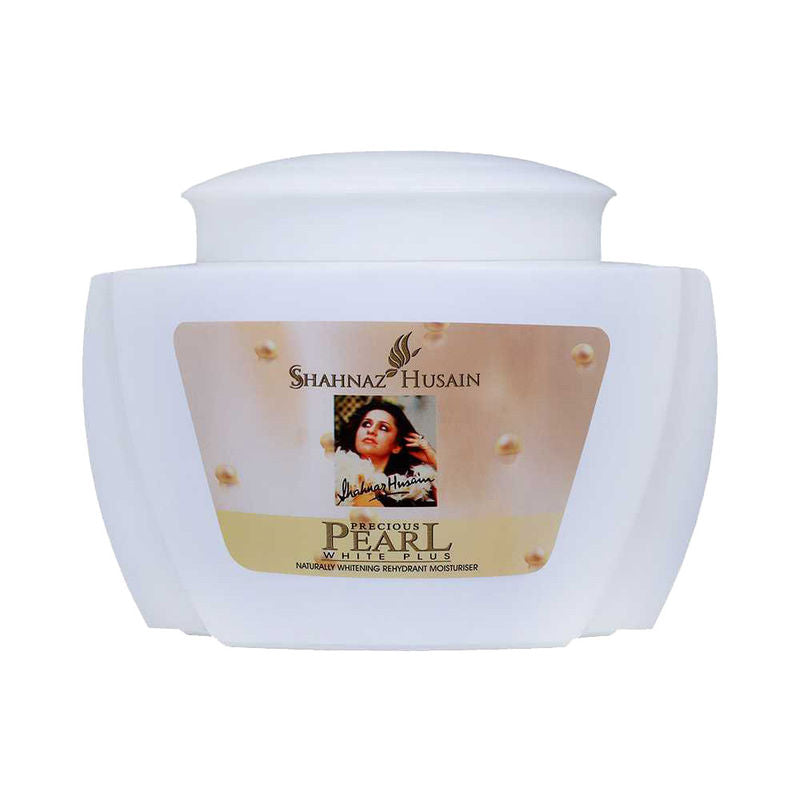
Shahnaz Husain Precious Pearl White Plus Cream Naturally Whitening Rehydrant Moisturiser

Shahnaz Husain Precious Pearl White Plus Cream Naturally Whitening Rehydrant Moisturiser
Shahnaz Husain
shahnaz-husain-precious-pearl-white-plus-cream-naturally-whitening-rehydrant-moisturiser
Moisturize
10084866392357
Morning or Evening?
How often will you use this product?
Notes


Highlights
WHAT IS IT?
face moisturizer and day cream with pearl powder and organic extracts
FEATURES
luxurious formula, powder of real pearls, organic extracts and oils, natural rehydrants, sun-filters, removes tan, evens color tone, easily absorbed, smooth and glowing skin, soft radiant youthful skin
BEST FOR
CHECKS
Who Is It For?
What Does It Help With?
Sun-damaged Skin Removing Tan Even Color Tone Lustrous And Youthful SkinBudget
Premium ($76-$150)How To Use
Which routine should it be used in?
Instructions:
Key Information

What Shahnaz Husain Says
Product Description:
Pearl White Plus Cream, a luxurious formulation for lustrous and youthful skin, is a unique blend of powder of real pearls with organic extracts and oils. Containing natural rehydrants and sun-filters, it helps sun-damaged skin, removing tan and producing an even color tone. Easily absorbed, it ensures smooth and glowing skin, leaving it soft, radiant and youthful.
About the Brand:
Ingredients Overview
Ingredients List
Aqua (Water), Stearic Acid, Cetyl Alcohol, Rosa centifolia Flower Water, Caprylic/Capric Triglyceride, Triethenolamine, Pearl Powder, PEG-100 Stearate, Glyceryl Stearate, Sucrose Dilaurate (and) Polysorbate-20, Pisum sativum (Pea) Extract, Caprylyl Glycol (and) Caprylhydroxamic Acid (and) Glycerin, Simmondsia (Jojoba) Seed Oil, Butyrospermum parkii Butter (Shea Butter), Daucus carota (Carrot) Seed Extract, Olea europaea (Olive) Fruit Oil, Tocopheryl Acetate, Niacinamide, Dimethicone, Parfum (Fragrance), Amyl Cinnamal, Benzyl Salicylate, Eugenol, Geraniol, Isoeugenol, Benzyl Benzoate, Linalool, Alpha-isomethyl Ionone, Butylphenyl Methylpropional, Tetrasodium EDTA, Sodium Sulfite, Pentaerythrityl Tetra-di-t-butyl, Hydroxyhydrocinnamate, Caratonia Siliqua Gum, Citric Acid, Phenoxyethanol, Ethylhexylglycerin
Key Ingredients
powder of real pearls, organic extracts, organic oils, natural rehydrants, sun-filters
Ingredients Details
Alpha-isomethyl Ionone
Common Name(s): Alpha-isomethyl ionone
DESCRIPTION
What It Does: Delivers targeted skin-conditioning or bioactive benefits through a specific mechanism of action suited to the formulation's intended purpose.
Why It's Used: Specialty actives address specific skin concerns through targeted molecular mechanisms, providing efficacy beyond what base formulation ingredients alone can achieve.
How It Works: The bioactive compound interacts with specific molecular targets in skin cells or the extracellular matrix — enzymes, receptors, structural proteins, or signaling molecules — triggering beneficial biological responses.
Typically Found In: Serums,treatments,moisturizers,specialty products
TECHNICAL DETAILS
Primary Category: Specialty actives
Secondary Functions: Skin-conditioning,anti-aging
Application Areas:

Facial Skincare

Body Care
Hair Care
Beard Care
Color Cosmetics (Makeup)
Dietary/Oral Supplements
Typical Concentration Range: 0.01–5%
SOURCING & ETHICS
Vegan Status: Yes
Halal Status: Yes
Source Notes: Specialty active ingredient; check individual sourcing for vegan status.
SKIN COMPATIBILITY
Irritancy Rating: 1
Comedogenicity Rating: 0
Sensitivity Concerns: Low sensitization potential at recommended use concentrations.
Safe for Sensitive Skin: Yes
SAFETY & COMPATIBILITY
Safety Profile: Well-characterized cosmetic ingredient with established safety profile. generally non-irritating at typical use concentrations. suitable for leave-on and rinse-off cosmetics.
Works Well With: Niacinamide,hyaluronic acid,vitamin c,peptides
Avoid Combining With: Incompatible with oxidizing agents; check ph stability
SCIENTIFIC NOTE
Specialty actives typically work through enzyme inhibition (e.g., tyrosinase inhibition for brightening, mmp inhibition for anti-aging), receptor activation (e.g., retinoid receptors, ppar-γ for barrier genes), or transcription factor modulation (e.g., nrf2 for antioxidant gene upregulation). structure-activity relationships determine potency and selectivity.
Last Verified: Cosing eu database; pcpc cosmetic ingredient safety reviews; ingredient-specific safety and efficacy literature
Primary Sources: 2025-01-15
Amyl Cinnamal
Common Name(s): Alpha-amyl cinnamic aldehyde,jasmine aldehyde
CAS Number: 122-40-7
DESCRIPTION
What It Does: Provides rich classic jasmine-type floral fragrance note.
Why It's Used: Classic jasmine fragrance aldehyde for premium perfumery providing the richer, deeper jasmine note used in high-quality fragrance compositions.
How It Works: C5-substituted cinnamic aldehyde provides broader, richer floral note vs hexyl cinnamal. good skin substantivity. widely used in combination with hexyl cinnamal for complex jasmine character.
Typically Found In: Premium fragrances,luxury cosmetics
TECHNICAL DETAILS
Primary Category: Fragrance component – aldehyde
Secondary Functions: Skin conditioning
Application Areas:
Facial Skincare
Body Care
Hair Care
Beard Care
Color Cosmetics (Makeup)
Dietary/Oral Supplements
Typical Concentration Range: 0.001%–0.5%
SOURCING & ETHICS
Vegan Status: Yes – synthetic
Halal Status: Yes
Source Notes: Commercially produced for cosmetic use. verify vegan/halal status with supplier.
SKIN COMPATIBILITY
Irritancy Rating: 1/5 – very low
Comedogenicity Rating: 0/5 – non-comedogenic
Sensitivity Concerns: Well-tolerated by most skin types.
Safe for Sensitive Skin: Yes
SAFETY & COMPATIBILITY
Safety Profile: Eu cosmetics regulation: declared fragrance allergen. ifra guidelines apply.
Works Well With: Standard skincare actives
Avoid Combining With: No known significant incompatibilities
SCIENTIFIC NOTE
Amyl cinnamal and hexyl cinnamal differ only in the alpha-substituent chain length (c5 amyl vs c6 hexyl). this single carbon difference shifts the scent character from amyl cinnamal's broader, richer jasmine to hexyl cinnamal's crisper, airier jasmine – demonstrating the extraordinary sensitivity of olfactory receptors to minor molecular changes in linear chain length.
Last Verified: Cosing database,ifra standards
Primary Sources: 2026-03-12
Benzyl Benzoate
Common Name(s): Benzyl ester of benzoic acid,scabimite
CAS Number: 120-51-4
DESCRIPTION
What It Does: Provides fixative fragrance and solvent properties with anti-mite activity.
Why It's Used: Natural ester fragrance compound occurring in jasmine and ylang ylang providing fixative and solvent benefits in fragranced cosmetics.
How It Works: Ester of benzyl alcohol and benzoic acid. solvent for difficult-to-dissolve fragrance compounds. penetrates insect/mite cuticle for scabicidal activity. mild skin fixative from ester-protein interactions.
Typically Found In: Fragrances,floral compounds,medical scabies treatment
TECHNICAL DETAILS
Primary Category: Fragrance component / scabicide
Secondary Functions: Skin conditioning
Application Areas:
Facial Skincare
Body Care
Hair Care
Beard Care
Color Cosmetics (Makeup)
Dietary/Oral Supplements
Typical Concentration Range: 0.001%–1%
SOURCING & ETHICS
Vegan Status: Yes – from jasmine, ylang ylang, peru balsam
Halal Status: Yes
Source Notes: Commercially produced for cosmetic use. verify vegan/halal status with supplier.
SKIN COMPATIBILITY
Irritancy Rating: 1/5 – very low
Comedogenicity Rating: 0/5 – non-comedogenic
Sensitivity Concerns: Well-tolerated by most skin types.
Safe for Sensitive Skin: Yes
SAFETY & COMPATIBILITY
Safety Profile: Eu cosmetics regulation: declared fragrance allergen. ifra guidelines apply.
Works Well With: Standard skincare actives
Avoid Combining With: No known significant incompatibilities
SCIENTIFIC NOTE
Benzyl benzoate's natural occurrence in jasmine absolute (up to 6%) means that products containing jasmine absolute naturally contain benzyl benzoate as a declared fragrance allergen – regardless of whether the formulator intentionally added it. this highlights how natural ingredients can automatically generate regulatory allergen declarations.
Last Verified: Cosing database,ifra standards
Primary Sources: 2026-03-12
Benzyl Salicylate
Common Name(s): Benzyl 2-hydroxybenzoate,salicylate ester
CAS Number: 118-58-1
DESCRIPTION
What It Does: Provides floral-balsamic scent with uv-absorbing fixative properties.
Why It's Used: Natural jasmine-associated fragrance ester with mild uv protection contribution for fragranced sun-exposed products.
How It Works: Salicylate ester absorbs uv-b mildly. provides fixative function by slowing evaporation of lighter fragrance top notes. naturally in jasmine absolute (1-3%). good skin absorption.
Typically Found In: Floral fragrances,sun-exposed products
TECHNICAL DETAILS
Primary Category: Fragrance component – floral fixative
Secondary Functions: Skin conditioning
Application Areas:
Facial Skincare
Body Care
Hair Care
Beard Care
Color Cosmetics (Makeup)
Dietary/Oral Supplements
Typical Concentration Range: 0.001%–1%
SOURCING & ETHICS
Vegan Status: Yes – from jasmine absolute, or synthetic
Halal Status: Yes
Source Notes: Commercially produced for cosmetic use. verify vegan/halal status with supplier.
SKIN COMPATIBILITY
Irritancy Rating: 1/5 – very low
Comedogenicity Rating: 0/5 – non-comedogenic
Sensitivity Concerns: Well-tolerated by most skin types.
Safe for Sensitive Skin: Yes
SAFETY & COMPATIBILITY
Safety Profile: Eu cosmetics regulation: declared fragrance allergen. ifra guidelines apply.
Works Well With: Standard skincare actives
Avoid Combining With: No known significant incompatibilities
SCIENTIFIC NOTE
Benzyl salicylate's salicylate moiety provides uv absorption in the uvb range (absorbs at 295-315nm) despite not being a registered uv filter. its occurrence in jasmine absolute means natural jasmine-fragranced products inherently contain a mild uv absorber – an incidental benefit of the natural fragrance chemistry that wasn't intentionally designed as photoprotection.
Last Verified: Cosing database,ifra standards
Primary Sources: 2026-03-12
