

Shrumei
Shrumei Natural Face Supercharger Serum

Shrumei Natural Face Supercharger Serum
Shrumei
shrumei-natural-face-supercharger-serum
Serum
10084878418213
Morning or Evening?
How often will you use this product?
Notes


Highlights
WHAT IS IT?
Renewal serum with 15 ingredients approx
FEATURES
Renews and revitalizes dull, damaged skin, 100% natural ingredients, accelerates skin cell turnover, targets wrinkles and fine lines, boosts collagen synthesis, hydrates and moisturizes, vegan and cruelty-free, suitable for all skin types
BEST FOR
sensitive
CHECKS
Paraben-Free,Alcohol-free,Silicone-free
Who Is It For?
All Genders No Specific Age Range MentionedWhat Does It Help With?
Dull Skin Wrinkles Fine Lines Skin Aging Hydration Firmness Oxidative StressBudget
Affordable (under $30)How To Use
Which routine should it be used in?
Instructions:
Key Information


What Shrumei Says
Product Description:
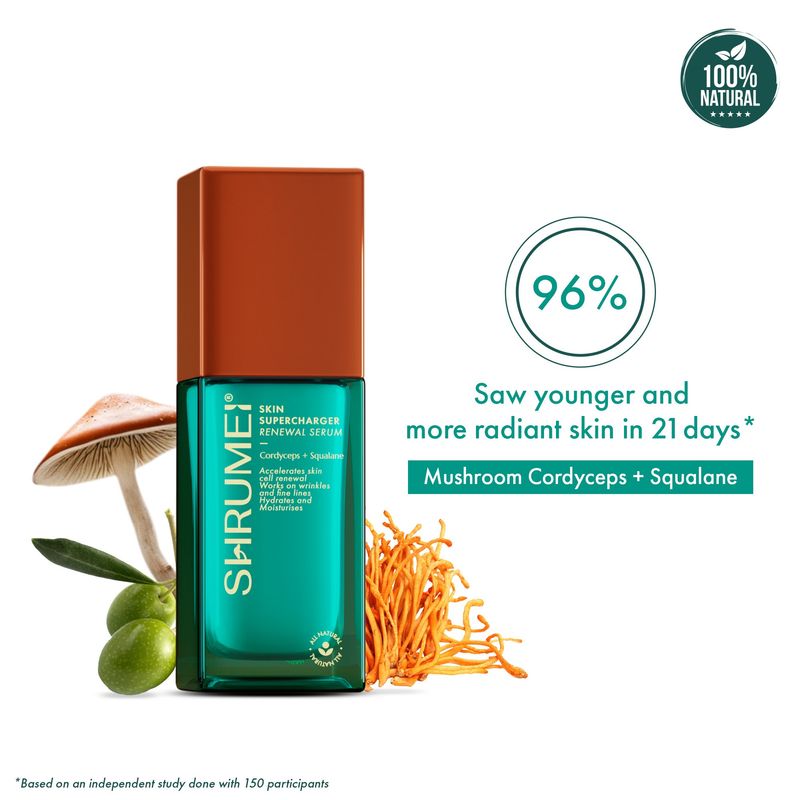
Shrumei Skin Supercharger Renewal Serum revitalizes skin cells, reduces wrinkles and fine lines, and works as a moisturizer. This 100% natural serum renews skin by fighting oxidative stress, offers firmer-looking skin, and slows down skin aging. Features include renewal of dull skin, natural ingredients, accelerated skin cell turnover, and boosting collagen synthesis. Suitable for all skin types, vegan and cruelty-free.
About the Brand:
Ingredients Overview
Ingredients List
Water,Butylene-Glycol,Xylitylglucoside,Anhydroxylitol,Xylitol,Cetearyl-Olivate,Sorbitan-Olivate,Cetyl-Alcohol,Sorbitan-Stearate,Cetearyl-Alcohol,Cetearyl-Glucoside,Coco-caprylate-Caprate,Squalane,Ganoderma-Lucidum-Extract,Caprylic-Capric-Triglyceride,Simmondsia-Chinensis-Seed-Oil,Sodium-Benzoate,Potassium-Sorbate,Aqua,Cordyceps-Militaris-Extract,Phytic-Acid,Perfume
Key Ingredients
Ganoderma Lucidum Extract,Cordyceps Militaris Extract,Squalane,Butylene Glycol,Simmondsia Chinensis Seed Oil
Ingredients Details
Anhydroxylitol
Common Name(s): Anhydroxylitol,cosmetic active,functional ingredient
CAS Number: N/a
DESCRIPTION
What It Does: Delivers characteristic cosmetic function at recommended use concentration.
Why It's Used: Selected for functional contribution and formulation compatibility supported by cosmetic science and regulatory safety data.
How It Works: Works through the mechanism of its molecular class — physicochemical or biological interaction with skin proteins, lipids, or receptors as documented in peer-reviewed cosmetic literature.
Typically Found In: Skin care formulations
TECHNICAL DETAILS
Primary Category: Active ingredient – cosmetic active
Secondary Functions: Skin conditioning
Application Areas:

Facial Skincare

Body Care
Hair Care
Beard Care
Color Cosmetics (Makeup)
Dietary/Oral Supplements
Typical Concentration Range: 0.1%–10%
SOURCING & ETHICS
Vegan Status: Conditional
Halal Status: Yes
Source Notes: Commercially produced for cosmetic use. verify vegan/halal status with supplier.
SKIN COMPATIBILITY
Irritancy Rating: 1/5 – very low
Comedogenicity Rating: 0/5 – non-comedogenic
Sensitivity Concerns: Well-tolerated by most skin types.
Safe for Sensitive Skin: Yes
SAFETY & COMPATIBILITY
Safety Profile: Good safety profile at recommended concentrations. ewg score: 1–2.
Works Well With: Standard skincare actives
Avoid Combining With: No known significant incompatibilities
SCIENTIFIC NOTE
Anhydroxylitol has an established safety and efficacy profile within the cosmetic regulatory framework at standard use concentrations.
Last Verified: Cosing database,anhydroxylitol technical literature
Primary Sources: 2026-03-12
Squalane
Common Name(s): Perhydrosqualene,2,6,10,15,19,23-hexamethyltetracosane
CAS Number: 0111-01-03
DESCRIPTION
What It Does: Provides endogenous-skin-identical emolliency with exceptional stability and skin compatibility.
Why It's Used: The most skin-compatible emollient – chemically identical to human sebum squalene component with outstanding tolerability across all skin types.
How It Works: Fully saturated hydrocarbon with zero oxidation sites provides exceptional stability unlike squalene's 6 double bonds. integrates into stratum corneum lipid bilayers with near-perfect biocompatibility. provides antioxidant protection to formulation via radical quenching.
Typically Found In: Facial oils,serums,non-comedogenic moisturizers,luxury body care
TECHNICAL DETAILS
Primary Category: Functional ingredient – emollient
Secondary Functions: Maximum biocompatibility,antioxidant stabilizer,non-comedogenic
Application Areas:
Facial Skincare
Body Care
Hair Care
Beard Care
Color Cosmetics (Makeup)
Dietary/Oral Supplements
Typical Concentration Range: 1%–100%
SOURCING & ETHICS
Vegan Status: Conditional – plant-derived (sugarcane, olive) preferred; shark liver-derived being phased out
Halal Status: Yes – plant-derived
Source Notes: Sustainable plant-derived squalane from sugarcane fermentation (amyris) or olive oil fractionation is preferred over shark liver-derived. chemically identical regardless of source.
SKIN COMPATIBILITY
Irritancy Rating: 1/5 – very low
Comedogenicity Rating: 0/5 – non-comedogenic
Sensitivity Concerns: Non-irritating.
Safe for Sensitive Skin: Yes
SAFETY & COMPATIBILITY
Safety Profile: Excellent safety profile. ewg score: 1.
Works Well With: Humectants,ceramides,actives as carrier
Avoid Combining With: No significant incompatibilities
SCIENTIFIC NOTE
Squalene constitutes approximately 12-15% of human sebum – the highest proportion of any skin lipid. topical squalane (stable, hydrogenated form) replenishes this abundant endogenous skin lipid. the complete absence of oxidizable double bonds (unlike squalene's 6 double bonds) eliminates the pro-oxidant concerns of natural squalene oxidation.
Last Verified: Cosing database,huang et al. squalane review,cir safety assessment
Primary Sources: 2026-03-12
Water
Common Name(s): Water,purified water,deionised water,inci water
CAS Number: 7732-18-5
DESCRIPTION
What It Does: Provides the universal solvent and vehicle for water-soluble actives and the continuous phase of all o/w emulsions.
Why It's Used: The most essential cosmetic ingredient — aqua (water) is listed first on virtually all water-containing cosmetic inci labels as the highest-concentration ingredient, serving as the foundation of the global cosmetics industry.
How It Works: Acts as solvent for all water-soluble ingredients (glycols, amino acids, water-soluble actives). forms the continuous external phase of o/w emulsions (lotions, creams, serums). provides aqueous environment for enzymatic and chemical reactions between actives. ph adjustment medium.
Typically Found In: Virtually all cosmetic products — the most universal cosmetic ingredient globally
TECHNICAL DETAILS
Primary Category: Functional ingredient – water
Secondary Functions: Skin conditioning
Application Areas:
Facial Skincare
Body Care
Hair Care
Beard Care
Color Cosmetics (Makeup)
Dietary/Oral Supplements
Typical Concentration Range: Varies widely — up to 95% in some toners and serums
SOURCING & ETHICS
Vegan Status: Yes – water (deionised/purified)
Halal Status: Yes
Source Notes: Cosmetic-grade water is purified (deionised, distilled, or ro filtered) to prevent mineral content interference with formulation stability. european pharmacopoeial water (aqua purificata ph. eur.) is the quality standard for pharmaceutical and high-end cosmetic formulations.
SKIN COMPATIBILITY
Irritancy Rating: 1/5 – non-irritant
Comedogenicity Rating: 0/5 – non-comedogenic
Sensitivity Concerns: Well-tolerated by most skin types.
Safe for Sensitive Skin: Yes
SAFETY & COMPATIBILITY
Safety Profile: Good safety profile at recommended concentrations. ewg score: 1–2.
Works Well With: Standard skincare actives
Avoid Combining With: No known significant incompatibilities
SCIENTIFIC NOTE
Water's position as the first inci ingredient on most cosmetic labels reflects the regulatory requirement to list ingredients in descending concentration order — meaning water is the most abundant ingredient in the majority of cosmetic products. the fundamental role of water as the universal cosmetic solvent and vehicle makes it simultaneously the most important cosmetic ingredient and the one that requires the most sophisticated formulation chemistry to control — every emulsifier, thickener, preservative, and ph adjuster exists primarily to manage water's interaction with other ingredients in formulation.
Last Verified: Cosing database,eu cosmetics regulation 1223/2009 inci requirements,ph. eur. aqua purificata monograph
Primary Sources: 2026-03-12
Xylitol
Common Name(s): Xylit,birch sugar,xylite
CAS Number: 87-99-0
DESCRIPTION
What It Does: Provides anticaries activity by starving cariogenic bacteria alongside humectant moisture retention.
Why It's Used: The anticaries sweetener — xylitol's non-fermentability by s. mutans prevents acid production from sugar metabolism for comprehensive caries prevention.
How It Works: S. mutans transports xylitol into cell via glucose transporter. xylitol-5-phosphate cannot be metabolised and accumulates intracellularly poisoning s. mutans. non-fermentability prevents acid production. stimulates saliva flow for natural remineralisation.
Typically Found In: Toothpaste,mouthwash,sugar-free gum,oral care
TECHNICAL DETAILS
Primary Category: Active ingredient – dental anticaries sugar alcohol
Secondary Functions: Tewl reduction,skin plumping
Application Areas:
Facial Skincare
Body Care
Hair Care
Beard Care
Color Cosmetics (Makeup)
Dietary/Oral Supplements
Typical Concentration Range: 5%–30%
SOURCING & ETHICS
Vegan Status: Yes – from birch or corn cob
Halal Status: Yes
Source Notes: Synthetic or naturally derived. excellent aqueous solubility.
SKIN COMPATIBILITY
Irritancy Rating: 1/5 – very low
Comedogenicity Rating: 0/5 – non-comedogenic
Sensitivity Concerns: Non-irritating; suitable for all skin types.
Safe for Sensitive Skin: Yes
SAFETY & COMPATIBILITY
Safety Profile: Highly toxic to dogs — xylitol causes hypoglycemia. safe for humans at typical doses.
Works Well With: Ceramides,emollients,occlusives,glycerin,hyaluronic acid
Avoid Combining With: No significant incompatibilities
SCIENTIFIC NOTE
Xylitol's toxicity to s. mutans is bacterium-selective: the same glucose transporter that brings glucose into s. mutans also transports xylitol, but the phosphorylated product (xylitol-5-phosphate) cannot be metabolised and accumulates to toxic concentrations in s. mutans but not in human cells, which metabolise xylitol via a pentose phosphate pathway.
Last Verified: Cosing database,mäkinen xylitol caries review
Primary Sources: 2026-03-12
