

Simple
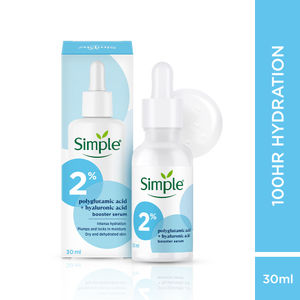
Simple 2% Hyaluronic Acid + Polyglutamic Acid Booster Serum 30 ml

Simple 2% Hyaluronic Acid + Polyglutamic Acid Booster Serum 30 ml
Simple
simple-2-hyaluronic-acid-polyglutamic-acid-booster-serum-30-ml
Serum
10084938481957
Morning or Evening?
How often will you use this product?
Notes


Highlights
WHAT IS IT?
Booster Serum with 2 main hydration ingredients
FEATURES
Contains Hyaluronic Acid and Polyglutamic Acid, provides 100 hours hydration, non-greasy, non-sticky, dermatologically tested, suitable for dry, dehydrated and sensitive skin, hypoallergenic, free from colour and perfume
BEST FOR
dry
CHECKS
No colour, no perfume, no harsh chemicals
Who Is It For?
Men And Women Suitable For Sensitive Skin No Specific Age MentionedWhat Does It Help With?
Hydration Soft And Smooth Skin Dry And Dehydrated SkinBudget
Affordable (under $30)How To Use
Which routine should it be used in?
Instructions:
Key Information


What Simple Says
Product Description:
Simple 2 Hyaluronic Acid + Polyglutamic Acid Booster Face Serum formulated with two hydration heroes - Hyaluronic Acid and Polyglutamic Acid. It is potent yet kind to skin and maximises skin hydration while promoting soft and smooth skin. Polyglutamic Acid known to retain moisture and Hyaluronic Acid hydrates deeper layers of the skin giving your skin 100 hours of hydration. Simple 2 Hyaluronic Acid + Polyglutamic Acid Booster Face Serum has a nongreasy and nonsticky formula that penetrates deeply into the skin while retaining it to give instant hydration leaving the skin plump and soft. It is dermatologically tested and approved hypoallergenic and noncomedogenic. This serum is suitable for dry and dehydrated skin and even for sensitive skin for both men and women. How to Use: Cleanse your face with a facewash and pat dry. Take a pea sized amount of the Simple Booster Serum in your palm. Spread it between your palms without rubbing too much. Dab the serum all over your face and neck using small and gentle tapping motions. Follow with the Simple Moisturiser. For best results, use daily. At Simple, we're all about making products which are kind to skin and have skin-loving ingredients. All our products are free from colour, perfume, and a strict list of 2000+ harsh chemicals (we call them baddies).
About the Brand:
Ingredients Overview
Ingredients List
Aqua, Propanediol, Sodium acrylates copolymer & Lecithin, Sodium hyaluronate , Sodium Polyglutamate, Propylene Glycol, Pachyrhizus Erosus (Bengkoang) Root Extract, Sodium Benzoate, Potassium sorbate, Sodium Gluconate, 3 Iodo 2 Propynyl Butylcarbamate, Phenoxyethanol
Key Ingredients
Hyaluronic Acid, Polyglutamic Acid
Ingredients Details
Phenoxyethanol
Common Name(s): 2-phenoxyethanol,rose ether,ethylene glycol monophenyl ether
CAS Number: 122-99-6
DESCRIPTION
What It Does: Prevents microbial contamination and spoilage in cosmetic formulations.
Why It's Used: The benchmark cosmetic preservative – eu-permitted up to 1%, effective against virtually all cosmetically relevant microorganisms, and excellent tolerability.
How It Works: Phenol ring provides broad antimicrobial activity via disruption of bacterial and fungal cell membranes and inhibition of enzymatic activity. effective against gram-positive and gram-negative bacteria, yeasts (candida), and molds (aspergillus). activity ph range: 3-9.
Typically Found In: All cosmetic formulations as primary preservative
TECHNICAL DETAILS
Primary Category: Functional ingredient – broad-spectrum preservative
Secondary Functions: Skin conditioning
Application Areas:

Facial Skincare

Body Care
Hair Care
Beard Care
Color Cosmetics (Makeup)
Dietary/Oral Supplements
Typical Concentration Range: 0.1%–1% (eu max 1%)
SOURCING & ETHICS
Vegan Status: Yes – synthetic
Halal Status: Yes
Source Notes: Commercially produced for cosmetic use. verify vegan/halal status with supplier.
SKIN COMPATIBILITY
Irritancy Rating: 1/5 – very low
Comedogenicity Rating: 0/5 – non-comedogenic
Sensitivity Concerns: Well-tolerated by most skin types.
Safe for Sensitive Skin: Yes
SAFETY & COMPATIBILITY
Safety Profile: Eu cosmetics regulation max 1%. sccs assessed as safe at ≤1%. avoid use around eyes in baby products per some country regulations. ewg score: 4.
Works Well With: Standard skincare actives
Avoid Combining With: No known significant incompatibilities
SCIENTIFIC NOTE
Phenoxyethanol's widespread adoption as the primary cosmetic preservative followed the phaseout of parabens from many formulations in the 2000s-2010s. despite having a comparable or better safety profile to parabens, it is often cited in 'free-from' formulations – a consumer perception issue rather than a scientific safety concern.
Last Verified: Cosing database,sccs opinion on phenoxyethanol,cir safety assessment
Primary Sources: 2026-03-12
Potassium Sorbate
Common Name(s): Potassium e,2-hexenoate,sorbate of potash
CAS Number: 24634-61-5
DESCRIPTION
What It Does: Provides mould and yeast focused broad-spectrum preservation in a widely accepted food-grade preservative.
Why It's Used: Standard mould and yeast preservative — potassium sorbate is effective at slightly higher ph than sodium benzoate, making it the preferred sorbate preservative for formulations at ph 4.5-6.
How It Works: Inactive salt form — sorbic acid (free acid, pka 4.76) is active. more effective than benzoate at higher ph (pka 4.76 vs benzoate 4.2). active at ph up to ~6.0 (meaningful sorbic acid present). inhibits malassezia and candida at lower concentrations than bacteria. synergistic with sodium benzoate.
Typically Found In: Cosmetics ph 4-6,natural preservation systems,combined with sodium benzoate
TECHNICAL DETAILS
Primary Category: Functional ingredient – sorbate preservative
Secondary Functions: Skin conditioning
Application Areas:
Facial Skincare
Body Care
Hair Care
Beard Care
Color Cosmetics (Makeup)
Dietary/Oral Supplements
Typical Concentration Range: 0.1%–0.6%
SOURCING & ETHICS
Vegan Status: Yes – synthetic
Halal Status: Yes
Source Notes: Commercially produced for cosmetic use. verify vegan/halal status with supplier.
SKIN COMPATIBILITY
Irritancy Rating: 1/5 – very low
Comedogenicity Rating: 0/5 – non-comedogenic
Sensitivity Concerns: Well-tolerated by most skin types.
Safe for Sensitive Skin: Yes
SAFETY & COMPATIBILITY
Safety Profile: Eu max 0.6% cosmetics. fda gras. synergistic with sodium benzoate. oxidises to sorbaldehyde (yellow colouration) on uv exposure — protect from light.
Works Well With: Standard skincare actives
Avoid Combining With: No known significant incompatibilities
SCIENTIFIC NOTE
Potassium sorbate's antifungal mechanism (disruption of mitochondrial electron transport in fungi) is different from its antibacterial mechanism (cell membrane and enzyme disruption). this mechanistic bifunctionality provides broad spectrum from a single preservative, though the lower antifungal mic values mean mould and yeast protection is achieved at lower concentrations than bacterial protection.
Last Verified: Cosing database,eu preservative annex v,fda gras,cir safety assessment
Primary Sources: 2026-03-12
Propanediol
Common Name(s): 1,3-propanediol,zemea,bio-propanediol
CAS Number: 504-63-2
DESCRIPTION
What It Does: Provides humectant and solvent functionality from sustainable corn-based fermentation.
Why It's Used: Bio-based propylene glycol alternative from renewable corn — propanediol provides equivalent functionality to propylene glycol with sustainable renewable feedstock and superior skin feel.
How It Works: Two oh groups provide humectant water binding. excellent solvent for fragrances, actives, and preservatives. mild antimicrobial from diol structure for preservative system boosting. renew corn fermentation origin (dupont zemea process). better skin feel than propylene glycol — less sticky.
Typically Found In: Virtually all cosmetic categories as pg alternative
TECHNICAL DETAILS
Primary Category: Functional ingredient – humectant
Secondary Functions: Tewl reduction,skin plumping
Application Areas:
Facial Skincare
Body Care
Hair Care
Beard Care
Color Cosmetics (Makeup)
Dietary/Oral Supplements
Typical Concentration Range: 1%–20%
SOURCING & ETHICS
Vegan Status: Yes – from corn sugar fermentation
Halal Status: Yes
Source Notes: Synthetic or naturally derived. excellent aqueous solubility.
SKIN COMPATIBILITY
Irritancy Rating: 1/5 – very low
Comedogenicity Rating: 0/5 – non-comedogenic
Sensitivity Concerns: Non-irritating; suitable for all skin types.
Safe for Sensitive Skin: Yes
SAFETY & COMPATIBILITY
Safety Profile: Excellent safety profile. ewg score: 1.
Works Well With: Ceramides,emollients,occlusives,glycerin,hyaluronic acid
Avoid Combining With: No significant incompatibilities
SCIENTIFIC NOTE
Propanediol's dupont tate & lyle bio products 'zemea' process ferments corn sugar to 1,3-propanediol using engineered e. coli — one of the first commercially viable bio-fermentation routes to a cosmetic diol previously made only from petroleum. the renewable route produces chemically identical 1,3-propanediol while reducing carbon footprint by approximately 40% vs petrochemical synthesis.
Last Verified: Cosing database,dupont tate & lyle zemea technical data,cir safety assessment
Primary Sources: 2026-03-12
Propylene Glycol
Common Name(s): 1,2-propanediol,pdg,propane-1,2-diol
CAS Number: 57-55-6
DESCRIPTION
What It Does: Provides humectant hydration alongside solubilization of water-soluble actives and preservation boosting.
Why It's Used: Multi-function glycol for comprehensive formulation utility: hydration, solubilization, and preservation in a single cost-effective ingredient.
How It Works: Two hydroxyl groups provide water binding for humectant activity. propylene backbone provides solvent capacity for both polar and moderately non-polar actives. antimicrobial activity via membrane disruption enhancing preservative systems.
Typically Found In: Moisturizers,serums,toners,almost all aqueous formulations
TECHNICAL DETAILS
Primary Category: Functional ingredient – glycol humectant / solvent
Secondary Functions: Tewl reduction,skin plumping
Application Areas:
Facial Skincare
Body Care
Hair Care
Beard Care
Color Cosmetics (Makeup)
Dietary/Oral Supplements
Typical Concentration Range: 1%–15%
SOURCING & ETHICS
Vegan Status: Yes – from propylene oxide (petrochemical) or bio-based (corn fermentation)
Halal Status: Yes
Source Notes: Synthetic or naturally derived. excellent aqueous solubility.
SKIN COMPATIBILITY
Irritancy Rating: 2/5 – low to moderate; potential sensitizer in sensitive individuals at high concentrations
Comedogenicity Rating: 0/5 – non-comedogenic
Sensitivity Concerns: Non-irritating; suitable for all skin types.
Safe for Sensitive Skin: Yes
SAFETY & COMPATIBILITY
Safety Profile: Well-established safety profile. ewg score: 3. bio-based pg available from corn fermentation.
Works Well With: Ceramides,emollients,occlusives,glycerin,hyaluronic acid
Avoid Combining With: No significant incompatibilities
SCIENTIFIC NOTE
Propylene glycol's dual polarity (two hydroxyl groups + propylene hydrocarbon backbone) enables dissolution of ingredients spanning a wide hydrophilicity range – from highly polar actives (amino acids, glycerin) to moderately lipophilic actives (salicylic acid, retinol). this broad solubility range makes it uniquely versatile as a cosmetic solvent.
Last Verified: Cosing database,cir safety assessment
Primary Sources: 2026-03-12
