
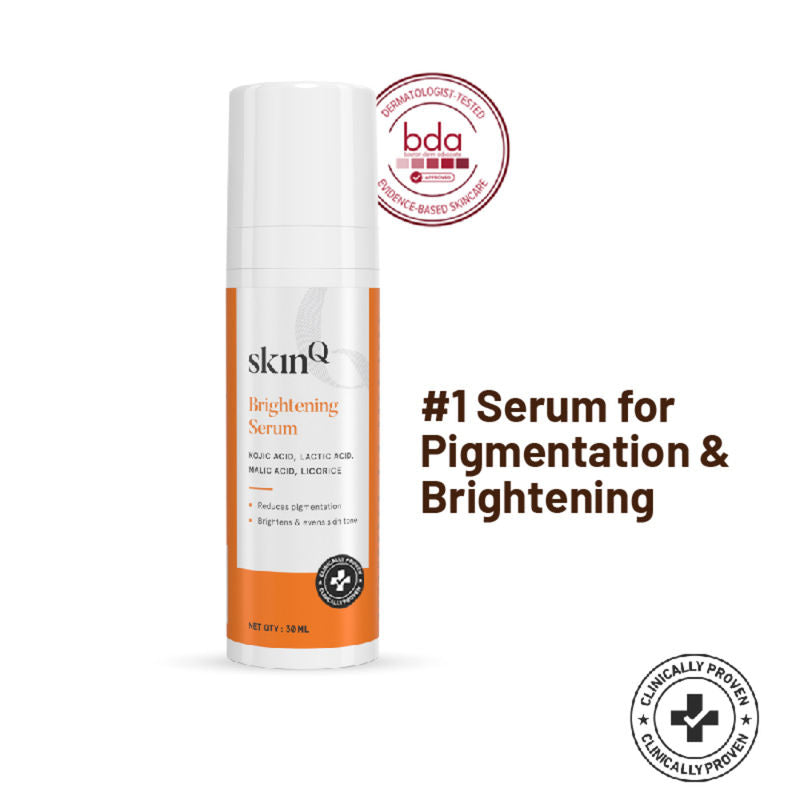

SkinQ
SkinQ Brightening Serum

SkinQ Brightening Serum
SkinQ
skinq-brightening-serum
Serum
10084848435493
Morning or Evening?
How often will you use this product?
Notes


Highlights
WHAT IS IT?
Brightening serum with 5 active ingredients
FEATURES
5-in-1 multi-active formula, anti-hyperpigmentation, brightening, hydration, dermatologist recommended
BEST FOR
combination
CHECKS
toxins, non-vegan ingredients, animal cruelty
Who Is It For?
Adults All GendersWhat Does It Help With?
Hyperpigmentation Dark Spots Uneven Skin Tone Tan DehydrationBudget
Affordable (under $30)How To Use
Which routine should it be used in?
Instructions:
Key Information


What SkinQ Says
Product Description:
SkinQ’s Brightening Serum is the best solution for people looking to get a radiant and even-toned complexion for their skin. It is an easy-to-use and effective serum with a 5-in-1 multi-active formula for anti-hyperpigmentation and brightening skin tone. Active ingredients like Lactic Acid (AHA) remove dark spots and give an even complexion, Licorice reduces tan and pigmentation, Kojic Dipalmitate inhibits pigment synthesis, Malic Acid brightens skin, Sodium Hyaluronate hydrates skin and other potent extracts for brightening skin. SkinQ is formulated in-house by multi-award winning, internationally renowned celebrity cosmetic dermatologist and Indian beauty guru Dr. Chytra Anand. This dermatologist recommended face serum is advance and clinical formulated with active ingredients that deliver better result than the off-the-shelf products available in the market. Therefore, after years of research, SkinQ is proud to bring beauty curated for the Indian skin using only naturally derived active ingredients. All their products are Made Safe certified, toxin free, vegan friendly and cruelty-free.
About the Brand:
Ingredients Overview
Ingredients List
lactic-acid,licorice,kojic-dipalmitate,malic-acid,sodium-hyaluronate
Key Ingredients
Lactic Acid, Licorice, Kojic Dipalmitate, Malic Acid, Sodium Hyaluronate
Ingredients Details
Kojic Dipalmitate
Common Name(s): Kojic acid dipalmitate,kdp,kojic acid ester
CAS Number: 79725-98-7
DESCRIPTION
What It Does: Provides stable lipophilic kojic acid for deeper-penetrating brightening with improved formulation stability.
Why It's Used: Stable brightening kojic acid — kojic dipalmitate provides effective brightening with 6+ months formulation stability vs pure kojic acid's rapid discoloration in aqueous formulations.
How It Works: Dipalmitate ester protects kojic acid's reactive 3-hydroxy-4-pyranone from oxidation. skin esterases cleave palmitate groups releasing free kojic acid for tyrosinase copper chelation. higher logp than free kojic acid provides better skin penetration. oil-phase compatible for anhydrous formulations.
Typically Found In: Brightening creams,stable lightening products,oil-phase brighteners
TECHNICAL DETAILS
Primary Category: Active ingredient – brightening / tyrosinase inhibitor
Secondary Functions: Melanin inhibition,hyperpigmentation reduction
Application Areas:

Facial Skincare

Body Care
Hair Care
Beard Care
Color Cosmetics (Makeup)
Dietary/Oral Supplements
Typical Concentration Range: 0.5%–3%
SOURCING & ETHICS
Vegan Status: Yes – from kojic acid (fermentation) + palmitic acid (plant)
Halal Status: Yes
Source Notes: Synthetic or plant-derived.
SKIN COMPATIBILITY
Irritancy Rating: 1/5 – very low
Comedogenicity Rating: 0/5 – non-comedogenic
Sensitivity Concerns: Non-irritating; well-tolerated.
Safe for Sensitive Skin: Yes
SAFETY & COMPATIBILITY
Safety Profile: Excellent safety profile. use with spf for maximum efficacy. ewg score: 1.
Works Well With: Niacinamide,vitamin c,alpha-arbutin,tranexamic acid,spf
Avoid Combining With: No significant incompatibilities
SCIENTIFIC NOTE
Kojic dipalmitate's stability advantage (white powder, 6+ month stability vs kojic acid's rapid yellow discoloration) arises from the ester groups masking the alpha-pyranone's iron-chelating catechol-type functionality. kojic acid's discoloration results from iron complexation and oxidation of the 3-hydroxyl group — precisely the same group that provides tyrosinase copper chelation and is protected by palmitate esterification.
Last Verified: 2026-03-12
Primary Sources: Cosing database,cir safety assessment
Lactic Acid
Common Name(s): L-lactic acid,2-hydroxypropionic acid,milk acid
CAS Number: 50-21-5
DESCRIPTION
What It Does: Exfoliates dead skin cells, attracts and retains moisture, brightens skin tone, and improves texture.
Why It's Used: Dual exfoliant and humectant – uniquely hydrating vs other ahas. gentler and suitable for normal-to-sensitive skin.
How It Works: Disrupts desmosomes to promote exfoliation at low ph. acts as humectant. also stimulates ceramide synthesis at lower concentrations for barrier support.
Typically Found In: Chemical exfoliants,toners,serums,professional peels
TECHNICAL DETAILS
Primary Category: Active ingredient – alpha hydroxy acid (aha)
Secondary Functions: Humectant,brightening,barrier support,ceramide synthesis
Application Areas:
Facial Skincare
Body Care
Hair Care
Beard Care
Color Cosmetics (Makeup)
Dietary/Oral Supplements
Typical Concentration Range: 2%–10% (daily); 20%–90% (professional); active at ph ≤3.9
SOURCING & ETHICS
Vegan Status: Conditional - feedstock declaration required
Halal Status: Unverified - feedstock declaration required (plant, animal and petrochemical routes all exist)
Source Notes: Fermentation-derived from carbohydrates or synthetically produced. both l-form and dl-form used. [audit 2026-07-29 rev2: origin-dependent: the same inci exists in plant, animal and petrochemical versions and the name does not discriminate. determination requires shariah-panel sign-off.]
SKIN COMPATIBILITY
Irritancy Rating: 2/5 – low to moderate
Comedogenicity Rating: 0/5 – non-comedogenic
Sensitivity Concerns: Photosensitizing – spf required. better tolerated than glycolic acid for most skin types.
Safe for Sensitive Skin: Use with caution – spf required
SAFETY & COMPATIBILITY
Safety Profile: Safe at otc concentrations. eu: ≤10% leave-on at ph ≥3.5. mandatory spf advisory.
Works Well With: Niacinamide,ceramides,hyaluronic acid,spf
Avoid Combining With: Retinol in same step; multiple exfoliants simultaneously
SCIENTIFIC NOTE
Lactic acid's role as a natural moisturizing factor (nmf) component makes it uniquely hydrating among ahas. ceramide synthesis stimulation at 2% provides barrier benefits complementing exfoliating activity.
Last Verified: 2026-03-12
Primary Sources: Cosing database,stiller et al. lactic acid review,sccs aha opinion
Malic Acid
Common Name(s): L-malic acid,2-hydroxybutanedioic acid,apple acid
CAS Number: 6915-15-7
DESCRIPTION
What It Does: Gently exfoliates skin, brightens complexion, balances ph, acts as chelating agent.
Why It's Used: Gentle exfoliant for multi-aha blends; larger molecular size provides moderate exfoliation with low irritation.
How It Works: At low ph, disrupts corneocyte adhesion for gentle exfoliation. dicarboxylic acid structure enables metal chelation as formulation stabilizer.
Typically Found In: Chemical exfoliants,toners,serums,professional peels
TECHNICAL DETAILS
Primary Category: Active ingredient – alpha hydroxy acid (aha)
Secondary Functions: Chelating agent,ph adjuster,mild exfoliant
Application Areas:
Facial Skincare
Body Care
Hair Care
Beard Care
Color Cosmetics (Makeup)
Dietary/Oral Supplements
Typical Concentration Range: 1%–10%
SOURCING & ETHICS
Vegan Status: Yes – synthetic or fermentation-derived
Halal Status: Yes
Source Notes: Derived from apples and other fruits or synthetically produced via maleic acid hydration.
SKIN COMPATIBILITY
Irritancy Rating: 2/5 – low to moderate
Comedogenicity Rating: 0/5 – non-comedogenic
Sensitivity Concerns: Very well-tolerated; gentler than glycolic or lactic acid; low photosensitization.
Safe for Sensitive Skin: Yes – preferred aha for sensitive skin
SAFETY & COMPATIBILITY
Safety Profile: Safe at otc concentrations. eu: ≤10% leave-on at ph ≥3.5. mandatory spf advisory.
Works Well With: Niacinamide,ceramides,hyaluronic acid,spf
Avoid Combining With: Retinol in same step; multiple exfoliants simultaneously
SCIENTIFIC NOTE
Malic acid's molecular weight (~134 da vs 76 da for glycolic acid) provides shallower skin penetration and more superficial exfoliating action, ideal for sensitive skin.
Last Verified: 2026-03-12
Primary Sources: Cosing database,cir safety assessment,sccs aha opinion
Sodium Hyaluronate
Common Name(s): Sodium salt of hyaluronic acid,naha
CAS Number: 9067-32-7
DESCRIPTION
What It Does: Provides hyaluronic acid hydration in the most formulation-stable and compatible form.
Why It's Used: The standard form of ha used in cosmetics – more stable than free ha, better solubility, and equivalent skin hydration benefits.
How It Works: Sodium salt reduces the polyelectrolyte repulsion of ha chains, allowing better packing in formulations. on skin, sodium ions dissociate and the ha chain unfolds to its full water-binding conformation. provides full ha humectant and barrier benefits equivalent to free ha.
Typically Found In: Hydrating serums,toners,moisturizers,sheet masks,anti-aging products
TECHNICAL DETAILS
Primary Category: Active ingredient – ha sodium salt
Secondary Functions: Equivalent ha hydration,superior stability
Application Areas:
Facial Skincare
Body Care
Hair Care
Beard Care
Color Cosmetics (Makeup)
Dietary/Oral Supplements
Typical Concentration Range: 0.1%–2%
SOURCING & ETHICS
Vegan Status: Conditional - feedstock declaration required
Halal Status: Unverified - feedstock declaration required (plant, animal and petrochemical routes all exist)
Source Notes: Synthetic or naturally derived. excellent aqueous solubility. [audit 2026-07-29 rev2: origin-dependent: the same inci exists in plant, animal and petrochemical versions and the name does not discriminate. determination requires shariah-panel sign-off.]
SKIN COMPATIBILITY
Irritancy Rating: 1/5 – very low
Comedogenicity Rating: 0/5 – non-comedogenic
Sensitivity Concerns: Non-irritating; suitable for all skin types.
Safe for Sensitive Skin: Yes
SAFETY & COMPATIBILITY
Safety Profile: Excellent safety profile. ewg score: 1.
Works Well With: Ceramides,emollients,occlusives,glycerin,hyaluronic acid
Avoid Combining With: No significant incompatibilities
SCIENTIFIC NOTE
The sodium salt form of ha has approximately 10% better water solubility than free hyaluronic acid at equivalent molecular weight due to reduced chain-chain electrostatic repulsion from partial sodium counterion screening. this improved solubility enables higher concentration formulations without viscosity issues.
Last Verified: 2026-03-12
Primary Sources: Cosing database,cir safety assessment