

Nykaa E retail limited
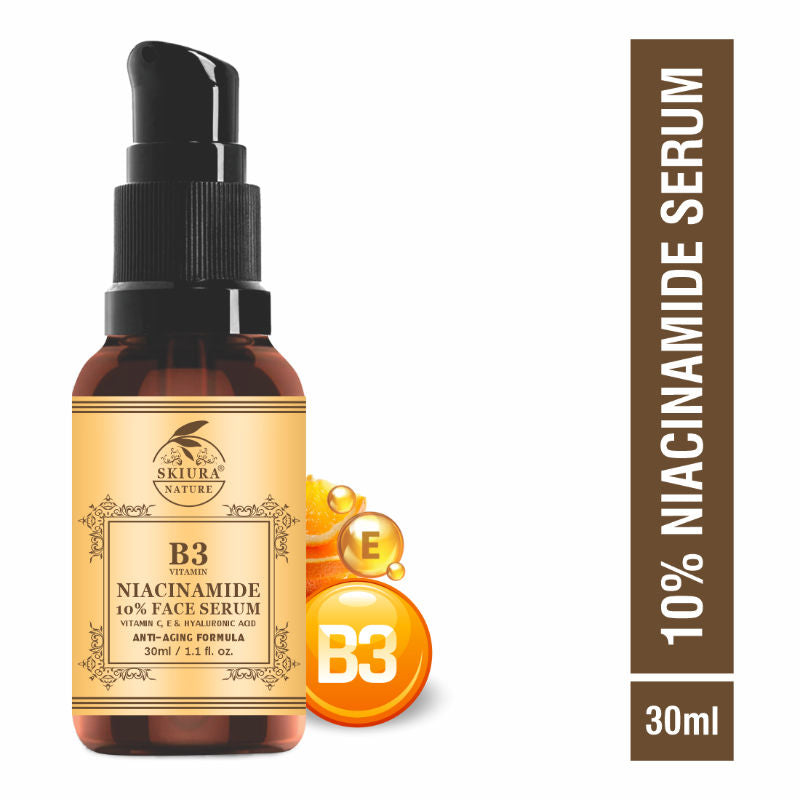
Skiura Nature 10% Niacinamide Face Serum

Skiura Nature 10% Niacinamide Face Serum
Nykaa E retail limited
skiura-nature-10-niacinamide-face-serum
Serum
10084832575781
Morning or Evening?
How often will you use this product?
Notes


Highlights
WHAT IS IT?
Face Serum with multiple active ingredients
FEATURES
Reduces acne marks and hyperpigmentation, Infused with niacinamide (vitamin B3), hyaluronic acid, Regulates sebum production to prevent acne breakouts, Calms redness and irritation, Provides hydration and retains moisture, Temporarily plumps fine lines and wrinkles, Softens and smooths skin, Vegan and cruelty-free
BEST FOR
oily
CHECKS
Paraben-Free,Preservative-Free
Who Is It For?
What Does It Help With?
Acne Marks Hyperpigmentation Uneven Skin Tone Oil Regulation Hydration Fine Lines WrinklesBudget
Affordable (under $30)How To Use
Which routine should it be used in?
Instructions:
Key Information


What Nykaa E retail limited Says
Product Description:
Skiura 10% Niacinamide Face Serum is enriched with potent active ingredients like hyaluronic acid, vitamin C, vitamin E, and niacinamide to effectively reduce the appearance of acne spots, promote an even skin tone, and provide ultra-hydration. Niacinamide (vitamin B3) works on multiple levels, penetrating deep into the epidermis to tackle acne and acne marks. It enhances skin texture by unclogging pores, extracting excess oil and sebum, and regulating oil production to prevent whiteheads and blackheads. With its ability to deliver 24-hour hydration, this cream helps maintain a balanced, clear complexion, leaving your skin looking smooth, refreshed, and radiant.
About the Brand:
Ingredients Overview
Ingredients List
aloe-barbadensis-leaf-extract,propylene-glycol-dicaprate,glycérol,acb-mix,water,butylene-glycol,bacillus/folic-acid-ferment-filtrate-extract,sodium-hyaluronate,niacinamide-pc,allantoin,sodium-gluconate,acide-glycolique,dl-panthenol,zinc,triethanolamine,preservative,q.s.-base
Key Ingredients
niacinamide, hyaluronic acid, vitamin C, vitamin E
Ingredients Details
Allantoin
Common Name(s): 5-ureidohydantoin,glyoxyldiureide,aluminum dihydroxy allantoinate
CAS Number: 97-59-6
DESCRIPTION
What It Does: Soothes irritation, accelerates wound healing, promotes skin cell renewal, and provides mild keratolytic exfoliation.
Why It's Used: Gold standard multi-function soothing active – one of the most widely used cosmetic ingredients across all product types for its exceptional tolerability and clinically proven multi-action skin conditioning.
How It Works: Promotes keratinocyte proliferation and fibroblast migration for wound healing. mild keratolytic activity by disrupting corneocyte binding. anti-irritant via direct protein binding and anti-inflammatory cytokine reduction. humectant activity via hydroxyl groups.
Typically Found In: Post-procedure products,sensitive skin formulas,wound care,anti-acne treatments,baby products
TECHNICAL DETAILS
Primary Category: Active ingredient – soothing / anti-inflammatory
Secondary Functions: Wound healing,keratolytic,anti-irritant
Application Areas:

Facial Skincare
Body Care

Hair Care
Beard Care
Color Cosmetics (Makeup)
Dietary/Oral Supplements
Typical Concentration Range: 0.1%–2%
SOURCING & ETHICS
Vegan Status: Conditional - feedstock declaration required
Halal Status: Unverified - feedstock declaration required (plant, animal and petrochemical routes all exist)
Source Notes: Plant-derived extract or synthetic. [audit 2026-07-29 rev2: origin-dependent: the same inci exists in plant, animal and petrochemical versions and the name does not discriminate. determination requires shariah-panel sign-off.]
SKIN COMPATIBILITY
Irritancy Rating: 1/5 – very low
Comedogenicity Rating: 0/5 – non-comedogenic
Sensitivity Concerns: Exceptionally well-tolerated; suitable for all skin types including baby and compromised skin.
Safe for Sensitive Skin: Yes – particularly recommended for sensitive skin
SAFETY & COMPATIBILITY
Safety Profile: Excellent safety profile. ewg score: 1.
Works Well With: Ceramides,panthenol,allantoin,hyaluronic acid,centella asiatica
Avoid Combining With: No significant incompatibilities
SCIENTIFIC NOTE
Allantoin's keratinocyte proliferation stimulation occurs via receptor-mediated signaling (possibly machr activation) rather than non-specific irritation-driven proliferation, making it a true wound-healing stimulant rather than a pro-inflammatory proliferative signal.
Last Verified: 2026-03-12
Primary Sources: Cosing database,cir safety assessment,araújo et al. allantoin review
Triethanolamine
Common Name(s): Triethanolamine,cosmetic active,functional ingredient
CAS Number: N/a
DESCRIPTION
What It Does: Delivers characteristic cosmetic function at recommended use concentration.
Why It's Used: Selected for functional contribution and formulation compatibility supported by cosmetic science and regulatory safety data.
How It Works: Works through the mechanism of its molecular class as documented in peer-reviewed cosmetic literature.
Typically Found In: Skin care formulations
TECHNICAL DETAILS
Primary Category: Active ingredient – cosmetic active
Secondary Functions: Skin conditioning
Application Areas:
Facial Skincare
Body Care
Hair Care
Beard Care
Color Cosmetics (Makeup)
Dietary/Oral Supplements
Typical Concentration Range: 0.1%–10%
SOURCING & ETHICS
Vegan Status: Conditional - supplier confirmation required
Halal Status: Unverified - supplier confirmation required
Source Notes: Commercially produced for cosmetic use. verify vegan/halal status with supplier. [audit 2026-07-29 rev2: the record's own source_notes does not assert a non-animal origin, or instructs the reader to verify with the supplier; "yes" asserts knowledge the record does not hold. determination requires shariah-panel sign-off.]
SKIN COMPATIBILITY
Irritancy Rating: 1/5 – very low
Comedogenicity Rating: 0/5 – non-comedogenic
Sensitivity Concerns: Well-tolerated by most skin types.
Safe for Sensitive Skin: Yes
SAFETY & COMPATIBILITY
Safety Profile: Good safety profile at recommended concentrations. ewg score: 1–2.
Works Well With: Standard skincare actives
Avoid Combining With: No known significant incompatibilities
SCIENTIFIC NOTE
Triethanolamine has an established safety profile within the cosmetic regulatory framework at standard use concentrations.
Last Verified: 2026-03-12
Primary Sources: Cosing database,triethanolamine technical literature
Water
Common Name(s): Water,purified water,deionised water,inci water
CAS Number: 7732-18-5
DESCRIPTION
What It Does: Provides the universal solvent and vehicle for water-soluble actives and the continuous phase of all o/w emulsions.
Why It's Used: The most essential cosmetic ingredient — aqua (water) is listed first on virtually all water-containing cosmetic inci labels as the highest-concentration ingredient, serving as the foundation of the global cosmetics industry.
How It Works: Acts as solvent for all water-soluble ingredients (glycols, amino acids, water-soluble actives). forms the continuous external phase of o/w emulsions (lotions, creams, serums). provides aqueous environment for enzymatic and chemical reactions between actives. ph adjustment medium.
Typically Found In: Virtually all cosmetic products — the most universal cosmetic ingredient globally
TECHNICAL DETAILS
Primary Category: Functional ingredient – water
Secondary Functions: Skin conditioning
Application Areas:
Facial Skincare
Body Care
Hair Care
Beard Care
Color Cosmetics (Makeup)
Dietary/Oral Supplements
Typical Concentration Range: Varies widely — up to 95% in some toners and serums
SOURCING & ETHICS
Vegan Status: Yes – water (deionised/purified)
Halal Status: Yes
Source Notes: Cosmetic-grade water is purified (deionised, distilled, or ro filtered) to prevent mineral content interference with formulation stability. european pharmacopoeial water (aqua purificata ph. eur.) is the quality standard for pharmaceutical and high-end cosmetic formulations.
SKIN COMPATIBILITY
Irritancy Rating: 1/5 – non-irritant
Comedogenicity Rating: 0/5 – non-comedogenic
Sensitivity Concerns: Well-tolerated by most skin types.
Safe for Sensitive Skin: Yes
SAFETY & COMPATIBILITY
Safety Profile: Good safety profile at recommended concentrations. ewg score: 1–2.
Works Well With: Standard skincare actives
Avoid Combining With: No known significant incompatibilities
SCIENTIFIC NOTE
Water's position as the first inci ingredient on most cosmetic labels reflects the regulatory requirement to list ingredients in descending concentration order — meaning water is the most abundant ingredient in the majority of cosmetic products. the fundamental role of water as the universal cosmetic solvent and vehicle makes it simultaneously the most important cosmetic ingredient and the one that requires the most sophisticated formulation chemistry to control — every emulsifier, thickener, preservative, and ph adjuster exists primarily to manage water's interaction with other ingredients in formulation.
Last Verified: 2026-03-12
Primary Sources: Cosing database,eu cosmetics regulation 1223/2009 inci requirements,ph. eur. aqua purificata monograph
Zinc
Common Name(s): Zinc
DESCRIPTION
What It Does: Provides antioxidant protection, soothing anti-inflammatory effects, and skin-conditioning benefits through plant-derived polyphenols and phytochemicals.
Why It's Used: Plant extracts concentrate bioactive phytochemicals evolved for environmental protection — uv, microbial, and oxidative stressors — that translate to skin benefits.
How It Works: Polyphenols (flavonoids, phenolic acids) inhibit nf-κb-mediated inflammatory signaling, scavenge reactive oxygen species through electron donation, and chelate pro-oxidant metal ions to reduce oxidative skin damage.
Typically Found In: Lipsticks,foundations,eye shadows,blushers,nail polish
TECHNICAL DETAILS
Primary Category: Colorants
Secondary Functions: Colorant
Application Areas:
Facial Skincare
Body Care
Hair Care
Beard Care
Color Cosmetics (Makeup)
Dietary/Oral Supplements
Typical Concentration Range: As needed for color intensity
SOURCING & ETHICS
Vegan Status: Yes
Halal Status: Yes
Source Notes: Synthetic or mineral colorant; regulatory approval required per region.
SKIN COMPATIBILITY
Irritancy Rating: 1
Comedogenicity Rating: 0
Sensitivity Concerns: Low sensitization potential at recommended use concentrations.
Safe for Sensitive Skin: Yes
SAFETY & COMPATIBILITY
Safety Profile: Well-characterized cosmetic ingredient with established safety profile. generally non-irritating at typical use concentrations. suitable for leave-on and rinse-off cosmetics.
Works Well With: Other pigments,binders,film formers
Avoid Combining With: Incompatible with highly alkaline or acidic formulations (color shift)
SCIENTIFIC NOTE
Plant secondary metabolites (flavonoids, terpenes, phenolic acids) are biosynthesized as defense compounds against uv, herbivores, and pathogens. their anti-inflammatory activity typically derives from competitive inhibition of cox-2 and 5-lox enzymes (ic50 1–50 µm), while antioxidant activity involves single electron transfer (set) and hydrogen atom transfer (hat) mechanisms with structure-dependent rate constants.
Last Verified: ##########
Primary Sources: Cosing eu database; pcpc cosmetic ingredient safety reviews; ingredient-specific safety and efficacy literature