

Soulflower
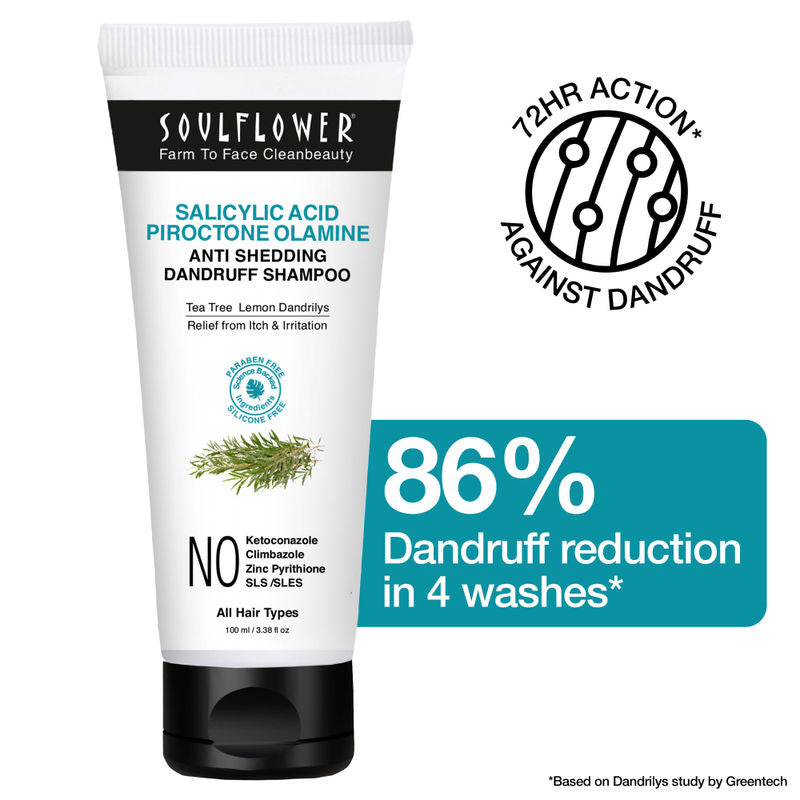
Soulflower Anti Dandruff Shampoo with Salicylic Acid for Dry and Frizzy Hair, Controls Irritation
Soulflower Anti-dandruff Shampoo is formulated to tackle flakes and keep them at bay. This shampoo is an anti-recurrent, fast-acting 4-in-1 formula for dandruff control, hair conditioning, hair loss control, and scalp conditioning. It’s a scalp rescue shampoo enriched with piroctone olamine, which is clinically proven to reduce dandruff and prevent itchy scalp.
Sulfate-free
Paraben-free
Natural
Scalp Issues
Dandruff
Itchy Scalp
Optimized for Your Environment & Lifestyle
Nykaa
In stock
Recommended

Soulflower Anti Dandruff Shampoo with Salicylic Acid for Dry and Frizzy Hair, Controls Irritation
Soulflower
soulflower-anti-dandruff-shampoo-with-salicylic-acid-for-dry-and-frizzy-hair-controls-irritation
Shampoo
10202964394277
Morning or Evening?
How often will you use this product?
Notes


Secure payment protection
Your Biodata Compatibility Analysis
Based on your 6 hair health indices and environmental factors
Poor Match
Significant incompatibilities
Growth Cycle Health Index
Hair Match
Hair Health Index Alignment
Optimal for OSI, SSI, DI, HSI
Ingredient Efficacy
Matching Ingredient Score
Environment Compatibility
Current UV, Air Quality & Humidity
Why This Works for Your Specific Profile
Damage Index:
Damage levels outside specified range may not benefit optimally from product formulation
Water Quality:
No water quality-specific conflicts
Hair:
No porosity-specific conflicts
Active Lifestyle:
Activity levels outside optimal range affect product performance and maintenance requirements
Your Hair Profile Integration
Your Hair Archetype

Density Level

Washing Frequency

Shedding Level

Oil Level
Your Hair Health Indices
Oil Secretion (OSI)
Very low oil production
Scalp Sensitivity (SSI)
Very low sensitivity
Growth Rate (CMR)
Poor metabolism rate
Damage Index (DI)
Minimal damage
Hair Strength (HSI)
Very weak strength
Softness Index (SI)
Significant improvement needed
Water & Environmental Integration

Water:


Expected Results & Timeline
Key Highlights

What is it?
Anti-dandruff shampoo with key active ingredient piroctone olamine and salicylic acid

Who Is It For
Adults

Budget
Rs. 249.45 - Rs. 498.90

Timeline
Visible effect from 8th day on daily use
Why You’ll Love It

What Does It Help With?
Dandruff, scalp irritation, itchy scalp, hair loss control

Best for
Scalp Issues

Features
Gentle yet effective shampoo for long-term dandruff control without irritation or dryness, Enriched with piroctone olamine for effective dandruff and itch prevention, 4-in-1 formula for dandruff control, scalp conditioning, hair conditioning, and hair loss control, Formulated with ECOCERT COSMOS-approved preservatives, Free from harsh chemicals like ZPTO, dimethicone, ketoconazole, and SLS/SLES, FDA approved, Vegan and cruelty-free

Checks
ECOCERT COSMOS-approved preservatives, FDA approved, Vegan, Cruelty-free
Ingredients Overview
Ingredients List
Aqua, Sodium-Lauroyl-Sarcosinate, Cocamidopropyl-Betaine, Vegetable-Glycerin, Cocamide-Mea, Glycol-Distearate, Cetrimonium-Chloride, Orange-Peel-Extract, Lemon-Oil, Piroctone-Olamine, Dandrilys, Salicylic-Acid, Polyquaternium-7, Tea-Tree-Oil, Ethylene-Glycol-Distearate, Ethylene-Glycol-Monostearate, Sodium-Benzoate, Potassium-Sorbate, Aqua, Propanediol-Dicaprylate, Polyquaternium-10, Guar-Hydroxypropyltrimonium-Chloride, Spearmint-Oil
Key Ingredients
Piroctone Olamine, Dandrilys, Tea Tree Oil, Salicylic Acid
Ingredients Details
Piroctone Olamine
Common Name(s): Octopirox,piroctone ethanolamine,om-90
CAS Number: 68890-66-4
DESCRIPTION
What It Does: Provides iron chelation anti-malassezia anti-dandruff with lower environmental impact than zpt.
Why It's Used: Environmentally-preferable anti-dandruff — piroctone olamine's lower aquatic toxicity vs zinc pyrithione provides comparable anti-dandruff efficacy with improved environmental profile for rinse-off scalp products.
How It Works: Hydroxamic acid chelates iron from malassezia — iron-depleted malassezia cannot produce the lipases initiating the dandruff cascade. also directly antimicrobial at higher concentrations. unique iron-starvation mechanism vs zpt membrane disruption or climbazole cyp51 inhibition.
Typically Found In: Anti-dandruff shampoos,scalp treatments (eu preferred)
TECHNICAL DETAILS
Primary Category: Active ingredient – cosmetic active
Secondary Functions: Skin conditioning
Application Areas:

Facial Skincare

Body Care
Hair Care
Beard Care
Color Cosmetics (Makeup)
Dietary/Oral Supplements
Typical Concentration Range: 0.5%–1%
SOURCING & ETHICS
Vegan Status: Conditional - supplier confirmation required
Halal Status: Unverified - supplier confirmation required
Source Notes: Commercially produced for cosmetic use. verify vegan/halal status with supplier. [audit 2026-07-29 rev2: the record's own source_notes does not assert a non-animal origin, or instructs the reader to verify with the supplier; "yes" asserts knowledge the record does not hold. determination requires shariah-panel sign-off.]
SKIN COMPATIBILITY
Irritancy Rating: 1/5 – very low
Comedogenicity Rating: 0/5 – non-comedogenic
Sensitivity Concerns: Well-tolerated by most skin types.
Safe for Sensitive Skin: Yes
SAFETY & COMPATIBILITY
Safety Profile: Eu cosmetic approved. not fda otc approved for dandruff claims in us.
Works Well With: Standard skincare actives
Avoid Combining With: No known significant incompatibilities
SCIENTIFIC NOTE
Piroctone olamine's unique iron-starvation antifungal mechanism (starving malassezia of essential iron) provides anti-dandruff from nutrient deprivation rather than direct cell killing — a fungistatic rather than fungicidal approach with different ecological implications for scalp microbiome impact vs bactericidal/fungicidal mechanisms.
Last Verified: 2026-03-12
Primary Sources: Cosing database,boyle et al. piroctone olamine anti-dandruff study
Polyquaternium-10
Common Name(s): Pq-10,hydroxyethylcellulose ethyl trimethylammonium chloride,jr-400
CAS Number: 54351-50-7
DESCRIPTION
What It Does: Provides film-forming conditioning and detangling with heat protection in a polymer that adsorbs substantively to hair.
Why It's Used: The most widely used cationic polymer conditioner – provides excellent conditioning and detangling while adsorbing strongly to damaged hair areas that need conditioning most.
How It Works: Cationic quaternary ammonium groups along the polymer backbone adsorb to anionic sites on hair keratin. higher charge density on damaged hair (more negative sites) leads to preferential adsorption where conditioning is needed. polymer film formation provides heat protection and volume.
Typically Found In: Shampoos,2-in-1 products,conditioners,styling products
TECHNICAL DETAILS
Primary Category: Functional ingredient – cationic polymer conditioner
Secondary Functions: Skin conditioning
Application Areas:
Facial Skincare
Body Care
Hair Care
Beard Care
Color Cosmetics (Makeup)
Dietary/Oral Supplements
Typical Concentration Range: 0.1%–2%
SOURCING & ETHICS
Vegan Status: Conditional - supplier confirmation required
Halal Status: Unverified - supplier confirmation required
Source Notes: Commercially produced for cosmetic use. verify vegan/halal status with supplier. [audit 2026-07-29 rev2: the record's own source_notes does not assert a non-animal origin, or instructs the reader to verify with the supplier; "yes" asserts knowledge the record does not hold. determination requires shariah-panel sign-off.]
SKIN COMPATIBILITY
Irritancy Rating: 1/5 – very low
Comedogenicity Rating: 0/5 – non-comedogenic
Sensitivity Concerns: Well-tolerated by most skin types.
Safe for Sensitive Skin: Yes
SAFETY & COMPATIBILITY
Safety Profile: Good safety profile at recommended concentrations. ewg score: 1–2.
Works Well With: Standard skincare actives
Avoid Combining With: No known significant incompatibilities
SCIENTIFIC NOTE
Polyquaternium-10's 'self-targeting' to damaged hair sites is a unique smart conditioning mechanism. as hair damage increases negative charge density by exposing keratin's aspartate and glutamate carboxylate groups, pq-10's cationic polymer backbone adsorbs preferentially to these high-charge damage sites – automatically delivering more conditioning where the hair needs it most.
Last Verified: 2026-03-12
Primary Sources: Cosing database,robbins hair science,cir safety assessment
Polyquaternium-7
Common Name(s): Polyquaternium-7,cationic conditioning polymer,substantive film-former
CAS Number: N/a
DESCRIPTION
What It Does: Deposits a conditioning film on hair and skin through electrostatic attraction to negative cuticle/corneocyte surfaces, reduces hair-on-hair friction for improved combability and detangling, eliminates static charge buildup, and provides anti-frizz humidity resistance.
Why It's Used: Cationic polymers are the primary hair conditioning technology — the permanent positive quaternary ammonium groups provide substantive deposition that resists rinsing, delivering persistent conditioning between washes unlike small-molecule cationic conditioners.
How It Works: At shampoo/conditioner ph 4.5–5.5, hair cuticle carries net negative charge (isoelectric point ph ~3.5). polyquaternium cations undergo electrostatic attraction depositing on the cuticle surface. during rinsing, the deposited polymer film persists from reduced surface-solution equilibrium at low bulk concentration — substantive deposition from favourable interfacial versus bulk partitioning.
Typically Found In: Shampoos,conditioners,leave-in products
TECHNICAL DETAILS
Primary Category: Active ingredient – cosmetic active
Secondary Functions: Skin conditioning
Application Areas:
Facial Skincare
Body Care
Hair Care
Beard Care
Color Cosmetics (Makeup)
Dietary/Oral Supplements
Typical Concentration Range: 0.1%–3%
SOURCING & ETHICS
Vegan Status: Conditional - supplier confirmation required
Halal Status: Unverified - supplier confirmation required
Source Notes: Commercially produced for cosmetic use. verify vegan/halal status with supplier. [audit 2026-07-29 rev2: the record's own source_notes does not assert a non-animal origin, or instructs the reader to verify with the supplier; "yes" asserts knowledge the record does not hold. determination requires shariah-panel sign-off.]
SKIN COMPATIBILITY
Irritancy Rating: 1/5 – very low
Comedogenicity Rating: 0/5 – non-comedogenic
Sensitivity Concerns: Well-tolerated by most skin types.
Safe for Sensitive Skin: Yes
SAFETY & COMPATIBILITY
Safety Profile: Good safety profile at recommended concentrations. ewg score: 1–2.
Works Well With: Standard skincare actives
Avoid Combining With: No known significant incompatibilities
SCIENTIFIC NOTE
Different polyquaternium numbers indicate different backbone chemistries: pq-7 (acrylamide/quaternary acrylate copolymer) for leave-on flexibility; pq-10 (hydroxyethylcellulose/quaternary ammonium) for substantive deposition; pq-11 (vp/dimethylaminoethyl methacrylate) for styling fixation.
Last Verified: 2026-03-12
Primary Sources: Cosing database,polyquaternium-7 cationic conditioning deposition review
Salicylic Acid
Common Name(s): Bha,2-hydroxybenzoic acid,orthohydroxybenzoic acid,willow bark acid
CAS Number: 69-72-7
DESCRIPTION
What It Does: Salicylic acid exfoliates the skin surface and inside pores, dissolves the 'glue' holding dead skin cells together, reduces sebum production, and combats acne-causing bacteria.
Why It's Used: Its oil solubility makes it uniquely effective at penetrating pores and dissolving sebum plugs – a function that water-soluble ahas cannot perform. it is the preferred exfoliant for oily, acne-prone, and congested skin.
How It Works: Salicylic acid disrupts desmosomal bonds between corneocytes, promoting exfoliation. its oil solubility allows it to penetrate the sebaceous follicle, dissolving sebum and dead cells. it also has anti-inflammatory properties by inhibiting prostaglandin synthesis.
Typically Found In: Cleansers,toners,serums,spot treatments,masks,chemical peels,anti-dandruff shampoos,acne treatments
TECHNICAL DETAILS
Primary Category: Active ingredient – beta hydroxy acid (bha)
Secondary Functions: Anti-acne,anti-dandruff,keratolytic
Application Areas:
Facial Skincare
Body Care
Hair Care
Beard Care
Color Cosmetics (Makeup)
Dietary/Oral Supplements
Typical Concentration Range: 0.5%–2% (otc acne treatment in us); up to 30% in professional chemical peels
SOURCING & ETHICS
Vegan Status: Yes – synthetic or willow bark derived
Halal Status: Yes
Source Notes: Naturally occurring in willow bark (salix alba) and wintergreen oil. commercially produced synthetically via kolbe-schmitt reaction for cosmetic use.
SKIN COMPATIBILITY
Irritancy Rating: 3/5 – moderate; can cause dryness, peeling, and irritation, especially at higher concentrations
Comedogenicity Rating: 0/5 – non-comedogenic; actually anti-comedogenic
Sensitivity Concerns: Can cause irritation, dryness, and sun sensitivity. avoid contact with eyes. not recommended during pregnancy at high concentrations. can be drying – follow with moisturizer.
Safe for Sensitive Skin: Use with caution – start with lower concentrations and frequency; may not be suitable for reactive or rosacea-prone skin
SAFETY & COMPATIBILITY
Safety Profile: Safe at otc concentrations (0.5–2%). regulated as a drug in some countries (us: fda category i acne treatment). avoid in pregnancy at high concentrations.
Works Well With: Niacinamide,zinc,tea tree oil,benzoyl peroxide (at different times),hyaluronic acid (to counteract dryness)
Avoid Combining With: High concentrations of retinol (cumulative irritation),multiple exfoliating acids simultaneously,benzoyl peroxide in same step (can increase irritation)
SCIENTIFIC NOTE
Salicylic acid is a member of the salicylate family and shares structural similarity with aspirin. its anti-inflammatory mechanism mirrors aspirin's cox inhibition pathway, making it uniquely effective for inflammatory acne.
Last Verified: 2026-03-12
Primary Sources: Cosing database,cir safety assessment,us fda acne monograph,journal of the american academy of dermatology
Personalized Usage Instructions
How to Use
Step 1
Apply shampoo on wet hair and scalp
Step 2
Lather until a rich foam is formed
Step 3
Rinse with water and follow up with SLS/SLES-free conditioner
Medical Chemicals

Protein/Moisture
- Moisture
pH Level
- Acidic

Porosity Taget
- Normal Porosity
Customized for Your Profile
Scalp Condtions
Anti-Dandruff, Sensitive Scalp, pH Balanced, Oil Control, Dry Scalp
Climate Suitability
Humid, Dry, Soft Water
Clinical Claims
Clinically proven antifungal efficacy, effective dandruff and itch prevention
Frequency
Apply shampoo on wet hair and scalp. Lather until a rich foam is formed. Rinse with water and follow up with SLS/SLES-free conditioner.
Product Information

ECOCERT COSMOS-approved preservatives
FDA approved
Vegan
Cruelty-free