

dermalogica
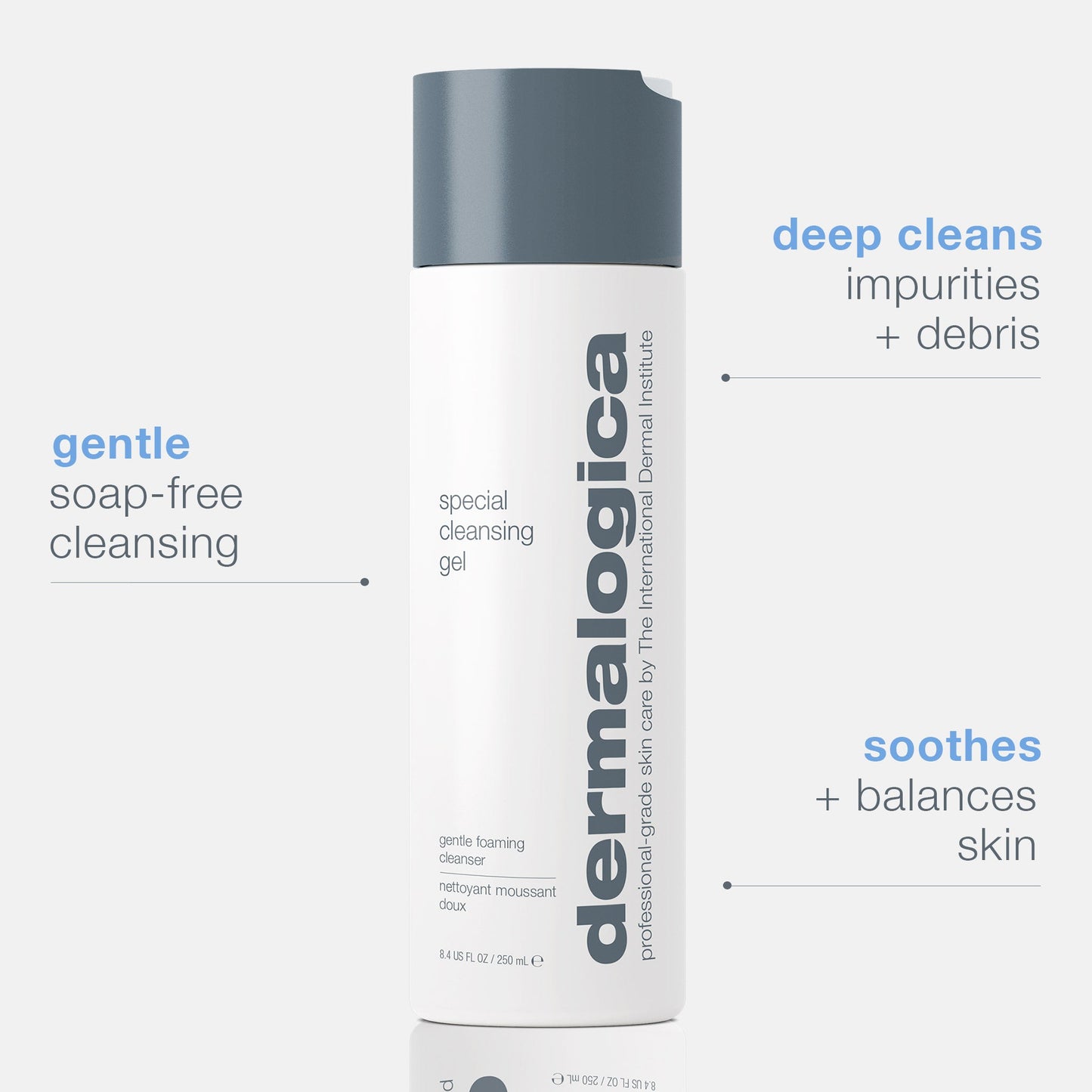
Special Cleansing Gel

Special Cleansing Gel
dermalogica
special-cleansing-gel
Cleanse
9784808112421
Morning or Evening?
How often will you use this product?
Notes


Highlights
WHAT IS IT?
Soap-free foaming gel cleanser
FEATURES
Removes impurities, maintains natural moisture balance, contains natural foaming agents, soothes skin
BEST FOR
combination
CHECKS
Soap-free
Who Is It For?
All Ages All GendersWhat Does It Help With?
Dullness Oiliness Pores Skin CleansingBudget
Mid-range ($30-$75)How To Use
Which routine should it be used in?
Instructions:
Key Information


What dermalogica Says
Product Description:
Soap-free, foaming gel cleanser that thoroughly removes impurities without disturbing skin's natural moisture balance. Contains naturally-foaming Quillaja Saponaria, calming Balm Mint and Lavender extracts, and Citric Acid for pore cleansing and tone evening.
About the Brand:
Ingredients Overview
Ingredients List
Water/Aqua/Eau, Sodium C14-16 Olefin Sulfonate, Sodium Lauroyl Sarcosinate, Butylene Glycol, Hydroxyethylcellulose, Lavandula Angustifolia (Lavender) Oil, Quillaja Saponaria Bark Extract, Citrus Limon (Lemon) Peel Oil, Melissa Officinalis Leaf Extract, Citrus Aurantium Bergamia (Bergamot) Fruit Oil, Cymbopogon Nardus (Citronella) Oil, Glycerin, Cocamidopropyl Betaine, Sodium Cocoamphoacetate, Hydroxyacetophenone, Cocamidopropyl Hydroxysultaine, 1,2-Hexanediol, Caprylyl Glycol, Propanediol, Citric Acid, O-Cymen5-Ol, Disodium EDTA, PPG-5-Ceteth-20, Sodium Hydroxide, Sodium Benzoate
Key Ingredients
Quillaja Saponaria, Balm Mint, Lavender Extract, Citric Acid
Ingredients Details
Butylene Glycol
Common Name(s): 1,3-butanediol,bg,1,3-butylene glycol
CAS Number: 107-88-0
DESCRIPTION
What It Does: Provides humectant hydration and active ingredient solubilization with excellent skin feel.
Why It's Used: Preferred glycol humectant in premium and k-beauty formulations for superior skin feel vs propylene glycol with equivalent functionality.
How It Works: Two hydroxyl groups at 1,3-positions provide water binding and solvent activity. better tolerated than propylene glycol with minimal sensitization risk. 4-carbon backbone provides slightly greater hydrophobic character enabling dissolution of less polar actives vs pg.
Typically Found In: Toners,essences,serums,k-beauty formulas
TECHNICAL DETAILS
Primary Category: Functional ingredient – glycol humectant
Secondary Functions: Tewl reduction,skin plumping
Application Areas:

Facial Skincare
Body Care
Hair Care

Beard Care
Color Cosmetics (Makeup)
Dietary/Oral Supplements
Typical Concentration Range: 1%–10%
SOURCING & ETHICS
Vegan Status: Yes – synthetic
Halal Status: Yes
Source Notes: Synthetic or naturally derived. excellent aqueous solubility.
SKIN COMPATIBILITY
Irritancy Rating: 1/5 – very low
Comedogenicity Rating: 0/5 – non-comedogenic
Sensitivity Concerns: Non-irritating; suitable for all skin types.
Safe for Sensitive Skin: Yes
SAFETY & COMPATIBILITY
Safety Profile: Excellent safety profile. ewg score: 1.
Works Well With: Ceramides,emollients,occlusives,glycerin,hyaluronic acid
Avoid Combining With: No significant incompatibilities
SCIENTIFIC NOTE
K-beauty's preference for butylene glycol over propylene glycol is driven by two factors: bg's superior skin feel (less tacky than pg's higher viscosity) and its lower sensitization potential (1,3-bg has better spatial distribution of hydroxyl groups that reduces protein interaction vs pg's 1,2-position oh groups).
Last Verified: 2026-03-12
Primary Sources: Cosing database,cir safety assessment
Citrus Limon Lemon Peel Oil
Common Name(s): Citrus limon lemon peel oil oil
DESCRIPTION
What It Does: Nourishes and softens skin through its balanced fatty acid profile, while antioxidant compounds protect against oxidative skin damage.
Why It's Used: Plant oils provide physiologically compatible lipid structures that integrate into the skin barrier and deliver fat-soluble antioxidants directly to skin cells.
How It Works: Fatty acids integrate into stratum corneum lipid lamellae, reinforcing the lipid barrier. antioxidants (tocopherols, carotenoids, polyphenols) neutralize ros through electron donation or singlet oxygen quenching.
Typically Found In: Face oils,serums,moisturizers,hair treatments,body oils
TECHNICAL DETAILS
Primary Category: Plant oils
Secondary Functions: Emollient,antioxidant
Application Areas:
Facial Skincare
Body Care
Hair Care
Beard Care
Color Cosmetics (Makeup)
Dietary/Oral Supplements
Typical Concentration Range: 0.5–30%
SOURCING & ETHICS
Vegan Status: Yes
Halal Status: Yes
Source Notes: Cold-pressed or solvent-extracted plant oil; no animal components.
SKIN COMPATIBILITY
Irritancy Rating: 1899-12-31 00:00:00 -0800
Comedogenicity Rating: 2000-01-01 00:00:00 -0800
Sensitivity Concerns: Low sensitization potential at recommended use concentrations.
Safe for Sensitive Skin: Yes
SAFETY & COMPATIBILITY
Safety Profile: Well-characterized cosmetic ingredient with established safety profile. generally non-irritating at typical use concentrations. suitable for leave-on and rinse-off cosmetics.
Works Well With: Vitamin e,ceramides,other plant oils,squalane
Avoid Combining With: Strong oxidizers (accelerate rancidity)
SCIENTIFIC NOTE
Vegetable oils are triglyceride matrices where the fatty acid composition determines skin compatibility, barrier function, and comedogenicity. oleic acid-rich oils (>60%) soften barrier lipids and enhance penetration; linoleic acid-rich oils reinforce ceramide-poor stratum corneum; saturated fatty acid-rich oils provide occlusion without skin penetration.
Last Verified: 2025-01-15
Primary Sources: Cosing eu database; pcpc cosmetic ingredient safety reviews; aocs plant oil composition databases; fatty acid pharmacology reviews
Hydroxyethylcellulose
Common Name(s): Hec,natrosol,ethylhydroxyethylcellulose
CAS Number: 9004-62-0
DESCRIPTION
What It Does: Provides non-ionic thickening compatible with anionic surfactants and electrolyte-containing formulations.
Why It's Used: Non-ionic cellulose thickener for surfactant systems where anionic/cationic thickener incompatibility is a concern.
How It Works: Hydroxyethyl substitution disrupts cellulose crystallinity enabling water solubility. non-ionic nature provides compatibility with anionic, cationic, and amphoteric surfactants. pseudoplastic rheology provides shear-thinning for dispensing. film formation from cellulose backbone.
Typically Found In: Shampoos,body washes,clear gels,surfactant systems
TECHNICAL DETAILS
Primary Category: Functional ingredient – cellulose thickener
Secondary Functions: Tewl reduction,skin plumping
Application Areas:
Facial Skincare
Body Care
Hair Care
Beard Care
Color Cosmetics (Makeup)
Dietary/Oral Supplements
Typical Concentration Range: 0.1%–3%
SOURCING & ETHICS
Vegan Status: Conditional - supplier confirmation required
Halal Status: Unverified - supplier confirmation required
Source Notes: Synthetic or naturally derived. excellent aqueous solubility. [audit 2026-07-29 rev2: status downgraded on audit. determination requires shariah-panel sign-off.]
SKIN COMPATIBILITY
Irritancy Rating: 1/5 – very low
Comedogenicity Rating: 0/5 – non-comedogenic
Sensitivity Concerns: Non-irritating; suitable for all skin types.
Safe for Sensitive Skin: Yes
SAFETY & COMPATIBILITY
Safety Profile: Excellent safety profile. ewg score: 1.
Works Well With: Ceramides,emollients,occlusives,glycerin,hyaluronic acid
Avoid Combining With: No significant incompatibilities
SCIENTIFIC NOTE
Hydroxyethylcellulose's non-ionic character is its primary differentiator from anionic carboxymethylcellulose – the absence of ionizable groups means hec maintains stable viscosity across ph 2-12 and at high electrolyte concentrations where carboxymethylcellulose destabilizes. this ionic independence makes hec the preferred cellulose thickener for acidic and salt-containing formulations.
Last Verified: 2026-03-12
Primary Sources: Cosing database,ashland hec technical data,cir safety assessment
Lavandula Angustifolia Lavender Oil
Common Name(s): Lavandula angustifolia lavender oil oil
DESCRIPTION
What It Does: Nourishes and softens skin through its balanced fatty acid profile, while antioxidant compounds protect against oxidative skin damage.
Why It's Used: Plant oils provide physiologically compatible lipid structures that integrate into the skin barrier and deliver fat-soluble antioxidants directly to skin cells.
How It Works: Fatty acids integrate into stratum corneum lipid lamellae, reinforcing the lipid barrier. antioxidants (tocopherols, carotenoids, polyphenols) neutralize ros through electron donation or singlet oxygen quenching.
Typically Found In: Face oils,serums,moisturizers,hair treatments,body oils
TECHNICAL DETAILS
Primary Category: Plant oils
Secondary Functions: Emollient,antioxidant
Application Areas:
Facial Skincare
Body Care
Hair Care
Beard Care
Color Cosmetics (Makeup)
Dietary/Oral Supplements
Typical Concentration Range: 0.5–30%
SOURCING & ETHICS
Vegan Status: Yes
Halal Status: Yes
Source Notes: Cold-pressed or solvent-extracted plant oil; no animal components.
SKIN COMPATIBILITY
Irritancy Rating: 1899-12-31 00:00:00 -0800
Comedogenicity Rating: 2000-01-01 00:00:00 -0800
Sensitivity Concerns: Low sensitization potential at recommended use concentrations.
Safe for Sensitive Skin: Yes
SAFETY & COMPATIBILITY
Safety Profile: Well-characterized cosmetic ingredient with established safety profile. generally non-irritating at typical use concentrations. suitable for leave-on and rinse-off cosmetics.
Works Well With: Vitamin e,ceramides,other plant oils,squalane
Avoid Combining With: Strong oxidizers (accelerate rancidity)
SCIENTIFIC NOTE
Vegetable oils are triglyceride matrices where the fatty acid composition determines skin compatibility, barrier function, and comedogenicity. oleic acid-rich oils (>60%) soften barrier lipids and enhance penetration; linoleic acid-rich oils reinforce ceramide-poor stratum corneum; saturated fatty acid-rich oils provide occlusion without skin penetration.
Last Verified: 2025-01-15
Primary Sources: Cosing eu database; pcpc cosmetic ingredient safety reviews; aocs plant oil composition databases; fatty acid pharmacology reviews