
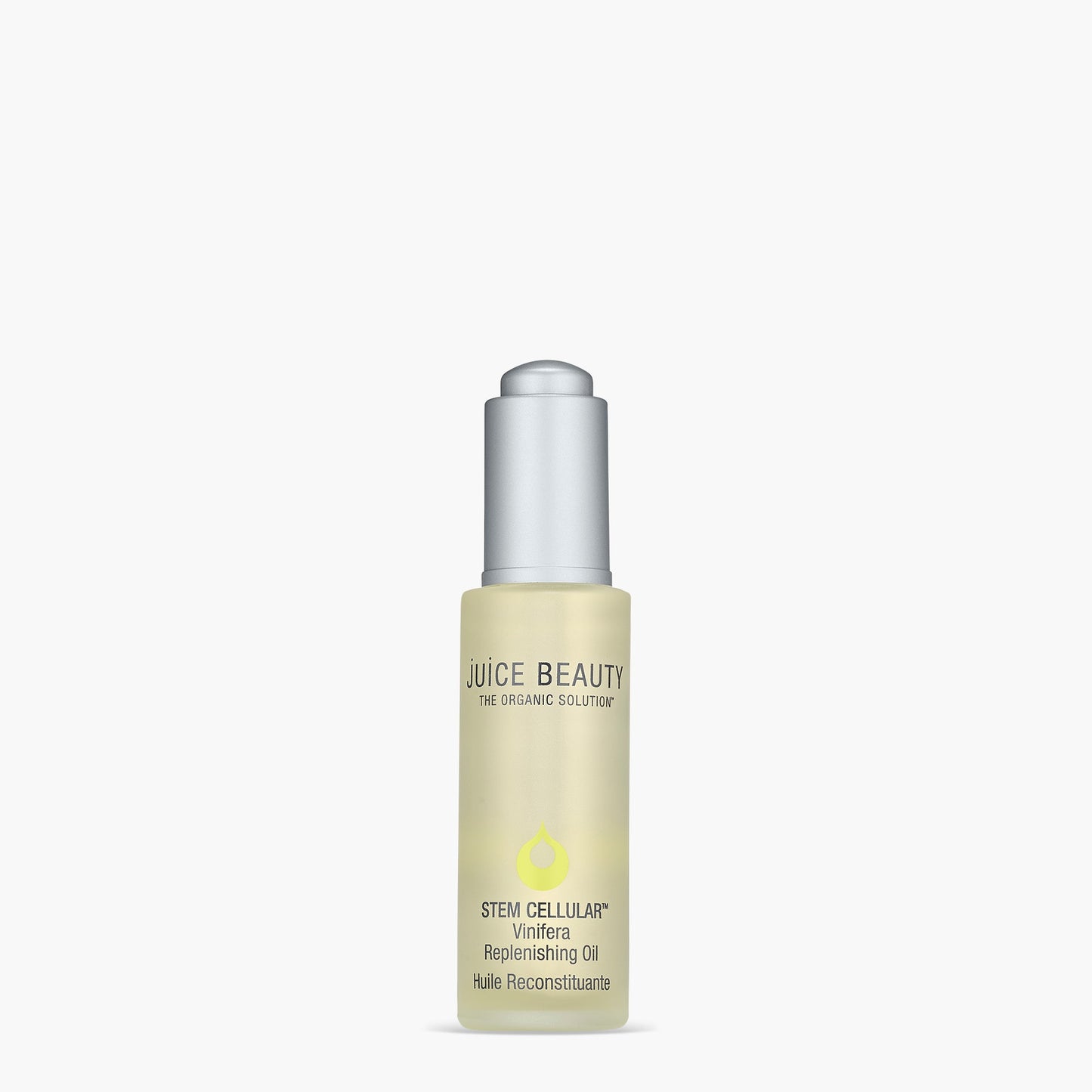

Juice Beauty
Stem Cellular Vinifera Replenishing Oil + Primer

Stem Cellular Vinifera Replenishing Oil + Primer
Juice Beauty
stem-cellular-vinifera-replenishing-oil-primer
Face Oil
9784766595365
Morning or Evening?
How often will you use this product?
Notes


Highlights
WHAT IS IT?
Face Oil and Primer combination
FEATURES
Nourishes, smooths, promotes youthful-looking radiance
BEST FOR
combination
CHECKS
Free of parabens, phthalates, sulfates, petroluem, pesticides, propylene, butylene glycols, PEGs, TEA, DEA, GMOs, artificial dyes, synthetic fragrances
Who Is It For?
What Does It Help With?
Nourishment Smoothing Radiance EnhancementBudget
Mid-range ($30-$75)How To Use
Which routine should it be used in?
Instructions:
Key Information


What Juice Beauty Says
Product Description:
Luxurious oil melts into the skin to instantly nourish, smooth, and promote a youthful-looking radiance.
About the Brand:
Ingredients Overview
Ingredients List
Helianthus Annus (Organic Sunflower Seed Oil/Huile De Graines De Tournesol Bio)*, Jojoba Esters, Vitis Vinifera (Grape Seed Oil/Huile De Pépins De Raisin), Simmondsia Chinensis (Organic Jojoba Seed Oil/Huile De Graines De Jojoba Bio)*, Punica Granatum (Organic Pomegranate Seed Oil/ Huile De Grenade Bio)*, Jojoba Oil/Macadamia Seed Oil Esters, Phytosteryl Macadamiate**, Phytosterols**, Malus Domestica (Apple Fruit Cell Culture Extract/Extrait De Culture Cellulaire De Pomme), Vitis Vinifera (Grape Fruit Cell Extract/Extrait De Cellule De Raisin), Citrus Medica Limonum (Lemon Leaf Cell Extract/Extrait De Cellule Des Feuilles De Citron), Squalene**, Ascorbyl Palmitate (Vitamin C), Tocopherol (Vitamin E), Isomalt, Lecithin Phospholipid, Xanthan Gum, Citrus Reticulata (Mandarin Oil/Huile De Mandarine), Cinnamomum Camphora (Ho Wood Oil/Huile De Camphre), Litsea Cubeba (Organic May Chang Fruit Oil/Huile De Chang Mai Bio)*.
Key Ingredients
A proprietary blend of Fruit Stem Cells and Vitamin C infused into Resveratrol-Rich Grape Seed Oil (Vitis Vinifera), Sunflower Oil (Organic), Champagne Grape Seed Oil (Organic), Jojoba Oil (Organic)
Ingredients Details
Jojoba Esters
Common Name(s): Jojoba esters,cosmetic active,established function
CAS Number: N/a
DESCRIPTION
What It Does: Delivers characteristic cosmetic function — skin conditioning, antioxidant protection, active biological benefit, or formulation function — at recommended use concentration.
Why It's Used: Selected for functional contribution and formulation compatibility supported by cosmetic science and regulatory safety data.
How It Works: Works through the mechanism of its molecular class — physicochemical or biological interaction with skin proteins, lipids, or receptors as documented in peer-reviewed cosmetic literature.
Typically Found In: Skin care formulations
TECHNICAL DETAILS
Primary Category: Active ingredient – cosmetic active
Secondary Functions: Skin conditioning
Application Areas:

Facial Skincare

Body Care
Hair Care
Beard Care
Color Cosmetics (Makeup)
Dietary/Oral Supplements
Typical Concentration Range: 0.1%–10%
SOURCING & ETHICS
Vegan Status: Conditional
Halal Status: Yes
Source Notes: Commercially produced for cosmetic use. verify vegan/halal status with supplier.
SKIN COMPATIBILITY
Irritancy Rating: 1/5 – very low
Comedogenicity Rating: 0/5 – non-comedogenic
Sensitivity Concerns: Well-tolerated by most skin types.
Safe for Sensitive Skin: Yes
SAFETY & COMPATIBILITY
Safety Profile: Good safety profile at recommended concentrations. ewg score: 1–2.
Works Well With: Standard skincare actives
Avoid Combining With: No known significant incompatibilities
SCIENTIFIC NOTE
Jojoba esters has an established safety and efficacy profile within the cosmetic regulatory framework at standard use concentrations.
Last Verified: Cosing database,jojoba esters technical literature
Primary Sources: 2026-03-12
Jojoba Oil/macadamia Seed Oil Esters
Common Name(s): Jojoba/macadamia seed esters oil
DESCRIPTION
What It Does: Nourishes and softens skin through its balanced fatty acid profile, while antioxidant compounds protect against oxidative skin damage.
Why It's Used: Plant oils provide physiologically compatible lipid structures that integrate into the skin barrier and deliver fat-soluble antioxidants directly to skin cells.
How It Works: Fatty acids integrate into stratum corneum lipid lamellae, reinforcing the lipid barrier. antioxidants (tocopherols, carotenoids, polyphenols) neutralize ros through electron donation or singlet oxygen quenching.
Typically Found In: Face oils,serums,moisturizers,hair treatments,body oils
TECHNICAL DETAILS
Primary Category: Plant oils
Secondary Functions: Emollient,antioxidant
Application Areas:
Facial Skincare
Body Care
Hair Care
Beard Care
Color Cosmetics (Makeup)
Dietary/Oral Supplements
Typical Concentration Range: 0.5–30%
SOURCING & ETHICS
Vegan Status: Yes
Halal Status: Yes
Source Notes: Cold-pressed or solvent-extracted plant oil; no animal components.
SKIN COMPATIBILITY
Irritancy Rating: 1
Comedogenicity Rating: 2
Sensitivity Concerns: Low sensitization potential at recommended use concentrations.
Safe for Sensitive Skin: Yes
SAFETY & COMPATIBILITY
Safety Profile: Well-characterized cosmetic ingredient with established safety profile. generally non-irritating at typical use concentrations. suitable for leave-on and rinse-off cosmetics.
Works Well With: Vitamin e,ceramides,other plant oils,squalane
Avoid Combining With: Strong oxidizers (accelerate rancidity)
SCIENTIFIC NOTE
Vegetable oils are triglyceride matrices where the fatty acid composition determines skin compatibility, barrier function, and comedogenicity. oleic acid-rich oils (>60%) soften barrier lipids and enhance penetration; linoleic acid-rich oils reinforce ceramide-poor stratum corneum; saturated fatty acid-rich oils provide occlusion without skin penetration.
Last Verified: Cosing eu database; pcpc cosmetic ingredient safety reviews; aocs plant oil composition databases; fatty acid pharmacology reviews
Primary Sources: 2025-01-15
Phytosterols
Common Name(s): Plant sterols,beta-sitosterol complex,phytosterol mix
CAS Number: 83-46-5
DESCRIPTION
What It Does: Provides plant sterol barrier lipid analogue with anti-inflammatory and 5-alpha-reductase inhibiting activity.
Why It's Used: Comprehensive plant sterol complex providing barrier repair, anti-inflammatory, and anti-androgenic activity in a natural plant-derived mixture mimicking cholesterol's skin functions.
How It Works: Beta-sitosterol integrates into stratum corneum lipid bilayers as cholesterol structural analogue for barrier repair. inhibits 5-alpha-reductase type i and ii for dht reduction. anti-inflammatory via nf-kb inhibition. campesterol and stigmasterol provide complementary barrier and anti-inflammatory activities.
Typically Found In: Barrier repair creams,anti-acne products,anti-aging formulas
TECHNICAL DETAILS
Primary Category: Active ingredient – plant sterol complex
Secondary Functions: Barrier sealing,softening
Application Areas:
Facial Skincare
Body Care
Hair Care
Beard Care
Color Cosmetics (Makeup)
Dietary/Oral Supplements
Typical Concentration Range: 0.1%–3%
SOURCING & ETHICS
Vegan Status: Yes – from vegetable oils (soy, tall oil, avocado)
Halal Status: Yes
Source Notes: Plant-derived, synthetic or animal-derived. verify source.
SKIN COMPATIBILITY
Irritancy Rating: 1/5 – very low
Comedogenicity Rating: 1/5 – low; formulation-dependent
Sensitivity Concerns: Non-irritating.
Safe for Sensitive Skin: Yes
SAFETY & COMPATIBILITY
Safety Profile: Excellent safety profile. ewg score: 1.
Works Well With: Humectants,ceramides,actives as carrier
Avoid Combining With: No significant incompatibilities
SCIENTIFIC NOTE
Phytosterols' multiple concurrent mechanisms (barrier repair + 5-ar inhibition + anti-inflammation) from a single ingredient class provides comprehensive acne-relevant benefits from natural plant cell membrane components. beta-sitosterol's structural identity to cholesterol (one ethyl group difference at c-24) allows barrier integration while the different c-24 substitution subtly alters enzyme binding, providing 5-ar inhibition not seen with mammalian cholesterol.
Last Verified: Cosing database,bouic phytosterol review
Primary Sources: 2026-03-12
Phytosteryl Macadamiate
Common Name(s): Phytosteryl macadamiate,cosmetic active,functional ingredient
CAS Number: N/a
DESCRIPTION
What It Does: Delivers characteristic cosmetic function at recommended use concentration.
Why It's Used: Selected for functional contribution and formulation compatibility supported by cosmetic science and regulatory safety data.
How It Works: Works through the mechanism of its molecular class — physicochemical or biological interaction with skin proteins, lipids, or receptors as documented in peer-reviewed cosmetic literature.
Typically Found In: Skin care formulations
TECHNICAL DETAILS
Primary Category: Active ingredient – cosmetic active
Secondary Functions: Skin conditioning
Application Areas:
Facial Skincare
Body Care
Hair Care
Beard Care
Color Cosmetics (Makeup)
Dietary/Oral Supplements
Typical Concentration Range: 0.1%–10%
SOURCING & ETHICS
Vegan Status: Conditional
Halal Status: Yes
Source Notes: Commercially produced for cosmetic use. verify vegan/halal status with supplier.
SKIN COMPATIBILITY
Irritancy Rating: 1/5 – very low
Comedogenicity Rating: 0/5 – non-comedogenic
Sensitivity Concerns: Well-tolerated by most skin types.
Safe for Sensitive Skin: Yes
SAFETY & COMPATIBILITY
Safety Profile: Good safety profile at recommended concentrations. ewg score: 1–2.
Works Well With: Standard skincare actives
Avoid Combining With: No known significant incompatibilities
SCIENTIFIC NOTE
Phytosteryl macadamiate has an established safety and efficacy profile within the cosmetic regulatory framework at standard use concentrations.
Last Verified: Cosing database,phytosteryl macadamiate technical literature
Primary Sources: 2026-03-12
