

Eminence Organic Skin Care
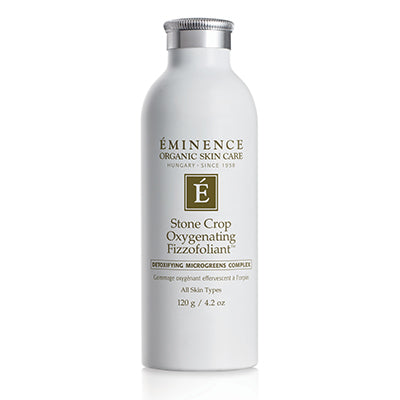
Stone Crop Oxygenating Fizzofoliant

Stone Crop Oxygenating Fizzofoliant
Eminence Organic Skin Care
stone-crop-oxygenating-fizzofoliant
Exfoliation
9628202107173
Morning or Evening?
How often will you use this product?
Notes


Highlights
WHAT IS IT?
Powder-to-foam exfoliant
FEATURES
Light fizzing action, gently invigorates skin, removes impurities
BEST FOR
All skin types
CHECKS
Does not contain nuts, gluten
Who Is It For?
Adults Both Women And MenWhat Does It Help With?
Brightens And Revitalizes Skin Appearance Reduces Redness Due To DrynessBudget
Mid-rangeHow To Use
Which routine should it be used in?
Instructions:
Key Information


What Eminence Organic Skin Care Says
Product Description:
This powder-to-foam exfoliant employs microgreens, stone crop and rice flour with adzuki flour to infuse skin with a youthful looking glow. With its light fizzing action, this revitalizing formula gently invigorates the skin and removes impurities to reveal a beautiful, brighter looking complexion.
About the Brand:
Ingredients Overview
Ingredients List
Oryza Sativa (Rice) Starch, Sodium Bicarbonate, Citric Acid, Phaseolus Angularis (Adzuki) Seed Powder, Sodium Cocoyl Isethionate, Spinacia Oleracea (Spinach) Leaf Powder, Helianthus Annuus (Sunflower) Seed Oil, Chickpea Flour, Calcium Sulfate, Diatomaceous Earth, Malic Acid, Peat Water (Heilmoor Water), Ascorbic Acid (Vitamin C), Sempervivum Tectorum (Stone Crop), Tocopheryl Acetate (Vitamin E), Carica Papaya (Papaya) Fruit, Brassica Oleracea Italica (Broccoli) Sprout Extract, Raphanus Sativus (Radish) Seed Extract, Trifolium Pratense (Clover) Extract, Curcuma Longa (Turmeric) Root Powder, Schisandra Chinensis (Five Flavor Berry) Fruit Powder, Silybum Marianum (Milk Thistle) Seed, Lepidium Sativum (Swiss Cress) Sprout Extract, Lecithin, Vegetable Glycerin, Aloe Barbadensis (Aloe) Leaf Juice, Vegetable Glycerin, AQUA, Natural Fragrance, Biocomplex2™ [Euterpe Oleracea (Acai) Fruit, Citrus Limon (Lemon) Juice, Malpighia Glabra (Barbados Cherry) Fruit, Emblica Officinalis (Indian Gooseberry) Fruit Powder, Adansonia Digitata (Baobab) Fruit, Myrciaria Dubia (Camu Camu) Fruit, Daucus Carota Sativa (Carrot) Root Powder, Cocos Nucifera (Coconut) Water, Lycium Barbarum (Goji) Fruit, Helianthus Annuus (Sunflower) Seed Oil, Plant-Derived Maltodextrin, Thioctic Acid (Alpha Lipoic Acid) and Ubiquinone (Coenzyme Q10)
Key Ingredients
Stone Crop, Detoxifying Microgreens Complex (Broccoli, Radish and Clover, and Detoxophane from Swiss cress sprouts), Rice, Adzuki Flour
Ingredients Details
Calcium Sulfate
Common Name(s): Calcium sulfate,calcium mineral,abrasive filler oral care mineral
CAS Number: N/a
DESCRIPTION
What It Does: Calcium sulfate provides mild mechanical abrasion for plaque and surface stain removal in dental formulations, releases calcium and phosphate ions into saliva for enamel remineralisation support, builds opacity in cosmetic formulations as an inorganic white filler, and provides a safe inorganic framework for controlled release applications.
Why It's Used: Formulators choose calcium sulfate in dental pastes and oral care formulations for its direct mineral compatibility with tooth enamel — the calcium and phosphate ions it releases are the exact building blocks of hydroxyapatite enamel [ca₁₀(po₄)₆(oh)₂]. this ionic compatibility means the mineral provides both abrasive cleaning function and remineralisation ion supplementation from the same ingredient. in skin care, calcium-based minerals provide opacity, skin conditioning through ca²⁺ ion release, and enzyme cofactor support for skin barrier maintenance enzymes including transglutaminase (which crosslinks cornified envelope proteins) that require ca²⁺ for activity.
How It Works: Calcium sulfate works through its calcium and phosphate ion dissociation chemistry: calcium phosphate minerals have limited but non-zero water solubility — the specific solubility product (ksp) determines the equilibrium ion concentration. at the tooth surface, ca²⁺ and po₄³⁻ ions released from calcium sulfate increase the ion activity product in the salivary diffusion layer, creating supersaturation relative to enamel crystal solubility. when this supersaturation exceeds the enamel ksp, hydroxyapatite crystal growth is thermodynamically favoured — the ions are incorporated into demineralised enamel lesions from the concentration gradient-driven mineral deposition. for skin care applications, ca²⁺ ions interact with calmodulin and calcium-sensing receptors on keratinocytes, modulating the differentiation programme that produces the cornified envelope and barrier lipid layers critical for skin barrier function.
Typically Found In: Oral care dental,mineral skin care
TECHNICAL DETAILS
Primary Category: Active ingredient – mineral / metal active
Secondary Functions: Antimicrobial,sebum regulation,antioxidant enzyme cofactor
Application Areas:

Facial Skincare

Body Care
Hair Care
Beard Care
Color Cosmetics (Makeup)
Dietary/Oral Supplements
Typical Concentration Range: 0.5%–50%
SOURCING & ETHICS
Vegan Status: Yes – mineral
Halal Status: Yes
Source Notes: Mineral/inorganic compound. cosmetic or pharmaceutical grade.
SKIN COMPATIBILITY
Irritancy Rating: 1/5 – very low
Comedogenicity Rating: 0/5 – non-comedogenic
Sensitivity Concerns: Non-irritating at recommended concentrations.
Safe for Sensitive Skin: Yes at recommended concentrations
SAFETY & COMPATIBILITY
Safety Profile: Excellent safety profile at cosmetic concentrations. ewg score: 1–2.
Works Well With: Niacinamide,salicylic acid,other actives
Avoid Combining With: No significant incompatibilities at standard concentrations
SCIENTIFIC NOTE
Calcium phosphate remineralisation ksp chemistry: hydroxyapatite ksp = [ca²⁺]¹⁰[po₄³⁻]⁶[oh⁻]² = 10⁻¹¹⁷ in physiological conditions. when ca²⁺ and po₄³⁻ concentrations in the oral fluid/salivary diffusion layer exceed the thermodynamic precipitation threshold (ion activity product > ksp), spontaneous crystal deposition occurs. dental mineral formulations work by maintaining ca²⁺ and po₄³⁻ at or above the critical supersaturation threshold long enough for crystal growth to occur on the enamel surface — the concentration × contact time product determines the extent of remineralisation.
Last Verified: Cosing database,calcium sulfate calcium mineral oral care remineralisation review
Primary Sources: 2026-03-12
Chickpea Flour
Common Name(s): Chickpea flour
DESCRIPTION
What It Does: Delivers targeted skin-conditioning or bioactive benefits through a specific mechanism of action suited to the formulation's intended purpose.
Why It's Used: Specialty actives address specific skin concerns through targeted molecular mechanisms, providing efficacy beyond what base formulation ingredients alone can achieve.
How It Works: The bioactive compound interacts with specific molecular targets in skin cells or the extracellular matrix — enzymes, receptors, structural proteins, or signaling molecules — triggering beneficial biological responses.
Typically Found In: Serums,treatments,moisturizers,specialty products
TECHNICAL DETAILS
Primary Category: Specialty actives
Secondary Functions: Skin-conditioning,anti-aging
Application Areas:
Facial Skincare
Body Care
Hair Care
Beard Care
Color Cosmetics (Makeup)
Dietary/Oral Supplements
Typical Concentration Range: 0.01–5%
SOURCING & ETHICS
Vegan Status: Yes
Halal Status: Yes
Source Notes: Specialty active ingredient; check individual sourcing for vegan status.
SKIN COMPATIBILITY
Irritancy Rating: 1899-12-31 00:00:00 -0800
Sensitivity Concerns: Low sensitization potential at recommended use concentrations.
Safe for Sensitive Skin: Yes
SAFETY & COMPATIBILITY
Safety Profile: Well-characterized cosmetic ingredient with established safety profile. generally non-irritating at typical use concentrations. suitable for leave-on and rinse-off cosmetics.
Works Well With: Niacinamide,hyaluronic acid,vitamin c,peptides
Avoid Combining With: Incompatible with oxidizing agents; check ph stability
SCIENTIFIC NOTE
Specialty actives typically work through enzyme inhibition (e.g., tyrosinase inhibition for brightening, mmp inhibition for anti-aging), receptor activation (e.g., retinoid receptors, ppar-γ for barrier genes), or transcription factor modulation (e.g., nrf2 for antioxidant gene upregulation). structure-activity relationships determine potency and selectivity.
Last Verified: Cosing eu database; pcpc cosmetic ingredient safety reviews; ingredient-specific safety and efficacy literature
Primary Sources: 2025-01-15
Citric Acid
Common Name(s): Lemon acid,2-hydroxypropane-1,2,3-tricarboxylic acid
CAS Number: 77-92-9
DESCRIPTION
What It Does: Adjusts ph to optimal ranges, chelates destabilizing metal ions, provides mild exfoliation at higher concentrations.
Why It's Used: Universal cosmetic ph adjuster and chelating agent. aha exfoliant activity is secondary.
How It Works: As ph adjuster, donates protons. as chelating agent, three carboxylic groups bind divalent metals (ca²⁺, mg²⁺, fe²⁺) preventing oxidative degradation.
Typically Found In: Nearly all cosmetic formulations,brightening products,exfoliants
TECHNICAL DETAILS
Primary Category: Active ingredient – alpha hydroxy acid (aha)
Secondary Functions: Chelating agent,ph adjustment,preservation enhancement
Application Areas:
Facial Skincare
Body Care
Hair Care
Beard Care
Color Cosmetics (Makeup)
Dietary/Oral Supplements
Typical Concentration Range: 0.1%–10%
SOURCING & ETHICS
Vegan Status: Yes – synthetic or fermentation-derived
Halal Status: Yes
Source Notes: Produced by fermentation of sugars by aspergillus niger. gras (e330). most abundant organic acid in citrus.
SKIN COMPATIBILITY
Irritancy Rating: 1/5 – very low at low concentrations; 2/5 at exfoliant concentrations
Comedogenicity Rating: 0/5 – non-comedogenic
Sensitivity Concerns: Photosensitizing – mandatory spf use. start at low frequency.
Safe for Sensitive Skin: Use with caution – spf required
SAFETY & COMPATIBILITY
Safety Profile: Safe at otc concentrations. eu: ≤10% leave-on at ph ≥3.5. mandatory spf advisory.
Works Well With: Niacinamide,ceramides,hyaluronic acid,spf
Avoid Combining With: Retinol in same step; multiple exfoliants simultaneously
SCIENTIFIC NOTE
Three carboxylic acid groups provide multiple proton donation sites and stronger chelation than monocarboxylic ahas. this makes citric acid the preferred cosmetic chelating agent alongside edta.
Last Verified: Cosing database,cir safety assessment,ewg skin deep
Primary Sources: 2026-03-12
Diatomaceous Earth
Common Name(s): Diatomite,kieselguhr,amorphous silica
CAS Number: 68855-54-9
DESCRIPTION
What It Does: Provides gentle natural exfoliation and oil absorption from fossilised diatom shells.
Why It's Used: Natural renewable mineral exfoliant from diatom shells with unique earth-history narrative and gentle exfoliation from amorphous (non-crystalline) silica.
How It Works: Amorphous sio2 from diatom frustules provides gentle abrasion. very high surface area from diatom pore structure (100-200 m²/g) provides oil absorption. amorphous (vs crystalline) silica does not cause silicosis. natural fossil formation story provides sustainability narrative.
Typically Found In: Gentle natural exfoliants,absorbing powders
TECHNICAL DETAILS
Primary Category: Functional ingredient – diatom shell silica
Secondary Functions: Skin conditioning
Application Areas:
Facial Skincare
Body Care
Hair Care
Beard Care
Color Cosmetics (Makeup)
Dietary/Oral Supplements
Typical Concentration Range: 0.5%–15%
SOURCING & ETHICS
Vegan Status: Yes – natural mineral fossil
Halal Status: Yes
Source Notes: Commercially produced for cosmetic use. verify vegan/halal status with supplier.
SKIN COMPATIBILITY
Irritancy Rating: 1/5 – very low
Comedogenicity Rating: 0/5 – non-comedogenic
Sensitivity Concerns: Well-tolerated by most skin types.
Safe for Sensitive Skin: Yes
SAFETY & COMPATIBILITY
Safety Profile: Good safety profile at recommended concentrations. ewg score: 1–2.
Works Well With: Standard skincare actives
Avoid Combining With: No known significant incompatibilities
SCIENTIFIC NOTE
Diatom frustules (shells) are natural nanoscale engineering marvels – their precisely structured silica pores with specific geometry (different for each of 100,000+ diatom species) provide the template for biomimetic nanotechnology research. the same nanoscale pore precision that makes diatom silica useful for oil absorption and filtration provides cosmetic diatomaceous earth with higher surface area than geometrically random synthetic silica of equivalent particle size.
Last Verified: Cosing database,cir safety assessment
Primary Sources: 2026-03-12
