
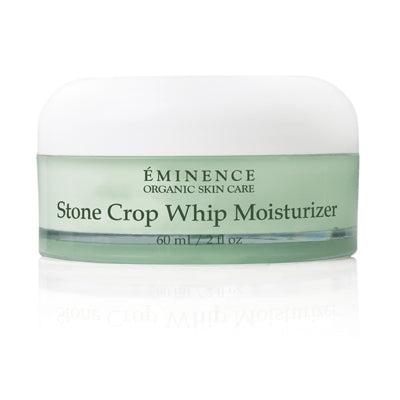

Eminence Organic Skin Care
Stone Crop Whip Moisturizer

Stone Crop Whip Moisturizer
Eminence Organic Skin Care
stone-crop-whip-moisturizer
Moisturize
9628191359269
Morning or Evening?
How often will you use this product?
Notes


Highlights
WHAT IS IT?
Moisturizer with natural ingredients
FEATURES
Hydrating, healing, reduces irritation, clarifies skin appearance
BEST FOR
All skin types
CHECKS
Does not contain nuts, gluten
Who Is It For?
Adults Both Women And MenWhat Does It Help With?
Irritation Clarifying SkinBudget
PremiumHow To Use
Which routine should it be used in?
Instructions:
Key Information


What Eminence Organic Skin Care Says
Product Description:
Stone crop is a natural succulent that's been used for centuries as a first-aid plant. As a key part of this effective moisturizer, it heals, reduces the appearance of irritation and gently clarifies the skin's appearance.
About the Brand:
Ingredients Overview
Ingredients List
Aloe Barbadensis (Aloe) Leaf Juice, Helianthus Annuus (Sunflower) Seed Oil, Citrus Limon (Lemon) Peel Extract, Arctostaphylos Uva-Ursi (Bearberry) Leaf Extract, Jasminum Officinale (Jasmine) Flower Extract, Lavandula Angustifolia (Lavender) Flower Extract, Calendula Officinalis Flower Extract, Sempervivum Tectorum (Stone Crop) Extract, Oryza Sativa (Rice) Extract, Camellia Sinensis (Green Tea) Leaf Extract, Rosmarinus Officinalis (Rosemary) Leaf Extract, Glycine Soja (Soybean) Germ Extract, Chlorella Pyrenoidosa (Green Algae) Extract and Vegetable Glycerin], Zea Mays (Corn) Germ Oil, Cetearyl Alcohol, Sodium Cetearyl Sulfate, Butyrospermum Parkii (Shea) Butter, Vegetable Glycerin, Caesalpinia Spinosa (Tara Tree) Gum, Vegetable Glycerin, Corn-Derived Propanediol, Stearic Acid, Glyceryl Stearate, Cetyl Palmitate, Calendula Officinalis Flower Oil, Sempervivum Tectorum (Stone Crop) Extract, Chlorophyll, Benzyl Alcohol, Dehydroacetic Acid, Salicylic Acid, Corn-Derived Methyl Glucose Sesquistearate, Sodium Salicylate, Xanthan Gum, Sodium Benzoate, Potassium Sorbate, Vegetable Squalane, Tocopheryl Acetate (Vitamin E), Ascorbyl Palmitate (Vitamin C Ester), Plant-Derived Lecithin, Vegetable Heptyl Glucoside, Caprylyl Glycol, 1,2-Hexanediol, Tropolone, Natural Fragrance, Biocomplex2TM [Euterpe Oleracea (Acai) Fruit Extract, Citrus Limon (Lemon) Juice, Malpighia Glabra (Barbados Cherry) Fruit Extract, Emblica Officinalis (Indian Gooseberry) Fruit Extract, Adansonia Digitata (Baobab) Fruit Extract, Myrciaria Dubia (Camu Camu) Fruit Extract, Daucus Carota Sativa (Carrot) Root Extract, Cocos Nucifera (Coconut) Water, Lycium Barbarum (Goji) Fruit Extract, Helianthus Annuus (Sunflower) Seed Oil, Plant-Derived Maltodextrin, Vegetable Glycerin, Thioctic Acid (Alpha Lipoic Acid) and Ubiquinone (Coenzyme Q10)
Key Ingredients
Stone Crop, Lemon, Corn Germ Oil, Biocomplex2™
Ingredients Details
Biocomplex2™
Common Name(s): Biocomplex2™
DESCRIPTION
What It Does: Delivers targeted skin-conditioning or bioactive benefits through a specific mechanism of action suited to the formulation's intended purpose.
Why It's Used: Specialty actives address specific skin concerns through targeted molecular mechanisms, providing efficacy beyond what base formulation ingredients alone can achieve.
How It Works: The bioactive compound interacts with specific molecular targets in skin cells or the extracellular matrix — enzymes, receptors, structural proteins, or signaling molecules — triggering beneficial biological responses.
Typically Found In: Serums,treatments,moisturizers,specialty products
TECHNICAL DETAILS
Primary Category: Specialty actives
Secondary Functions: Skin-conditioning,anti-aging
Application Areas:

Facial Skincare

Body Care
Hair Care
Beard Care
Color Cosmetics (Makeup)
Dietary/Oral Supplements
Typical Concentration Range: 0.01–5%
SOURCING & ETHICS
Vegan Status: Yes
Halal Status: Yes
Source Notes: Specialty active ingredient; check individual sourcing for vegan status.
SKIN COMPATIBILITY
Irritancy Rating: 1899-12-31 00:00:00 -0800
Sensitivity Concerns: Low sensitization potential at recommended use concentrations.
Safe for Sensitive Skin: Yes
SAFETY & COMPATIBILITY
Safety Profile: Well-characterized cosmetic ingredient with established safety profile. generally non-irritating at typical use concentrations. suitable for leave-on and rinse-off cosmetics.
Works Well With: Niacinamide,hyaluronic acid,vitamin c,peptides
Avoid Combining With: Incompatible with oxidizing agents; check ph stability
SCIENTIFIC NOTE
Specialty actives typically work through enzyme inhibition (e.g., tyrosinase inhibition for brightening, mmp inhibition for anti-aging), receptor activation (e.g., retinoid receptors, ppar-γ for barrier genes), or transcription factor modulation (e.g., nrf2 for antioxidant gene upregulation). structure-activity relationships determine potency and selectivity.
Last Verified: Cosing eu database; pcpc cosmetic ingredient safety reviews; ingredient-specific safety and efficacy literature
Primary Sources: 2025-01-15
Corn Germ Oil
Common Name(s): Corn germ oil oil
DESCRIPTION
What It Does: Nourishes and softens skin through its balanced fatty acid profile, while antioxidant compounds protect against oxidative skin damage.
Why It's Used: Plant oils provide physiologically compatible lipid structures that integrate into the skin barrier and deliver fat-soluble antioxidants directly to skin cells.
How It Works: Fatty acids integrate into stratum corneum lipid lamellae, reinforcing the lipid barrier. antioxidants (tocopherols, carotenoids, polyphenols) neutralize ros through electron donation or singlet oxygen quenching.
Typically Found In: Face oils,serums,moisturizers,hair treatments,body oils
TECHNICAL DETAILS
Primary Category: Plant oils
Secondary Functions: Emollient,antioxidant
Application Areas:
Facial Skincare
Body Care
Hair Care
Beard Care
Color Cosmetics (Makeup)
Dietary/Oral Supplements
Typical Concentration Range: 0.5–30%
SOURCING & ETHICS
Vegan Status: Yes
Halal Status: Yes
Source Notes: Cold-pressed or solvent-extracted plant oil; no animal components.
SKIN COMPATIBILITY
Irritancy Rating: 1899-12-31 00:00:00 -0800
Comedogenicity Rating: 1900-01-01 00:00:00 -0800
Sensitivity Concerns: Low sensitization potential at recommended use concentrations.
Safe for Sensitive Skin: Yes
SAFETY & COMPATIBILITY
Safety Profile: Well-characterized cosmetic ingredient with established safety profile. generally non-irritating at typical use concentrations. suitable for leave-on and rinse-off cosmetics.
Works Well With: Vitamin e,ceramides,other plant oils,squalane
Avoid Combining With: Strong oxidizers (accelerate rancidity)
SCIENTIFIC NOTE
Vegetable oils are triglyceride matrices where the fatty acid composition determines skin compatibility, barrier function, and comedogenicity. oleic acid-rich oils (>60%) soften barrier lipids and enhance penetration; linoleic acid-rich oils reinforce ceramide-poor stratum corneum; saturated fatty acid-rich oils provide occlusion without skin penetration.
Last Verified: Cosing eu database; pcpc cosmetic ingredient safety reviews; aocs plant oil composition databases; fatty acid pharmacology reviews
Primary Sources: 2025-01-15
Lemon
Common Name(s): Lemon,cosmetic active,functional ingredient
CAS Number: N/a
DESCRIPTION
What It Does: Delivers characteristic cosmetic function at recommended use concentration.
Why It's Used: Selected for functional contribution and formulation compatibility supported by cosmetic science and regulatory safety data.
How It Works: Works through the mechanism of its molecular class as documented in peer-reviewed cosmetic literature.
Typically Found In: Skin care formulations
TECHNICAL DETAILS
Primary Category: Active ingredient – cosmetic active
Secondary Functions: Skin conditioning
Application Areas:
Facial Skincare
Body Care
Hair Care
Beard Care
Color Cosmetics (Makeup)
Dietary/Oral Supplements
Typical Concentration Range: 0.1%–10%
SOURCING & ETHICS
Vegan Status: Conditional
Halal Status: Yes
Source Notes: Commercially produced for cosmetic use. verify vegan/halal status with supplier.
SKIN COMPATIBILITY
Irritancy Rating: 1/5 – very low
Comedogenicity Rating: 0/5 – non-comedogenic
Sensitivity Concerns: Well-tolerated by most skin types.
Safe for Sensitive Skin: Yes
SAFETY & COMPATIBILITY
Safety Profile: Good safety profile at recommended concentrations. ewg score: 1–2.
Works Well With: Standard skincare actives
Avoid Combining With: No known significant incompatibilities
SCIENTIFIC NOTE
Lemon has an established safety profile within the cosmetic regulatory framework at standard use concentrations.
Last Verified: Cosing database,lemon technical literature
Primary Sources: 2026-03-12
Stone Crop
Common Name(s): Stone crop
DESCRIPTION
What It Does: Delivers targeted skin-conditioning or bioactive benefits through a specific mechanism of action suited to the formulation's intended purpose.
Why It's Used: Specialty actives address specific skin concerns through targeted molecular mechanisms, providing efficacy beyond what base formulation ingredients alone can achieve.
How It Works: The bioactive compound interacts with specific molecular targets in skin cells or the extracellular matrix — enzymes, receptors, structural proteins, or signaling molecules — triggering beneficial biological responses.
Typically Found In: Serums,treatments,moisturizers,specialty products
TECHNICAL DETAILS
Primary Category: Specialty actives
Secondary Functions: Skin-conditioning,anti-aging
Application Areas:
Facial Skincare
Body Care
Hair Care
Beard Care
Color Cosmetics (Makeup)
Dietary/Oral Supplements
Typical Concentration Range: 0.01–5%
SOURCING & ETHICS
Vegan Status: Yes
Halal Status: Yes
Source Notes: Specialty active ingredient; check individual sourcing for vegan status.
SKIN COMPATIBILITY
Irritancy Rating: 1899-12-31 00:00:00 -0800
Sensitivity Concerns: Low sensitization potential at recommended use concentrations.
Safe for Sensitive Skin: Yes
SAFETY & COMPATIBILITY
Safety Profile: Well-characterized cosmetic ingredient with established safety profile. generally non-irritating at typical use concentrations. suitable for leave-on and rinse-off cosmetics.
Works Well With: Niacinamide,hyaluronic acid,vitamin c,peptides
Avoid Combining With: Incompatible with oxidizing agents; check ph stability
SCIENTIFIC NOTE
Specialty actives typically work through enzyme inhibition (e.g., tyrosinase inhibition for brightening, mmp inhibition for anti-aging), receptor activation (e.g., retinoid receptors, ppar-γ for barrier genes), or transcription factor modulation (e.g., nrf2 for antioxidant gene upregulation). structure-activity relationships determine potency and selectivity.
Last Verified: Cosing eu database; pcpc cosmetic ingredient safety reviews; ingredient-specific safety and efficacy literature
Primary Sources: 2025-01-15
