
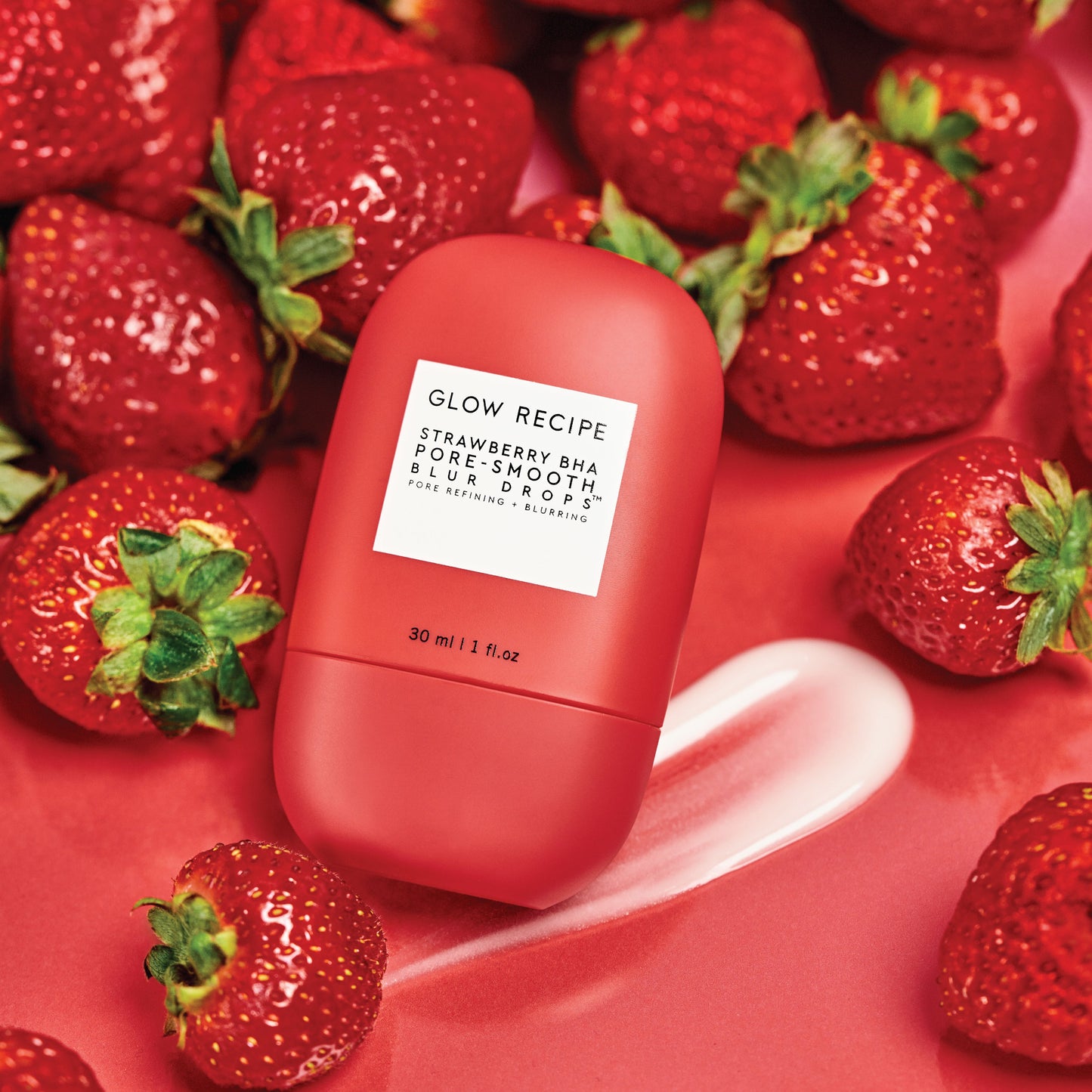

Glow Recipe
Strawberry BHA Pore-Smooth Blur Drops

Strawberry BHA Pore-Smooth Blur Drops
Glow Recipe
strawberry-bha-pore-smooth-blur-drops
Serum
9784798150949
Morning or Evening?
How often will you use this product?
Notes


Highlights
WHAT IS IT?
Serum + primer hybrid with BHA and strawberry enzymes
FEATURES
Reduces pore size, Mattifies skin, Prolongs makeup wear, Reduces excess shine for up to 8 hours
BEST FOR
oily
CHECKS
Free of parabens, mineral oil, sulfates, silicones, phthalates, drying alcohols and synthetic dyes
Who Is It For?
All Ages All GendersWhat Does It Help With?
Pore Reduction Oil Control Skin BlurringBudget
Mid-range ($30-$75)How To Use
Which routine should it be used in?
Instructions:
Key Information


What Glow Recipe Says
Product Description:
Encapsulated BHA + strawberry enzymes visibly reduce pore size over time while mattifying tapioca and rice instantly blur. This serum + primer hybrid helps prolong makeup wear and reduce excess shine for up to 8 hours.
About the Brand:
Ingredients Overview
Ingredients List
Water/Aqua/Eau, Tapioca Starch, Isopentyldiol, Nylon-12, C9-12 Alkane, Distarch Phosphate, Ammonium Acryloyldimethyltaurate/VP Copolymer, Saccharide Isomerate, Fragaria Vesca (Strawberry) Leaf Extract, Salicylic Acid, Salix Alba Bark Extract, Fragaria Vesca (Strawberry) Fruit Extract, Leuconostoc/Radish Root Ferment Filtrate, Sodium Hyaluronate, Bisabolol, Coco-Caprylate/Caprate, Triheptanoin, Butylene Glycol, Pentylene Glycol, Propanediol, Caprylyl Glycol, Polyglyceryl-10 Dioleate, Dilinoleic Acid/Butanediol Copolymer, Polyglyceryl-10 Dipalmitate, Ethylhexylglycerin, Sodium Hydroxide, 1,2-Hexanediol, Phenoxyethanol, Castor Oil/IPDI Copolymer, Citric Acid, Fragrance/Parfum*.*100% Naturally Derived
Key Ingredients
BHA, strawberry-enzymes, tapioca, rice
Ingredients Details
Ammonium Acryloyldimethyltaurate/vp Copolymer
Common Name(s): Ammonium acryloyldimethyltaurate/vp copolymer
DESCRIPTION
What It Does: Delivers targeted skin-conditioning or bioactive benefits through a specific mechanism of action suited to the formulation's intended purpose.
Why It's Used: Specialty actives address specific skin concerns through targeted molecular mechanisms, providing efficacy beyond what base formulation ingredients alone can achieve.
How It Works: The bioactive compound interacts with specific molecular targets in skin cells or the extracellular matrix — enzymes, receptors, structural proteins, or signaling molecules — triggering beneficial biological responses.
Typically Found In: Serums,treatments,moisturizers,specialty products
TECHNICAL DETAILS
Primary Category: Specialty actives
Secondary Functions: Skin-conditioning,anti-aging
Application Areas:

Facial Skincare

Body Care
Hair Care
Beard Care
Color Cosmetics (Makeup)
Dietary/Oral Supplements
Typical Concentration Range: 0.01–5%
SOURCING & ETHICS
Vegan Status: Conditional - supplier confirmation required
Halal Status: Unverified - supplier confirmation required
Source Notes: Specialty active ingredient; check individual sourcing for vegan status. [audit 2026-07-29 rev2: the record's own source_notes does not assert a non-animal origin, or instructs the reader to verify with the supplier; "yes" asserts knowledge the record does not hold. determination requires shariah-panel sign-off.]
SKIN COMPATIBILITY
Irritancy Rating: 1
Comedogenicity Rating: 0
Sensitivity Concerns: Low sensitization potential at recommended use concentrations.
Safe for Sensitive Skin: Yes
SAFETY & COMPATIBILITY
Safety Profile: Well-characterized cosmetic ingredient with established safety profile. generally non-irritating at typical use concentrations. suitable for leave-on and rinse-off cosmetics.
Works Well With: Niacinamide,hyaluronic acid,vitamin c,peptides
Avoid Combining With: Incompatible with oxidizing agents; check ph stability
SCIENTIFIC NOTE
Specialty actives typically work through enzyme inhibition (e.g., tyrosinase inhibition for brightening, mmp inhibition for anti-aging), receptor activation (e.g., retinoid receptors, ppar-γ for barrier genes), or transcription factor modulation (e.g., nrf2 for antioxidant gene upregulation). structure-activity relationships determine potency and selectivity.
Last Verified: 2025-01-15
Primary Sources: Cosing eu database; pcpc cosmetic ingredient safety reviews; ingredient-specific safety and efficacy literature
C9-12 Alkane
Common Name(s): C9-12 alkane,cosmetic active,functional ingredient
CAS Number: N/a
DESCRIPTION
What It Does: Delivers characteristic cosmetic function at recommended use concentration.
Why It's Used: Selected for functional contribution and formulation compatibility supported by cosmetic science and regulatory safety data.
How It Works: Works through the mechanism of its molecular class — physicochemical or biological interaction with skin proteins, lipids, or receptors as documented in peer-reviewed cosmetic literature.
Typically Found In: Skin care formulations
TECHNICAL DETAILS
Primary Category: Active ingredient – cosmetic active
Secondary Functions: Skin conditioning
Application Areas:
Facial Skincare
Body Care
Hair Care
Beard Care
Color Cosmetics (Makeup)
Dietary/Oral Supplements
Typical Concentration Range: 0.1%–10%
SOURCING & ETHICS
Vegan Status: Conditional - supplier confirmation required
Halal Status: Unverified - supplier confirmation required
Source Notes: Commercially produced for cosmetic use. verify vegan/halal status with supplier. [audit 2026-07-29 rev2: the record's own source_notes does not assert a non-animal origin, or instructs the reader to verify with the supplier; "yes" asserts knowledge the record does not hold. determination requires shariah-panel sign-off.]
SKIN COMPATIBILITY
Irritancy Rating: 1/5 – very low
Comedogenicity Rating: 0/5 – non-comedogenic
Sensitivity Concerns: Well-tolerated by most skin types.
Safe for Sensitive Skin: Yes
SAFETY & COMPATIBILITY
Safety Profile: Good safety profile at recommended concentrations. ewg score: 1–2.
Works Well With: Standard skincare actives
Avoid Combining With: No known significant incompatibilities
SCIENTIFIC NOTE
C9-12 alkane has an established safety and efficacy profile within the cosmetic regulatory framework at standard use concentrations.
Last Verified: 2026-03-12
Primary Sources: Cosing database,c9-12 alkane technical literature
Distarch Phosphate
Common Name(s): Distarch phosphate,natural biopolymer,film-former texture absorbent
CAS Number: N/a
DESCRIPTION
What It Does: Distarch phosphate absorbs surface sebum and cosmetic oils through its porous granule structure, provides a silky soft-focus powdery finish on skin from the biopolymer particle's low friction coefficient, forms a breathable protective film on skin and hair, and acts as an excipient carrier or encapsulation matrix for actives in powder formulations.
Why It's Used: Formulators choose distarch phosphate as a biodegradable, renewable alternative to synthetic polymers (ptfe, nylon, polyethylene) in powder cosmetics — providing equivalent or superior absorbency and skin feel without microplastic regulatory concerns under eu regulation 2023/2055. natural starch granules have an intrinsically soft, semi-crystalline structure (mohs hardness ~1) that spreads smoothly on skin without abrasion, making them preferred over silica or talc when maximum gentleness is required. modified versions (cross-linked, esterified) extend the range of performance from pure powder through gel-forming to film-forming applications.
How It Works: Distarch phosphate works through the physical properties of its semicrystalline polysaccharide granule architecture: (1) oil absorption — starch granules are semicrystalline spheres (amylose crystalline domains surrounded by amorphous amylopectin matrix) with a porous surface and internal channels. surface sebum and oil penetrate the granule via capillary action into these channels and are immobilised by van der waals forces with the polysaccharide chains — providing oil-mattifying at the skin surface; (2) soft-focus texture — granule diameter (5–50 μm, depending on source) and smooth spherical morphology provide low-friction glide between skin surface and the applying finger/brush, with the semicrystalline granule structure being soft enough to deform without sharp edges; (3) film formation — when wetted, starch granules gelatinise (crystalline structure melts to amorphous hydrogel) above 60°c during processing, cooling to form a continuous film. modified starches with crosslinks maintain film integrity without complete gelatinisation; (4) biodegradation — amylase enzymes in soil rapidly hydrolyse the α-1,4 and α-1,6 glycosidic bonds, providing complete mineralisation to co₂ and water — zero environmental persistence compared to synthetic polymer particles.
Typically Found In: Powders,dry shampoos,biodegradable cosmetics
TECHNICAL DETAILS
Primary Category: Active ingredient – cosmetic active
Secondary Functions: Skin conditioning
Application Areas:
Facial Skincare
Body Care
Hair Care
Beard Care
Color Cosmetics (Makeup)
Dietary/Oral Supplements
Typical Concentration Range: 0.5%–30%
SOURCING & ETHICS
Vegan Status: Conditional - supplier confirmation required
Halal Status: Unverified - supplier confirmation required
Source Notes: Commercially produced for cosmetic use. verify vegan/halal status with supplier. [audit 2026-07-29 rev2: the record's own source_notes does not assert a non-animal origin, or instructs the reader to verify with the supplier; "yes" asserts knowledge the record does not hold. determination requires shariah-panel sign-off.]
SKIN COMPATIBILITY
Irritancy Rating: 1/5 – very low
Comedogenicity Rating: 0/5 – non-comedogenic
Sensitivity Concerns: Well-tolerated by most skin types.
Safe for Sensitive Skin: Yes
SAFETY & COMPATIBILITY
Safety Profile: Good safety profile at recommended concentrations. ewg score: 1–2.
Works Well With: Standard skincare actives
Avoid Combining With: No known significant incompatibilities
SCIENTIFIC NOTE
Starch granule oil absorption capacity: oil absorption capacity (oac) of biopolymer powders correlates with granule porosity and internal surface area. rice starch (3–8 μm granules, high surface area) oac ~1.0 g oil/g; tapioca starch (15–35 μm, lower surface area) oac ~0.8 g/g; corn starch (10–25 μm) oac ~0.9 g/g. cross-linked modified starches maintain granule integrity under mechanical stress providing higher effective oac in use conditions. silica (oac ~2.5 g/g) outperforms starches on pure absorbency but the skin feel advantage of the softer biopolymer — particularly the non-abrasive, cushioned texture — justifies the lower oac for sensitive skin powders.
Last Verified: 2026-03-12
Primary Sources: Cosing database,starch biopolymer cosmetic application review
Isopentyldiol
Common Name(s): Isopentyldiol,cosmetic active,functional ingredient
CAS Number: N/a
DESCRIPTION
What It Does: Delivers characteristic cosmetic function at recommended use concentration.
Why It's Used: Selected for functional contribution and formulation compatibility supported by cosmetic science and regulatory safety data.
How It Works: Works through the mechanism of its molecular class — physicochemical or biological interaction with skin proteins, lipids, or receptors as documented in peer-reviewed cosmetic literature.
Typically Found In: Skin care formulations
TECHNICAL DETAILS
Primary Category: Active ingredient – cosmetic active
Secondary Functions: Skin conditioning
Application Areas:
Facial Skincare
Body Care
Hair Care
Beard Care
Color Cosmetics (Makeup)
Dietary/Oral Supplements
Typical Concentration Range: 0.1%–10%
SOURCING & ETHICS
Vegan Status: Conditional - supplier confirmation required
Halal Status: Unverified - supplier confirmation required
Source Notes: Commercially produced for cosmetic use. verify vegan/halal status with supplier. [audit 2026-07-29 rev2: the record's own source_notes does not assert a non-animal origin, or instructs the reader to verify with the supplier; "yes" asserts knowledge the record does not hold. determination requires shariah-panel sign-off.]
SKIN COMPATIBILITY
Irritancy Rating: 1/5 – very low
Comedogenicity Rating: 0/5 – non-comedogenic
Sensitivity Concerns: Well-tolerated by most skin types.
Safe for Sensitive Skin: Yes
SAFETY & COMPATIBILITY
Safety Profile: Good safety profile at recommended concentrations. ewg score: 1–2.
Works Well With: Standard skincare actives
Avoid Combining With: No known significant incompatibilities
SCIENTIFIC NOTE
Isopentyldiol has an established safety and efficacy profile within the cosmetic regulatory framework at standard use concentrations.
Last Verified: 2026-03-12
Primary Sources: Cosing database,isopentyldiol technical literature