
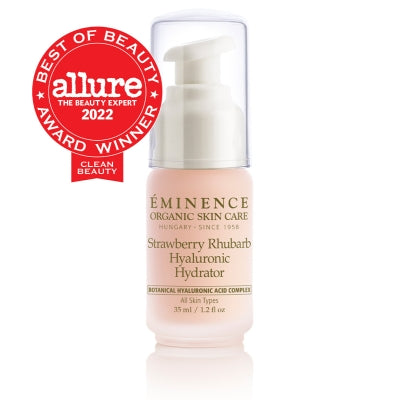

Eminence Organic Skin Care
Strawberry Rhubarb Hyaluronic Hydrator

Strawberry Rhubarb Hyaluronic Hydrator
Eminence Organic Skin Care
strawberry-rhubarb-hyaluronic-hydrator
Moisturize
9628190245157
Morning or Evening?
How often will you use this product?
Notes


Highlights
WHAT IS IT?
Lightweight gel-cream moisturizer
FEATURES
Rejuvenates dull skin, locks in moisture, reveals radiant-looking skin
BEST FOR
All skin types
CHECKS
Does not contain parabens, soy, nuts, gluten
Who Is It For?
Adults Both Women And MenWhat Does It Help With?
Dull Skin Lack Of HydrationBudget
PremiumHow To Use
Which routine should it be used in?
Instructions:
Key Information


What Eminence Organic Skin Care Says
Product Description:
With a fresh, dewy finish, this vegan gel-cream rejuvenates the appearance of dull skin. Lightweight in texture, this hydrator pairs our innovative Botanical Hyaluronic Acid Complex with panthenol, strawberry and rhubarb to lock in moisture and reveal radiant-looking skin. Ideal for all skin types.
About the Brand:
Ingredients Overview
Ingredients List
Aloe Barbadensis (Aloe) Leaf Juice, Helianthus Annuus (Sunflower) Seed Oil, Rheum Palmatum (Rhubarb) Root Extract, Althaea Officinalis (Marshmallow) Root Extract, Vitis Vinifera (Grape) Seed Extract, Fragaria Chiloensis (Strawberry) Fruit Extract, Oryza Sativa (Rice) Extract, Vitis Vinifera (Grape) Seed Oil And Vegetable Glycerin], Vegetable Glycerin, Caprylyl-Caprylate/Caprate, Caprylic/Capric Triglyceride, Undecane, Tridecane, AQUA, Panthenol (Provitamin B5), Aloe Barbadensis (Aloe) Leaf Extract, Ppg-20 Methyl Glucose Ether, Sodium Hyaluronate (Botanical Hyaluronic Acid), Fragaria Vesca (Strawberry) Fruit Extract, Rheum Rhabarbarum (Rhubarb) Extract, Xylitylglucoside, Anhydroxylitol, Xylitol, Beta Vulgaris (Beet) Root Extract, Carbomer, Benzyl Alcohol, Vegetable Heptyl Glucoside, 1,2-Hexanediol, Caprylyl Glycol, Tropolone, Vitis Vinifera (Grape) Juice Extract, Sucrose, Pectin, Citric Acid, Corn-Derived Propanediol, Sodium Benzoate, Natural Fragrance (Parfum), Biocomplex2™ [Euterpe Oleracea (Acai) Fruit Extract, Citrus Limon (Lemon) Juice, Malpighia Glabra (Barbados Cherry) Fruit Extract, Emblica Officinalis (Indian Gooseberry) Fruit Extract, Adansonia Digitata (Baobab) Fruit Extract, Myrciaria Dubia (Camu Camu) Fruit Extract, Daucus Carota Sativa (Carrot) Root Extract, Cocos Nucifera (Coconut) Water, Lycium Barbarum (Goji) Fruit Extract, Helianthus Annuus (Sunflower) Seed Oil, Plant-Derived Maltodextrin, Vegetable Glycerin, Thioctic Acid (Alpha Lipoic Acid) And Ubiquinone (Coenzyme Q10)
Key Ingredients
Althaea Officinalis (Marsh Mallow) Root Extract, Grape (Vitis Vinifera) Extract, Sodium Hyaluronate, Strawberry, Ubiquinone (Coenzyme Q10)
Ingredients Details
Caprylyl Caprylate/caprate
Common Name(s): Caprylyl caprylate/caprate
DESCRIPTION
What It Does: Smooths and softens skin by filling intercorneocyte spaces, reducing friction, and providing a pleasant aesthetic skin feel in formulations.
Why It's Used: Synthetic esters provide tailored aesthetic properties — spreadability, skin feel, volatility, refractive index — that natural oils alone cannot consistently deliver.
How It Works: The ester molecule fills microscopic surface irregularities between corneocytes, reducing coefficient of friction, reflecting light uniformly, and providing a lubrication layer that protects the skin surface.
Typically Found In: Moisturizers,sunscreens,color cosmetics,body lotions,lip products
TECHNICAL DETAILS
Primary Category: Synthetic emollients
Secondary Functions: Emollient
Application Areas:

Facial Skincare

Body Care
Hair Care
Beard Care
Color Cosmetics (Makeup)
Dietary/Oral Supplements
Typical Concentration Range: 1–20%
SOURCING & ETHICS
Vegan Status: Conditional - feedstock declaration required
Halal Status: Unverified - feedstock declaration required (plant, animal and petrochemical routes all exist)
Source Notes: Synthetically produced ester emollient; no animal components. [audit 2026-07-29 rev2: origin-dependent: the same inci exists in plant, animal and petrochemical versions and the name does not discriminate. determination requires shariah-panel sign-off.]
SKIN COMPATIBILITY
Irritancy Rating: 1
Comedogenicity Rating: 1
Sensitivity Concerns: Low sensitization potential at recommended use concentrations.
Safe for Sensitive Skin: Yes
SAFETY & COMPATIBILITY
Safety Profile: Well-characterized cosmetic ingredient with established safety profile. generally non-irritating at typical use concentrations. suitable for leave-on and rinse-off cosmetics.
Works Well With: Silicones,uv filters,other emollients
Avoid Combining With: Strongly alkaline conditions (risk of saponification of ester-type emollients)
SCIENTIFIC NOTE
The spreading coefficient of an emollient is governed by its surface tension, viscosity, and polarity. esters with branched alkyl chains (e.g., isopropyl, isostearyl) spread rapidly and leave a non-tacky film; linear long-chain esters provide more substantive moisturization. hlb value determines the preferred formulation system (w/o vs o/w emulsions).
Last Verified: 2025-01-15
Primary Sources: Cosing eu database; pcpc cosmetic ingredient safety reviews; ingredient-specific safety and efficacy literature
Helianthus Annuus (sunflower) Seed Oil
Common Name(s): Helianthus annuus (sunflower) seed oil,botanical oil,phytochemical active
CAS Number: N/a
DESCRIPTION
What It Does: Provides antioxidant protection from reactive oxygen species, reduces inflammatory cytokine production in skin, and conditions skin through the plant's phytochemical complex.
Why It's Used: Natural origin narrative, traditional use heritage, and multi-functional phytochemical profile supporting concurrent skin care claims from one ingredient.
How It Works: Polyphenols, terpenoids, and alkaloids scavenge ros via h• donation, inhibit nf-kb or cox-2 inflammatory pathways, and interact with skin surface proteins for conditioning.
Typically Found In: Botanical skin care,natural products
TECHNICAL DETAILS
Primary Category: Active ingredient – antioxidant
Secondary Functions: Free radical scavenging,anti-aging
Application Areas:
Facial Skincare
Body Care
Hair Care
Beard Care
Color Cosmetics (Makeup)
Dietary/Oral Supplements
Typical Concentration Range: 0.1%–10%
SOURCING & ETHICS
Vegan Status: Conditional - supplier confirmation required
Halal Status: Yes
Source Notes: Plant-derived extract or synthetic. [audit 2026-07-29 rev2: status downgraded on audit. determination requires shariah-panel sign-off.]
SKIN COMPATIBILITY
Irritancy Rating: 1/5 – very low
Comedogenicity Rating: 0/5 – non-comedogenic
Sensitivity Concerns: Non-irritating; well-tolerated.
Safe for Sensitive Skin: Yes
SAFETY & COMPATIBILITY
Safety Profile: Excellent safety profile. ewg score: 1.
Works Well With: Vitamin c,vitamin e,ferulic acid,spf,other antioxidants
Avoid Combining With: No significant incompatibilities
SCIENTIFIC NOTE
Plant secondary metabolites evolved as photoprotectants and antimicrobials — mechanisms directly applicable to cosmetic antioxidant and anti-inflammatory activity in human skin.
Last Verified: 2026-03-12
Primary Sources: Cosing database,helianthus annuus (sunflower) seed botanical review
Vitis Vinifera (grape) Seed Extract
Common Name(s): Vitis vinifera (grape) seed extract,botanical extract,phytochemical active
CAS Number: N/a
DESCRIPTION
What It Does: Provides antioxidant protection from reactive oxygen species, reduces inflammatory cytokine production in skin, and conditions skin through the plant's phytochemical complex.
Why It's Used: Natural origin narrative, traditional use heritage, and multi-functional phytochemical profile supporting concurrent skin care claims from one ingredient.
How It Works: Polyphenols, terpenoids, and alkaloids scavenge ros via h• donation, inhibit nf-kb or cox-2 inflammatory pathways, and interact with skin surface proteins for conditioning.
Typically Found In: Botanical skin care,natural products
TECHNICAL DETAILS
Primary Category: Active ingredient – antioxidant
Secondary Functions: Free radical scavenging,anti-aging
Application Areas:
Facial Skincare
Body Care
Hair Care
Beard Care
Color Cosmetics (Makeup)
Dietary/Oral Supplements
Typical Concentration Range: 0.1%–10%
SOURCING & ETHICS
Vegan Status: Conditional - supplier confirmation required
Halal Status: Yes
Source Notes: Plant-derived extract or synthetic. [audit 2026-07-29 rev2: status downgraded on audit. determination requires shariah-panel sign-off.]
SKIN COMPATIBILITY
Irritancy Rating: 1/5 – very low
Comedogenicity Rating: 0/5 – non-comedogenic
Sensitivity Concerns: Non-irritating; well-tolerated.
Safe for Sensitive Skin: Yes
SAFETY & COMPATIBILITY
Safety Profile: Excellent safety profile. ewg score: 1.
Works Well With: Vitamin c,vitamin e,ferulic acid,spf,other antioxidants
Avoid Combining With: No significant incompatibilities
SCIENTIFIC NOTE
Plant secondary metabolites evolved as photoprotectants and antimicrobials — mechanisms directly applicable to cosmetic antioxidant and anti-inflammatory activity in human skin.
Last Verified: 2026-03-12
Primary Sources: Cosing database,vitis vinifera (grape) seed extract botanical review