

SunScoop
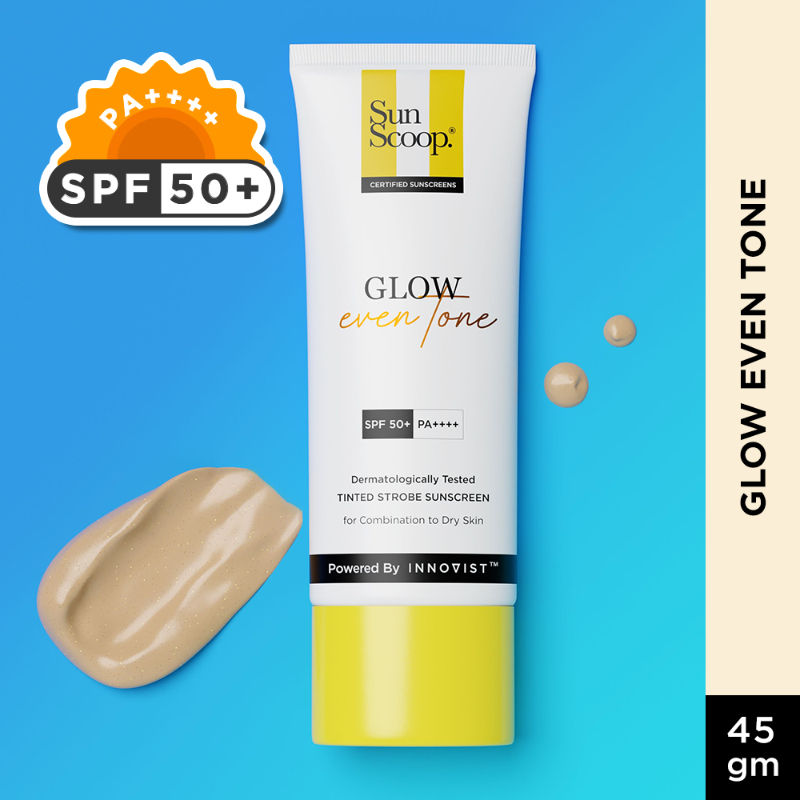
SunScoop Glow Even Tone Cream Face Sunscreen SPF 50+ PA++++, Broad Spectrum, Tinted, & No White Cast

SunScoop Glow Even Tone Cream Face Sunscreen SPF 50+ PA++++, Broad Spectrum, Tinted, & No White Cast
SunScoop
sunscoop-glow-even-tone-cream-face-sunscreen-spf-50-pa-broad-spectrum-tinted-no-white-cast
Suncare
10084974362917
Morning or Evening?
How often will you use this product?
Notes


Highlights
WHAT IS IT?
Tinted Face Sunscreen with broad spectrum SPF 50+ PA++++, 23+ ingredients
FEATURES
Tinted formula, no white cast, waterproof, broad spectrum UVA/UVB protection, natural finish, includes licorice root extract, lightweight texture, suitable for daily use
BEST FOR
sensitive
CHECKS
No white cast, fragrance-free, non-sticky
Who Is It For?
All Genders No Specific Age Range MentionedWhat Does It Help With?
Sun Protection Even Skin Tone Glow No White Cast Suitable For Medium Skin TonesBudget
Affordable (under $30)How To Use
Which routine should it be used in?
Instructions:
Key Information


What SunScoop Says
Product Description:
Broad spectrum tinted sunscreen with no white cast; acts as a BB cream for medium skin tones, waterproof and long-lasting, provides natural finish and skincare benefits including licorice root extract.
About the Brand:
Ingredients Overview
Ingredients List
Purified-Water,C-12-15-Alkyl-Benzoate,Ethylhexyl-Triazone,Diethylamino-Hydroxybenzoyl-Hexyl-Benzoate,Diethylhexyl-Maleate,Zinc-oxide,Bis-ethylhexyloxyphenol-Methoxyphenyl-Triazine,Cetearyl-Alcohol,Glycerin,Stearic-Acid,Glyceryl-Monostearate,Phenoxyethanol,Betaine,Mica,Ceteareth-20,Cetyl-Alcohol,CI-77492,Ammonium-Acryloyldimethyltaurate/VP-Copolymer,Titanium-Dioxide,Xanthan-Gum,Methylene-Bis-Benzotriazolyl-Tetramethylbutylphenol,Sodium-Acrylate/Sodium-Acryloyldimethyl-Taurate,Glycyrrhiza-Glabra-(Licorice)-Root-Extract,Disodium-EDTA,Hydrogenated-Polydecene,Tocopheryl-Acetate,Decyl-Glucoside,Sorbitan-Laurate,CI-77491,Trideceth-6,Propylene-Glycol,Caesalpinia-Spinosa-Fruit-Pod-Extract,Helianthus-Annuus-Sprout-Extract,Sodium-Benzoate
Key Ingredients
Ethylhexyl Triazone, Zinc oxide, Glycyrrhiza Glabra (Licorice) Root Extract, Tocopheryl Acetate
Ingredients Details
Betaine
Common Name(s): Trimethylglycine,tmg,natural betaine
CAS Number: 107-43-7
DESCRIPTION
What It Does: Provides osmoprotective humectant conditioning with anti-irritant and mild foam-boosting activity.
Why It's Used: Natural-origin multifunctional osmolyte from sugar beet providing hydration, anti-irritancy, and conditioning in virtually every cosmetic category.
How It Works: Quaternary ammonium betaine provides zwitterionic character for water binding via ionic hydration. osmoprotective function at 100–500mm as compatible solute protecting cells from osmotic stress. reduces surfactant irritation by competing with sls for protein binding sites. mild foam enhancement.
Typically Found In: Virtually all categories — moisturisers, shampoos, cleansers
TECHNICAL DETAILS
Primary Category: Functional ingredient – humectant
Secondary Functions: Tewl reduction,skin plumping
Application Areas:

Facial Skincare
Body Care
Hair Care

Beard Care
Color Cosmetics (Makeup)
Dietary/Oral Supplements
Typical Concentration Range: 0.5%–10%
SOURCING & ETHICS
Vegan Status: Conditional - feedstock declaration required
Halal Status: Unverified - feedstock declaration required (plant, animal and petrochemical routes all exist)
Source Notes: Synthetic or naturally derived. excellent aqueous solubility. [audit 2026-07-29 rev2: origin-dependent: the same inci exists in plant, animal and petrochemical versions and the name does not discriminate. determination requires shariah-panel sign-off.]
SKIN COMPATIBILITY
Irritancy Rating: 1/5 – very low
Comedogenicity Rating: 0/5 – non-comedogenic
Sensitivity Concerns: Non-irritating; suitable for all skin types.
Safe for Sensitive Skin: Yes
SAFETY & COMPATIBILITY
Safety Profile: Excellent safety profile. ewg score: 1.
Works Well With: Ceramides,emollients,occlusives,glycerin,hyaluronic acid
Avoid Combining With: No significant incompatibilities
SCIENTIFIC NOTE
Betaine's anti-irritant mechanism for surfactant systems involves competitive protein protection: betaine at high concentrations preferentially interacts with skin proteins, occupying binding sites that would otherwise be occupied by surfactant molecules causing protein denaturation. this competition reduces available protein binding for irritating surfactants, explaining betaine's well-documented ability to reduce sls irritation when co-formulated.
Last Verified: 2026-03-12
Primary Sources: Cosing database,craig betaine osmoprotective review,cir safety assessment
Ceteareth-20
Common Name(s): Polyethylene glycol cetearyl ether,peg-20 cetearyl ether
CAS Number: 68439-49-6
DESCRIPTION
What It Does: Provides high-hlb o/w emulsification for stable cream formation from ethoxylated cetearyl alcohol.
Why It's Used: Classic self-emulsifying wax component for standard pharmaceutical and cosmetic cream formulation.
How It Works: 20 eo units on cetearyl alcohol chain provide hlb ~15-17 for strong o/w emulsification. often pre-blended with cetearyl alcohol as 'emulsifying wax' for simplified cream making. combined low-hlb cetearyl alcohol + high-hlb ceteareth-20 forms a balanced self-emulsifying system.
Typically Found In: Classic pharmaceutical and cosmetic creams
TECHNICAL DETAILS
Primary Category: Functional ingredient – ethoxylated fatty alcohol emulsifier
Secondary Functions: Skin conditioning
Application Areas:
Facial Skincare
Body Care
Hair Care
Beard Care
Color Cosmetics (Makeup)
Dietary/Oral Supplements
Typical Concentration Range: 1%–8%
SOURCING & ETHICS
Vegan Status: Conditional - feedstock declaration required
Halal Status: Unverified - feedstock declaration required (plant, animal and petrochemical routes all exist)
Source Notes: Commercially produced for cosmetic use. verify vegan/halal status with supplier. [audit 2026-07-29 rev2: origin-dependent: the same inci exists in plant, animal and petrochemical versions and the name does not discriminate. determination requires shariah-panel sign-off.]
SKIN COMPATIBILITY
Irritancy Rating: 1/5 – very low
Comedogenicity Rating: 0/5 – non-comedogenic
Sensitivity Concerns: Well-tolerated by most skin types.
Safe for Sensitive Skin: Yes
SAFETY & COMPATIBILITY
Safety Profile: Good safety profile at recommended concentrations. ewg score: 1–2.
Works Well With: Standard skincare actives
Avoid Combining With: No known significant incompatibilities
SCIENTIFIC NOTE
Ceteareth-20's combination with cetearyl alcohol in the classic 'emulsifying wax nf' creates what is called a 'mixed emulsifier system' where the fatty alcohol forms lamellar crystal phases that physically trap and stabilize oil droplets. this physical (lamellar crystal) + chemical (hlb balance) dual stabilization provides superior stability compared to either component alone.
Last Verified: 2026-03-12
Primary Sources: Cosing database,cir safety assessment
Glycerin
Common Name(s): Glycerol,glycerine,1,2,3-propanetriol
CAS Number: 56-81-5
DESCRIPTION
What It Does: Glycerin pulls water from the environment and deeper skin layers into the outer skin layer (epidermis), boosting moisture levels and keeping skin soft, smooth, and plump.
Why It's Used: It is used in virtually every moisturizer, serum, and cleanser because it is highly effective at hydrating skin, is well-tolerated by all skin types, and enhances the texture and spreadability of formulations.
How It Works: As a humectant, glycerin forms hydrogen bonds with water molecules, trapping them in the skin. it also reinforces the skin barrier by integrating into lipid structures between skin cells.
Typically Found In: Moisturizers,serums,cleansers,toners,sheet masks,sunscreens,body lotions,shampoos,conditioners
TECHNICAL DETAILS
Primary Category: Humectant
Secondary Functions: Skin barrier support,emollient,solvent
Application Areas:
Facial Skincare
Body Care
Hair Care
Beard Care
Color Cosmetics (Makeup)
Dietary/Oral Supplements
Typical Concentration Range: 1%–30% (typical: 3–10%)
SOURCING & ETHICS
Vegan Status: Conditional - feedstock declaration required
Halal Status: Unverified - feedstock declaration required (plant, animal and petrochemical routes all exist)
Source Notes: Derived from plant oils via hydrolysis or saponification; synthetic versions also available. palm-derived glycerin carries sustainability concerns. [audit 2026-07-29 rev2: origin-dependent: the same inci exists in plant, animal and petrochemical versions and the name does not discriminate. determination requires shariah-panel sign-off.]
SKIN COMPATIBILITY
Irritancy Rating: 1/5 – very low; non-irritating at all standard concentrations
Comedogenicity Rating: 0/5 – non-comedogenic
Sensitivity Concerns: Extremely rare allergic reactions; generally safe for all skin types including sensitive and baby skin
Safe for Sensitive Skin: Yes
SAFETY & COMPATIBILITY
Safety Profile: Widely recognized as safe. ewg hazard score: 1. no significant concerns for irritation, sensitization, or toxicity at typical concentrations (up to 50%).
Works Well With: Hyaluronic acid,ceramides,niacinamide,panthenol,urea,peptides,retinol,ahas/bhas
Avoid Combining With: No known incompatibilities at standard concentrations
SCIENTIFIC NOTE
Glycerin is an endogenous skin component found naturally in the stratum corneum. aquaporin-3 channels in keratinocytes facilitate glycerin transport, making it integral to natural skin hydration pathways.
Last Verified: 2026-03-12
Primary Sources: Cosing database,cir safety assessment,ewg skin deep,inci decoder
Mica
Common Name(s): Muscovite mica,sericite,potassium aluminum silicate
CAS Number: 12001-26-2
DESCRIPTION
What It Does: Provides shimmer and pearlescence from flat-platelet mica crystal light reflection.
Why It's Used: Universal cosmetic shimmer ingredient – mica's flat-platelet morphology provides the directional light reflection responsible for the dimensional shimmer effect in all pearlescent cosmetics.
How It Works: Flat platelets (1-200μm) reflect and refract light specularly producing shimmer. when coated with tio2 or iron oxides, provides colour-shifting pearlescence via thin-film optical interference. natural slip from platelet layering reduces application friction.
Typically Found In: Foundation,eyeshadow,highlighter,blush – virtually all colour cosmetics
TECHNICAL DETAILS
Primary Category: Colorant – mineral shimmer pigment
Secondary Functions: Skin conditioning
Application Areas:
Facial Skincare
Body Care
Hair Care
Beard Care
Color Cosmetics (Makeup)
Dietary/Oral Supplements
Typical Concentration Range: 0.01%–50%
SOURCING & ETHICS
Vegan Status: Conditional - supplier confirmation required
Halal Status: Unverified - supplier confirmation required
Source Notes: Commercially produced for cosmetic use. verify vegan/halal status with supplier. [audit 2026-07-29 rev2: the record's own source_notes does not assert a non-animal origin, or instructs the reader to verify with the supplier; "yes" asserts knowledge the record does not hold. determination requires shariah-panel sign-off.]
SKIN COMPATIBILITY
Irritancy Rating: 1/5 – very low
Comedogenicity Rating: 0/5 – non-comedogenic
Sensitivity Concerns: Well-tolerated by most skin types.
Safe for Sensitive Skin: Yes
SAFETY & COMPATIBILITY
Safety Profile: Good safety profile at recommended concentrations. ewg score: 1–2.
Works Well With: Standard skincare actives
Avoid Combining With: No known significant incompatibilities
SCIENTIFIC NOTE
Mica-based pearlescent pigments (mica coated with tio2 or iron oxides) produce colour-shifting optical effects via thin-film light interference – the same phenomenon as oil on water or butterfly wings. as tio2 coating thickness increases, the interference wavelength shifts from silver → gold → red → violet → blue → green, creating the entire pearlescent colour palette from a single mineral substrate by controlling coating thickness.
Last Verified: 2026-03-12
Primary Sources: Cosing database,eu cosmetics regulation annex iv,cir safety assessment