
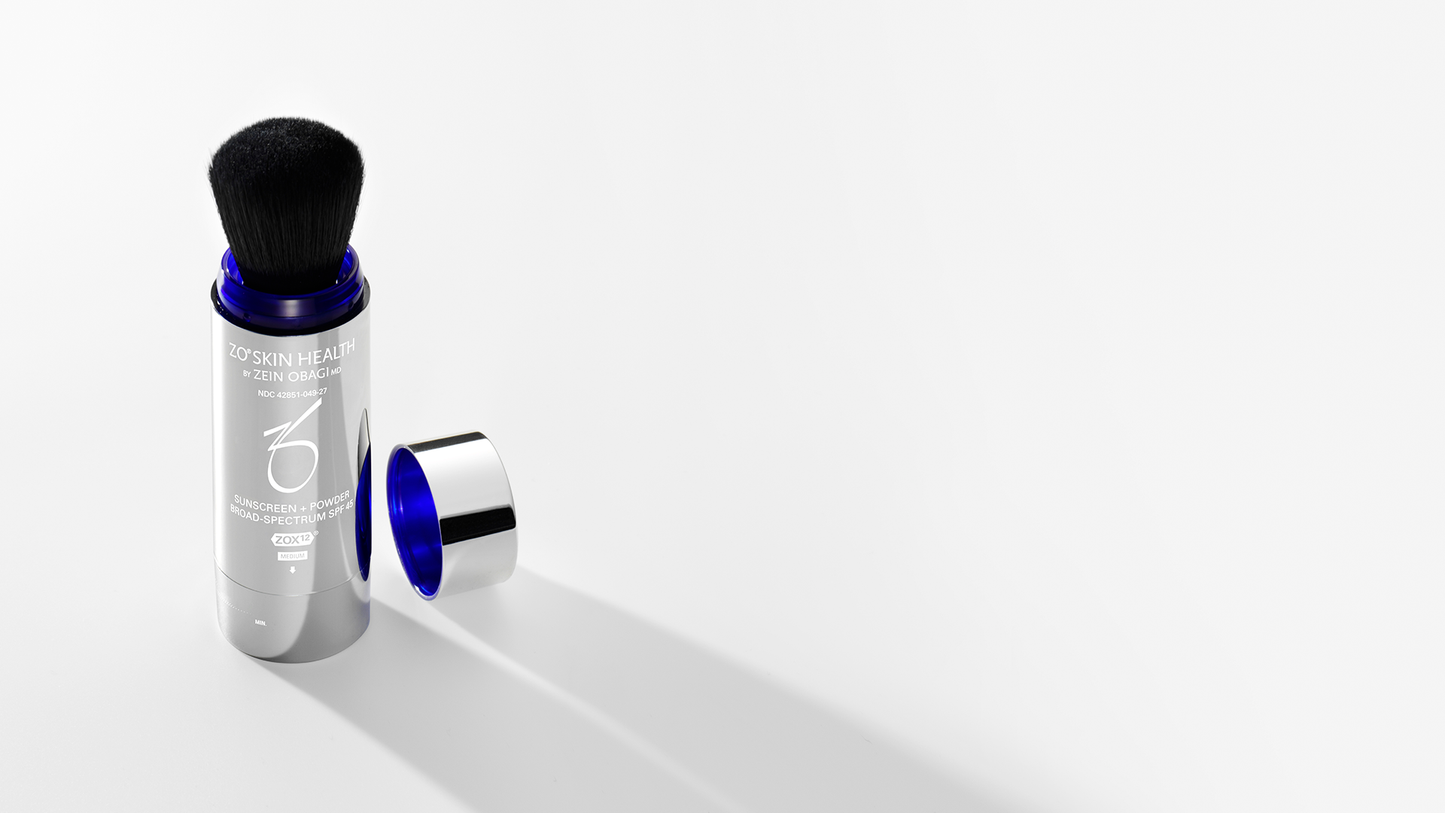

ZO Skin Health
Sunscreen + Powder Broad-Spectrum SPF 45

Sunscreen + Powder Broad-Spectrum SPF 45
ZO Skin Health
sunscreen-powder-broad-spectrum-spf-45
Suncare
9706804871461
Morning or Evening?
How often will you use this product?
Notes


Highlights
WHAT IS IT?
A powder sunscreen with broad-spectrum SPF 45 protection
FEATURES
Sun protection with ZO® antioxidant technology, maintains hydration and absorbs surface oil to minimize shine.
BEST FOR
All Skin Types (mentioned in product indicators)
CHECKS
Free of parabens, talc, phthalates, synthetic fragrances, fillers, GMO ingredients
Who Is It For?
Suitable For Adults Of All GendersWhat Does It Help With?
Sun Protection Oil Control Providing CoverageBudget
Mid-rangeHow To Use
Which routine should it be used in?
Instructions:
Key Information


What ZO Skin Health Says
Product Description:
Sunscreen + Powder SPF 45 is powered by Triple-Spectrum Protection® and exclusive ZO® antioxidant technology to deliver superior skin defense with a hint of advanced color pigments.
About the Brand:
Ingredients Overview
Ingredients List
Mica, Hydroxyapatite, PolymethylMethacrylate, HDI/Trimethylol Hexyllactone Crosspolymer, Simmondsia Chinensis (Jojoba) Butter, Bronze Powder, Simmondsia Chinensis (Jojoba) Seed Oil, Iron Oxides, Triethoxycaprylylsilane, Bisabolol, Ethyl Ferulate, Ethylhexylglycerin, Melanin, Pentylene Glycol, Water, Silica, Tocopheryl Acetate, Ascorbic Acid, Retinyl Palmitate, Phenoxyethanol
Key Ingredients
Zinc Oxide, Fractionated melanin, ZOX12® complex (contains vitamins A, C and E)
Ingredients Details
Bronze Powder
Common Name(s): Metal effect powder,metallic optical pigment,colour cosmetics shimmer
CAS Number: N/a
DESCRIPTION
What It Does: Creates authentic metallic colour and reflectance effects in eye shadows, highlighters, and nail colour through true metal specular reflection unavailable from non-metallic pearlescent pigments.
Why It's Used: Metal powders are the only way to achieve true metallic mirror-like reflectance in cosmetics — mica and synthetic pearlescents provide pearl or shimmer effects, but only actual metal particles provide the authentic metallic luster requiring genuine metal conductivity.
How It Works: Metal surface electrons (free electron plasma) provide broad-spectrum reflection across visible wavelengths through drude model optical conductivity. the reflectance of metal surfaces (>90% for aluminum) provides the high-intensity metallic colour depth absent from non-conducting mineral pigments. particle size controls finish: fine (<10 μm) → satin; coarse (>30 μm) → glitter.
Typically Found In: Eye shadows,highlighters,nail colour
TECHNICAL DETAILS
Primary Category: Active ingredient – mineral / metal active
Secondary Functions: Antimicrobial,sebum regulation,antioxidant enzyme cofactor
Application Areas:

Facial Skincare

Body Care
Hair Care
Beard Care
Color Cosmetics (Makeup)
Dietary/Oral Supplements
Typical Concentration Range: Check regulatory limits
SOURCING & ETHICS
Vegan Status: Yes – mineral
Halal Status: Yes
Source Notes: Mineral/inorganic compound. cosmetic or pharmaceutical grade.
SKIN COMPATIBILITY
Irritancy Rating: 1/5 – very low
Comedogenicity Rating: 0/5 – non-comedogenic
Sensitivity Concerns: Non-irritating at recommended concentrations.
Safe for Sensitive Skin: Yes at recommended concentrations
SAFETY & COMPATIBILITY
Safety Profile: Excellent safety profile at cosmetic concentrations. ewg score: 1–2.
Works Well With: Niacinamide,salicylic acid,other actives
Avoid Combining With: No significant incompatibilities at standard concentrations
SCIENTIFIC NOTE
Aluminum and bronze powders are regulated as cosmetic colorants with specific maximum particle size and purity requirements. nano-sized metal powders (<100 nm) require additional safety assessment and regulatory notification in the eu.
Last Verified: 2026-03-12
Primary Sources: Cosing database,metal powder cosmetic colorant regulatory review
Hdi/trimethylol Hexyllactone Crosspolymer
Common Name(s): Hdi/trimethylol hexyllactone crosspolymer
DESCRIPTION
What It Does: Delivers targeted skin-conditioning or bioactive benefits through a specific mechanism of action suited to the formulation's intended purpose.
Why It's Used: Specialty actives address specific skin concerns through targeted molecular mechanisms, providing efficacy beyond what base formulation ingredients alone can achieve.
How It Works: The bioactive compound interacts with specific molecular targets in skin cells or the extracellular matrix — enzymes, receptors, structural proteins, or signaling molecules — triggering beneficial biological responses.
Typically Found In: Serums,treatments,moisturizers,specialty products
TECHNICAL DETAILS
Primary Category: Specialty actives
Secondary Functions: Skin-conditioning,anti-aging
Application Areas:
Facial Skincare
Body Care
Hair Care
Beard Care
Color Cosmetics (Makeup)
Dietary/Oral Supplements
Typical Concentration Range: 0.01–5%
SOURCING & ETHICS
Vegan Status: Conditional - supplier confirmation required
Halal Status: Unverified - supplier confirmation required
Source Notes: Specialty active ingredient; check individual sourcing for vegan status. [audit 2026-07-29 rev2: the record's own source_notes does not assert a non-animal origin, or instructs the reader to verify with the supplier; "yes" asserts knowledge the record does not hold. determination requires shariah-panel sign-off.]
SKIN COMPATIBILITY
Irritancy Rating: 1
Comedogenicity Rating: 0
Sensitivity Concerns: Low sensitization potential at recommended use concentrations.
Safe for Sensitive Skin: Yes
SAFETY & COMPATIBILITY
Safety Profile: Well-characterized cosmetic ingredient with established safety profile. generally non-irritating at typical use concentrations. suitable for leave-on and rinse-off cosmetics.
Works Well With: Niacinamide,hyaluronic acid,vitamin c,peptides
Avoid Combining With: Incompatible with oxidizing agents; check ph stability
SCIENTIFIC NOTE
Specialty actives typically work through enzyme inhibition (e.g., tyrosinase inhibition for brightening, mmp inhibition for anti-aging), receptor activation (e.g., retinoid receptors, ppar-γ for barrier genes), or transcription factor modulation (e.g., nrf2 for antioxidant gene upregulation). structure-activity relationships determine potency and selectivity.
Last Verified: 2025-01-15
Primary Sources: Cosing eu database; pcpc cosmetic ingredient safety reviews; ingredient-specific safety and efficacy literature
Hydroxyapatite
Common Name(s): Hydroxyapatite,cosmetic active,functional ingredient
CAS Number: N/a
DESCRIPTION
What It Does: Delivers characteristic cosmetic function at recommended use concentration.
Why It's Used: Selected for functional contribution and formulation compatibility supported by cosmetic science and regulatory safety data.
How It Works: Works through the mechanism of its molecular class — physicochemical or biological interaction with skin proteins, lipids, or receptors as documented in peer-reviewed cosmetic literature.
Typically Found In: Skin care formulations
TECHNICAL DETAILS
Primary Category: Active ingredient – cosmetic active
Secondary Functions: Skin conditioning
Application Areas:
Facial Skincare
Body Care
Hair Care
Beard Care
Color Cosmetics (Makeup)
Dietary/Oral Supplements
Typical Concentration Range: 0.1%–10%
SOURCING & ETHICS
Vegan Status: Conditional - supplier confirmation required
Halal Status: Unverified - supplier confirmation required
Source Notes: Commercially produced for cosmetic use. verify vegan/halal status with supplier. [audit 2026-07-29 rev2: the record's own source_notes does not assert a non-animal origin, or instructs the reader to verify with the supplier; "yes" asserts knowledge the record does not hold. determination requires shariah-panel sign-off.]
SKIN COMPATIBILITY
Irritancy Rating: 1/5 – very low
Comedogenicity Rating: 0/5 – non-comedogenic
Sensitivity Concerns: Well-tolerated by most skin types.
Safe for Sensitive Skin: Yes
SAFETY & COMPATIBILITY
Safety Profile: Good safety profile at recommended concentrations. ewg score: 1–2.
Works Well With: Standard skincare actives
Avoid Combining With: No known significant incompatibilities
SCIENTIFIC NOTE
Hydroxyapatite has an established safety and efficacy profile within the cosmetic regulatory framework at standard use concentrations.
Last Verified: 2026-03-12
Primary Sources: Cosing database,hydroxyapatite technical literature
Iron Oxides
Common Name(s): Ci 77491,ci 77492,ci 77499,ferric oxide
CAS Number: 1309-37-1
DESCRIPTION
What It Does: Provide natural skin-tone matching color and visible light/hev protection complementing uv filters.
Why It's Used: Multi-function colorants providing natural pigmentation and hev/blue light protection not provided by standard uv filters – increasingly important in modern high-protection sunscreens.
How It Works: Iron oxide crystal lattice absorbs and scatters visible light (400–700nm) particularly hev (blue light, 400–450nm) that uv filters cannot block. red, yellow, and black iron oxides mixed in precise ratios match natural skin tones.
Typically Found In: Tinted sunscreens,tinted moisturizers,foundations,bb/cc creams
TECHNICAL DETAILS
Primary Category: Functional ingredient – iron oxide colorant / uv absorber
Secondary Functions: Hev blue light defense,natural colorant,visible light absorber
Application Areas:
Facial Skincare
Body Care
Hair Care
Beard Care
Color Cosmetics (Makeup)
Dietary/Oral Supplements
Typical Concentration Range: 0.1%–10% (colorant)
SOURCING & ETHICS
Vegan Status: Yes – inorganic mineral
Halal Status: Yes
Source Notes: Mineral/inorganic compound. cosmetic or pharmaceutical grade.
SKIN COMPATIBILITY
Irritancy Rating: 1/5 – very low
Comedogenicity Rating: 0/5 – non-comedogenic
Sensitivity Concerns: Non-irritating; suitable for sensitive skin.
Safe for Sensitive Skin: Yes at recommended concentrations
SAFETY & COMPATIBILITY
Safety Profile: Excellent safety profile at cosmetic concentrations. ewg score: 1–2.
Works Well With: Niacinamide,salicylic acid,other actives
Avoid Combining With: No significant incompatibilities at standard concentrations
SCIENTIFIC NOTE
Hev (high-energy visible) light at 400–450nm is generated by screens, led lighting, and sunlight. clinical studies demonstrate hev causes hyperpigmentation and oxidative stress. iron oxides in tinted sunscreens provide the only currently available cosmetic protection against this wavelength range.
Last Verified: 2026-03-12
Primary Sources: Cosing database,sangueza et al. iron oxide hev study,cir safety assessment