
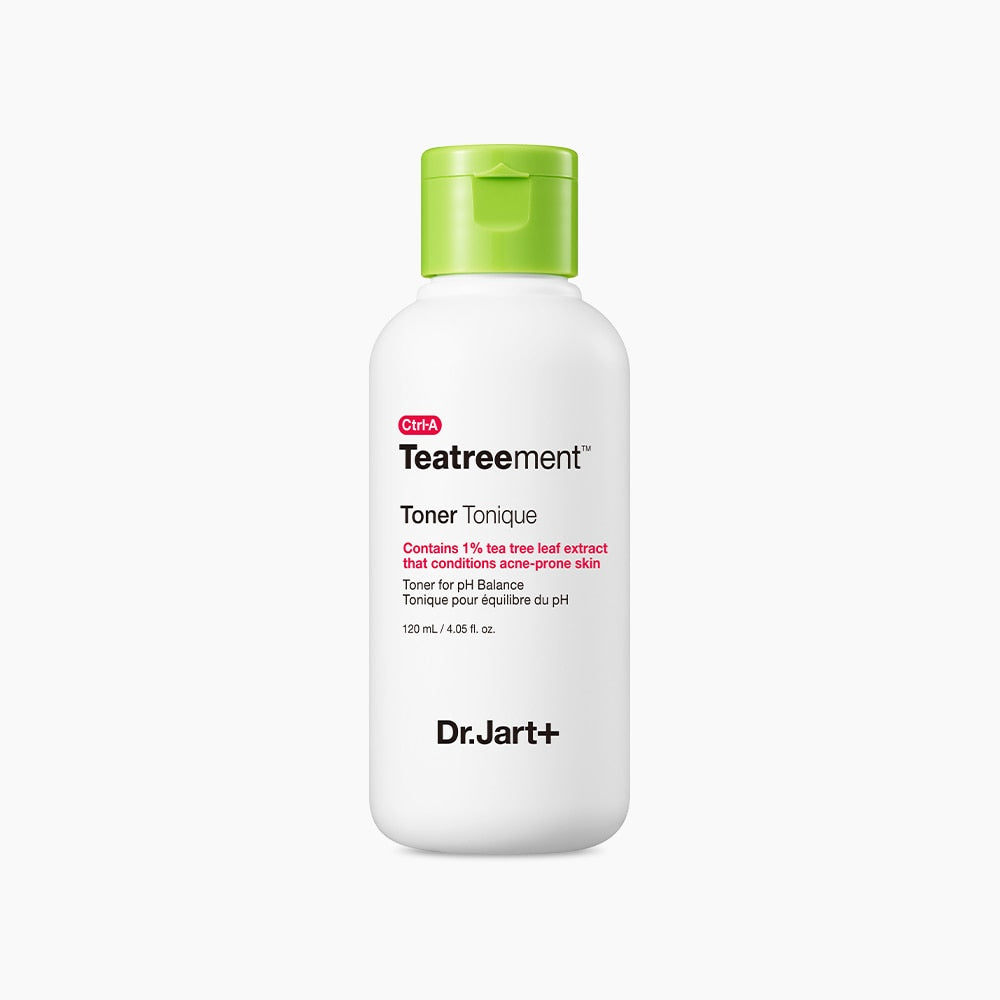

Dr.Jart+
Teatreement_x0099_ Toner for Oily Skin

Teatreement_x0099_ Toner for Oily Skin
Dr.Jart+
teatreement-toner-for-oily-skin
Tone
9706786816293
Morning or Evening?
How often will you use this product?
Notes


Highlights
WHAT IS IT?
A toner with Teatreement™ solution and Australian Tea Tree Leaf
FEATURES
Purifies oily, blemish-prone skin; Controls oil; Brightens skin
BEST FOR
Oily skin, Blemish-prone skin
CHECKS
Free of synthetic fragrances, parabens, silicones, phthalates, mineral oils, alcohol
Who Is It For?
For Adults (18+) Of All GendersWhat Does It Help With?
Blemishes Excess Oil Balancing SkinBudget
Mid-rangeHow To Use
Which routine should it be used in?
Instructions:
Key Information

What Dr.Jart+ Says
Product Description:
A purifying toner that clears the way to better skin by removing excess oil without disturbing skin's moisture barrier. This watery tea tree toner helps skin maintain a healthy balance of moisture and oil. The gentle formula quickly absorbs into skin and leaves it feeling smooth, fresh, hydrated and ready for the next step in your regimen. Dermatologist tested.
About the Brand:
Ingredients Overview
Ingredients List
Anthemis Nobilis Flower Extract, Camellia Sinesis Leaf Extract, Glycyrrhiza Glabra (Licorice) Rhizome/Root, Hamamelis Virginiana (Witch Hazel) Extract, Sodium Citrate, Cinnamomum Zelanicum Bark Extract, Pinus Pinaster Bark Extract, Melaleuca Alternifolia (Tea Tree) Leaf Oil, Ethylhexylglycerin, Citric Acid, Disodium EDTA, Hydrogenated Lecithin, Capryloyl Glycine, Hexylene Glycol, Octylododeceth-16, Allantoin, Sarcosine, Ceramide NP, Camphor, Carthamus Tinctorius (Sunflower) Seed Oil, 1,2-Hexanediol, Silica, Glycine Soja (Soybean) Sterols, Linoleic Acid, Phospholipids, 4-Terpineol, Methyl Methacrylate Crosspolymer, Salicylic Acid
Key Ingredients
Teatreement™ solution with Australian Tea Tree Leaf, 5% Niacinamide
Ingredients Details
Anthemis Nobilis Flower Extract
Common Name(s): Anthemis nobilis flower extract,botanical extract,phytochemical active
CAS Number: N/a
DESCRIPTION
What It Does: Provides antioxidant protection from reactive oxygen species, reduces inflammatory cytokine production in skin, and conditions skin surface through the plant's secondary metabolite complex.
Why It's Used: Chosen for its natural origin narrative, traditional use heritage, and multi-functional phytochemical profile that supports several concurrent skin care claims from one ingredient.
How It Works: Polyphenols, terpenoids, and alkaloids in the extract scavenge ros via hydrogen atom transfer, inhibit nf-kb or cox-2 inflammatory pathways, and interact with skin surface proteins for conditioning.
Typically Found In: Botanical skin care,natural products
TECHNICAL DETAILS
Primary Category: Active ingredient – antioxidant
Secondary Functions: Free radical scavenging,anti-aging
Application Areas:

Facial Skincare
Body Care

Hair Care
Beard Care
Color Cosmetics (Makeup)
Dietary/Oral Supplements
Typical Concentration Range: 0.1%–10%
SOURCING & ETHICS
Vegan Status: Yes
Halal Status: Yes
Source Notes: Plant-derived extract or synthetic.
SKIN COMPATIBILITY
Irritancy Rating: 1/5 – very low
Comedogenicity Rating: 0/5 – non-comedogenic
Sensitivity Concerns: Non-irritating; well-tolerated.
Safe for Sensitive Skin: Yes
SAFETY & COMPATIBILITY
Safety Profile: Excellent safety profile. ewg score: 1.
Works Well With: Vitamin c,vitamin e,ferulic acid,spf,other antioxidants
Avoid Combining With: No significant incompatibilities
SCIENTIFIC NOTE
Plant secondary metabolites evolved as uv photoprotectants and antimicrobial agents — mechanisms that directly translate to cosmetic antioxidant and anti-inflammatory activity in human skin.
Last Verified: 2026-03-12
Primary Sources: Cosing database,anthemis nobilis flower extract botanical review
Citric Acid
Common Name(s): Lemon acid,2-hydroxypropane-1,2,3-tricarboxylic acid
CAS Number: 77-92-9
DESCRIPTION
What It Does: Adjusts ph to optimal ranges, chelates destabilizing metal ions, provides mild exfoliation at higher concentrations.
Why It's Used: Universal cosmetic ph adjuster and chelating agent. aha exfoliant activity is secondary.
How It Works: As ph adjuster, donates protons. as chelating agent, three carboxylic groups bind divalent metals (ca²⁺, mg²⁺, fe²⁺) preventing oxidative degradation.
Typically Found In: Nearly all cosmetic formulations,brightening products,exfoliants
TECHNICAL DETAILS
Primary Category: Active ingredient – alpha hydroxy acid (aha)
Secondary Functions: Chelating agent,ph adjustment,preservation enhancement
Application Areas:
Facial Skincare
Body Care
Hair Care
Beard Care
Color Cosmetics (Makeup)
Dietary/Oral Supplements
Typical Concentration Range: 0.1%–10%
SOURCING & ETHICS
Vegan Status: Yes – synthetic or fermentation-derived
Halal Status: Yes
Source Notes: Produced by fermentation of sugars by aspergillus niger. gras (e330). most abundant organic acid in citrus.
SKIN COMPATIBILITY
Irritancy Rating: 1/5 – very low at low concentrations; 2/5 at exfoliant concentrations
Comedogenicity Rating: 0/5 – non-comedogenic
Sensitivity Concerns: Photosensitizing – mandatory spf use. start at low frequency.
Safe for Sensitive Skin: Use with caution – spf required
SAFETY & COMPATIBILITY
Safety Profile: Safe at otc concentrations. eu: ≤10% leave-on at ph ≥3.5. mandatory spf advisory.
Works Well With: Niacinamide,ceramides,hyaluronic acid,spf
Avoid Combining With: Retinol in same step; multiple exfoliants simultaneously
SCIENTIFIC NOTE
Three carboxylic acid groups provide multiple proton donation sites and stronger chelation than monocarboxylic ahas. this makes citric acid the preferred cosmetic chelating agent alongside edta.
Last Verified: 2026-03-12
Primary Sources: Cosing database,cir safety assessment,ewg skin deep
Ethylhexylglycerin
Common Name(s): Octylglycerin,2-ethylhexyl glycerol ether,sensiva sc 10
CAS Number: 70445-33-9
DESCRIPTION
What It Does: Provides antimicrobial skin conditioning with deodorant activity and preservation system enhancement.
Why It's Used: Multifunctional clean beauty preservation active — ethylhexylglycerin provides antimicrobial, deodorant, and skin conditioning in a single ingredient accepted in most natural cosmetic certification schemes.
How It Works: Glycerol ether provides antimicrobial via bacterial membrane phospholipid disruption. deodorant activity via reduction of underarm lipase enzyme activity (similar mechanism to triethyl citrate). skin conditioning from glycerol humectant component. synergistic with phenoxyethanol and diols.
Typically Found In: Natural preservation systems,deodorants,skin conditioning products
TECHNICAL DETAILS
Primary Category: Functional ingredient – antimicrobial glycerol ether
Secondary Functions: Skin conditioning
Application Areas:
Facial Skincare
Body Care
Hair Care
Beard Care
Color Cosmetics (Makeup)
Dietary/Oral Supplements
Typical Concentration Range: 0.1%–0.5%
SOURCING & ETHICS
Vegan Status: Conditional - supplier confirmation required
Halal Status: Unverified - supplier confirmation required
Source Notes: Commercially produced for cosmetic use. verify vegan/halal status with supplier. [audit 2026-07-29 rev2: the record's own source_notes does not assert a non-animal origin, or instructs the reader to verify with the supplier; "yes" asserts knowledge the record does not hold. determination requires shariah-panel sign-off.]
SKIN COMPATIBILITY
Irritancy Rating: 1/5 – very low
Comedogenicity Rating: 0/5 – non-comedogenic
Sensitivity Concerns: Well-tolerated by most skin types.
Safe for Sensitive Skin: Yes
SAFETY & COMPATIBILITY
Safety Profile: Good safety profile at recommended concentrations. ewg score: 1–2.
Works Well With: Standard skincare actives
Avoid Combining With: No known significant incompatibilities
SCIENTIFIC NOTE
Ethylhexylglycerin's deodorant mechanism is pharmacologically identical to triethyl citrate: both inhibit skin surface microbial lipase enzymes that convert odourless triglycerides to odorous free fatty acids. the glycerol ether structure of ethylhexylglycerin, combined with the 2-ethylhexyl chain, provides lipase inhibition similar to ester-based lipase inhibitors from a different chemical class.
Last Verified: 2026-03-12
Primary Sources: Cosing database,schülke sensiva sc 10 technical data,cir safety assessment
Pinus Pinaster Bark Extract
Common Name(s): Pinus pinaster bark extract
DESCRIPTION
What It Does: Provides antioxidant protection, soothing anti-inflammatory effects, and skin-conditioning benefits through plant-derived polyphenols and phytochemicals.
Why It's Used: Plant extracts concentrate bioactive phytochemicals evolved for environmental protection — uv, microbial, and oxidative stressors — that translate to skin benefits.
How It Works: Polyphenols (flavonoids, phenolic acids) inhibit nf-κb-mediated inflammatory signaling, scavenge reactive oxygen species through electron donation, and chelate pro-oxidant metal ions to reduce oxidative skin damage.
Typically Found In: Serums,toners,moisturizers,masks,essences
TECHNICAL DETAILS
Primary Category: Botanical extracts
Secondary Functions: Antioxidant,anti-inflammatory
Application Areas:
Facial Skincare
Body Care
Hair Care
Beard Care
Color Cosmetics (Makeup)
Dietary/Oral Supplements
Typical Concentration Range: 0.1–10%
SOURCING & ETHICS
Vegan Status: Yes
Halal Status: Yes
Source Notes: Plant-derived extract; no animal components.
SKIN COMPATIBILITY
Irritancy Rating: 1
Comedogenicity Rating: 0
Sensitivity Concerns: Low sensitization potential at recommended use concentrations.
Safe for Sensitive Skin: Yes
SAFETY & COMPATIBILITY
Safety Profile: Well-characterized cosmetic ingredient with established safety profile. generally non-irritating at typical use concentrations. suitable for leave-on and rinse-off cosmetics.
Works Well With: Niacinamide,hyaluronic acid,vitamin c,ceramides
Avoid Combining With: Strong oxidizing agents
SCIENTIFIC NOTE
Plant secondary metabolites (flavonoids, terpenes, phenolic acids) are biosynthesized as defense compounds against uv, herbivores, and pathogens. their anti-inflammatory activity typically derives from competitive inhibition of cox-2 and 5-lox enzymes (ic50 1–50 µm), while antioxidant activity involves single electron transfer (set) and hydrogen atom transfer (hat) mechanisms with structure-dependent rate constants.
Last Verified: ##########
Primary Sources: Cosing eu database; pcpc cosmetic ingredient safety reviews; phytochemical and ethnobotanical literature