

The Body Shop
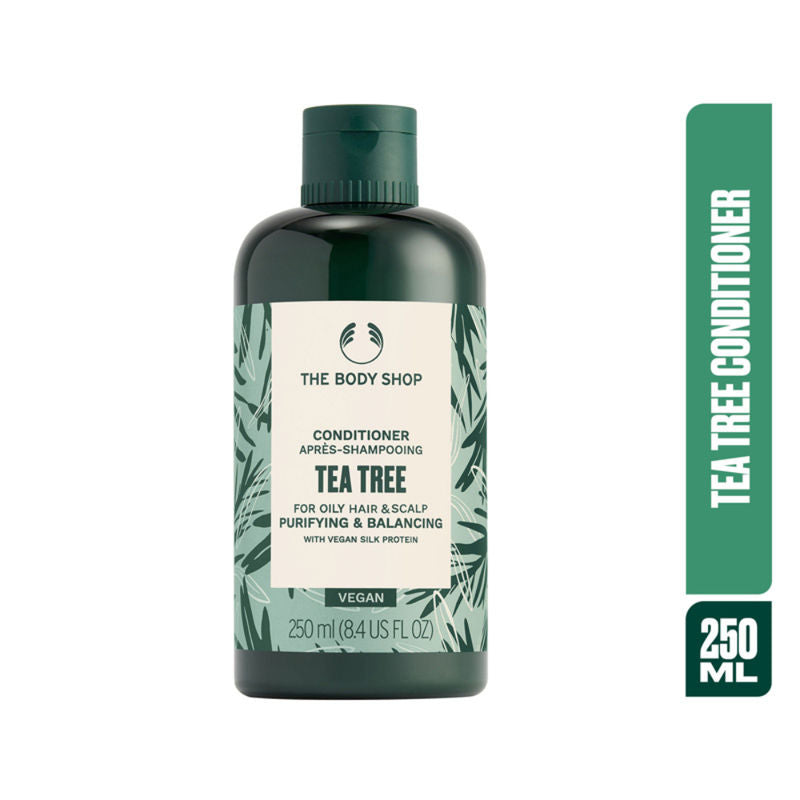
The Body Shop Tea Tree Purifying & Balancing Conditioner
Refresh oily locks with The Body Shop Tea Tree Purifying & Balancing Conditioner. Certified by The Vegan Society and made with 97% ingredients of natural origin, including organically-grown Community Fair Trade tea tree oil from Kenya and Community Fair Trade organic aloe vera from Mexico, this super conditioner leaves oily hair feeling softer, lighter, healthier and restored with moisture. Made with Vegan Silk Protein, use this seriously refreshing conditioner as part of The Body Shop’s 3-step Tea Tree routine to help repair hair from the inside out. This conditioner also comes in bottles made with 100% recycled plastic, including Community Fair Trade recycled plastic collected off the streets of Bengaluru, India, so it does good for your do and your planet.
Vegan
Silicone-free
Paraben-free
Sulfate-free
Natural
Oily Scalp
Optimized for Your Environment & Lifestyle
Nykaa
In stock
Recommended

The Body Shop Tea Tree Purifying & Balancing Conditioner
The Body Shop
the-body-shop-tea-tree-purifying-balancing-conditioner
Conditioner
10202967277861
Morning or Evening?
How often will you use this product?
Notes


Secure payment protection
Your Biodata Compatibility Analysis
Based on your 6 hair health indices and environmental factors
Poor Match
Significant incompatibilities
Growth Cycle Health Index
Hair Match
Hair Health Index Alignment
Optimal for OSI, SSI, DI, HSI
Ingredient Efficacy
Matching Ingredient Score
Environment Compatibility
Current UV, Air Quality & Humidity
Why This Works for Your Specific Profile
Damage Index:
Damaged hair structure cannot withstand product intensity causing increased breakage and further compromise
Water Quality:
Fine hair becomes weighed down and greasy from heavy formulation
Hair:
Porous structure over-absorbs product leading to buildup, stiffness, or excessive dryness
Active Lifestyle:
High activity and frequent washing rapidly strip product benefits requiring excessive reapplication
Your Hair Profile Integration
Your Hair Archetype

Density Level

Washing Frequency

Shedding Level

Oil Level
Your Hair Health Indices
Oil Secretion (OSI)
Very low oil production
Scalp Sensitivity (SSI)
Very low sensitivity
Growth Rate (CMR)
Poor metabolism rate
Damage Index (DI)
Minimal damage
Hair Strength (HSI)
Very weak strength
Softness Index (SI)
Significant improvement needed
Water & Environmental Integration

Water:


Expected Results & Timeline
Key Highlights

What is it?
Conditioner with key tea tree oil, aloe vera and vegan silk protein

Who Is It For
All Ages, All Genders

Budget
Rs. 940.37 - Rs. 1,880.74

Timeline
Visible repair with full regime
Why You’ll Love It

What Does It Help With?
Oily scalp, scalp issues, restoring moisture, frizz control

Best for
Oily Scalp

Features
Refreshingly light conditioner, Perfect for oily hair and scalp, Softens and refreshes hair, Made with 97% natural origin ingredients, Certified Vegan Society, Uses Community Fair Trade ingredients, Packaging made with 100% recycled plastic

Checks
Certified by The Vegan Society
Ingredients Overview
Ingredients List
aqua-water-eau, cetearyl-alcohol, cetrimonium-chloride, phenoxyethanol, melaleuca-alternifolia-leaf-oil-melaleuca-alternifolia-tea-tree-leaf-oil, hydroxyethylcellulose, panthenol, lecithin, propanediol, aloe-barbadensis-leaf-juice-powder, menthol, sr-spider-polypeptide-1, limonene, 1-2-hexanediol, caprylyl-glycol
Key Ingredients
Tea Tree Oil, Aloe Vera, Vegan Silk Protein, Panthenol
Ingredients Details
1-2-hexanediol
Common Name(s): 1-2-hexanediol,cosmetic active,functional ingredient
CAS Number: N/a
DESCRIPTION
What It Does: Delivers characteristic cosmetic function at recommended use concentration.
Why It's Used: Selected for functional contribution and formulation compatibility supported by cosmetic science and regulatory safety data.
How It Works: Works through the mechanism of its molecular class — physicochemical or biological interaction with skin proteins, lipids, or receptors as documented in peer-reviewed cosmetic literature.
Typically Found In: Skin care formulations
TECHNICAL DETAILS
Primary Category: Active ingredient – cosmetic active
Secondary Functions: Skin conditioning
Application Areas:

Facial Skincare

Body Care
Hair Care
Beard Care
Color Cosmetics (Makeup)
Dietary/Oral Supplements
Typical Concentration Range: 0.1%–10%
SOURCING & ETHICS
Vegan Status: Conditional
Halal Status: Yes
Source Notes: Commercially produced for cosmetic use. verify vegan/halal status with supplier.
SKIN COMPATIBILITY
Irritancy Rating: 1/5 – very low
Comedogenicity Rating: 0/5 – non-comedogenic
Sensitivity Concerns: Well-tolerated by most skin types.
Safe for Sensitive Skin: Yes
SAFETY & COMPATIBILITY
Safety Profile: Good safety profile at recommended concentrations. ewg score: 1–2.
Works Well With: Standard skincare actives
Avoid Combining With: No known significant incompatibilities
SCIENTIFIC NOTE
1-2-hexanediol has an established safety and efficacy profile within the cosmetic regulatory framework at standard use concentrations.
Last Verified: Cosing database,1-2-hexanediol technical literature
Primary Sources: 2026-03-12
Aloe Vera
Common Name(s): Aloe vera juice,aloe vera gel,aloe barbadensis
CAS Number: 85507-69-3
DESCRIPTION
What It Does: Provides acemannan-based wound healing and comprehensive moisturising skin conditioning from the quintessential healing plant.
Why It's Used: The most universally recognised natural healing plant — aloe vera's acemannan polysaccharides, vitamins, and enzymes provide a comprehensive wound healing and soothing profile with thousands of years of documented use.
How It Works: Acemannan (poly-mannose) activates dectin-1 for wound healing immune stimulation. gibberellin promotes fibroblast growth. salicylic acid derivative provides anti-inflammatory. vitamins c and e provide antioxidant. glucomannan provides humectant.
Typically Found In: After-sun products,wound healing,moisturisers,virtually all skin care categories
TECHNICAL DETAILS
Primary Category: Active ingredient – aloe vera gel
Secondary Functions: Redness reduction,anti-inflammatory,calming
Application Areas:
Facial Skincare
Body Care
Hair Care
Beard Care
Color Cosmetics (Makeup)
Dietary/Oral Supplements
Typical Concentration Range: 0.5%–99%
SOURCING & ETHICS
Vegan Status: Yes – from aloe barbadensis leaf
Halal Status: Yes
Source Notes: Plant-derived extract or synthetic.
SKIN COMPATIBILITY
Irritancy Rating: 1/5 – very low
Comedogenicity Rating: 0/5 – non-comedogenic
Sensitivity Concerns: Non-irritating; ideal for reactive and sensitive skin.
Safe for Sensitive Skin: Yes – particularly recommended for sensitive skin
SAFETY & COMPATIBILITY
Safety Profile: Excellent safety profile. ewg score: 1.
Works Well With: Ceramides,panthenol,allantoin,hyaluronic acid,centella asiatica
Avoid Combining With: No significant incompatibilities
SCIENTIFIC NOTE
Aloe vera's clinical evidence for sunburn relief is among the best for any botanical wound healing ingredient. multiple rcts demonstrate that aloe vera gel reduces healing time of first and second degree burns and sunburns, attributed primarily to acemannan's immunomodulatory wound healing activity and the anti-inflammatory salicylate derivatives providing prostaglandin inhibition.
Last Verified: Cosing database,surjushe et al. aloe vera skin review,cir safety assessment
Primary Sources: 2026-03-12
Hydroxyethylcellulose
Common Name(s): Hec,natrosol,ethylhydroxyethylcellulose
CAS Number: 9004-62-0
DESCRIPTION
What It Does: Provides non-ionic thickening compatible with anionic surfactants and electrolyte-containing formulations.
Why It's Used: Non-ionic cellulose thickener for surfactant systems where anionic/cationic thickener incompatibility is a concern.
How It Works: Hydroxyethyl substitution disrupts cellulose crystallinity enabling water solubility. non-ionic nature provides compatibility with anionic, cationic, and amphoteric surfactants. pseudoplastic rheology provides shear-thinning for dispensing. film formation from cellulose backbone.
Typically Found In: Shampoos,body washes,clear gels,surfactant systems
TECHNICAL DETAILS
Primary Category: Functional ingredient – cellulose thickener
Secondary Functions: Tewl reduction,skin plumping
Application Areas:
Facial Skincare
Body Care
Hair Care
Beard Care
Color Cosmetics (Makeup)
Dietary/Oral Supplements
Typical Concentration Range: 0.1%–3%
SOURCING & ETHICS
Vegan Status: Yes – from cellulose (plant)
Halal Status: Yes
Source Notes: Synthetic or naturally derived. excellent aqueous solubility.
SKIN COMPATIBILITY
Irritancy Rating: 1/5 – very low
Comedogenicity Rating: 0/5 – non-comedogenic
Sensitivity Concerns: Non-irritating; suitable for all skin types.
Safe for Sensitive Skin: Yes
SAFETY & COMPATIBILITY
Safety Profile: Excellent safety profile. ewg score: 1.
Works Well With: Ceramides,emollients,occlusives,glycerin,hyaluronic acid
Avoid Combining With: No significant incompatibilities
SCIENTIFIC NOTE
Hydroxyethylcellulose's non-ionic character is its primary differentiator from anionic carboxymethylcellulose – the absence of ionizable groups means hec maintains stable viscosity across ph 2-12 and at high electrolyte concentrations where carboxymethylcellulose destabilizes. this ionic independence makes hec the preferred cellulose thickener for acidic and salt-containing formulations.
Last Verified: Cosing database,ashland hec technical data,cir safety assessment
Primary Sources: 2026-03-12
Lecithin
Common Name(s): Soy lecithin,sunflower lecithin,phosphatidylcholine complex
CAS Number: 8002-43-5
DESCRIPTION
What It Does: Provides natural phospholipid emulsification with barrier-compatible delivery and liposome-forming properties.
Why It's Used: The most biologically authentic emulsifier – identical to cell membrane composition providing barrier-compatible delivery and liposome formation unavailable from synthetic emulsifiers.
How It Works: Phosphatidylcholine (pc), phosphatidylethanolamine (pe), phosphatidylinositol (pi) mixture provides hlb 7-12 for o/w emulsification. forms liposomal bilayers for active encapsulation. pc/pe/pi composition mirrors cell membrane for barrier-compatible delivery.
Typically Found In: Natural cosmetics,liposomal products,barrier repair,penetration-enhanced formulas
TECHNICAL DETAILS
Primary Category: Functional ingredient – natural phospholipid emulsifier
Secondary Functions: Skin conditioning
Application Areas:
Facial Skincare
Body Care
Hair Care
Beard Care
Color Cosmetics (Makeup)
Dietary/Oral Supplements
Typical Concentration Range: 0.5%–10%
SOURCING & ETHICS
Vegan Status: Conditional – soy lecithin (vegan); egg lecithin (not vegan)
Halal Status: Conditional – soy (halal); egg (verify)
Source Notes: Commercially produced for cosmetic use. verify vegan/halal status with supplier.
SKIN COMPATIBILITY
Irritancy Rating: 1/5 – very low
Comedogenicity Rating: 0/5 – non-comedogenic
Sensitivity Concerns: Well-tolerated by most skin types.
Safe for Sensitive Skin: Yes
SAFETY & COMPATIBILITY
Safety Profile: Good safety profile at recommended concentrations. ewg score: 1–2.
Works Well With: Standard skincare actives
Avoid Combining With: No known significant incompatibilities
SCIENTIFIC NOTE
Lecithin's phospholipid composition mirrors the composition of the stratum corneum's own lamellar bodies that deliver barrier lipids to the skin surface. this structural mimicry allows lecithin-based delivery systems to integrate seamlessly with the barrier lipid structure, exploiting the same transport pathway the skin uses for its own lipid secretion.
Last Verified: Cosing database,cir safety assessment
Primary Sources: 2026-03-12
Personalized Usage Instructions
How to Use
Step 1
Dampen your hair
Step 2
Gently massage in a walnut sized dollop of shampoo
Step 3
Work into a lather from root to tip
Step 4
Rinse thoroughly and follow with our Tea Tree Purifying & Balancing Conditioner
Medical Chemicals

Protein/Moisture
- Balanced
pH Level
- Acidic

Porosity Taget
- Normal Porosity
Customized for Your Profile
Scalp Condtions
Oil Control, pH Balanced, Sensitive Scalp
Climate Suitability
Humid, Dry, UV Protection, Pollution Shield, Summer
Clinical Claims
Visibly repairs hair using full regime of shampoo, conditioner, and scrub
Frequency
Dampen your hair. Gently massage in a walnut sized dollop of shampoo. Work into a lather from root to tip. Rinse thoroughly and follow with our Tea Tree Purifying & Balancing Conditioner.
Product Information

Certified by The Vegan Society
