
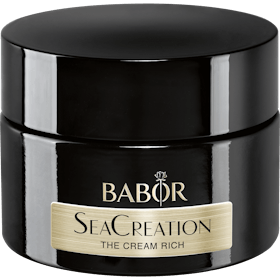

BABOR
THE CREAM RICH

THE CREAM RICH
BABOR
the-cream-rich
Moisturize
9580430688549
Morning or Evening?
How often will you use this product?
Notes


Highlights
WHAT IS IT?
Anti-aging face cream
FEATURES
Rich consistency, luxurious, anti-aging
BEST FOR
Mature Skin
CHECKS
Paraben Free
Who Is It For?
Not Specified But Likely For Adults (18+) Of All GendersWhat Does It Help With?
Reduces The Appearance Of Existing Signs Of Aging Provides Intensive Moisture Firms And Smooths SkinBudget
PremiumHow To Use
Which routine should it be used in?
Instructions:
Key Information

What BABOR Says
Product Description:
Rich luxury anti-aging face cream. A luxurious anti-aging face cream with a rich consistency.
About the Brand:
Ingredients Overview
Ingredients List
AQUA, ISOHEXADECANE, POLYGLYCERYL-3 POLYRICINOLEATE, GLYCERIN, SIMMONDSIA CHINENSIS SEED OIL, DECYL OLEATE, CERA MICROCRISTALLINA, BUTYROSPERMUM PARKII BUTTER, THERMUS THERMOPHILLUS FERMENT, TOCOPHERYL ACETATE, CETYL PALMITATE, SILICA DIMETHYL SILYLATE, MAGNESIUM SULFATE, METHYLSILANOL MANNURONATE, PANTHENOL, PHENOXYETHANOL, BUTYLENE GLYCOL, CERA ALBA, PSEUDOALTEROMONAS FERMENT EXTRACT, GLYCINE SOJA OIL, PARFUM, LIMONENE, LINALOOL, ETHYLHEXYLGLYCERIN, PRUNUS AMYGDALUS DULCIS OIL, MACROCYSTIS PYRIFERA EXTRACT, ALCOHOL, BISABOLOL, FUCUS VESICULOSUS EXTRACT, CAPRYLIC/CAPRIC TRIGLYCERIDE, SERICIN, GLYCOLIPIDS, POTASSIUM SORBATE, BENZYL ALCOHOL, SCLEROTIUM GUM, HEXYL CINNAMAL, CITRONELLOL, SODIUM BENZOATE, HYDROLYZED CONCHIOLIN PROTEIN, PLANKTON EXTRACT, SALICYLIC ACID, CITRIC ACID, PANTOLACTONE, GLUTATHIONE, ASCORBYL PALMITATE, CITRAL, ALPHA-ISOMETHYL IONONE, GERANIOL, BENZYL SALICYLATE, SODIUM HYDROXIDE, TOCOPHEROL, PRUNUS AMYGDALUS DULCIS FRUIT EXTRACT, HYDROXYCITRONELLAL, ASCORBIC ACID, GALACTARIC ACID, SORBIC ACID
Key Ingredients
MicroAlgae AP, Anti-aging protein Glycocéane GP3, BABOR thermophilus
Ingredients Details
Butyrospermum Parkii Butter
Common Name(s): Butyrospermum parkii butter,botanical carrier oil,emollient fatty acid delivery
CAS Number: N/a
DESCRIPTION
What It Does: Softens and conditions skin by integrating into sc lipid bilayers, delivers essential fatty acids (oleic, linoleic, linolenic) for barrier lipid synthesis, and provides rich, non-stripping moisturisation.
Why It's Used: Natural carrier oils provide the closest compositional match to endogenous sc lipids, delivering emolliency through genuine barrier integration rather than simple surface occlusion.
How It Works: Fatty acid triglycerides partition into sc lipid bilayers — oleic acid (c18:1) provides fluid, emollient integration; linoleic acid (c18:2) acts as essential ceramide precursor; saturated fatty acids provide more occlusive barrier reinforcement.
Typically Found In: Moisturisers,facial oils,natural skin care
TECHNICAL DETAILS
Primary Category: Functional ingredient – emollient
Secondary Functions: Barrier sealing,softening
Application Areas:

Facial Skincare
Body Care
Hair Care

Beard Care
Color Cosmetics (Makeup)
Dietary/Oral Supplements
Typical Concentration Range: 1%–100%
SOURCING & ETHICS
Vegan Status: Conditional
Halal Status: Yes
Source Notes: Plant-derived, synthetic or animal-derived. verify source.
SKIN COMPATIBILITY
Irritancy Rating: 1/5 – very low
Comedogenicity Rating: 1/5 – low; formulation-dependent
Sensitivity Concerns: Non-irritating.
Safe for Sensitive Skin: Yes
SAFETY & COMPATIBILITY
Safety Profile: Excellent safety profile. ewg score: 1.
Works Well With: Humectants,ceramides,actives as carrier
Avoid Combining With: No significant incompatibilities
SCIENTIFIC NOTE
Essential fatty acids — linoleic (c18:2, n-6) and α-linolenic (c18:3, n-3) acids — cannot be synthesised by the body; topical delivery through carrier oils provides direct substrate for ceramide and eicosanoid biosynthesis in the epidermis.
Last Verified: Cosing database,butyrospermum parkii butter carrier oil botanical review
Primary Sources: 2026-03-12
Cera Microcristallina
Common Name(s): Cera microcristallina,microcrystalline wax,structuring wax occlusive emollient
CAS Number: N/a
DESCRIPTION
What It Does: Structures lip balms and anhydrous formulations through the wax crystal network, provides occlusive barrier protection reducing tewl, and conditions skin with the emollient fatty acids and esters in the wax composition.
Why It's Used: Plant-derived wax providing cosmos-acceptable structuring for vegan formulations replacing beeswax.
How It Works: Microcrystalline wax forms a crystalline wax network above its melting point (beeswax ~62°c; carnauba ~83°c; candelilla ~68°c). on cooling, wax crystals nucleate and grow forming a three-dimensional network that immobilises liquid oils — providing semi-solid stick structure. wax melting point determines temperature stability range for product use conditions.
Typically Found In: Lip care,anhydrous balms,emulsions
TECHNICAL DETAILS
Primary Category: Functional ingredient – emollient
Secondary Functions: Barrier sealing,softening
Application Areas:
Facial Skincare
Body Care
Hair Care
Beard Care
Color Cosmetics (Makeup)
Dietary/Oral Supplements
Typical Concentration Range: 1%–30%
SOURCING & ETHICS
Vegan Status: Conditional
Halal Status: Conditional
Source Notes: Plant-derived, synthetic or animal-derived. verify source.
SKIN COMPATIBILITY
Irritancy Rating: 1/5 – very low
Comedogenicity Rating: 1/5 – low; formulation-dependent
Sensitivity Concerns: Non-irritating.
Safe for Sensitive Skin: Yes
SAFETY & COMPATIBILITY
Safety Profile: Excellent safety profile. ewg score: 1.
Works Well With: Humectants,ceramides,actives as carrier
Avoid Combining With: No significant incompatibilities
SCIENTIFIC NOTE
Carnauba (highest melting wax at ~83°c) provides the hardest, most heat-stable wax structure; beeswax (~62°c) provides more pliable, skin-compatible structure; candelilla (~68°c) provides the vegan beeswax alternative used in certified natural and vegan formulations.
Last Verified: Cosing database,natural wax structuring emollient review
Primary Sources: 2026-03-12
Decyl Oleate
Common Name(s): Decyl oleate,cosmetic active,functional ingredient
CAS Number: N/a
DESCRIPTION
What It Does: Delivers characteristic cosmetic function at recommended use concentration.
Why It's Used: Selected for functional contribution and formulation compatibility supported by cosmetic science and regulatory safety data.
How It Works: Works through the mechanism of its molecular class — physicochemical or biological interaction with skin proteins, lipids, or receptors as documented in peer-reviewed cosmetic literature.
Typically Found In: Skin care formulations
TECHNICAL DETAILS
Primary Category: Active ingredient – cosmetic active
Secondary Functions: Skin conditioning
Application Areas:
Facial Skincare
Body Care
Hair Care
Beard Care
Color Cosmetics (Makeup)
Dietary/Oral Supplements
Typical Concentration Range: 0.1%–10%
SOURCING & ETHICS
Vegan Status: Conditional
Halal Status: Yes
Source Notes: Commercially produced for cosmetic use. verify vegan/halal status with supplier.
SKIN COMPATIBILITY
Irritancy Rating: 1/5 – very low
Comedogenicity Rating: 0/5 – non-comedogenic
Sensitivity Concerns: Well-tolerated by most skin types.
Safe for Sensitive Skin: Yes
SAFETY & COMPATIBILITY
Safety Profile: Good safety profile at recommended concentrations. ewg score: 1–2.
Works Well With: Standard skincare actives
Avoid Combining With: No known significant incompatibilities
SCIENTIFIC NOTE
Decyl oleate has an established safety and efficacy profile within the cosmetic regulatory framework at standard use concentrations.
Last Verified: Cosing database,decyl oleate technical literature
Primary Sources: 2026-03-12
Glycerin
Common Name(s): Glycerol,glycerine,1,2,3-propanetriol
CAS Number: 56-81-5
DESCRIPTION
What It Does: Glycerin pulls water from the environment and deeper skin layers into the outer skin layer (epidermis), boosting moisture levels and keeping skin soft, smooth, and plump.
Why It's Used: It is used in virtually every moisturizer, serum, and cleanser because it is highly effective at hydrating skin, is well-tolerated by all skin types, and enhances the texture and spreadability of formulations.
How It Works: As a humectant, glycerin forms hydrogen bonds with water molecules, trapping them in the skin. it also reinforces the skin barrier by integrating into lipid structures between skin cells.
Typically Found In: Moisturizers,serums,cleansers,toners,sheet masks,sunscreens,body lotions,shampoos,conditioners
TECHNICAL DETAILS
Primary Category: Humectant
Secondary Functions: Skin barrier support,emollient,solvent
Application Areas:
Facial Skincare
Body Care
Hair Care
Beard Care
Color Cosmetics (Makeup)
Dietary/Oral Supplements
Typical Concentration Range: 1%–30% (typical: 3–10%)
SOURCING & ETHICS
Vegan Status: Yes – plant-derived (coconut, soy, palm) or synthetic
Halal Status: Yes – when plant-derived or synthetic; verify source with supplier
Source Notes: Derived from plant oils via hydrolysis or saponification; synthetic versions also available. palm-derived glycerin carries sustainability concerns.
SKIN COMPATIBILITY
Irritancy Rating: 1/5 – very low; non-irritating at all standard concentrations
Comedogenicity Rating: 0/5 – non-comedogenic
Sensitivity Concerns: Extremely rare allergic reactions; generally safe for all skin types including sensitive and baby skin
Safe for Sensitive Skin: Yes
SAFETY & COMPATIBILITY
Safety Profile: Widely recognized as safe. ewg hazard score: 1. no significant concerns for irritation, sensitization, or toxicity at typical concentrations (up to 50%).
Works Well With: Hyaluronic acid,ceramides,niacinamide,panthenol,urea,peptides,retinol,ahas/bhas
Avoid Combining With: No known incompatibilities at standard concentrations
SCIENTIFIC NOTE
Glycerin is an endogenous skin component found naturally in the stratum corneum. aquaporin-3 channels in keratinocytes facilitate glycerin transport, making it integral to natural skin hydration pathways.
Last Verified: Cosing database,cir safety assessment,ewg skin deep,inci decoder
Primary Sources: 2026-03-12
