

The Derma co.
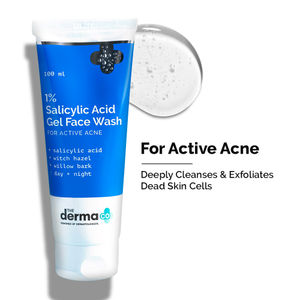
The Derma Co. 1% Salicylic Acid Gel Face Wash with Salicylic Acid & Witch Hazel For Active Acne - 100 ml

The Derma Co. 1% Salicylic Acid Gel Face Wash with Salicylic Acid & Witch Hazel For Active Acne - 100 ml
The Derma co.
the-derma-co-1-salicylic-acid-gel-face-wash-with-salicylic-acid-witch-hazel-for-active-acne-100-ml
Cleanse
10084942512421
Morning or Evening?
How often will you use this product?
Notes


Highlights
WHAT IS IT?
1% Salicylic Acid Gel Face Wash, 8 Key Ingredients
FEATURES
Deeply penetrates pores to eliminate acne-causing bacteria and impurities, lightweight and easy to absorb, anti-inflammatory properties to fade red-inflamed pimples, prevents acne breakouts, promotes clearer and brighter skin
BEST FOR
oily
CHECKS
Does not contain common allergens, fragrance-free, PEG-free
Who Is It For?
All Genders Suitable For Acne-prone And Sensitive Skin Age Range Not SpecifiedWhat Does It Help With?
Acne Pimples Blackheads Open Pores Skin Inflammation Dull SkinBudget
Affordable (under ₹30 Usd Equivalent Approx.)How To Use
Which routine should it be used in?
Instructions:
Key Information


What The Derma co. Says
Product Description:
How about a cleanser that also exfoliates? Make way for 1% Salicylic Acid Gel Face Wash with Witch Hazel and Willow Bark that deeply penetrates pores to eliminate acne-causing bacteria and impurities. The 1% concentration of Salicylic Acid in our gel face wash makes it extremely lightweight and easy to absorb. Salicylic Acid also has anti-inflammatory properties that play an important role in fading away red-inflamed pimples. Use it regularly to prevent acne breakouts and say hello to clearer and brighter skin. Ready for a filter-free selfie?
About the Brand:
Ingredients Overview
Ingredients List
Aqua, Sodium Alpha Olefin Sulfonate, Cocamidopropyl Betaine, Glycerin, Cocamide MEA, Sodium Lactate, Salicylic Acid, Salix Alba (Willow) Bark Extract, Hamamelis Virginiana (Witch Hazel) Extract, Coco-Glucoside,Glyceryl Oleate, PEG-120, Methyl Glucose Dioleate, Sodium Chloride, Phenoxyethanol, Triethylene glycol and Disodium EDTA
Key Ingredients
Salicylic Acid, Hyaluronic Acid, Kojic Acid, Niacinamide, Cica, Clay, AHA-BHA
Ingredients Details
Cocamide Mea
Common Name(s): Cocamide mea,fatty acid alkanolamide,foam booster viscosity builder
CAS Number: N/a
DESCRIPTION
What It Does: Boosts foam quality, stabilises foam lamellae, builds viscosity in surfactant systems, and reduces surface tension in cleansing formulations.
Why It's Used: Mea/mipa alkanolamides provide the same foam and viscosity benefits without n-nitrosamine concerns — the preferred choice in modern surfactant systems.
How It Works: Amide nitrogen lone pair inserts at foam bubble air-water interface alongside the fatty acid chain — the amide geometry stabilises foam lamellae through the gibbs-marangoni effect reducing drainage. viscosity building in surfactant systems arises from rod micelle formation above critical packing parameter.
Typically Found In: Shampoos,body wash,cleansers
TECHNICAL DETAILS
Primary Category: Active ingredient – cosmetic active
Secondary Functions: Skin conditioning
Application Areas:

Facial Skincare

Body Care
Hair Care
Beard Care
Color Cosmetics (Makeup)
Dietary/Oral Supplements
Typical Concentration Range: 1%–5%
SOURCING & ETHICS
Vegan Status: Conditional - supplier confirmation required
Halal Status: Unverified - supplier confirmation required
Source Notes: Commercially produced for cosmetic use. verify vegan/halal status with supplier. [audit 2026-07-29 rev2: the record's own source_notes does not assert a non-animal origin, or instructs the reader to verify with the supplier; "yes" asserts knowledge the record does not hold. determination requires shariah-panel sign-off.]
SKIN COMPATIBILITY
Irritancy Rating: 1/5 – very low
Comedogenicity Rating: 0/5 – non-comedogenic
Sensitivity Concerns: Well-tolerated by most skin types.
Safe for Sensitive Skin: Yes
SAFETY & COMPATIBILITY
Safety Profile: Good safety profile at recommended concentrations. ewg score: 1–2.
Works Well With: Standard skincare actives
Avoid Combining With: No known significant incompatibilities
SCIENTIFIC NOTE
Mea/mipa equivalents are not subject to nitrosamine restrictions and are the recommended modern alternative to dea in surfactant systems.
Last Verified: 2026-03-12
Primary Sources: Cosing database,cocamide mea alkanolamide review
Cocamidopropyl Betaine
Common Name(s): Capb,cocoamidopropyl betaine,coconut betaine
CAS Number: 61789-40-0
DESCRIPTION
What It Does: Boosts foam, enhances mildness, and conditions skin and hair when combined with primary surfactants.
Why It's Used: The standard foam booster and mildness enhancer in virtually all shampoos, body washes, and facial cleansers – provides synergistic mildness improvement with anionic surfactants.
How It Works: Amphoteric (zwitterionic) character provides positive charge interaction with hair keratin for antistatic conditioning. reduces irritation of co-formulated anionic surfactants via ionic complex formation. foam stabilization via bilayer reinforcement in foam lamellae.
Typically Found In: Shampoos,body washes,facial cleansers,baby products
TECHNICAL DETAILS
Primary Category: Functional ingredient – amphoteric surfactant
Secondary Functions: Skin conditioning
Application Areas:
Facial Skincare
Body Care
Hair Care
Beard Care
Color Cosmetics (Makeup)
Dietary/Oral Supplements
Typical Concentration Range: 2%–15%
SOURCING & ETHICS
Vegan Status: Conditional - feedstock declaration required
Halal Status: Unverified - feedstock declaration required (plant, animal and petrochemical routes all exist)
Source Notes: Commercially produced for cosmetic use. verify vegan/halal status with supplier. [audit 2026-07-29 rev2: origin-dependent: the same inci exists in plant, animal and petrochemical versions and the name does not discriminate. determination requires shariah-panel sign-off.]
SKIN COMPATIBILITY
Irritancy Rating: 1/5 – very low
Comedogenicity Rating: 0/5 – non-comedogenic
Sensitivity Concerns: Well-tolerated by most skin types.
Safe for Sensitive Skin: Yes
SAFETY & COMPATIBILITY
Safety Profile: Good safety profile at recommended concentrations. ewg score: 1–2.
Works Well With: Standard skincare actives
Avoid Combining With: No known significant incompatibilities
SCIENTIFIC NOTE
Capb's mildness-enhancing synergy with sls has a molecular mechanism: capb's positive imidazoline head group forms an ion pair complex with sls's anionic sulfate group, reducing sls's free monomer concentration (the irritation-causing species) without significantly reducing micelle-forming capacity (the cleansing species).
Last Verified: 2026-03-12
Primary Sources: Cosing database,ananthapadmanabhan surfactant review,cir safety assessment
Coco-glucoside
Common Name(s): Coconut glucoside,apg c8-c16
CAS Number: 68515-73-1
DESCRIPTION
What It Does: Provides gentle, natural-origin cleansing with good foam from mixed coconut chain alkyl glucosides.
Why It's Used: Widely used natural surfactant for green beauty formulations requiring good foam performance with natural-origin and mild credentials.
How It Works: Mixed c8-c16 fatty alcohol chain lengths from coconut provide broader foam stability than single-chain glucosides. non-ionic glucoside headgroup provides mildness. better detergency and rinsing than individual chain-length apgs due to mixed chain distribution.
Typically Found In: Natural shampoos,body washes,facial cleansers
TECHNICAL DETAILS
Primary Category: Functional ingredient – coconut alkyl glucoside
Secondary Functions: Skin conditioning
Application Areas:
Facial Skincare
Body Care
Hair Care
Beard Care
Color Cosmetics (Makeup)
Dietary/Oral Supplements
Typical Concentration Range: 2%–20%
SOURCING & ETHICS
Vegan Status: Conditional - supplier confirmation required
Halal Status: Unverified - supplier confirmation required
Source Notes: Commercially produced for cosmetic use. verify vegan/halal status with supplier. [audit 2026-07-29 rev2: the record's own source_notes does not assert a non-animal origin, or instructs the reader to verify with the supplier; "yes" asserts knowledge the record does not hold. determination requires shariah-panel sign-off.]
SKIN COMPATIBILITY
Irritancy Rating: 1/5 – very low
Comedogenicity Rating: 0/5 – non-comedogenic
Sensitivity Concerns: Well-tolerated by most skin types.
Safe for Sensitive Skin: Yes
SAFETY & COMPATIBILITY
Safety Profile: Good safety profile at recommended concentrations. ewg score: 1–2.
Works Well With: Standard skincare actives
Avoid Combining With: No known significant incompatibilities
SCIENTIFIC NOTE
Coco-glucoside's natural chain length distribution (c8-c16) provides synergistic surfactant effects where different chain lengths optimize different properties: shorter chains provide initial foam burst, longer chains provide foam stability and soil removal, creating better overall performance than any single chain length alone.
Last Verified: 2026-03-12
Primary Sources: Cosing database,cir safety assessment
Glycerin
Common Name(s): Glycerol,glycerine,1,2,3-propanetriol
CAS Number: 56-81-5
DESCRIPTION
What It Does: Glycerin pulls water from the environment and deeper skin layers into the outer skin layer (epidermis), boosting moisture levels and keeping skin soft, smooth, and plump.
Why It's Used: It is used in virtually every moisturizer, serum, and cleanser because it is highly effective at hydrating skin, is well-tolerated by all skin types, and enhances the texture and spreadability of formulations.
How It Works: As a humectant, glycerin forms hydrogen bonds with water molecules, trapping them in the skin. it also reinforces the skin barrier by integrating into lipid structures between skin cells.
Typically Found In: Moisturizers,serums,cleansers,toners,sheet masks,sunscreens,body lotions,shampoos,conditioners
TECHNICAL DETAILS
Primary Category: Humectant
Secondary Functions: Skin barrier support,emollient,solvent
Application Areas:
Facial Skincare
Body Care
Hair Care
Beard Care
Color Cosmetics (Makeup)
Dietary/Oral Supplements
Typical Concentration Range: 1%–30% (typical: 3–10%)
SOURCING & ETHICS
Vegan Status: Conditional - feedstock declaration required
Halal Status: Unverified - feedstock declaration required (plant, animal and petrochemical routes all exist)
Source Notes: Derived from plant oils via hydrolysis or saponification; synthetic versions also available. palm-derived glycerin carries sustainability concerns. [audit 2026-07-29 rev2: origin-dependent: the same inci exists in plant, animal and petrochemical versions and the name does not discriminate. determination requires shariah-panel sign-off.]
SKIN COMPATIBILITY
Irritancy Rating: 1/5 – very low; non-irritating at all standard concentrations
Comedogenicity Rating: 0/5 – non-comedogenic
Sensitivity Concerns: Extremely rare allergic reactions; generally safe for all skin types including sensitive and baby skin
Safe for Sensitive Skin: Yes
SAFETY & COMPATIBILITY
Safety Profile: Widely recognized as safe. ewg hazard score: 1. no significant concerns for irritation, sensitization, or toxicity at typical concentrations (up to 50%).
Works Well With: Hyaluronic acid,ceramides,niacinamide,panthenol,urea,peptides,retinol,ahas/bhas
Avoid Combining With: No known incompatibilities at standard concentrations
SCIENTIFIC NOTE
Glycerin is an endogenous skin component found naturally in the stratum corneum. aquaporin-3 channels in keratinocytes facilitate glycerin transport, making it integral to natural skin hydration pathways.
Last Verified: 2026-03-12
Primary Sources: Cosing database,cir safety assessment,ewg skin deep,inci decoder