
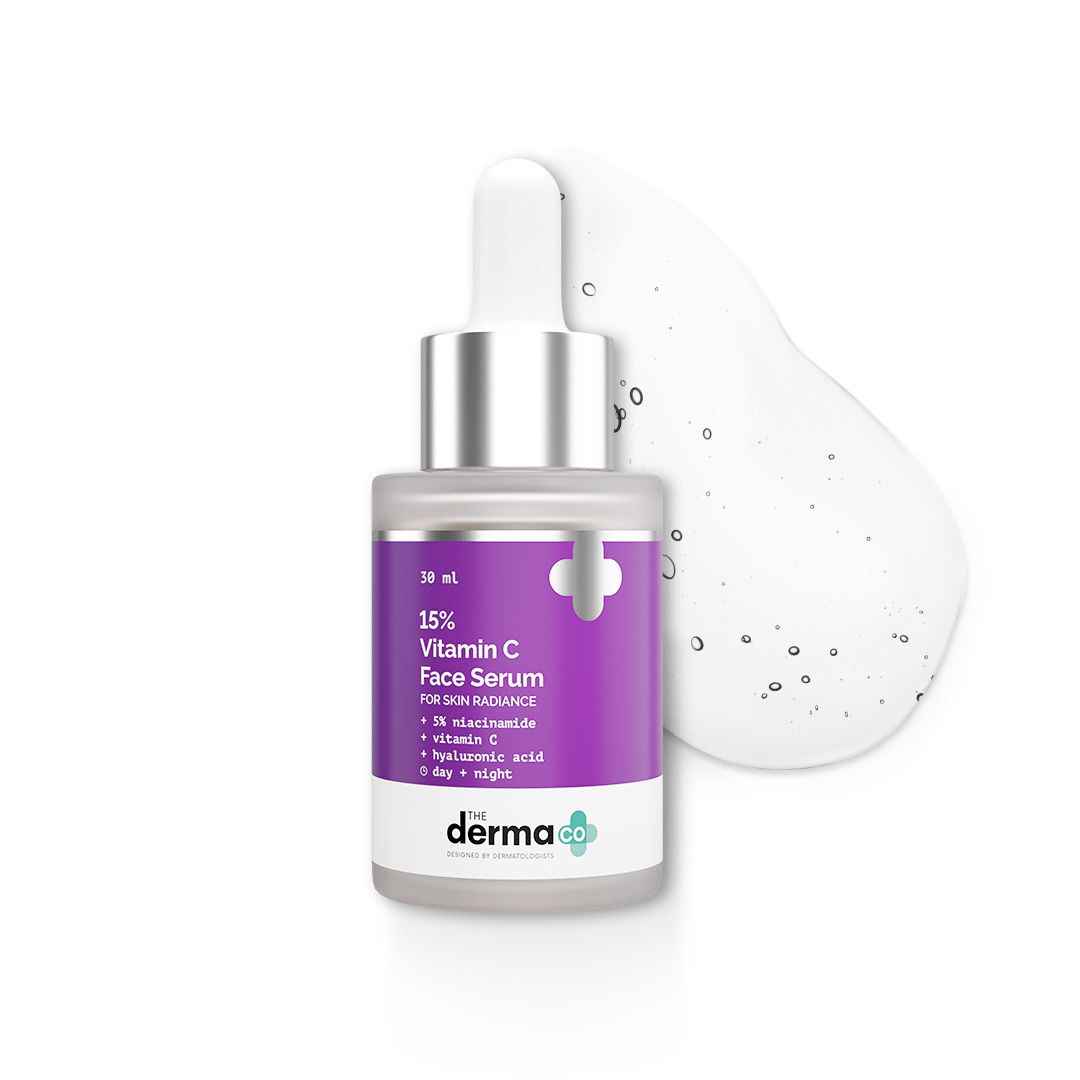

The Derma co.
The Derma Co. 15% Vitamin C Face Serum For Skin Radiance | 5% Niacinamide & Hyaluronic Acid | Non Irritating, Non Sticky |Brightening Serum for Dull Skin|For Men and Women -30 ml

The Derma Co. 15% Vitamin C Face Serum For Skin Radiance | 5% Niacinamide & Hyaluronic Acid | Non Irritating, Non Sticky |Brightening Serum for Dull Skin|For Men and Women -30 ml
The Derma co.
the-derma-co-15-vitamin-c-face-serum-for-skin-radiance-5-niacinamide-hyaluronic-acid-non-irritating-non-sticky-brightening-serum-for-dull-skin-for-men-and-women-30-ml
Serum
10084758454565
Morning or Evening?
How often will you use this product?
Notes


Highlights
WHAT IS IT?
Serum with 5 main active ingredients
FEATURES
Brightens skin, hydrates, firms, non-irritating, non-sticky, minimizes pores, enhances complexion, protects skin barrier
BEST FOR
sensitive
CHECKS
No irritants mentioned
Who Is It For?
For Men And Women Adults (age Range Not Specified Explicitly)What Does It Help With?
Dull Skin Uneven Complexion Open Pores DehydrationBudget
Mid-range ($30-$75)How To Use
Which routine should it be used in?
Instructions:
Key Information


What The Derma co. Says
Product Description:
Discover the secret to radiant healthylooking skin with The Derma Co.'s 15% Vitamin C serum. Enjoy a visibly brighter, smoother and firmer skin with our powerful serum packed with the potency of 5% Niacinamide and Hyaluronic acid. This lightweight, non-greasy serum gets seamlessly absorbed giving you a second-skin feel. Powered by the synergistic blend of Vitamin C, Niacinamide, Hyaluronic acid, Ferulic acid and Ceramides, this serum not only brightens but also hydrates, firms and protects your skin. With its ability to minimize open pores, enhance overall complexion and safeguard your skin's barrier function, this serum is an absolute gamechanger. And the best part? You can experience visible results in just 3-6 weeks! Imagine revealing your most radiant healthylooking self – a FilterFree complexion that glows with confidence.
About the Brand:
Ingredients Overview
Ingredients List
Purified water, 3-o-Ethyl Ascorbic Acid, Propanediol, Niacinamide, glycerin, Diethylene Glycol Monoethyl Ether, 1,2-Hexanediol, Sodium Hyaluronate, Potassium Hyaluronate, Hydroxypropyltrimonium Hyaluronate, Hydrolyzed Hyaluronic Acid, Hyaluronic Acid, Hydrolyzed Sodium Hyaluronate, Sodium Hyaluronate Crosspolymer, Pentylene Glycol, Butylene Glycol, Sodium Retinoyl Hyaluronate, Zinc Hydrolyzed Hyaluronate, Sodium Acetylated Hyaluronate, Laminaria Digitata Extract, Cetyl-Pg Hydroxyethyl Palmitamide, Ceramide 1, Ceramide 2, Ceramide 3, Ceramide 4, Ceramide 6 II, Dimethysilanol Hyaluronate, Sodium Benzoate, Ascorbylpropyl Hydrolyzed Hyaluronate, Ascorbyl Propyl Hyaluronate, Ferulic Acid, Ethylhexylglycerin, Phenoxyethanol, Acacia Senegal Gum, Xanthan Gum, Citric Acid, Panthenol, Sodium Metabisulfite
Key Ingredients
Vitamin C, Niacinamide, Hyaluronic acid, Ferulic acid, Ceramides
Ingredients Details
1-2-hexanediol
Common Name(s): 1-2-hexanediol,cosmetic active,functional ingredient
CAS Number: N/a
DESCRIPTION
What It Does: Delivers characteristic cosmetic function at recommended use concentration.
Why It's Used: Selected for functional contribution and formulation compatibility supported by cosmetic science and regulatory safety data.
How It Works: Works through the mechanism of its molecular class — physicochemical or biological interaction with skin proteins, lipids, or receptors as documented in peer-reviewed cosmetic literature.
Typically Found In: Skin care formulations
TECHNICAL DETAILS
Primary Category: Active ingredient – cosmetic active
Secondary Functions: Skin conditioning
Application Areas:

Facial Skincare

Body Care
Hair Care
Beard Care
Color Cosmetics (Makeup)
Dietary/Oral Supplements
Typical Concentration Range: 0.1%–10%
SOURCING & ETHICS
Vegan Status: Conditional - supplier confirmation required
Halal Status: Unverified - supplier confirmation required
Source Notes: Commercially produced for cosmetic use. verify vegan/halal status with supplier. [audit 2026-07-29 rev2: the record's own source_notes does not assert a non-animal origin, or instructs the reader to verify with the supplier; "yes" asserts knowledge the record does not hold. determination requires shariah-panel sign-off.]
SKIN COMPATIBILITY
Irritancy Rating: 1/5 – very low
Comedogenicity Rating: 0/5 – non-comedogenic
Sensitivity Concerns: Well-tolerated by most skin types.
Safe for Sensitive Skin: Yes
SAFETY & COMPATIBILITY
Safety Profile: Good safety profile at recommended concentrations. ewg score: 1–2.
Works Well With: Standard skincare actives
Avoid Combining With: No known significant incompatibilities
SCIENTIFIC NOTE
1-2-hexanediol has an established safety and efficacy profile within the cosmetic regulatory framework at standard use concentrations.
Last Verified: 2026-03-12
Primary Sources: Cosing database,1-2-hexanediol technical literature
3-o-ethyl Ascorbic Acid
Common Name(s): 3-o-ethyl ascorbic acid
DESCRIPTION
What It Does: Loosens corneocyte adhesion in the stratum corneum, accelerating cell turnover, refining skin texture, and improving radiance.
Why It's Used: Organic acids at cosmetic ph values provide controlled keratolytic exfoliation that improves skin texture, pore appearance, and radiance without mechanical irritation.
How It Works: At appropriate ph, the acid's undissociated form penetrates the stratum corneum and dissolves the ionic bonds between corneocyte desmosomes (calcium chelation mechanism), facilitating controlled desquamation and cell renewal.
Typically Found In: Toners,exfoliants,serums,peels,cleansers
TECHNICAL DETAILS
Primary Category: Exfoliants
Secondary Functions: Brightening,keratolytic
Application Areas:
Facial Skincare
Body Care
Hair Care
Beard Care
Color Cosmetics (Makeup)
Dietary/Oral Supplements
Typical Concentration Range: 0.5–20%
SOURCING & ETHICS
Vegan Status: Yes
Halal Status: Yes
Source Notes: Synthetic or plant-derived acid; no animal components.
SKIN COMPATIBILITY
Irritancy Rating: 2
Comedogenicity Rating: 0
Sensitivity Concerns: May cause irritation or stinging in sensitive or barrier-compromised skin at high concentrations; patch test recommended.
Safe for Sensitive Skin: Conditional
SAFETY & COMPATIBILITY
Safety Profile: Safe within recommended ph and concentration ranges. sensitization risk increases above 10% aha. patch test recommended for sensitive skin. mildly irritating to some individuals at typical cosmetic use concentrations.
Works Well With: Niacinamide,hyaluronic acid,ceramides,vitamin c
Avoid Combining With: High concentrations on sensitive/broken skin; avoid with physical exfoliants
SCIENTIFIC NOTE
Cosmetic acids function at the pka boundary: only the undissociated acid (rcooh) penetrates the stratum corneum lipid barrier, while the ionized carboxylate (rcoo⁻) does not. the henderson-hasselbalch equation governs the fraction of active species at formulation ph; typically 0.5–3.0% undissociated acid provides efficacy while minimizing irritation.
Last Verified: 2025-01-15
Primary Sources: Cosing eu database; pcpc cosmetic ingredient safety reviews; ingredient-specific safety and efficacy literature
Acacia Senegal Gum
Common Name(s): Acacia senegal gum,cosmetic active,functional ingredient
CAS Number: N/a
DESCRIPTION
What It Does: Delivers characteristic cosmetic function at recommended use concentration.
Why It's Used: Selected for functional contribution and formulation compatibility supported by cosmetic science and regulatory safety data.
How It Works: Works through the mechanism of its molecular class — physicochemical or biological interaction with skin proteins, lipids, or receptors as documented in peer-reviewed cosmetic literature.
Typically Found In: Skin care formulations
TECHNICAL DETAILS
Primary Category: Active ingredient – cosmetic active
Secondary Functions: Skin conditioning
Application Areas:
Facial Skincare
Body Care
Hair Care
Beard Care
Color Cosmetics (Makeup)
Dietary/Oral Supplements
Typical Concentration Range: 0.1%–10%
SOURCING & ETHICS
Vegan Status: Conditional - supplier confirmation required
Halal Status: Unverified - supplier confirmation required
Source Notes: Commercially produced for cosmetic use. verify vegan/halal status with supplier. [audit 2026-07-29 rev2: the record's own source_notes does not assert a non-animal origin, or instructs the reader to verify with the supplier; "yes" asserts knowledge the record does not hold. determination requires shariah-panel sign-off.]
SKIN COMPATIBILITY
Irritancy Rating: 1/5 – very low
Comedogenicity Rating: 0/5 – non-comedogenic
Sensitivity Concerns: Well-tolerated by most skin types.
Safe for Sensitive Skin: Yes
SAFETY & COMPATIBILITY
Safety Profile: Good safety profile at recommended concentrations. ewg score: 1–2.
Works Well With: Standard skincare actives
Avoid Combining With: No known significant incompatibilities
SCIENTIFIC NOTE
Acacia senegal gum has an established safety and efficacy profile within the cosmetic regulatory framework at standard use concentrations.
Last Verified: 2026-03-12
Primary Sources: Cosing database,acacia senegal gum technical literature
Ascorbyl Propyl Hyaluronate
Common Name(s): Ascorbyl propyl hyaluronate,ascorbyl propyl hyaluronate,ascorbyl-conjugated signal peptide or amino acid active,anti-aging bioactive
CAS Number: N/a
DESCRIPTION
What It Does: Stimulates collagen synthesis, inhibits mmp-mediated matrix degradation, or provides amino acid-specific skin metabolic support — delivering measurable anti-aging benefit at ppm concentrations.
Why It's Used: Precision sequence-receptor pharmacology enables mechanism-based anti-aging claims — defined amino acid sequence targeting specific receptors with quantifiable binding kinetics.
How It Works: Peptide receptor binding → kinase cascade → col1a1/col3a1 upregulation + mmp-1/mmp-3 downregulation. spps synthesis provides >98% sequence purity for reproducible receptor binding.
Typically Found In: Anti-aging serums,collagen products
TECHNICAL DETAILS
Primary Category: Active ingredient – peptide
Secondary Functions: Collagen synthesis,anti-aging
Application Areas:
Facial Skincare
Body Care
Hair Care
Beard Care
Color Cosmetics (Makeup)
Dietary/Oral Supplements
Typical Concentration Range: 1–5000 ppm
SOURCING & ETHICS
Vegan Status: Conditional - feedstock declaration required
Halal Status: Unverified - feedstock declaration required (plant, animal and petrochemical routes all exist)
Source Notes: Synthetically produced via solid-phase peptide synthesis (spps). [audit 2026-07-29 rev2: origin-dependent: the same inci exists in plant, animal and petrochemical versions and the name does not discriminate. determination requires shariah-panel sign-off.]
SKIN COMPATIBILITY
Irritancy Rating: 1/5 – very low
Comedogenicity Rating: 0/5 – non-comedogenic
Sensitivity Concerns: Non-irritating at recommended concentrations.
Safe for Sensitive Skin: Yes
SAFETY & COMPATIBILITY
Safety Profile: Excellent safety profile. ewg score: 1.
Works Well With: Retinoids,niacinamide,vitamin c,hyaluronic acid
Avoid Combining With: Strong acids below ph 3.5; oxidising agents
SCIENTIFIC NOTE
Conjugated peptides provide dual mechanism: the peptide sequence provides receptor-mediated collagen synthesis stimulation while the aromatic/vitamin conjugate adds independent antioxidant or metabolic cofactor activity.
Last Verified: 2026-03-22
Primary Sources: Cosing database,ascorbyl propyl hyaluronate signal peptide anti-aging review