

The Derma co.
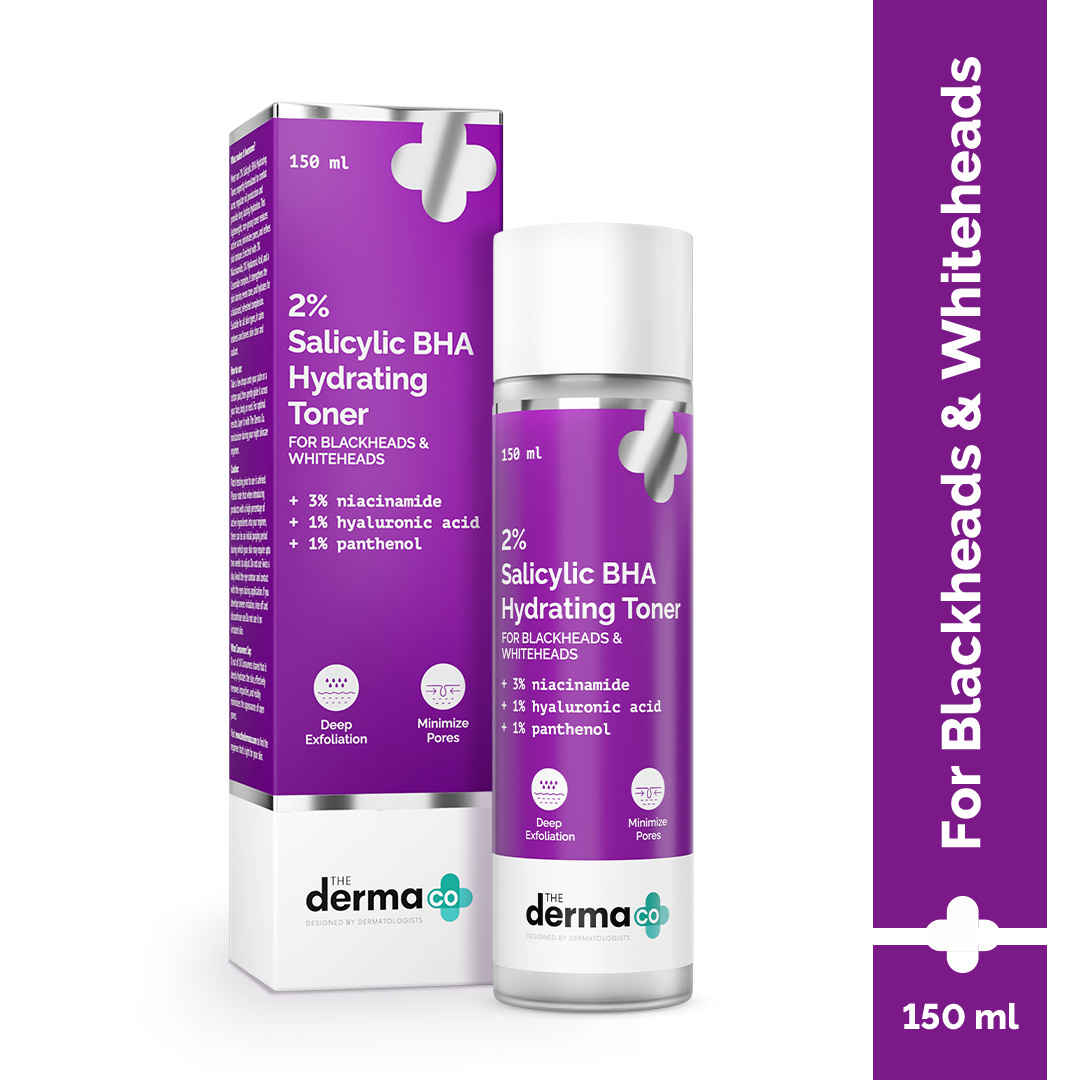
The Derma Co. 2% Salicylic BHA Hydrating Toner - 150 ml

The Derma Co. 2% Salicylic BHA Hydrating Toner - 150 ml
The Derma co.
the-derma-co-2-salicylic-bha-hydrating-toner-150-ml
Tone
10084758585637
Morning or Evening?
How often will you use this product?
Notes


Highlights
WHAT IS IT?
Hydrating Toner with 4 key ingredients
FEATURES
Dermat-approved, removes blackheads & whiteheads, exfoliates dead skin, fades dark spots, controls excess oil, unclogs pores, hydrates and soothes skin, lightweight water-like texture, suitable for all skin types
BEST FOR
All skin types (Inferred Sensitive skin friendly tag implies suit for sensitive skin)
CHECKS
Who Is It For?
What Does It Help With?
Blackheads Whiteheads Uneven Texture Dark Spots Excess Oil Hydration Soothing SkinBudget
Affordable (under $30)How To Use
Which routine should it be used in?
Instructions:
Key Information


What The Derma co. Says
Product Description:
When the power of 4 potent actives combine, magic science happens! Introducing The Derma Co. 2% Salicylic BHA Hydrating Toner a dermat-approved toner that treats the extras on your skin, leaving it smooth & hydrated. With a powerful mix of 4 ingredients, its all-set to be an essential step in your everyday skincare or makeup routine. With 4 actives working together in perfect synergy, it stands out in the world of skincare. 2% Salicylic Acid takes the lead and remove blackheads & whiteheads , removing dead skin and reveal a smoother complexion. 3% Niacinamide fades dark spots, controls excess oil & unclogs the pores for a smoother, clearer skin. Meanwhile, 1% Hyaluronic Acid & 1% Panthenol hydrates & soothes the skin, leaving it plump with long-lasting hydration. Texture: light, Absorption: heavy! With the lightweight, water-like texture, it absorbs easily into the skin and offers deep hydration. What sets this toner apart? Its dermat-approved and suitable for all skin types. Add it to your skincare routine and get it ready for everything that might come its way!
About the Brand:
Ingredients Overview
Ingredients List
Purified Water, Propylene Glycol, Propanediol, Niacinamide, Glycerin Salicylic Acid, Ethylhexylglycerin (And) Phenoxyethanol, Sodium Hydroxide, Trehalose, Panthenol, 1,2-Hexanediol, Sodium Hyaluronate, Potassium Hyaluronate, Hydroxypropyltrimonium Hyaluronate, Hydrolyzed Hyaluronic Acid, Hyaluronic Acid, Hydrolyzed Sodium Hyaluronate, Sodium Hyaluronate Crosspolymer, Sodium Retinoyl Hyaluronate, Zinc Hydrolyzed Hyaluronate, Sodium Acetylated Hyaluronate, Ascorbylpropyl Hydrolyzed Hyaluronate, Ascorbyl Propyl Hyaluronate, Dimethylsilanol Hyaluronate, Sodium Benzoate, Pentylene Glycol, Butylene Glycol, Laminaria Digitata Extract & Cetyl-Pg Hydroxyethyl Palmitamide & Ceramide 1 & Ceramide 2 & Ceramide 3 & Ceramide 4 & Ceramide 6 Ii, Hydroxyethylcellulose, Disodium Edta
Key Ingredients
salicylic-acid,niacinamide,hyaluronic-acid,panthenol
Ingredients Details
1-2-hexanediol
Common Name(s): 1-2-hexanediol,cosmetic active,functional ingredient
CAS Number: N/a
DESCRIPTION
What It Does: Delivers characteristic cosmetic function at recommended use concentration.
Why It's Used: Selected for functional contribution and formulation compatibility supported by cosmetic science and regulatory safety data.
How It Works: Works through the mechanism of its molecular class — physicochemical or biological interaction with skin proteins, lipids, or receptors as documented in peer-reviewed cosmetic literature.
Typically Found In: Skin care formulations
TECHNICAL DETAILS
Primary Category: Active ingredient – cosmetic active
Secondary Functions: Skin conditioning
Application Areas:

Facial Skincare

Body Care
Hair Care
Beard Care
Color Cosmetics (Makeup)
Dietary/Oral Supplements
Typical Concentration Range: 0.1%–10%
SOURCING & ETHICS
Vegan Status: Conditional
Halal Status: Yes
Source Notes: Commercially produced for cosmetic use. verify vegan/halal status with supplier.
SKIN COMPATIBILITY
Irritancy Rating: 1/5 – very low
Comedogenicity Rating: 0/5 – non-comedogenic
Sensitivity Concerns: Well-tolerated by most skin types.
Safe for Sensitive Skin: Yes
SAFETY & COMPATIBILITY
Safety Profile: Good safety profile at recommended concentrations. ewg score: 1–2.
Works Well With: Standard skincare actives
Avoid Combining With: No known significant incompatibilities
SCIENTIFIC NOTE
1-2-hexanediol has an established safety and efficacy profile within the cosmetic regulatory framework at standard use concentrations.
Last Verified: Cosing database,1-2-hexanediol technical literature
Primary Sources: 2026-03-12
Ascorbyl Propyl Hyaluronate
Common Name(s): Ascorbyl propyl hyaluronate,ascorbyl propyl hyaluronate,ascorbyl-conjugated signal peptide or amino acid active,anti-aging bioactive
CAS Number: N/a
DESCRIPTION
What It Does: Stimulates collagen synthesis, inhibits mmp-mediated matrix degradation, or provides amino acid-specific skin metabolic support — delivering measurable anti-aging benefit at ppm concentrations.
Why It's Used: Precision sequence-receptor pharmacology enables mechanism-based anti-aging claims — defined amino acid sequence targeting specific receptors with quantifiable binding kinetics.
How It Works: Peptide receptor binding → kinase cascade → col1a1/col3a1 upregulation + mmp-1/mmp-3 downregulation. spps synthesis provides >98% sequence purity for reproducible receptor binding.
Typically Found In: Anti-aging serums,collagen products
TECHNICAL DETAILS
Primary Category: Active ingredient – peptide
Secondary Functions: Collagen synthesis,anti-aging
Application Areas:
Facial Skincare
Body Care
Hair Care
Beard Care
Color Cosmetics (Makeup)
Dietary/Oral Supplements
Typical Concentration Range: 1–5000 ppm
SOURCING & ETHICS
Vegan Status: Yes
Halal Status: Yes
Source Notes: Synthetically produced via solid-phase peptide synthesis (spps).
SKIN COMPATIBILITY
Irritancy Rating: 1/5 – very low
Comedogenicity Rating: 0/5 – non-comedogenic
Sensitivity Concerns: Non-irritating at recommended concentrations.
Safe for Sensitive Skin: Yes
SAFETY & COMPATIBILITY
Safety Profile: Excellent safety profile. ewg score: 1.
Works Well With: Retinoids,niacinamide,vitamin c,hyaluronic acid
Avoid Combining With: Strong acids below ph 3.5; oxidising agents
SCIENTIFIC NOTE
Conjugated peptides provide dual mechanism: the peptide sequence provides receptor-mediated collagen synthesis stimulation while the aromatic/vitamin conjugate adds independent antioxidant or metabolic cofactor activity.
Last Verified: Cosing database,ascorbyl propyl hyaluronate signal peptide anti-aging review
Primary Sources: 2026-03-22
Butylene Glycol
Common Name(s): 1,3-butanediol,bg,1,3-butylene glycol
CAS Number: 107-88-0
DESCRIPTION
What It Does: Provides humectant hydration and active ingredient solubilization with excellent skin feel.
Why It's Used: Preferred glycol humectant in premium and k-beauty formulations for superior skin feel vs propylene glycol with equivalent functionality.
How It Works: Two hydroxyl groups at 1,3-positions provide water binding and solvent activity. better tolerated than propylene glycol with minimal sensitization risk. 4-carbon backbone provides slightly greater hydrophobic character enabling dissolution of less polar actives vs pg.
Typically Found In: Toners,essences,serums,k-beauty formulas
TECHNICAL DETAILS
Primary Category: Functional ingredient – glycol humectant
Secondary Functions: Tewl reduction,skin plumping
Application Areas:
Facial Skincare
Body Care
Hair Care
Beard Care
Color Cosmetics (Makeup)
Dietary/Oral Supplements
Typical Concentration Range: 1%–10%
SOURCING & ETHICS
Vegan Status: Yes – synthetic
Halal Status: Yes
Source Notes: Synthetic or naturally derived. excellent aqueous solubility.
SKIN COMPATIBILITY
Irritancy Rating: 1/5 – very low
Comedogenicity Rating: 0/5 – non-comedogenic
Sensitivity Concerns: Non-irritating; suitable for all skin types.
Safe for Sensitive Skin: Yes
SAFETY & COMPATIBILITY
Safety Profile: Excellent safety profile. ewg score: 1.
Works Well With: Ceramides,emollients,occlusives,glycerin,hyaluronic acid
Avoid Combining With: No significant incompatibilities
SCIENTIFIC NOTE
K-beauty's preference for butylene glycol over propylene glycol is driven by two factors: bg's superior skin feel (less tacky than pg's higher viscosity) and its lower sensitization potential (1,3-bg has better spatial distribution of hydroxyl groups that reduces protein interaction vs pg's 1,2-position oh groups).
Last Verified: Cosing database,cir safety assessment
Primary Sources: 2026-03-12
Dimethylsilanol Hyaluronate
Common Name(s): Dimethylsilanol hyaluronate,dimethylsilanol hyaluronate,dimethylsilanol hyaluronate,enhanced ha derivative
CAS Number: N/a
DESCRIPTION
What It Does: Provides 1000x water retention humectancy with silicon-enhanced barrier integration for superior hydration versus standard ha formulations.
Why It's Used: Dimethylsilanol modification provides performance advantages over standard sodium hyaluronate — the modification providing the specific functional improvement for targeted applications
How It Works: Ha backbone (beta-1,3/beta-1,4 glucuronate-glcnac disaccharide repeat) provides the 1000x water binding from polyanionic carboxylate groups. dimethylsilanol modification alters the physicochemical properties — molecular weight, charge, or lipophilicity — to provide specific delivery or retention advantages versus unmodified ha.
Typically Found In: Anti-aging hydration,premium serums
TECHNICAL DETAILS
Primary Category: Active ingredient – humectant
Secondary Functions: Moisture retention,hydration
Application Areas:
Facial Skincare
Body Care
Hair Care
Beard Care
Color Cosmetics (Makeup)
Dietary/Oral Supplements
Typical Concentration Range: 0.1%–2%
SOURCING & ETHICS
Vegan Status: Yes
Halal Status: Yes
Source Notes: Plant-derived or fermentation-produced.
SKIN COMPATIBILITY
Irritancy Rating: 1/5 – very low
Comedogenicity Rating: 0/5 – non-comedogenic
Sensitivity Concerns: Non-irritating; suitable for sensitive skin.
Safe for Sensitive Skin: Yes
SAFETY & COMPATIBILITY
Safety Profile: Excellent safety profile. ewg score: 1.
Works Well With: Ceramides,emollients,occlusives,barrier actives
Avoid Combining With: No significant incompatibilities
SCIENTIFIC NOTE
Ha molecular weight determines skin penetration vs surface hydration: ultra-low mw (<10 kda) penetrates sc to dermis; low mw (50-300 kda) intermediate penetration; high mw (>1 mda) surface film only. chemical modification (acetylation, crosslinking) provides independent control of these delivery properties.
Last Verified: Cosing database,dimethylsilanol hyaluronate ha derivative review
Primary Sources: 2026-03-22
