

The Derma co.
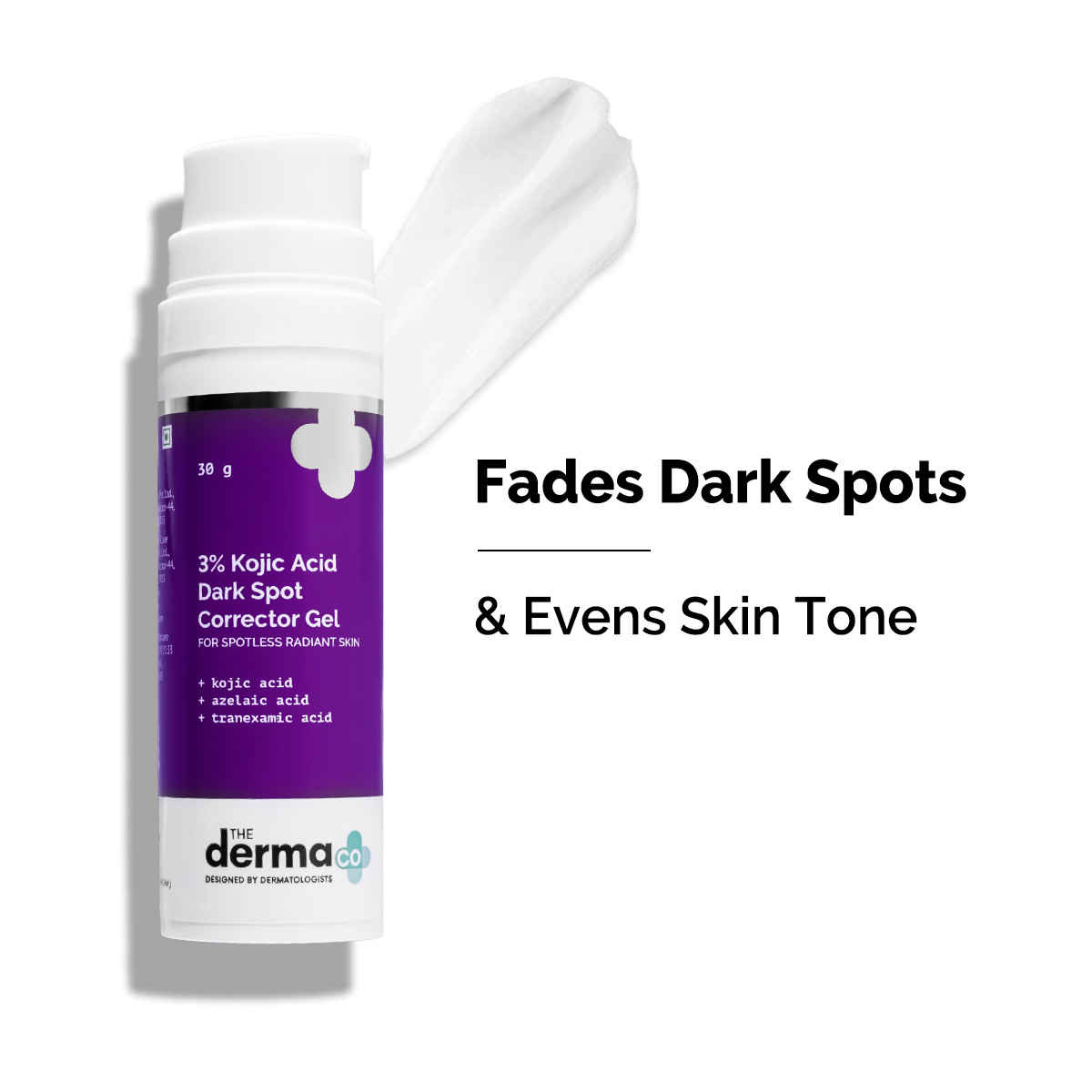
The Derma Co 3% Kojic Acid Dark Spot Corrector Gel | With Azelaic & Tranexamic Acid | For Spotless & Radiant Skin | Reduces Dark Spots, Pigmentation & Blemishes | For Men & Women | 30 gm

The Derma Co 3% Kojic Acid Dark Spot Corrector Gel | With Azelaic & Tranexamic Acid | For Spotless & Radiant Skin | Reduces Dark Spots, Pigmentation & Blemishes | For Men & Women | 30 gm
The Derma co.
the-derma-co-3-kojic-acid-dark-spot-corrector-gel-with-azelaic-tranexamic-acid-for-spotless-radiant-skin-reduces-dark-spots-pigmentation-blemishes-for-men-women-30-gm
Serum
10084763828517
Morning or Evening?
How often will you use this product?
Notes


Highlights
WHAT IS IT?
Dark Spot Corrector Gel with 3 main actives
FEATURES
Contains Kojic Acid, Azelaic Acid, and Tranexamic Acid; removes dead and dark cells; promotes clearer skin tone; reduces melanin formation; fragrance-free
BEST FOR
sensitive
CHECKS
No fragrance
Who Is It For?
Men & Women; Age Range Not SpecifiedWhat Does It Help With?
Dark Spots Pigmentation Blemishes Acne Scars Age SpotsBudget
Affordable (under $30)How To Use
Which routine should it be used in?
Instructions:
Key Information


What The Derma co. Says
Product Description:
Your favorite Kojic Acid now in a gel form to fight dark spots The dream team of Kojic Acid Azelaic Acid and Tranexamic Acid removes dead and dark cells while promoting a clearer skin tone. Regular use of the gel reduces melanin formation for skin thats free of acne scars pigmentation age spots and blemishes. Its time to say hello to radiant smooth clear & soft skin with our 3 Kojic Acid Dark Spot Corrector Gel. The best part Its fragrancefree
About the Brand:
Ingredients Overview
Ingredients List
Aqua, Caprylic/Capric Triglycerides, Glycolic Acid, Kojic Acid Dipalmitate, Butyrospermum Parkii (Shea) Butter, Sodium Acrylate/Sodium Acryloyldimethyl Taurate Copolymer, Hydrogenated Polydecene, Trideceth-6, Sorbitan Laurate, 4-Butylresorcinol, Butylene Glycol, Cetearyl Alcohol, Dicetyl Phosphate, Ceteth-10 Phosphate, Azelaic Acid, Tranexamic Acid, Cetyl Acetate, Arbutin, Lecithin, Cetearyl Alcohol, Ceteareth-20, Glycyrrhiza Glabra (Licorice) Root Extract, Morus Alba (Mulberry) Extract, Laminaria Digitata Extract, Cetyl-PG Hydroxyethyl Palmitamide, Ceramide 1, Ceramide 2, Ceramide 3, Ceramide 4, Ceramide 6 II, Propylene Glycol, L-Arginine, Phenoxyethanol, Ethylhexylglycerin, Sodium Hyaluronate, Xanthan Gum, Sodium Hydroxide, Sodium Metabisulfite, Pentaerythrityl Tetra-Di-T-Butyl Hydroxyhydrocinnamate
Key Ingredients
Kojic Acid, Azelaic Acid, Tranexamic Acid
Ingredients Details
4-butylresorcinol
Common Name(s): P-butylresorcinol,rucinol
CAS Number: 18979-61-8
DESCRIPTION
What It Does: Provides exceptional brightening through the most potent tyrosinase inhibition of any commonly used cosmetic brightening agent.
Why It's Used: The most potent tyrosinase inhibitor available in cosmetics – exceptional for refractory hyperpigmentation and melasma where standard brighteners provide insufficient efficacy.
How It Works: Resorcinol backbone competitively inhibits both tyrosine hydroxylase (reaction 1) and dopa oxidase (reaction 2) activities of tyrosinase. n-butyl chain provides superior membrane affinity for enhanced delivery to melanosomes.
Typically Found In: High-potency brightening serums,melasma treatments,stubborn hyperpigmentation products
TECHNICAL DETAILS
Primary Category: Active ingredient – resorcinol tyrosinase inhibitor
Secondary Functions: Dual tyrosinase reaction inhibition,potent brightening
Application Areas:

Facial Skincare

Body Care
Hair Care
Beard Care
Color Cosmetics (Makeup)
Dietary/Oral Supplements
Typical Concentration Range: 0.1%–1%
SOURCING & ETHICS
Vegan Status: Yes – synthetic
Halal Status: Yes
Source Notes: Synthetic or plant-derived.
SKIN COMPATIBILITY
Irritancy Rating: 2/5 – low to moderate
Comedogenicity Rating: 0/5 – non-comedogenic
Sensitivity Concerns: Use with spf; introduce gradually. photosensitizing.
Safe for Sensitive Skin: Yes
SAFETY & COMPATIBILITY
Safety Profile: Excellent safety profile. use with spf for maximum efficacy. ewg score: 1.
Works Well With: Niacinamide,vitamin c,alpha-arbutin,tranexamic acid,spf
Avoid Combining With: No significant incompatibilities
SCIENTIFIC NOTE
4-butylresorcinol's inhibition of both tyrosinase catalytic reactions (tyrosine→dopa and dopa→dopaquinoneoxidase) is unique among common brighteners. most tyrosinase inhibitors only block the first reaction (tyrosine→dopa). blocking both steps provides more complete melanin biosynthesis inhibition.
Last Verified: ##########
Primary Sources: Cosing database,choi et al. 4-butylresorcinol study,sccs opinion on butylresorcinol
Arbutin
Common Name(s): Arbutin,cosmetic active,functional ingredient
CAS Number: N/a
DESCRIPTION
What It Does: Delivers characteristic cosmetic function — skin conditioning, protection, preservation, or active biological benefit — at recommended use concentration.
Why It's Used: Selected for its functional contribution and formulation compatibility — supported by cosmetic science literature and regulatory safety assessment.
How It Works: Works through the mechanism of its molecular class — physicochemical interaction with the formulation or biological interaction with skin proteins, lipids, or receptors as documented in peer-reviewed literature.
Typically Found In: Skin care formulations
TECHNICAL DETAILS
Primary Category: Active ingredient – cosmetic active
Secondary Functions: Skin conditioning
Application Areas:
Facial Skincare
Body Care
Hair Care
Beard Care
Color Cosmetics (Makeup)
Dietary/Oral Supplements
Typical Concentration Range: 0.1%–10%
SOURCING & ETHICS
Vegan Status: Conditional - supplier confirmation required
Halal Status: Unverified - supplier confirmation required
Source Notes: Commercially produced for cosmetic use. verify vegan/halal status with supplier. [audit 2026-07-29 rev2: the record's own source_notes does not assert a non-animal origin, or instructs the reader to verify with the supplier; "yes" asserts knowledge the record does not hold. determination requires shariah-panel sign-off.]
SKIN COMPATIBILITY
Irritancy Rating: 1/5 – very low
Comedogenicity Rating: 0/5 – non-comedogenic
Sensitivity Concerns: Well-tolerated by most skin types.
Safe for Sensitive Skin: Yes
SAFETY & COMPATIBILITY
Safety Profile: Good safety profile at recommended concentrations. ewg score: 1–2.
Works Well With: Standard skincare actives
Avoid Combining With: No known significant incompatibilities
SCIENTIFIC NOTE
Arbutin delivers documented functional benefit with an established safety profile within the cosmetic regulatory framework (cosing eu, cir usa).
Last Verified:
Azelaic Acid
Common Name(s): Nonanedioic acid,lepargylic acid
CAS Number: 123-99-9
DESCRIPTION
What It Does: Reduces acne, evens skin tone, calms rosacea, and reduces hyperpigmentation through multiple complementary mechanisms.
Why It's Used: Multi-action gold standard for hyperpigmentation, acne, rosacea, and post-inflammatory hyperpigmentation (pih) – well-tolerated by all skin tones.
How It Works: Inhibits tyrosinase (melanin synthesis) and abnormal melanocyte proliferation. inhibits 5-alpha-reductase (sebum control). antimicrobial against p. acnes and malassezia. anti-inflammatory via nf-kb pathway inhibition.
Typically Found In: Brightening serums,anti-acne treatments,rosacea products,hyperpigmentation formulations
TECHNICAL DETAILS
Primary Category: Active ingredient – dicarboxylic acid
Secondary Functions: Anti-acne,rosacea management,sebum control
Application Areas:
Facial Skincare
Body Care
Hair Care
Beard Care
Color Cosmetics (Makeup)
Dietary/Oral Supplements
Typical Concentration Range: 5%–20% (otc 5–10%; prescription 15–20%)
SOURCING & ETHICS
Vegan Status: Conditional - supplier confirmation required
Halal Status: Unverified - supplier confirmation required
Source Notes: Naturally from malassezia yeast on skin; produced by ozonolysis of oleic acid commercially. [audit 2026-07-29 rev2: the record's own source_notes does not assert a non-animal origin, or instructs the reader to verify with the supplier; "yes" asserts knowledge the record does not hold. determination requires shariah-panel sign-off.]
SKIN COMPATIBILITY
Irritancy Rating: 2/5 – low to moderate; initial tingling expected
Comedogenicity Rating: 0/5 – non-comedogenic
Sensitivity Concerns: Initial tingling and stinging normalizes within 2–4 weeks of regular use.
Safe for Sensitive Skin: Use with caution – transient tingling common during introduction
SAFETY & COMPATIBILITY
Safety Profile: Excellent long-term safety. fda-approved for acne (benzaclin) and rosacea (finacea). ewg score: 1.
Works Well With: Ceramides,niacinamide,hyaluronic acid,spf
Avoid Combining With: Multiple exfoliating acids simultaneously; high concentrations without spf
SCIENTIFIC NOTE
Azelaic acid's combined tyrosinase inhibition + abnormal melanocyte selectivity (normalizes only overactive melanocytes, unlike hydroquinone) makes it uniquely safe for long-term use without bleaching normal-pigmented skin.
Last Verified: 2026-03-12
Primary Sources: Cosing database,draelos azelaic acid review,fda drug approval database
Butylene Glycol
Common Name(s): 1,3-butanediol,bg,1,3-butylene glycol
CAS Number: 107-88-0
DESCRIPTION
What It Does: Provides humectant hydration and active ingredient solubilization with excellent skin feel.
Why It's Used: Preferred glycol humectant in premium and k-beauty formulations for superior skin feel vs propylene glycol with equivalent functionality.
How It Works: Two hydroxyl groups at 1,3-positions provide water binding and solvent activity. better tolerated than propylene glycol with minimal sensitization risk. 4-carbon backbone provides slightly greater hydrophobic character enabling dissolution of less polar actives vs pg.
Typically Found In: Toners,essences,serums,k-beauty formulas
TECHNICAL DETAILS
Primary Category: Functional ingredient – glycol humectant
Secondary Functions: Tewl reduction,skin plumping
Application Areas:
Facial Skincare
Body Care
Hair Care
Beard Care
Color Cosmetics (Makeup)
Dietary/Oral Supplements
Typical Concentration Range: 1%–10%
SOURCING & ETHICS
Vegan Status: Yes – synthetic
Halal Status: Yes
Source Notes: Synthetic or naturally derived. excellent aqueous solubility.
SKIN COMPATIBILITY
Irritancy Rating: 1/5 – very low
Comedogenicity Rating: 0/5 – non-comedogenic
Sensitivity Concerns: Non-irritating; suitable for all skin types.
Safe for Sensitive Skin: Yes
SAFETY & COMPATIBILITY
Safety Profile: Excellent safety profile. ewg score: 1.
Works Well With: Ceramides,emollients,occlusives,glycerin,hyaluronic acid
Avoid Combining With: No significant incompatibilities
SCIENTIFIC NOTE
K-beauty's preference for butylene glycol over propylene glycol is driven by two factors: bg's superior skin feel (less tacky than pg's higher viscosity) and its lower sensitization potential (1,3-bg has better spatial distribution of hydroxyl groups that reduces protein interaction vs pg's 1,2-position oh groups).
Last Verified: 2026-03-12
Primary Sources: Cosing database,cir safety assessment