

The Derma co.
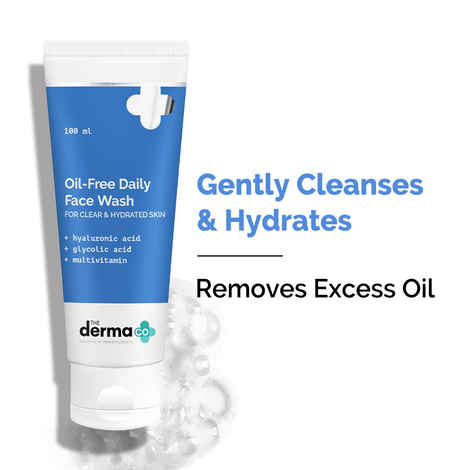
The Derma Co. Oil-Free Daily Face Wash With Hyaluronic Acid, Glycolic Acid & Multivitamins for Clear & Hydrated Skin - 100 ml

The Derma Co. Oil-Free Daily Face Wash With Hyaluronic Acid, Glycolic Acid & Multivitamins for Clear & Hydrated Skin - 100 ml
The Derma co.
the-derma-co-oil-free-daily-face-wash-with-hyaluronic-acid-glycolic-acid-multivitamins-for-clear-hydrated-skin-100-ml
Cleanse
10085079548197
Morning or Evening?
How often will you use this product?
Notes


Highlights
WHAT IS IT?
Face wash with 7 ingredients
FEATURES
Removes excess oil, neutralizes greasy shine, gently exfoliates skin with Glycolic Acid, hydrates with Hyaluronic Acid, contains multivitamins for nourishment
BEST FOR
oily
CHECKS
No information on what it doesn't contain explicitly
Who Is It For?
No Explicit Age/gender Info AvailableWhat Does It Help With?
Controls Excess Oil Hydrating Gentle CleansingBudget
Affordable (under $30)How To Use
Which routine should it be used in?
Instructions:
Key Information


What The Derma co. Says
Product Description:
Did someone wish for an oilfree face wash Well your wish is our command Put oily skin to bed and make way for super hydrated and oilfree skin with our Oilfree Daily Face Wash. It removes excess oil neutralizes the greasy shine and gently exfoliates your skin with the help of Glycolic Acid. The hero of skin hydration Hyaluronic Acid fights postface wash drying by keeping the skin hydrated and calm. Multivitamin supports healthy skin function while keeping your skin nourished. We are sure youll fall in love with this face wash
About the Brand:
Ingredients Overview
Ingredients List
DM Water, Rheostyl 85 L (Acrylates Copolymer), AMP-95 (2-AMINO-2-METHYL-1-PROPANOL), Alfodet XL 46 (Alpha Olefin Sulfonate), CAPB (Coco Amido Propyl Betaine), Ecosense 1200 (Lauryl-Glucoside), Glycolic Acid, Salicylic Acid(<2% w/w), Propylene Glycol, Noigen CL 150 D (PEG- 150 Distearate), Nordic Beauty Birch sap (Betula Alba Juice), Zigamoist HA (Sodium Hyaluronate) & DM Hydantoin
Key Ingredients
Hyaluronic Acid, Glycolic Acid, Multivitamins
Ingredients Details
Glycolic Acid
Common Name(s): Hydroxyacetic acid,2-hydroxyacetic acid
CAS Number: 79-14-1
DESCRIPTION
What It Does: Provides maximum aha efficacy from the smallest most penetrating alpha-hydroxy acid.
Why It's Used: The most potent aha — glycolic acid's smallest molecular size provides the deepest penetration and highest efficacy of any alpha-hydroxy acid for exfoliation and anti-aging.
How It Works: Smallest aha (mw 76) provides deepest stratum corneum penetration. disrupts corneodesmosomes reducing cohesion. stimulates fibroblast collagen i and iii synthesis. efficacy is ph-dependent — free acid fraction determines activity.
Typically Found In: Chemical peels,body lotions,anti-aging serums,exfoliating toners
TECHNICAL DETAILS
Primary Category: Active ingredient – primary aha
Secondary Functions: Brightening,collagen stimulation
Application Areas:

Facial Skincare
Body Care

Hair Care
Beard Care
Color Cosmetics (Makeup)
Dietary/Oral Supplements
Typical Concentration Range: 1%–10% cosmetic; higher professional
SOURCING & ETHICS
Vegan Status: Yes – synthetic or fermentation-derived
Halal Status: Yes
Source Notes: Fermentation-derived or synthetic. ph must be ≤4.0 for aha activity.
SKIN COMPATIBILITY
Irritancy Rating: 2/5 – low to moderate
Comedogenicity Rating: 0/5 – non-comedogenic
Sensitivity Concerns: Photosensitizing – mandatory spf use. start at low frequency.
Safe for Sensitive Skin: Use with caution – spf required
SAFETY & COMPATIBILITY
Safety Profile: Eu cosmetics: max 10% leave-on, ph ≥3.5, mandatory sun protection advisory. professional peel concentrations regulated separately.
Works Well With: Niacinamide,ceramides,hyaluronic acid,spf
Avoid Combining With: Retinol in same step; multiple exfoliants simultaneously
SCIENTIFIC NOTE
Glycolic acid's ph-dependent efficacy is critical: at ph 3.0 ~100% is in the free acid (membrane-permeable) form; at ph 3.5 ~70%; at ph 4.0 ~50%. the eu ph ≥3.5 requirement reduces free acid proportion, lowering efficacy but also reducing irritation — why professional peel concentrations at lower ph are far more active than equivalent cosmetic concentrations.
Last Verified: 2026-03-12
Primary Sources: Cosing database,eu aha guidelines,cir safety assessment
Propylene Glycol
Common Name(s): 1,2-propanediol,pdg,propane-1,2-diol
CAS Number: 57-55-6
DESCRIPTION
What It Does: Provides humectant hydration alongside solubilization of water-soluble actives and preservation boosting.
Why It's Used: Multi-function glycol for comprehensive formulation utility: hydration, solubilization, and preservation in a single cost-effective ingredient.
How It Works: Two hydroxyl groups provide water binding for humectant activity. propylene backbone provides solvent capacity for both polar and moderately non-polar actives. antimicrobial activity via membrane disruption enhancing preservative systems.
Typically Found In: Moisturizers,serums,toners,almost all aqueous formulations
TECHNICAL DETAILS
Primary Category: Functional ingredient – glycol humectant / solvent
Secondary Functions: Tewl reduction,skin plumping
Application Areas:
Facial Skincare
Body Care
Hair Care
Beard Care
Color Cosmetics (Makeup)
Dietary/Oral Supplements
Typical Concentration Range: 1%–15%
SOURCING & ETHICS
Vegan Status: Conditional - supplier confirmation required
Halal Status: Unverified - supplier confirmation required
Source Notes: Synthetic or naturally derived. excellent aqueous solubility. [audit 2026-07-29 rev2: status downgraded on audit. determination requires shariah-panel sign-off.]
SKIN COMPATIBILITY
Irritancy Rating: 2/5 – low to moderate; potential sensitizer in sensitive individuals at high concentrations
Comedogenicity Rating: 0/5 – non-comedogenic
Sensitivity Concerns: Non-irritating; suitable for all skin types.
Safe for Sensitive Skin: Yes
SAFETY & COMPATIBILITY
Safety Profile: Well-established safety profile. ewg score: 3. bio-based pg available from corn fermentation.
Works Well With: Ceramides,emollients,occlusives,glycerin,hyaluronic acid
Avoid Combining With: No significant incompatibilities
SCIENTIFIC NOTE
Propylene glycol's dual polarity (two hydroxyl groups + propylene hydrocarbon backbone) enables dissolution of ingredients spanning a wide hydrophilicity range – from highly polar actives (amino acids, glycerin) to moderately lipophilic actives (salicylic acid, retinol). this broad solubility range makes it uniquely versatile as a cosmetic solvent.
Last Verified: 2026-03-12
Primary Sources: Cosing database,cir safety assessment