

Nykaa E retail limited
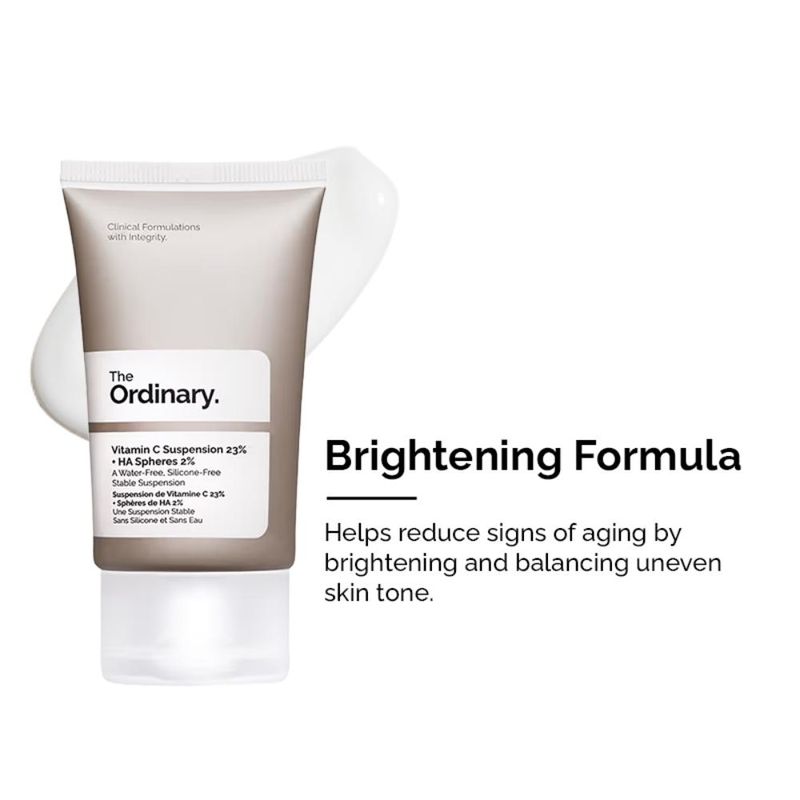
The Ordinary Vitamin C Suspension 23% + HA Spheres 2%

The Ordinary Vitamin C Suspension 23% + HA Spheres 2%
Nykaa E retail limited
the-ordinary-vitamin-c-suspension-23-ha-spheres-2
Serum
10084981113125
Morning or Evening?
How often will you use this product?
Notes


Highlights
WHAT IS IT?
Vitamin C Suspension formula with 23% Vitamin C and 2% HA spheres
FEATURES
Brightens and balances uneven skin tone, reduces signs of ageing, antioxidant support, water-free and stable vitamin C with added hydration from HA spheres
BEST FOR
all
CHECKS
No water, no indication of preservatives, fragrance-free not explicitly stated but water-free and stable formula
Who Is It For?
All Skin TypesWhat Does It Help With?
Dullness Signs Of Ageing Uneven Skin Tone Antioxidant SupportBudget
Affordable (under $30)How To Use
Which routine should it be used in?
Instructions:
Key Information


What Nykaa E retail limited Says
Product Description:
A vitamin C brightening formula with HA spheres. Targets: Dullness, signs of ageing, antioxidant support, uneven skin tone. Suitable for: All skin types. Format: Suspension (slightly granular texture). Vitamin C Suspension 23% in HA Spheres uses direct vitamin C and hyaluronic acid to help visibly reduce signs of aging by brightening and balancing uneven skin tone. This water-free formula provides 23% pure l-ascorbic acid which remains completely stable due to the absence of water. The formula is supported with spheres of hyaluronic acid for added hydration. Note: The slightly granular texture is due to vitamin C powder being suspended in an oil-like base; each application requires a few seconds to absorb. Can be diluted in a cream base to build tolerance over time.
About the Brand:
Ingredients Overview
Ingredients List
ascorbic-acid,squalane,isodecyl-neopentanoate,isononyl-isononanoate,coconut-alkanes,ethylene-propylene-styrene-copolymer,ethylhexyl-palmitate,silica-dimethyl-silylate,sodium-hyaluronate,glucomannan,coco-caprylate-caprate,butylene-ethylene-styrene-copolymer,acrylates-ethylhexyl-acrylate-crosspolymer,trihydroxystearin,bht
Key Ingredients
ascorbic-acid,sodium-hyaluronate
Ingredients Details
Bht
Common Name(s): Bht
DESCRIPTION
What It Does: Delivers targeted skin-conditioning or bioactive benefits through a specific mechanism of action suited to the formulation's intended purpose.
Why It's Used: Specialty actives address specific skin concerns through targeted molecular mechanisms, providing efficacy beyond what base formulation ingredients alone can achieve.
How It Works: The bioactive compound interacts with specific molecular targets in skin cells or the extracellular matrix — enzymes, receptors, structural proteins, or signaling molecules — triggering beneficial biological responses.
Typically Found In: Serums,treatments,moisturizers,specialty products
TECHNICAL DETAILS
Primary Category: Specialty actives
Secondary Functions: Skin-conditioning,anti-aging
Application Areas:

Facial Skincare

Body Care
Hair Care
Beard Care
Color Cosmetics (Makeup)
Dietary/Oral Supplements
Typical Concentration Range: 0.01–5%
SOURCING & ETHICS
Vegan Status: Yes
Halal Status: Yes
Source Notes: Specialty active ingredient; check individual sourcing for vegan status.
SKIN COMPATIBILITY
Irritancy Rating: 1
Comedogenicity Rating: 0
Sensitivity Concerns: Low sensitization potential at recommended use concentrations.
Safe for Sensitive Skin: Yes
SAFETY & COMPATIBILITY
Safety Profile: Well-characterized cosmetic ingredient with established safety profile. generally non-irritating at typical use concentrations. suitable for leave-on and rinse-off cosmetics.
Works Well With: Niacinamide,hyaluronic acid,vitamin c,peptides
Avoid Combining With: Incompatible with oxidizing agents; check ph stability
SCIENTIFIC NOTE
Specialty actives typically work through enzyme inhibition (e.g., tyrosinase inhibition for brightening, mmp inhibition for anti-aging), receptor activation (e.g., retinoid receptors, ppar-γ for barrier genes), or transcription factor modulation (e.g., nrf2 for antioxidant gene upregulation). structure-activity relationships determine potency and selectivity.
Last Verified: Cosing eu database; pcpc cosmetic ingredient safety reviews; ingredient-specific safety and efficacy literature
Primary Sources: 2025-01-15
Glucomannan
Common Name(s): Natural polysaccharide,prebiotic or humectant biopolymer,skin conditioning
CAS Number: N/a
DESCRIPTION
What It Does: Provides skin surface hydration through hydroxyl group water binding, supports beneficial skin microbiome organisms as a selective fermentation substrate, and forms a conditioning film that reduces tewl.
Why It's Used: Natural polysaccharides combine humectant function with microbiome prebiotic activity — a dual benefit unavailable from synthetic humectants like glycerin, important for microbiome-conscious formulation.
How It Works: Hydroxyl groups on the polysaccharide backbone bind water through hydrogen bonding (5–7 h₂o molecules per sugar unit) providing hygroscopic moisture retention. fructans and inulins are selectively fermented by beneficial lactobacillus skin commensals providing a prebiotic microbiome benefit.
Typically Found In: Hydrating,microbiome support,barrier
TECHNICAL DETAILS
Primary Category: Functional ingredient – humectant
Secondary Functions: Tewl reduction,skin plumping
Application Areas:
Facial Skincare
Body Care
Hair Care
Beard Care
Color Cosmetics (Makeup)
Dietary/Oral Supplements
Typical Concentration Range: 0.1%–5%
SOURCING & ETHICS
Vegan Status: Yes
Halal Status: Yes
Source Notes: Synthetic or naturally derived. excellent aqueous solubility.
SKIN COMPATIBILITY
Irritancy Rating: 1/5 – very low
Comedogenicity Rating: 0/5 – non-comedogenic
Sensitivity Concerns: Non-irritating; suitable for all skin types.
Safe for Sensitive Skin: Yes
SAFETY & COMPATIBILITY
Safety Profile: Excellent safety profile. ewg score: 1.
Works Well With: Ceramides,emollients,occlusives,glycerin,hyaluronic acid
Avoid Combining With: No significant incompatibilities
SCIENTIFIC NOTE
Inulin-type fructans specifically promote lactobacillus growth over pathogenic s. aureus — the selective fermentation providing a natural prebiotic differentiation for microbiome-targeted skin care claims.
Last Verified: Cosing database,natural polysaccharide humectant prebiotic review
Primary Sources: 2026-03-12
Squalane
Common Name(s): Perhydrosqualene,2,6,10,15,19,23-hexamethyltetracosane
CAS Number: 0111-01-03
DESCRIPTION
What It Does: Provides endogenous-skin-identical emolliency with exceptional stability and skin compatibility.
Why It's Used: The most skin-compatible emollient – chemically identical to human sebum squalene component with outstanding tolerability across all skin types.
How It Works: Fully saturated hydrocarbon with zero oxidation sites provides exceptional stability unlike squalene's 6 double bonds. integrates into stratum corneum lipid bilayers with near-perfect biocompatibility. provides antioxidant protection to formulation via radical quenching.
Typically Found In: Facial oils,serums,non-comedogenic moisturizers,luxury body care
TECHNICAL DETAILS
Primary Category: Functional ingredient – emollient
Secondary Functions: Maximum biocompatibility,antioxidant stabilizer,non-comedogenic
Application Areas:
Facial Skincare
Body Care
Hair Care
Beard Care
Color Cosmetics (Makeup)
Dietary/Oral Supplements
Typical Concentration Range: 1%–100%
SOURCING & ETHICS
Vegan Status: Conditional – plant-derived (sugarcane, olive) preferred; shark liver-derived being phased out
Halal Status: Yes – plant-derived
Source Notes: Sustainable plant-derived squalane from sugarcane fermentation (amyris) or olive oil fractionation is preferred over shark liver-derived. chemically identical regardless of source.
SKIN COMPATIBILITY
Irritancy Rating: 1/5 – very low
Comedogenicity Rating: 0/5 – non-comedogenic
Sensitivity Concerns: Non-irritating.
Safe for Sensitive Skin: Yes
SAFETY & COMPATIBILITY
Safety Profile: Excellent safety profile. ewg score: 1.
Works Well With: Humectants,ceramides,actives as carrier
Avoid Combining With: No significant incompatibilities
SCIENTIFIC NOTE
Squalene constitutes approximately 12-15% of human sebum – the highest proportion of any skin lipid. topical squalane (stable, hydrogenated form) replenishes this abundant endogenous skin lipid. the complete absence of oxidizable double bonds (unlike squalene's 6 double bonds) eliminates the pro-oxidant concerns of natural squalene oxidation.
Last Verified: Cosing database,huang et al. squalane review,cir safety assessment
Primary Sources: 2026-03-12
Trihydroxystearin
Common Name(s): Trihydroxystearin,cosmetic active,functional ingredient
CAS Number: N/a
DESCRIPTION
What It Does: Delivers characteristic cosmetic function at recommended use concentration.
Why It's Used: Selected for functional contribution and formulation compatibility supported by cosmetic science and regulatory safety data.
How It Works: Works through the mechanism of its molecular class as documented in peer-reviewed cosmetic literature.
Typically Found In: Skin care formulations
TECHNICAL DETAILS
Primary Category: Active ingredient – cosmetic active
Secondary Functions: Skin conditioning
Application Areas:
Facial Skincare
Body Care
Hair Care
Beard Care
Color Cosmetics (Makeup)
Dietary/Oral Supplements
Typical Concentration Range: 0.1%–10%
SOURCING & ETHICS
Vegan Status: Conditional
Halal Status: Yes
Source Notes: Commercially produced for cosmetic use. verify vegan/halal status with supplier.
SKIN COMPATIBILITY
Irritancy Rating: 1/5 – very low
Comedogenicity Rating: 0/5 – non-comedogenic
Sensitivity Concerns: Well-tolerated by most skin types.
Safe for Sensitive Skin: Yes
SAFETY & COMPATIBILITY
Safety Profile: Good safety profile at recommended concentrations. ewg score: 1–2.
Works Well With: Standard skincare actives
Avoid Combining With: No known significant incompatibilities
SCIENTIFIC NOTE
Trihydroxystearin has an established safety profile within the cosmetic regulatory framework at standard use concentrations.
Last Verified: Cosing database,trihydroxystearin technical literature
Primary Sources: 2026-03-12
