

THE PASTELS SHOP
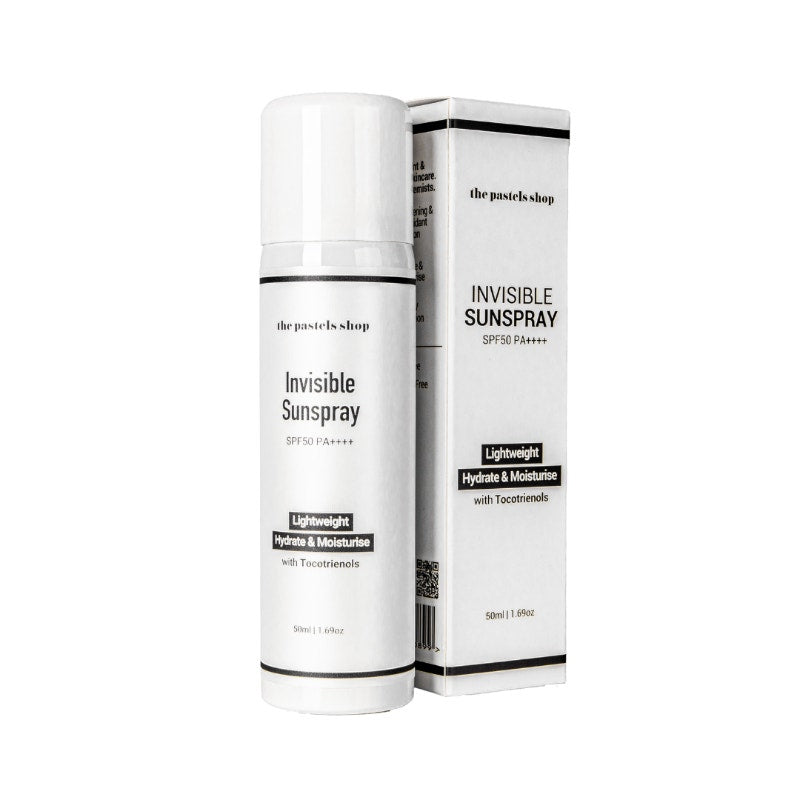
The Pastels Shop Invisible Sunspray Spf50 Pa++++ 50Ml

The Pastels Shop Invisible Sunspray Spf50 Pa++++ 50Ml
THE PASTELS SHOP
the-pastels-shop-invisible-sunspray-spf50-pa-50ml
Suncare
10085086789925
Morning or Evening?
How often will you use this product?
Notes


Highlights
WHAT IS IT?
Sunspray with 11 ingredients approx
FEATURES
Lightweight, Hydrate & Moisture, Brightening & Antioxidant Function, High UV Protection
BEST FOR
sensitive
CHECKS
Does not specify alcohol, parabens, silicones, or sulfates explicitly but emphasizes minimal ingredients and preservative-free
Who Is It For?
All Ages And Genders (not Specifically Mentioned But Typical For Sunscreens)What Does It Help With?
Uv Protection Hydration Brightening Antioxidant BenefitsBudget
Mid-range ($30-$75)How To Use
Which routine should it be used in?
Instructions:
Key Information


What THE PASTELS SHOP Says
Product Description:
Simple yet effective, The Pastels Shop Invisible Sunspray redefines sun care with a focus on hydration, minimalism, and maximum protection. Elevate your sun care routine and step into the light with confidence. Embrace a weightless and hydrating formula that offers minimal ingredients but maximum protection against harmful UVA & UVB rays
About the Brand:
Ingredients Overview
Ingredients List
Isododecane,Ethylhexyl-Methoxycinnamate,Bis-Ethylhexyloxyphenol-Methoxyphenyl-Triazine,Ethylhexyl-Triazone,Tocotrienols,Tocopherol,Candida-Bombicola/Glucose/Methyl-Rapeseedate-Ferment,Olea-Europaea-(Olive)-Fruit-Oil,Helianthus-Annuus-(Sunflower)-Seed-Oil,Argania-Spinosa-Kernel-Oil,Lithospermum-Erythrorhizon-Root-Extract,Glycyrrhiza-Uralensis-(Licorice)-Root-Extract
Key Ingredients
Ethylhexyl Methoxycinnamate,Bis-Ethylhexyloxyphenol Methoxyphenyl Triazine,Ethylhexyl Triazone,Tocotrienols,Tocopherol
Ingredients Details
Isododecane
Common Name(s): Permethyl 99a,c12 isoparaffin,volatile hydrocarbon
CAS Number: 31807-55-3
DESCRIPTION
What It Does: Provides quick-dry volatile hydrocarbon carrier for colour cosmetics with complete evaporation and no residue.
Why It's Used: Primary colour cosmetic carrier — isododecane's volatility and excellent pigment dispersion combined with complete evaporation make it the standard carrier for long-wear foundations and colour cosmetics.
How It Works: Volatile isoparaffin (bp 177-188°c) evaporates from skin within 10-20 minutes. excellent pigment dispersion for colour cosmetics. spreading enhancement from low surface tension. no residue after evaporation provides clean, long-wear finish.
Typically Found In: Long-wear foundations,colour cosmetics,primers,sunscreens
TECHNICAL DETAILS
Primary Category: Functional ingredient – volatile hydrocarbon
Secondary Functions: Barrier sealing,softening
Application Areas:

Facial Skincare
Body Care
Hair Care

Beard Care
Color Cosmetics (Makeup)
Dietary/Oral Supplements
Typical Concentration Range: 5%–60%
SOURCING & ETHICS
Vegan Status: Conditional - supplier confirmation required
Halal Status: Unverified - supplier confirmation required
Source Notes: Plant-derived, synthetic or animal-derived. verify source. [audit 2026-07-29 rev2: the record's own source_notes does not assert a non-animal origin, or instructs the reader to verify with the supplier; "yes" asserts knowledge the record does not hold. determination requires shariah-panel sign-off.]
SKIN COMPATIBILITY
Irritancy Rating: 1/5 – very low
Comedogenicity Rating: 1/5 – low; formulation-dependent
Sensitivity Concerns: Non-irritating.
Safe for Sensitive Skin: Yes
SAFETY & COMPATIBILITY
Safety Profile: Excellent safety profile. ewg score: 1.
Works Well With: Humectants,ceramides,actives as carrier
Avoid Combining With: No significant incompatibilities
SCIENTIFIC NOTE
Isododecane's position as the preferred colour cosmetic carrier arises from a unique combination of properties that no other solvent provides simultaneously: volatility (complete evaporation for clean finish), pigment dispersion (superior to water or alcohols), compatibility with silicones (unlike many solvents), and skin safety (inert hydrocarbon without irritation potential of polar solvents).
Last Verified: 2026-03-12
Primary Sources: Cosing database,cir safety assessment
Tocopherol
Common Name(s): Vitamin e,alpha-tocopherol,d-alpha-tocopherol,(+)-alpha-tocopherol
CAS Number: 59-02-9
DESCRIPTION
What It Does: Tocopherol neutralizes free radicals that damage skin cells, protects cell membranes from lipid peroxidation, moisturizes, and helps maintain a healthy skin barrier.
Why It's Used: It is used as both a skin-active antioxidant and a formulation stabilizer (preventing oxidation of other ingredients). it has decades of safety and efficacy evidence and works synergistically with vitamin c.
How It Works: As a chain-breaking antioxidant, tocopherol donates hydrogen atoms to interrupt lipid peroxidation chain reactions. it is regenerated by vitamin c (ascorbic acid) in the vitamins c+e antioxidant cycle, creating a more durable antioxidant defense.
Typically Found In: Moisturizers,serums,oils,sunscreens,eye creams,lip balms,antioxidant formulations,haircare products
TECHNICAL DETAILS
Primary Category: Active ingredient – antioxidant/vitamin e
Secondary Functions: Emollient,formulation stabilizer,barrier support
Application Areas:
Facial Skincare
Body Care
Hair Care
Beard Care
Color Cosmetics (Makeup)
Dietary/Oral Supplements
Typical Concentration Range: 0.1%–1% (typical: 0.1–0.5% as active; higher as formulation antioxidant)
SOURCING & ETHICS
Vegan Status: Yes – plant-derived (soybean, sunflower, wheat germ oil) or synthetic
Halal Status: Yes – plant-derived or synthetic
Source Notes: Natural d-alpha-tocopherol is derived from plant oils and is more bioactive. synthetic dl-alpha-tocopherol is less expensive. tocopherol acetate (tocopheryl acetate) is the more stable ester form.
SKIN COMPATIBILITY
Irritancy Rating: 1/5 – very low; rare contact sensitivity reported
Comedogenicity Rating: 2/5 – mildly comedogenic at higher concentrations; formulation-dependent
Sensitivity Concerns: A small percentage of people report contact sensitization to tocopherol, particularly with leave-on products. comedogenicity risk is higher in oil-heavy formulations.
Safe for Sensitive Skin: Generally yes; perform patch test if history of vitamin e sensitivity
SAFETY & COMPATIBILITY
Safety Profile: Very safe; widely used. ewg hazard score: 2–3 (depending on concentration). no significant systemic concerns from topical use.
Works Well With: Ascorbic acid (vitamin c) – synergistic antioxidant pair,ferulic acid – stabilizes and boosts both c and e,ceramides,spf,retinol
Avoid Combining With: Very high concentrations of benzoyl peroxide may oxidize tocopherol; potential comedogenicity concerns in acne-prone skin when in heavy oil bases
SCIENTIFIC NOTE
The combination of vitamin c, vitamin e, and ferulic acid (the 'ce ferulic' formulation) provides fourfold photoprotection against uv-induced free radical damage – a synergy documented in landmark research by pinnell et al.
Last Verified: ##########
Primary Sources: Cosing database,cir safety assessment,pinnell et al. (2005) journal of investigative dermatology,efsa panel on food additives
Tocotrienols
Common Name(s): Tocotrienol complex,palm tocotrienols,annatto tocotrienols
CAS Number: 6829-55-6
DESCRIPTION
What It Does: Provides superior antioxidant protection and demonstrated clinical hair growth support.
Why It's Used: Premium antioxidant and haircare for superior free radical scavenging and clinical hair growth benefits.
How It Works: Unsaturated side chain provides greater membrane mobility, encountering free radicals at higher rates than tocopherols. also reduces oxidative stress at hair follicles.
Typically Found In: Premium antioxidant serums,hair growth products
TECHNICAL DETAILS
Primary Category: Active ingredient – vitamin e derivative
Secondary Functions: Hair growth,superior membrane antioxidant
Application Areas:
Facial Skincare
Body Care
Hair Care
Beard Care
Color Cosmetics (Makeup)
Dietary/Oral Supplements
Typical Concentration Range: 0.05%–1%
SOURCING & ETHICS
Vegan Status: Conditional - supplier confirmation required
Halal Status: Unverified - supplier confirmation required
Source Notes: Plant-derived (soy, sunflower) or synthetic. requires antioxidant stabilization. [audit 2026-07-29 rev2: status downgraded on audit. determination requires shariah-panel sign-off.]
SKIN COMPATIBILITY
Irritancy Rating: 1/5 – very low
Comedogenicity Rating: 1/5 – very low
Sensitivity Concerns: Rare contact sensitization; generally very well-tolerated.
Safe for Sensitive Skin: Yes
SAFETY & COMPATIBILITY
Safety Profile: Excellent safety profile. ewg score: 1.
Works Well With: Ascorbic acid,ferulic acid,ceramides,spf
Avoid Combining With: No significant incompatibilities
SCIENTIFIC NOTE
Double-blind clinical trial (beoy et al., 2010, tropical life sciences research) found tocotrienol complex significantly increased hair count in volunteers with hair loss vs placebo.
Last Verified: 2026-03-12
Primary Sources: Cosing database,beoy et al. (2010) tocotrienol hair growth study