

Naturium
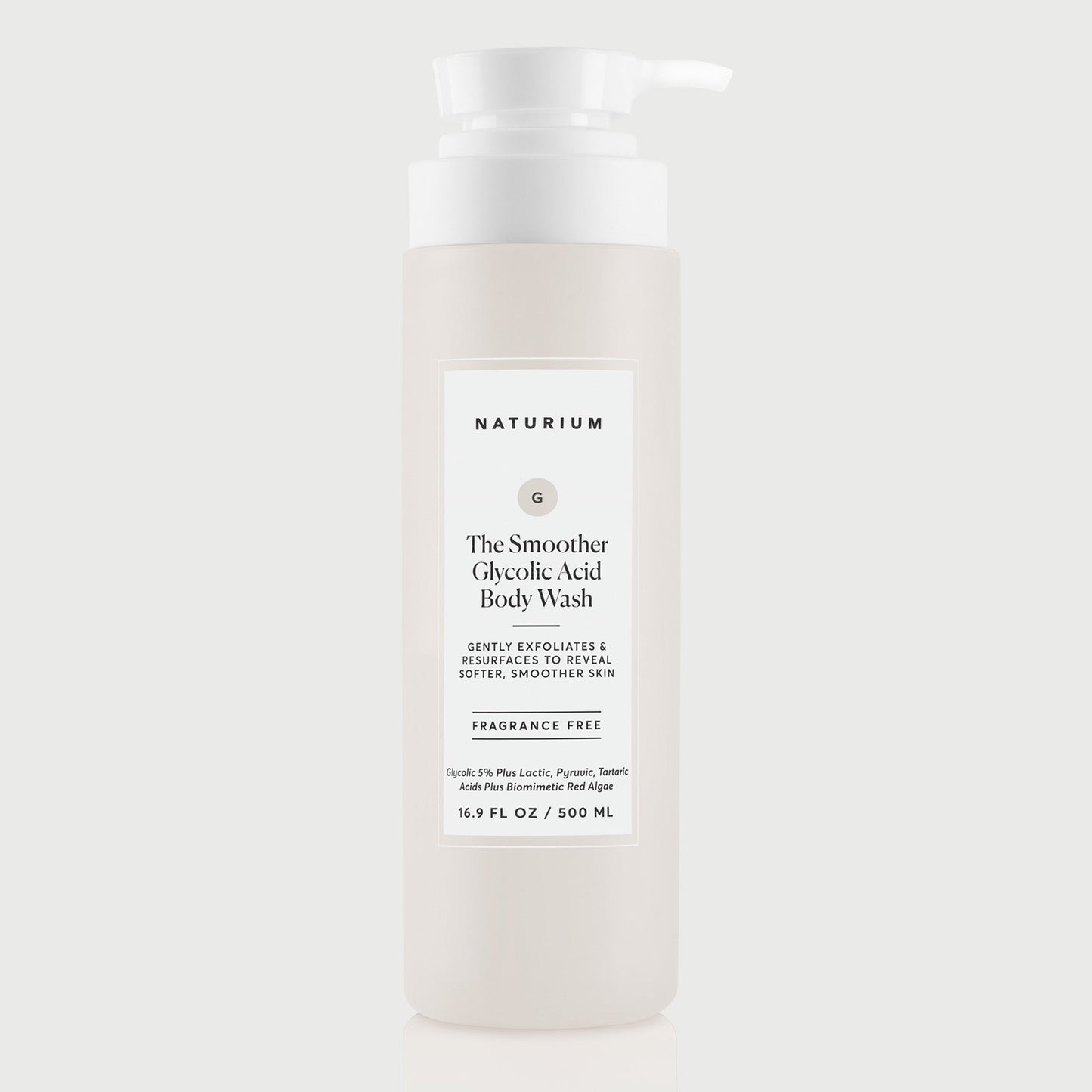
The Smoother Glycolic Acid Exfoliating Body Wash

The Smoother Glycolic Acid Exfoliating Body Wash
Naturium
the-smoother-glycolic-acid-exfoliating-body-wash
Body care
9818315391269
Morning or Evening?
How often will you use this product?
Notes


Highlights
WHAT IS IT?
Exfoliating body wash with AHA blend
FEATURES
Exfoliates and resurfaces rough and uneven texture, Can be used as facial cleanser
BEST FOR
all skin types
CHECKS
Free of alcohol, paraben, sulfate, silicon, oil, fragrance
Who Is It For?
All Ages And GendersWhat Does It Help With?
Rough Texture Uneven Skin Dead Skin Cell Removal Skin Softening And SmoothingBudget
Affordable (under $30)How To Use
Which routine should it be used in?
Instructions:
Key Information


What Naturium Says
Product Description:
Our glycolic acid body wash exfoliates and resurfaces rough and uneven texture. Formulated with an AHA blend including glycolic, lactic, pyruvic and tartaric acids, our cleanser sloughs off dead skin cells, revealing softer, smoother and more supple looking skin. Can also be used as a facial cleanser.
About the Brand:
Ingredients Overview
Ingredients List
Aqua/Water/Eau, Sodium Cocoyl Isethionate, Glycolic Acid, Sodium Hydroxide, Cocamidopropyl Hydroxysultaine, Coconut Acid, Sodium Methyl Cocoyl Taurate, Glycol Distearate, Cocamide MIPA, Lactic Acid, Malic Acid, Pyruvic Acid, Tartaric Acid, Sodium PCA, Polyquaternium-73, Polyquaternium-10, Glycerin, Caprylyl Glycol, Didecyldimonium Chloride, Methylpropanediol, Polyquaternium-80, Citric Acid, Tetrasodium Glutamate Diacetate, Sodium Lactate, Sodium Chloride, Sodium Isethionate, Sodium Benzoate
Key Ingredients
glycolic acid, lactic acid, pyruvic acid, tartaric acid
Ingredients Details
Glycolic Acid
Common Name(s): Hydroxyacetic acid,2-hydroxyacetic acid
CAS Number: 79-14-1
DESCRIPTION
What It Does: Provides maximum aha efficacy from the smallest most penetrating alpha-hydroxy acid.
Why It's Used: The most potent aha — glycolic acid's smallest molecular size provides the deepest penetration and highest efficacy of any alpha-hydroxy acid for exfoliation and anti-aging.
How It Works: Smallest aha (mw 76) provides deepest stratum corneum penetration. disrupts corneodesmosomes reducing cohesion. stimulates fibroblast collagen i and iii synthesis. efficacy is ph-dependent — free acid fraction determines activity.
Typically Found In: Chemical peels,body lotions,anti-aging serums,exfoliating toners
TECHNICAL DETAILS
Primary Category: Active ingredient – primary aha
Secondary Functions: Brightening,collagen stimulation
Application Areas:

Facial Skincare
Body Care

Hair Care
Beard Care
Color Cosmetics (Makeup)
Dietary/Oral Supplements
Typical Concentration Range: 1%–10% cosmetic; higher professional
SOURCING & ETHICS
Vegan Status: Yes – synthetic or fermentation-derived
Halal Status: Yes
Source Notes: Fermentation-derived or synthetic. ph must be ≤4.0 for aha activity.
SKIN COMPATIBILITY
Irritancy Rating: 2/5 – low to moderate
Comedogenicity Rating: 0/5 – non-comedogenic
Sensitivity Concerns: Photosensitizing – mandatory spf use. start at low frequency.
Safe for Sensitive Skin: Use with caution – spf required
SAFETY & COMPATIBILITY
Safety Profile: Eu cosmetics: max 10% leave-on, ph ≥3.5, mandatory sun protection advisory. professional peel concentrations regulated separately.
Works Well With: Niacinamide,ceramides,hyaluronic acid,spf
Avoid Combining With: Retinol in same step; multiple exfoliants simultaneously
SCIENTIFIC NOTE
Glycolic acid's ph-dependent efficacy is critical: at ph 3.0 ~100% is in the free acid (membrane-permeable) form; at ph 3.5 ~70%; at ph 4.0 ~50%. the eu ph ≥3.5 requirement reduces free acid proportion, lowering efficacy but also reducing irritation — why professional peel concentrations at lower ph are far more active than equivalent cosmetic concentrations.
Last Verified: 2026-03-12
Primary Sources: Cosing database,eu aha guidelines,cir safety assessment
Lactic Acid
Common Name(s): L-lactic acid,2-hydroxypropionic acid,milk acid
CAS Number: 50-21-5
DESCRIPTION
What It Does: Exfoliates dead skin cells, attracts and retains moisture, brightens skin tone, and improves texture.
Why It's Used: Dual exfoliant and humectant – uniquely hydrating vs other ahas. gentler and suitable for normal-to-sensitive skin.
How It Works: Disrupts desmosomes to promote exfoliation at low ph. acts as humectant. also stimulates ceramide synthesis at lower concentrations for barrier support.
Typically Found In: Chemical exfoliants,toners,serums,professional peels
TECHNICAL DETAILS
Primary Category: Active ingredient – alpha hydroxy acid (aha)
Secondary Functions: Humectant,brightening,barrier support,ceramide synthesis
Application Areas:
Facial Skincare
Body Care
Hair Care
Beard Care
Color Cosmetics (Makeup)
Dietary/Oral Supplements
Typical Concentration Range: 2%–10% (daily); 20%–90% (professional); active at ph ≤3.9
SOURCING & ETHICS
Vegan Status: Conditional - feedstock declaration required
Halal Status: Unverified - feedstock declaration required (plant, animal and petrochemical routes all exist)
Source Notes: Fermentation-derived from carbohydrates or synthetically produced. both l-form and dl-form used. [audit 2026-07-29 rev2: origin-dependent: the same inci exists in plant, animal and petrochemical versions and the name does not discriminate. determination requires shariah-panel sign-off.]
SKIN COMPATIBILITY
Irritancy Rating: 2/5 – low to moderate
Comedogenicity Rating: 0/5 – non-comedogenic
Sensitivity Concerns: Photosensitizing – spf required. better tolerated than glycolic acid for most skin types.
Safe for Sensitive Skin: Use with caution – spf required
SAFETY & COMPATIBILITY
Safety Profile: Safe at otc concentrations. eu: ≤10% leave-on at ph ≥3.5. mandatory spf advisory.
Works Well With: Niacinamide,ceramides,hyaluronic acid,spf
Avoid Combining With: Retinol in same step; multiple exfoliants simultaneously
SCIENTIFIC NOTE
Lactic acid's role as a natural moisturizing factor (nmf) component makes it uniquely hydrating among ahas. ceramide synthesis stimulation at 2% provides barrier benefits complementing exfoliating activity.
Last Verified: 2026-03-12
Primary Sources: Cosing database,stiller et al. lactic acid review,sccs aha opinion
Pyruvic Acid
Common Name(s): 2-oxopropanoic acid,alpha-ketopropionic acid
CAS Number: 127-17-3
DESCRIPTION
What It Does: Provides deep exfoliation, collagen stimulation, and reduces acne with effects comparable to higher glycolic acid concentrations.
Why It's Used: Professional peels for multi-action: exfoliation + collagen stimulation + antibacterial against p. acnes.
How It Works: Disrupts corneocyte cohesion for exfoliation. stimulates fibroblast proliferation and collagen synthesis as a krebs cycle intermediate. antibacterial against p. acnes.
Typically Found In: Professional chemical peels,advanced treatment serums
TECHNICAL DETAILS
Primary Category: Active ingredient – alpha-keto acid
Secondary Functions: Collagen stimulation,antibacterial
Application Areas:
Facial Skincare
Body Care
Hair Care
Beard Care
Color Cosmetics (Makeup)
Dietary/Oral Supplements
Typical Concentration Range: 5%–40% (professional only at higher concentrations)
SOURCING & ETHICS
Vegan Status: Yes – synthetic or fermentation-derived
Halal Status: Yes
Source Notes: Synthetically produced or from natural fermentation.
SKIN COMPATIBILITY
Irritancy Rating: 4/5 – high at professional concentrations
Comedogenicity Rating: 0/5 – non-comedogenic
Sensitivity Concerns: Photosensitizing – mandatory spf use. start at low frequency.
Safe for Sensitive Skin: Consumer concentrations: use with caution; professional: practitioner-administered only
SAFETY & COMPATIBILITY
Safety Profile: Requires careful ph management. professional concentrations require medical/aesthetician supervision.
Works Well With: Niacinamide,ceramides,hyaluronic acid,spf
Avoid Combining With: Retinol in same step; multiple exfoliants simultaneously
SCIENTIFIC NOTE
Pyruvic acid's collagen stimulation mechanism via krebs cycle intermediate may support cellular energy metabolism enhancing regenerative capacity – distinct from purely mechanical aha exfoliation.
Last Verified: 2026-03-12
Primary Sources: Cosing database,cotellessa et al. pyruvic acid peels review
Tartaric Acid
Common Name(s): L-tartaric acid,grape acid
CAS Number: 526-83-0
DESCRIPTION
What It Does: Provides gentle exfoliation, brightens skin tone, balances ph, offers mild antioxidant benefits.
Why It's Used: Multi-aha and fruit acid formulations for moderate exfoliation with good tolerability.
How It Works: At appropriate ph, cleaves corneocyte adhesion. tartrate chelation stabilizes formulations by binding pro-oxidant metal ions.
Typically Found In: Chemical exfoliants,toners,serums,professional peels
TECHNICAL DETAILS
Primary Category: Active ingredient – alpha hydroxy acid (aha)
Secondary Functions: Ph adjuster,antioxidant,chelating agent
Application Areas:
Facial Skincare
Body Care
Hair Care
Beard Care
Color Cosmetics (Makeup)
Dietary/Oral Supplements
Typical Concentration Range: 1%–10%
SOURCING & ETHICS
Vegan Status: Conditional - supplier confirmation required
Halal Status: Unverified - supplier confirmation required
Source Notes: Naturally from wine production byproducts or synthesized. gras for food use. [audit 2026-07-29 rev2: the record's own source_notes does not assert a non-animal origin, or instructs the reader to verify with the supplier; "yes" asserts knowledge the record does not hold. determination requires shariah-panel sign-off.]
SKIN COMPATIBILITY
Irritancy Rating: 2/5 – low to moderate
Comedogenicity Rating: 0/5 – non-comedogenic
Sensitivity Concerns: Photosensitizing – mandatory spf use. start at low frequency.
Safe for Sensitive Skin: Use with caution – spf required
SAFETY & COMPATIBILITY
Safety Profile: Safe at otc concentrations. eu: ≤10% leave-on at ph ≥3.5. mandatory spf advisory.
Works Well With: Niacinamide,ceramides,hyaluronic acid,spf
Avoid Combining With: Retinol in same step; multiple exfoliants simultaneously
SCIENTIFIC NOTE
Tartaric acid's dual hydroxyl-dicarboxylic acid structure provides both aha exfoliation and enhanced chelation activity vs single-hydroxyl ahas.
Last Verified: 2026-03-12
Primary Sources: Cosing database,cir safety assessment