

ThriveCo
ThriveCo Skin Expert Skincare Oil, Skin Repair Treatment, Hydrates Dry Skin with Centella & Rosehip

ThriveCo Skin Expert Skincare Oil, Skin Repair Treatment, Hydrates Dry Skin with Centella & Rosehip
ThriveCo
thriveco-skin-expert-skincare-oil-skin-repair-treatment-hydrates-dry-skin-with-centella-rosehip
Face Oil
10085031379237
Morning or Evening?
How often will you use this product?
Notes


Highlights
WHAT IS IT?
Face Oil with 11 ingredients
FEATURES
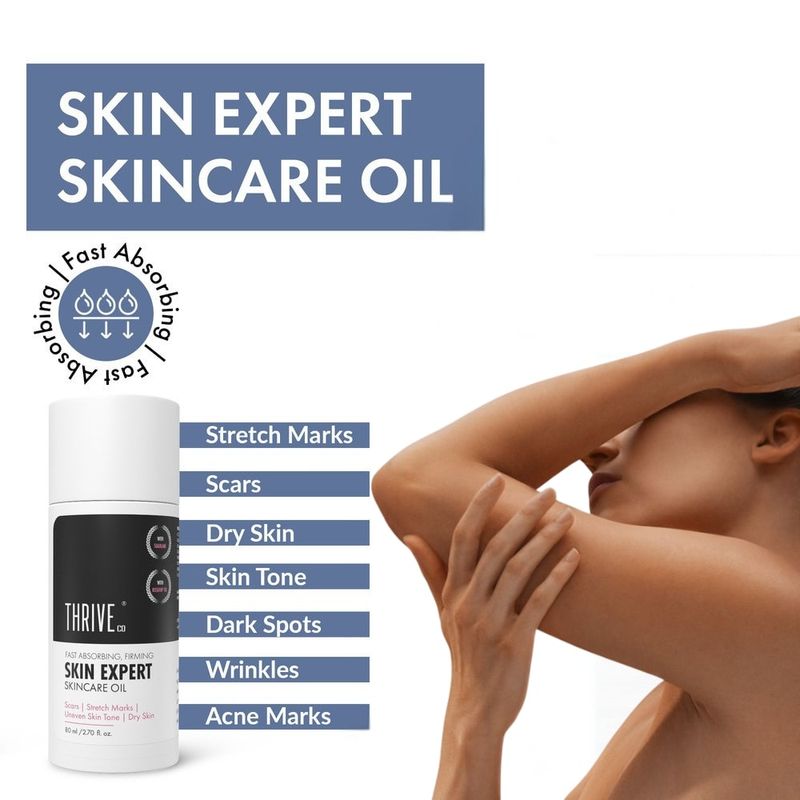
Ultra lightweight, improves skin elasticity, fades scars and stretchmarks, hydrates extremely dry skin, evens out skin tone
BEST FOR
dry
CHECKS
It doesn't contain sulfates, parabens, alcohol, silicones, microplastics, PEGs, aluminum, strong allergens
Who Is It For?
All Genders No Specific Age Range ProvidedWhat Does It Help With?
Improves Skin Elasticity Fades Scars And Stretchmarks Hydrates Dry Skin Evens Out Skin ToneBudget
Affordable (under $30)How To Use
Which routine should it be used in?
Instructions:
Key Information


What ThriveCo Says
Product Description:
Skin Expert Skincare oil is packed with effective ingredients such as Rosehip Oil which has betacarotene rich in anti-oxidants, providing photo-protection, brightens skin tone and increases cell turnover. Avacado Oil deeply moisturizes and nourishes the skin, promoting elasticity and protecting against stretch marks. Centella Oil boosts collagen production, enhances skin resilience, and supports healing, reducing the appearance of stretch marks. Olive Oil is a lightweight oil and moisturizing, helps maintain skin elasticity and suppleness, supporting prevention and reduction of stretch marks. Benefits: Ultra Lightweight Face and Body Oil: Skin Expert Skincare Oil deeply nourishes skin to improve skin elasticity. Fades scars and stretchmarks. Hydrates extremely dry skin and evens out skin tone.
About the Brand:
Ingredients Overview
Ingredients List
Cyclopentasiloxane,Dimethiconol,Isododecane,Cocos-Nucifera-Oil,Madhuca-Longifolia-Seed-Oil,Isopropyl-Myristate,Isoamyl-Laurate,Rosa-Rubiginosa-Seed-Oil,Persea-Gratissima-Oil,Squalane,Tocopheryl-Acetate,Centella-Asiatica-Extract,Helianthus-Annuus-Seed-Oil,Ascorbyl-Palmitate,Perfume
Key Ingredients
Rosehip Oil, Avocado Oil, Centella Oil, Olive Oil
Ingredients Details
Cyclopentasiloxane
Common Name(s): Cyclopentasiloxane,cyclic volatile silicone,dry-touch carrier solvent
CAS Number: N/a
DESCRIPTION
What It Does: Provides a dry, weightless application vehicle that evaporates cleanly leaving actives and non-volatile silicones deposited on skin — eliminating the residual heaviness of conventional liquid carrier solvents.
Why It's Used: Cyclosiloxanes are the unique volatile silicone solvents that dissolve non-volatile silicones (dimethicone, cyclomethicone), organic uv filters, and lipophilic actives, providing the sensory-superior dry-touch application experience in premium formulations.
How It Works: Cyclosiloxane vapour pressure (d5 cyclopentasiloxane ~0.3 mmhg at 25°c) provides clean evaporation at body temperature. the cyclic ring structure provides lower boiling point than equivalent linear dimethicone, enabling faster evaporation while the ring conformation maintains the silicone's low surface energy for smooth application.
Typically Found In: Primers,antiperspirants,sunscreens
TECHNICAL DETAILS
Primary Category: Functional ingredient – emollient
Secondary Functions: Barrier sealing,softening
Application Areas:

Facial Skincare
Body Care
Hair Care

Beard Care
Color Cosmetics (Makeup)
Dietary/Oral Supplements
Typical Concentration Range: 1%–50%
SOURCING & ETHICS
Vegan Status: Yes
Halal Status: Yes
Source Notes: Plant-derived, synthetic or animal-derived. verify source.
SKIN COMPATIBILITY
Irritancy Rating: 1/5 – very low
Comedogenicity Rating: 1/5 – low; formulation-dependent
Sensitivity Concerns: Non-irritating.
Safe for Sensitive Skin: Yes
SAFETY & COMPATIBILITY
Safety Profile: Excellent safety profile. ewg score: 1.
Works Well With: Humectants,ceramides,actives as carrier
Avoid Combining With: No significant incompatibilities
SCIENTIFIC NOTE
Cyclopentasiloxane (d5) and cyclohexasiloxane (d6) are under eu regulatory review for potential environmental persistence (pbt assessment) — formulators should monitor eu regulation 2018/35 implementation for restrictions in wash-off products.
Last Verified: Cosing database,eu cyclosiloxane regulatory review
Primary Sources: 2026-03-12
Dimethiconol
Common Name(s): Dimethiconol,cosmetic active,functional ingredient
CAS Number: N/a
DESCRIPTION
What It Does: Delivers characteristic cosmetic function at recommended use concentration.
Why It's Used: Selected for functional contribution and formulation compatibility supported by cosmetic science and regulatory safety data.
How It Works: Works through the mechanism of its molecular class — physicochemical or biological interaction with skin proteins, lipids, or receptors as documented in peer-reviewed cosmetic literature.
Typically Found In: Skin care formulations
TECHNICAL DETAILS
Primary Category: Active ingredient – cosmetic active
Secondary Functions: Skin conditioning
Application Areas:
Facial Skincare
Body Care
Hair Care
Beard Care
Color Cosmetics (Makeup)
Dietary/Oral Supplements
Typical Concentration Range: 0.1%–10%
SOURCING & ETHICS
Vegan Status: Conditional
Halal Status: Yes
Source Notes: Commercially produced for cosmetic use. verify vegan/halal status with supplier.
SKIN COMPATIBILITY
Irritancy Rating: 1/5 – very low
Comedogenicity Rating: 0/5 – non-comedogenic
Sensitivity Concerns: Well-tolerated by most skin types.
Safe for Sensitive Skin: Yes
SAFETY & COMPATIBILITY
Safety Profile: Good safety profile at recommended concentrations. ewg score: 1–2.
Works Well With: Standard skincare actives
Avoid Combining With: No known significant incompatibilities
SCIENTIFIC NOTE
Dimethiconol has an established safety and efficacy profile within the cosmetic regulatory framework at standard use concentrations.
Last Verified: Cosing database,dimethiconol technical literature
Primary Sources: 2026-03-12
Isododecane
Common Name(s): Permethyl 99a,c12 isoparaffin,volatile hydrocarbon
CAS Number: 31807-55-3
DESCRIPTION
What It Does: Provides quick-dry volatile hydrocarbon carrier for colour cosmetics with complete evaporation and no residue.
Why It's Used: Primary colour cosmetic carrier — isododecane's volatility and excellent pigment dispersion combined with complete evaporation make it the standard carrier for long-wear foundations and colour cosmetics.
How It Works: Volatile isoparaffin (bp 177-188°c) evaporates from skin within 10-20 minutes. excellent pigment dispersion for colour cosmetics. spreading enhancement from low surface tension. no residue after evaporation provides clean, long-wear finish.
Typically Found In: Long-wear foundations,colour cosmetics,primers,sunscreens
TECHNICAL DETAILS
Primary Category: Functional ingredient – volatile hydrocarbon
Secondary Functions: Barrier sealing,softening
Application Areas:
Facial Skincare
Body Care
Hair Care
Beard Care
Color Cosmetics (Makeup)
Dietary/Oral Supplements
Typical Concentration Range: 5%–60%
SOURCING & ETHICS
Vegan Status: Yes – synthetic
Halal Status: Yes
Source Notes: Plant-derived, synthetic or animal-derived. verify source.
SKIN COMPATIBILITY
Irritancy Rating: 1/5 – very low
Comedogenicity Rating: 1/5 – low; formulation-dependent
Sensitivity Concerns: Non-irritating.
Safe for Sensitive Skin: Yes
SAFETY & COMPATIBILITY
Safety Profile: Excellent safety profile. ewg score: 1.
Works Well With: Humectants,ceramides,actives as carrier
Avoid Combining With: No significant incompatibilities
SCIENTIFIC NOTE
Isododecane's position as the preferred colour cosmetic carrier arises from a unique combination of properties that no other solvent provides simultaneously: volatility (complete evaporation for clean finish), pigment dispersion (superior to water or alcohols), compatibility with silicones (unlike many solvents), and skin safety (inert hydrocarbon without irritation potential of polar solvents).
Last Verified: Cosing database,cir safety assessment
Primary Sources: 2026-03-12
Squalane
Common Name(s): Perhydrosqualene,2,6,10,15,19,23-hexamethyltetracosane
CAS Number: 0111-01-03
DESCRIPTION
What It Does: Provides endogenous-skin-identical emolliency with exceptional stability and skin compatibility.
Why It's Used: The most skin-compatible emollient – chemically identical to human sebum squalene component with outstanding tolerability across all skin types.
How It Works: Fully saturated hydrocarbon with zero oxidation sites provides exceptional stability unlike squalene's 6 double bonds. integrates into stratum corneum lipid bilayers with near-perfect biocompatibility. provides antioxidant protection to formulation via radical quenching.
Typically Found In: Facial oils,serums,non-comedogenic moisturizers,luxury body care
TECHNICAL DETAILS
Primary Category: Functional ingredient – emollient
Secondary Functions: Maximum biocompatibility,antioxidant stabilizer,non-comedogenic
Application Areas:
Facial Skincare
Body Care
Hair Care
Beard Care
Color Cosmetics (Makeup)
Dietary/Oral Supplements
Typical Concentration Range: 1%–100%
SOURCING & ETHICS
Vegan Status: Conditional – plant-derived (sugarcane, olive) preferred; shark liver-derived being phased out
Halal Status: Yes – plant-derived
Source Notes: Sustainable plant-derived squalane from sugarcane fermentation (amyris) or olive oil fractionation is preferred over shark liver-derived. chemically identical regardless of source.
SKIN COMPATIBILITY
Irritancy Rating: 1/5 – very low
Comedogenicity Rating: 0/5 – non-comedogenic
Sensitivity Concerns: Non-irritating.
Safe for Sensitive Skin: Yes
SAFETY & COMPATIBILITY
Safety Profile: Excellent safety profile. ewg score: 1.
Works Well With: Humectants,ceramides,actives as carrier
Avoid Combining With: No significant incompatibilities
SCIENTIFIC NOTE
Squalene constitutes approximately 12-15% of human sebum – the highest proportion of any skin lipid. topical squalane (stable, hydrogenated form) replenishes this abundant endogenous skin lipid. the complete absence of oxidizable double bonds (unlike squalene's 6 double bonds) eliminates the pro-oxidant concerns of natural squalene oxidation.
Last Verified: Cosing database,huang et al. squalane review,cir safety assessment
Primary Sources: 2026-03-12
