

TSUBUPORON
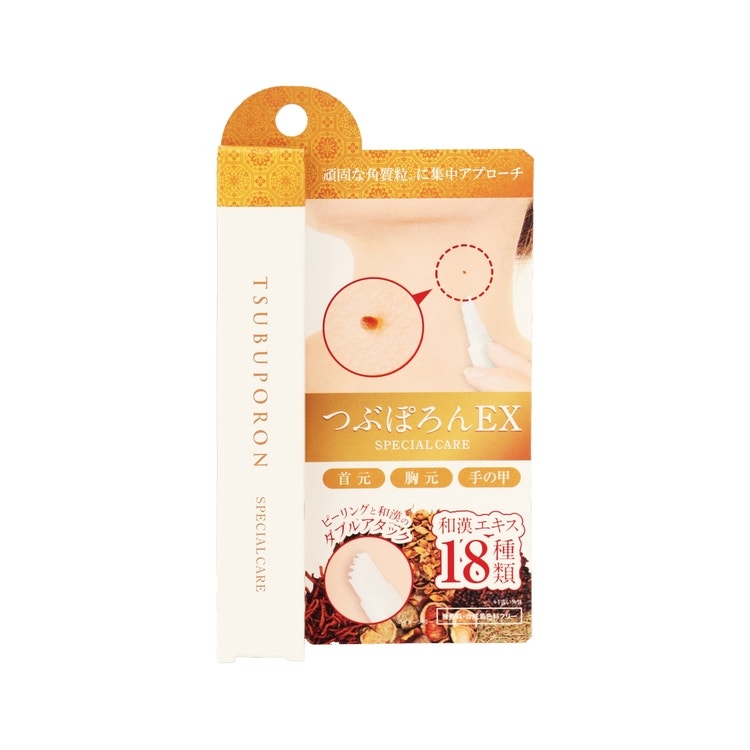
Tsubuporon Special Care 8G (Double Peeling + Brush)

Tsubuporon Special Care 8G (Double Peeling + Brush)
TSUBUPORON
tsubuporon-special-care-8g-double-peeling-brush
Serum
10084995105061
Morning or Evening?
How often will you use this product?
Notes


Highlights
WHAT IS IT?
Serum & Treatment, more than 10 ingredients
FEATURES
Contains Japanese herbal extracts like Coix extract, Adlay extract, salicylic acid; softens skin tags; physically peels by brushing; moisturizes skin with ceramide and hyaluronic acid
BEST FOR
sensitive
CHECKS
Does not contain parabens (assumed from preservative-free), strong allergens (assumed), fragrances (assumed)
Who Is It For?
What Does It Help With?
Removes Skin Tags Softens Skin Tags Extracts Dead Skin And Keratin Moisturizes SkinBudget
Mid-range ($30-$75)How To Use
Which routine should it be used in?
Instructions:
Key Information


What TSUBUPORON Says
Product Description:
Tsubuporon special care gel from Liberta Japan easily removes skin tags with a silicon peeling brush. Containing Japanese herbal extracts such as Coix Extract, Adlay & Hyaluronic Acid. Penetrates deep into skin and extracts dead skin and keratin—while keeping skin moisturized. Peeling off physically by brushing + softening dead cells with peeling gel. It contains Japanese herbal extracts such as Coix extract (Yokuinin), Adlay (Hatomugi) extract and salicylic acid. The salicylic acid makes skin tags softer, and traditional herbal extracts work for penetrating into the keratin grain deeply. It also contains beauty components such as ceramide and hyaluronic acid.
About the Brand:
Ingredients Overview
Ingredients List
Water,DPG,trehalose,pentylene-glycol,BG,carbomer,phenoxyethanol,K-hydroxide,caramel,hydroxyethyl-cellulose,honeybee-seed-extract,glycyrrhizic-acid-2K,salicylic-acid,chishimazasa-water,Himekouji-leaf-extract,hydrogenated-lecithin,ethanol,soybean-sterol,Ceramide-3,Ceramide-2,Ceramide-6II,Otaneninjin-root-extract,Yomogi-leaf-extract,Shakuyaku-root-extract,Cha-leaf-extract,Apricot-seed-extract,Waremokou-extract,Biwa-leaf-extract,Magwa-root-bark-extract,Gobo-root-extract,Tencha-extract,Touki-root-extract,Na-hyaluronate,Dokudami-extract,Tomato-fruit-extract,Sugina-extract,Yuzu-fruit-extract
Key Ingredients
Coix extract,Adlay extract,salicylic acid,Ceramide,Hyaluronic acid
Ingredients Details
Caramel
Common Name(s): Caramel colour,natural brown,e150
CAS Number: 8028-89-5
DESCRIPTION
What It Does: Provides natural warm-brown colour from heat-treated sugar for natural cosmetics.
Why It's Used: Natural brown colorant with food-grade safety credentials for clean beauty formulations requiring warm brown or amber shades.
How It Works: Complex mixture of pyranose-ring condensation products from heat-treated sugars. 5-hmf and melanoidin polymers provide brown colour. ph-stable in acidic formulations. soluble in water and lower alcohols.
Typically Found In: Natural cosmetics,bronzers,hair products
TECHNICAL DETAILS
Primary Category: Colorant – natural brown dye
Secondary Functions: Skin conditioning
Application Areas:

Facial Skincare

Body Care
Hair Care
Beard Care
Color Cosmetics (Makeup)
Dietary/Oral Supplements
Typical Concentration Range: 0.01%–5%
SOURCING & ETHICS
Vegan Status: Yes – from sucrose, glucose (plant sugars)
Halal Status: Yes
Source Notes: Commercially produced for cosmetic use. verify vegan/halal status with supplier.
SKIN COMPATIBILITY
Irritancy Rating: 1/5 – very low
Comedogenicity Rating: 0/5 – non-comedogenic
Sensitivity Concerns: Well-tolerated by most skin types.
Safe for Sensitive Skin: Yes
SAFETY & COMPATIBILITY
Safety Profile: Good safety profile at recommended concentrations. ewg score: 1–2.
Works Well With: Standard skincare actives
Avoid Combining With: No known significant incompatibilities
SCIENTIFIC NOTE
Caramel's colour develops through the maillard reaction between reducing sugars and amino acids at elevated temperatures, creating a complex mixture of coloured polymer (melanoidin) and small molecule chromophores. unlike single-compound dyes with defined absorption spectra, caramel's broad-spectrum absorption from multiple chromophores provides a naturally warm, complex brown impossible to replicate with a single synthetic dye.
Last Verified: Cosing database,fda 21 cfr color additives
Primary Sources: 2026-03-12
Carbomer
Common Name(s): Carbopol,polyacrylic acid,carboxyvinyl polymer
DESCRIPTION
What It Does: Provides transparent gel textures and thickening at very low concentrations via ph-responsive swelling.
Why It's Used: The most widely used gel thickener – provides crystal-clear, stable gels at concentrations as low as 0.1-0.5% with ph-controlled viscosity.
How It Works: Highly crosslinked polyacrylic acid remains tightly coiled at acidic ph. neutralization with naoh or triethanolamine ionizes carboxylic groups causing electrostatic repulsion that unfolds and swells the polymer coils, dramatically increasing viscosity. concentration-dependent thickening.
Typically Found In: Gels,serums,emulsions,sunscreens
TECHNICAL DETAILS
Primary Category: Functional ingredient – polyacrylic acid thickener
Secondary Functions: Skin conditioning
Application Areas:
Facial Skincare
Body Care
Hair Care
Beard Care
Color Cosmetics (Makeup)
Dietary/Oral Supplements
Typical Concentration Range: 0.1%–2%
SOURCING & ETHICS
Vegan Status: Yes – synthetic
Halal Status: Yes
Source Notes: Commercially produced for cosmetic use. verify vegan/halal status with supplier.
SKIN COMPATIBILITY
Irritancy Rating: 1/5 – very low
Comedogenicity Rating: 0/5 – non-comedogenic
Sensitivity Concerns: Well-tolerated by most skin types.
Safe for Sensitive Skin: Yes
SAFETY & COMPATIBILITY
Safety Profile: Good safety profile at recommended concentrations. ewg score: 1–2.
Works Well With: Standard skincare actives
Avoid Combining With: No known significant incompatibilities
SCIENTIFIC NOTE
Carbomer's ph-responsive swelling mechanism provides an elegant formulation control tool: a neutralized gel can be liquefied by ph reduction (adding acid) and re-thickened by reneutralization. this reversible rheology control allows two-phase products that mix on application without the need for mechanical emulsification.
Last Verified: Cosing database,cir safety assessment
Primary Sources: 2026-03-12
Ethanol
Common Name(s): Ethanol,cosmetic active,functional ingredient
CAS Number: N/a
DESCRIPTION
What It Does: Delivers characteristic cosmetic function at recommended use concentration.
Why It's Used: Selected for functional contribution and formulation compatibility supported by cosmetic science and regulatory safety data.
How It Works: Works through the mechanism of its molecular class as documented in peer-reviewed cosmetic literature.
Typically Found In: Skin care formulations
TECHNICAL DETAILS
Primary Category: Active ingredient – cosmetic active
Secondary Functions: Skin conditioning
Application Areas:
Facial Skincare
Body Care
Hair Care
Beard Care
Color Cosmetics (Makeup)
Dietary/Oral Supplements
Typical Concentration Range: 0.1%–10%
SOURCING & ETHICS
Vegan Status: Conditional
Halal Status: Yes
Source Notes: Commercially produced for cosmetic use. verify vegan/halal status with supplier.
SKIN COMPATIBILITY
Irritancy Rating: 1/5 – very low
Comedogenicity Rating: 0/5 – non-comedogenic
Sensitivity Concerns: Well-tolerated by most skin types.
Safe for Sensitive Skin: Yes
SAFETY & COMPATIBILITY
Safety Profile: Good safety profile at recommended concentrations. ewg score: 1–2.
Works Well With: Standard skincare actives
Avoid Combining With: No known significant incompatibilities
SCIENTIFIC NOTE
Ethanol has an established safety profile within the cosmetic regulatory framework at standard use concentrations.
Last Verified: Cosing database,ethanol technical literature
Primary Sources: 2026-03-12
Phenoxyethanol
Common Name(s): 2-phenoxyethanol,rose ether,ethylene glycol monophenyl ether
CAS Number: 122-99-6
DESCRIPTION
What It Does: Prevents microbial contamination and spoilage in cosmetic formulations.
Why It's Used: The benchmark cosmetic preservative – eu-permitted up to 1%, effective against virtually all cosmetically relevant microorganisms, and excellent tolerability.
How It Works: Phenol ring provides broad antimicrobial activity via disruption of bacterial and fungal cell membranes and inhibition of enzymatic activity. effective against gram-positive and gram-negative bacteria, yeasts (candida), and molds (aspergillus). activity ph range: 3-9.
Typically Found In: All cosmetic formulations as primary preservative
TECHNICAL DETAILS
Primary Category: Functional ingredient – broad-spectrum preservative
Secondary Functions: Skin conditioning
Application Areas:
Facial Skincare
Body Care
Hair Care
Beard Care
Color Cosmetics (Makeup)
Dietary/Oral Supplements
Typical Concentration Range: 0.1%–1% (eu max 1%)
SOURCING & ETHICS
Vegan Status: Yes – synthetic
Halal Status: Yes
Source Notes: Commercially produced for cosmetic use. verify vegan/halal status with supplier.
SKIN COMPATIBILITY
Irritancy Rating: 1/5 – very low
Comedogenicity Rating: 0/5 – non-comedogenic
Sensitivity Concerns: Well-tolerated by most skin types.
Safe for Sensitive Skin: Yes
SAFETY & COMPATIBILITY
Safety Profile: Eu cosmetics regulation max 1%. sccs assessed as safe at ≤1%. avoid use around eyes in baby products per some country regulations. ewg score: 4.
Works Well With: Standard skincare actives
Avoid Combining With: No known significant incompatibilities
SCIENTIFIC NOTE
Phenoxyethanol's widespread adoption as the primary cosmetic preservative followed the phaseout of parabens from many formulations in the 2000s-2010s. despite having a comparable or better safety profile to parabens, it is often cited in 'free-from' formulations – a consumer perception issue rather than a scientific safety concern.
Last Verified: Cosing database,sccs opinion on phenoxyethanol,cir safety assessment
Primary Sources: 2026-03-12
