
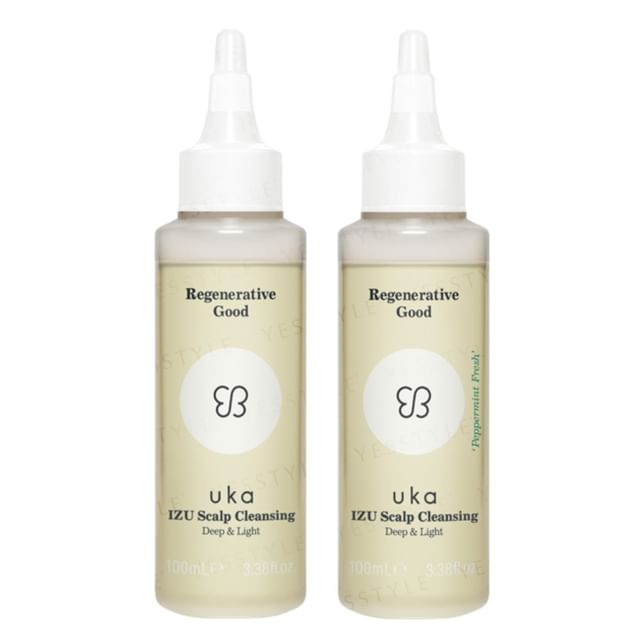

uka
uka IZU Scalp Cleansing Deep & Light 100mL
A scalp cleansing product that uses fine foam to refreshingly wash away excess sebum from the scalp. It has been upgraded to include 30% Kuromoji water for enhanced cleansing and moisturizing effects. The formula also contains fulvic acid, 37 types of minerals, and 20 amino acids to support scalp health. Scented with eucalyptus, mint, and tea tree for a refreshing experience.
Sulfate-free
Paraben-free
Silicone-free
Natural
Oily Scalp
Scalp Issues
Optimized for Your Environment & Lifestyle
Nykaa
In stock
Recommended

uka IZU Scalp Cleansing Deep & Light 100mL
uka
uka-izu-scalp-cleansing-deep-light-100ml
Scalp Cleanser
10523361902885
Morning or Evening?
How often will you use this product?
Notes


Secure payment protection
Your Biodata Compatibility Analysis
Based on your 6 hair health indices and environmental factors
Poor Match
Significant incompatibilities
Growth Cycle Health Index
Hair Match
Hair Health Index Alignment
Optimal for OSI, SSI, DI, HSI
Ingredient Efficacy
Matching Ingredient Score
Environment Compatibility
Current UV, Air Quality & Humidity
Why This Works for Your Specific Profile
Damage Index:
Damage levels outside specified range may not benefit optimally from product formulation
Water Quality:
Sensitive scalps experience irritation from active ingredients formulated for resilient skin
Hair:
No porosity-specific conflicts
Active Lifestyle:
Low activity produces insufficient stress or buildup making product intensity unnecessarily harsh
Your Hair Profile Integration
Your Hair Archetype

Density Level

Washing Frequency

Shedding Level

Oil Level
Your Hair Health Indices
Oil Secretion (OSI)
Very low oil production
Scalp Sensitivity (SSI)
Very low sensitivity
Growth Rate (CMR)
Poor metabolism rate
Damage Index (DI)
Minimal damage
Hair Strength (HSI)
Very weak strength
Softness Index (SI)
Significant improvement needed
Water & Environmental Integration

Water:


Expected Results & Timeline
Key Highlights

What is it?
Scalp cleanser with natural ingredients

Who Is It For
All ages and genders

Budget
Rs. 2,919.46 - Rs. 5,838.92

Timeline
Regular use leads to a healthy scalp condition
Why You’ll Love It

What Does It Help With?
Excess sebum, scalp impurities, scalp health

Best for
Oily Scalp

Features
Contains 30% Kuromoji water for enhanced cleansing and moisturizing effects; Includes fulvic acid, 37 types of minerals, and 20 amino acids to support scalp health; Scented with eucalyptus, mint, and tea tree for a refreshing experience

Checks
Hypo-allergenic
Ingredients Overview
Ingredients List
kuromoji-water, fulvic-acid, eucalyptus-oil, peppermint-oil, tea-tree-oil
Key Ingredients
Kuromoji water, Fulvic acid, Eucalyptus oil, Peppermint oil, Tea tree oil
Ingredients Details
Eucalyptus Oil
Common Name(s): Eucalyptus oil,blue gum oil,camphor eucalyptus
CAS Number: 8000-48-4
DESCRIPTION
What It Does: Provides eucalyptol anti-inflammatory and antimicrobial activity with characteristic camphoraceous clean scent.
Why It's Used: The respiratory wellness essential oil – eucalyptus oil's 1,8-cineole provides clinically validated mucolytic and bronchodilatory activity for respiratory symptom relief in topical chest rubs.
How It Works: 1,8-cineole (eucalyptol, 55-80%) activates trpm8 (cooling) and inhibits leukotriene synthesis (anti-inflammatory). antimicrobial via cineole membrane permeabilisation. mucolytic via mucus hydration improvement.
Typically Found In: Cooling products,respiratory relief,scalp treatments,men's grooming
TECHNICAL DETAILS
Primary Category: Active ingredient – soothing / anti-inflammatory
Secondary Functions: Redness reduction,anti-inflammatory,calming
Application Areas:

Facial Skincare

Body Care
Hair Care
Beard Care
Color Cosmetics (Makeup)
Dietary/Oral Supplements
Typical Concentration Range: 0.001%–2%
SOURCING & ETHICS
Vegan Status: Yes – from eucalyptus globulus leaves
Halal Status: Yes
Source Notes: Plant-derived extract or synthetic.
SKIN COMPATIBILITY
Irritancy Rating: 1/5 – very low
Comedogenicity Rating: 0/5 – non-comedogenic
Sensitivity Concerns: Non-irritating; ideal for reactive and sensitive skin.
Safe for Sensitive Skin: Yes – particularly recommended for sensitive skin
SAFETY & COMPATIBILITY
Safety Profile: Eu: avoid near eyes and face of infants/children under 2 due to trpv1/trpm8 stimulation. toxic if ingested.
Works Well With: Ceramides,panthenol,allantoin,hyaluronic acid,centella asiatica
Avoid Combining With: No significant incompatibilities
SCIENTIFIC NOTE
1,8-cineole's mucolytic mechanism involves penetration through bronchial epithelium membranes and direct activation of mucociliary transport (increased cilia beat frequency and mucus hydration). clinical studies for orally dosed cineole in bronchitis show equivalent efficacy to pharmaceutical mucolytics – one of the best-characterised pharmacological mechanisms for a fragrance compound's therapeutic effect.
Last Verified: 2026-03-12
Primary Sources: Cosing database,ifra standards,juergens et al. cineole anti-inflammatory study
Fulvic Acid
Common Name(s): Fulvic acid,fulvic acid,humic substance,mineral-organic antioxidant prebiotic electrolyte
CAS Number: N/a
DESCRIPTION
What It Does: Provides antioxidant protection from fulvic acid's poly-aromatic radical scavenging, prebiotic activity for skin microbiome beneficial organisms, trace mineral bioavailability from complexation, and skin conditioning from the polyanionic humic polymer.
Why It's Used: Fulvic acid provides the most mineralogically complex antioxidant in skin care — the ancient organic matter matrix containing hundreds of condensed polyphenol structures alongside trace mineral complexes unavailable from any single botanical source.
How It Works: Fulvic acid structure: condensed polyphenol-carboxylate polymer (mw 500-2000 da) with >5 carboxyl groups per molecule. radical scavenging: extended quinone-catechol redox system providing multiple h-atom donations. mineral chelation: carboxylate and hydroxyl groups complex fe²⁺, zn²⁺, cu²⁺ for bioavailable trace mineral delivery. prebiotic: humic oligosaccharide fragments fermented by bifidobacterium.
Typically Found In: Anti-aging,microbiome,mineral skin care
TECHNICAL DETAILS
Primary Category: Active ingredient – antioxidant
Secondary Functions: Free radical scavenging,anti-aging
Application Areas:
Facial Skincare
Body Care
Hair Care
Beard Care
Color Cosmetics (Makeup)
Dietary/Oral Supplements
Typical Concentration Range: 0.01%–2%
SOURCING & ETHICS
Vegan Status: Yes
Halal Status: Yes
Source Notes: Plant-derived extract or synthetic.
SKIN COMPATIBILITY
Irritancy Rating: 1/5 – very low
Comedogenicity Rating: 0/5 – non-comedogenic
Sensitivity Concerns: Non-irritating; well-tolerated.
Safe for Sensitive Skin: Yes
SAFETY & COMPATIBILITY
Safety Profile: Excellent safety profile. ewg score: 1.
Works Well With: Vitamin c,vitamin e,ferulic acid,spf,other antioxidants
Avoid Combining With: No significant incompatibilities
SCIENTIFIC NOTE
Fulvic acid heavy metal monitoring: humic substances from soil can accumulate heavy metals (pb, as, cd) depending on soil source — cosmetic-grade fulvic acid requires icp-ms verification of heavy metal content below regulatory limits before formulation.
Last Verified: 2026-03-22
Primary Sources: Cosing database,fulvic acid humic substance antioxidant prebiotic review
Tea Tree Oil
Common Name(s): Tea tree oil,tto,melaleuca oil
CAS Number: 68647-73-4
DESCRIPTION
What It Does: Provides the most potent single-plant broad-spectrum antimicrobial essential oil for skin antiseptic applications.
Why It's Used: The antimicrobial essential oil – tea tree oil's terpinen-4-ol provides clinically proven broad-spectrum antimicrobial activity in rct-level clinical studies for acne and mrsa decolonisation.
How It Works: Terpinen-4-ol (30-48%) provides membrane-disrupting antimicrobial activity vs gram+/- bacteria, fungi, and enveloped viruses. iso 4730 requires minimum 30% terpinen-4-ol and maximum 5% 1,8-cineole (sensitiser). anti-biofilm activity vs staphylococcus.
Typically Found In: Anti-acne products,antiseptic formulas,natural antimicrobials,scalp treatments
TECHNICAL DETAILS
Primary Category: Active ingredient – soothing / anti-inflammatory
Secondary Functions: Redness reduction,anti-inflammatory,calming
Application Areas:
Facial Skincare
Body Care
Hair Care
Beard Care
Color Cosmetics (Makeup)
Dietary/Oral Supplements
Typical Concentration Range: 0.001%–5%
SOURCING & ETHICS
Vegan Status: Yes – from melaleuca alternifolia leaves (australia)
Halal Status: Yes
Source Notes: Plant-derived extract or synthetic.
SKIN COMPATIBILITY
Irritancy Rating: 1/5 – very low
Comedogenicity Rating: 0/5 – non-comedogenic
Sensitivity Concerns: Non-irritating; ideal for reactive and sensitive skin.
Safe for Sensitive Skin: Yes – particularly recommended for sensitive skin
SAFETY & COMPATIBILITY
Safety Profile: Iso 4730:2017 quality standard defines authentic tea tree oil. can cause contact sensitisation at high concentrations. toxic if ingested.
Works Well With: Ceramides,panthenol,allantoin,hyaluronic acid,centella asiatica
Avoid Combining With: No significant incompatibilities
SCIENTIFIC NOTE
Randomised controlled trial comparison of 5% tea tree oil gel vs 5% benzoyl peroxide lotion for acne demonstrated equivalent efficacy for acne lesion reduction at 3 months. tea tree's slower onset (8 weeks vs 4 weeks for bpo) was offset by significantly fewer side effects (dryness, irritation, peeling) in the tto group – providing evidence-based support for clinical tto use as a well-tolerated bpo alternative.
Last Verified: 2026-03-12
Primary Sources: Cosing database,bassett et al. tea tree oil acne rct,iso 4730
Personalized Usage Instructions
How to Use
Step 1
Use once a week before shampooing
Step 2
Apply to the scalp, massage gently, and rinse thoroughly
Medical Chemicals

Protein/Moisture
- Moisture
pH Level
- Acidic

Porosity Taget
- Normal Porosity
Customized for Your Profile
Scalp Condtions
Oil Control, Dry Scalp
Climate Suitability
Humid, Dry, Pollution Shield, Summer
Clinical Claims
Frequency
Use once a week before shampooing. Apply to the scalp, massage gently, and rinse thoroughly.
Product Information

Hypo-allergenic