

Shiseido
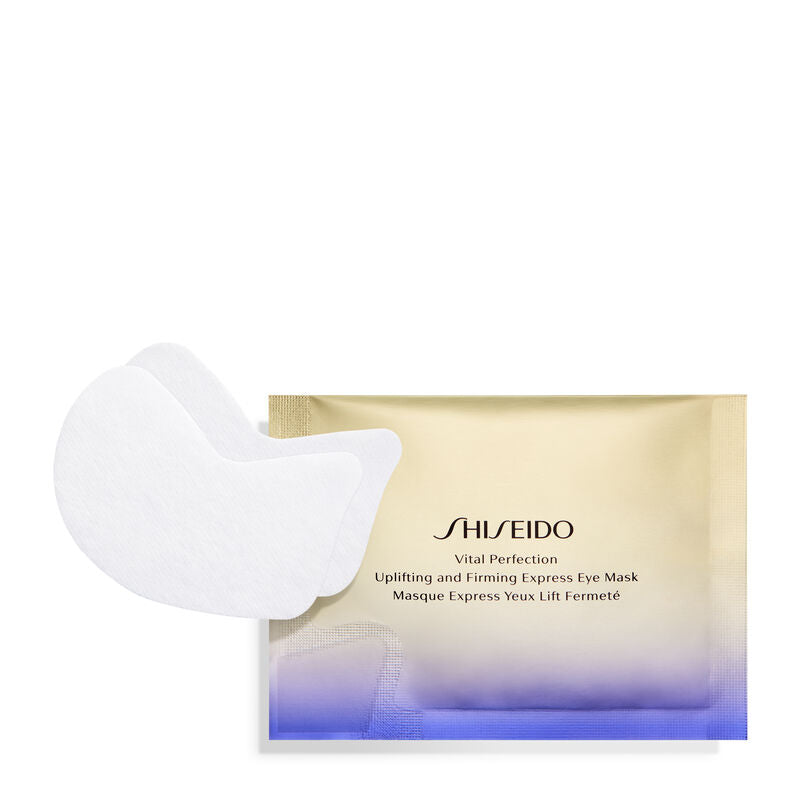
Uplifting and Firming Express Eye Mask

Uplifting and Firming Express Eye Mask
Shiseido
uplifting-and-firming-express-eye-mask
Eyecare
9605086150949
Morning or Evening?
How often will you use this product?
Notes


Highlights
WHAT IS IT?
Eye mask
FEATURES
Pure retinol supports the skin’s natural production of hyaluronic acid for greater resilience against signs of aging & fatigue, leading to a more radiant eye area.
BEST FOR
Anti aging, dry skin, sensitive skin, oily skin
CHECKS
Paraben-free
Who Is It For?
Not Specified Likely For AdultsWhat Does It Help With?
Dark Circles Undereye Bags Signs Of Fatigue Lifting And Firming Of The Eye AreaBudget
PremiumHow To Use
Which routine should it be used in?
Instructions:
Key Information

What Shiseido Says
Product Description:
A retinol eye mask that visibly lifts and firms around the eyes in just 1 week*. Immediately see a more radiant eye area, while helping target dark circles, undereye bags and signs of fatigue.
About the Brand:
Ingredients Overview
Ingredients List
AQUA,PENTAERYTHRITYL TETRAETHYLHEXANOATE,BUTYLENE GLYCOL,DIPHENYLSILOXY PHENYL TRIMETHICONE,GLYCERIN,DIPROPYLENE GLYCOL,POTASSIUM METHOXYSALICYLATE,PEG-60 HYDROGENATED CASTOR OIL,PHENOXYETHANOL,CARBOMER,XANTHAN GUM,METHYLPARABEN,TRISODIUM EDTA,POLYVINYL ALCOHOL,TOCOPHERYL ACETATE,VP/VA COPOLYMER,ROSA DAMASCENA FLOWER WATER,SODIUM CITRATE,POTASSIUM HYDROXIDE,BHT,SQUALANE,ALCOHOL,CAFFEINE,RETINOL,POLYSORBATE 20,CITRIC ACID,LAVANDULA ANGUSTIFOLIA (LAVENDER) OIL,PEG/PPG-14/7 DIMETHYL ETHER,FRAGRANCE (PARFUM),TOCOPHEROL,LINALOOL,LIMONENE,ANGELICA ACUTILOBA ROOT EXTRACT,ANGELICA KEISKEI LEAF/STEM EXTRACT,OLEA EUROPAEA (OLIVE) LEAF EXTRACT,SANGUISORBA OFFICINALIS ROOT EXTRACT,LAMIUM ALBUM FLOWER/LEAF/STEM EXTRACT,CAMELLIA SINENSIS LEAF EXTRACT,INOSITOL,CARTHAMUS TINCTORIUS (SAFFLOWER) FLOWER EXTRACT,PINUS SYLVESTRIS CONE EXTRACT,ZIZIPHUS JUJUBA FRUIT EXTRACT,ROSMARINUS OFFICINALIS (ROSEMARY) LEAF EXTRACT (ROSMARINUS OFFICINALIS LEAF EXTRACT),EUCHEUMA SERRA/GRATELOUPIA SPARSA/SACCHARINA ANGUSTATA/ULVA LINZA/UNDARIA PINNATIFIDA EXTRACT,SACCHARINA ANGUSTATA/UNDARIA PINNATIFIDA EXTRACT,BUPLEURUM FALCATUM ROOT EXTRACT,COIX LACRYMA-JOBI MA-YUEN SEED EXTRACT,
Key Ingredients
Retinol, Matsu Extract, Benibana Flower, Olive Root, Tea, Angelica Root Extracts
Ingredients Details
Butylene Glycol
Common Name(s): 1,3-butanediol,bg,1,3-butylene glycol
CAS Number: 107-88-0
DESCRIPTION
What It Does: Provides humectant hydration and active ingredient solubilization with excellent skin feel.
Why It's Used: Preferred glycol humectant in premium and k-beauty formulations for superior skin feel vs propylene glycol with equivalent functionality.
How It Works: Two hydroxyl groups at 1,3-positions provide water binding and solvent activity. better tolerated than propylene glycol with minimal sensitization risk. 4-carbon backbone provides slightly greater hydrophobic character enabling dissolution of less polar actives vs pg.
Typically Found In: Toners,essences,serums,k-beauty formulas
TECHNICAL DETAILS
Primary Category: Functional ingredient – glycol humectant
Secondary Functions: Tewl reduction,skin plumping
Application Areas:

Facial Skincare
Body Care
Hair Care

Beard Care
Color Cosmetics (Makeup)
Dietary/Oral Supplements
Typical Concentration Range: 1%–10%
SOURCING & ETHICS
Vegan Status: Yes – synthetic
Halal Status: Yes
Source Notes: Synthetic or naturally derived. excellent aqueous solubility.
SKIN COMPATIBILITY
Irritancy Rating: 1/5 – very low
Comedogenicity Rating: 0/5 – non-comedogenic
Sensitivity Concerns: Non-irritating; suitable for all skin types.
Safe for Sensitive Skin: Yes
SAFETY & COMPATIBILITY
Safety Profile: Excellent safety profile. ewg score: 1.
Works Well With: Ceramides,emollients,occlusives,glycerin,hyaluronic acid
Avoid Combining With: No significant incompatibilities
SCIENTIFIC NOTE
K-beauty's preference for butylene glycol over propylene glycol is driven by two factors: bg's superior skin feel (less tacky than pg's higher viscosity) and its lower sensitization potential (1,3-bg has better spatial distribution of hydroxyl groups that reduces protein interaction vs pg's 1,2-position oh groups).
Last Verified: 2026-03-12
Primary Sources: Cosing database,cir safety assessment
Carbomer
Common Name(s): Carbopol,polyacrylic acid,carboxyvinyl polymer
DESCRIPTION
What It Does: Provides transparent gel textures and thickening at very low concentrations via ph-responsive swelling.
Why It's Used: The most widely used gel thickener – provides crystal-clear, stable gels at concentrations as low as 0.1-0.5% with ph-controlled viscosity.
How It Works: Highly crosslinked polyacrylic acid remains tightly coiled at acidic ph. neutralization with naoh or triethanolamine ionizes carboxylic groups causing electrostatic repulsion that unfolds and swells the polymer coils, dramatically increasing viscosity. concentration-dependent thickening.
Typically Found In: Gels,serums,emulsions,sunscreens
TECHNICAL DETAILS
Primary Category: Functional ingredient – polyacrylic acid thickener
Secondary Functions: Skin conditioning
Application Areas:
Facial Skincare
Body Care
Hair Care
Beard Care
Color Cosmetics (Makeup)
Dietary/Oral Supplements
Typical Concentration Range: 0.1%–2%
SOURCING & ETHICS
Vegan Status: Conditional - supplier confirmation required
Halal Status: Unverified - supplier confirmation required
Source Notes: Commercially produced for cosmetic use. verify vegan/halal status with supplier. [audit 2026-07-29 rev2: the record's own source_notes does not assert a non-animal origin, or instructs the reader to verify with the supplier; "yes" asserts knowledge the record does not hold. determination requires shariah-panel sign-off.]
SKIN COMPATIBILITY
Irritancy Rating: 1/5 – very low
Comedogenicity Rating: 0/5 – non-comedogenic
Sensitivity Concerns: Well-tolerated by most skin types.
Safe for Sensitive Skin: Yes
SAFETY & COMPATIBILITY
Safety Profile: Good safety profile at recommended concentrations. ewg score: 1–2.
Works Well With: Standard skincare actives
Avoid Combining With: No known significant incompatibilities
SCIENTIFIC NOTE
Carbomer's ph-responsive swelling mechanism provides an elegant formulation control tool: a neutralized gel can be liquefied by ph reduction (adding acid) and re-thickened by reneutralization. this reversible rheology control allows two-phase products that mix on application without the need for mechanical emulsification.
Last Verified: 2026-03-12
Primary Sources: Cosing database,cir safety assessment
Diphenylsiloxy Phenyl Trimethicone
Common Name(s): Diphenylsiloxy phenyl trimethicone,phenyl silicone,conditioning silky film-forming
CAS Number: N/a
DESCRIPTION
What It Does: Diphenylsiloxy phenyl trimethicone deposits an ultra-thin, flexible conditioning film on skin and hair that dramatically reduces surface friction, provides water-repellent moisture lock-in, protects hair from heat damage and humidity-induced frizz, and delivers the smooth, silky sensory experience that distinguishes premium personal care from basic functional products.
Why It's Used: Formulators choose diphenylsiloxy phenyl trimethicone for its unique functional profile that organic emollients cannot replicate: the si-o backbone (bond angle 150° vs c-c 109°) provides exceptional molecular flexibility allowing the silicone polymer to flatten along any surface topology, creating an ultra-conforming film. the surface energy of cured silicone (~20 mn/m) is lower than any organic emollient, providing superior lubricity without the heaviness or comedogenic character of equivalent organic oils. for hair specifically, silicone deposition dramatically reduces the coefficient of friction between hair fibres from ~0.8 (uncoated) to ~0.25 (silicone-coated), providing the detangling and smoothing that defines premium conditioner performance.
How It Works: Diphenylsiloxy phenyl trimethicone functions through the si-o siloxane backbone's fundamental physical chemistry: (1) surface deposition — the polymer's backbone flexibility allows it to flatten onto hair and skin surfaces, maximising contact area and van der waals adhesion. the polydimethylsiloxane chain adopts a helical conformation in free solution but extends to near-flat conformation on surfaces, providing maximum coverage per molecule deposited; (2) low surface energy film — the methyl groups surrounding the si-o backbone present an array of non-polar, non-hydrogen-bonding surfaces. the surface energy of ~20 mn/m is lower than water (~72 mn/m) and organic oils (~30–35 mn/m), providing excellent lubricity from the lowest-energy surface; (3) thermal stability — si-o bond energy (105 kcal/mol vs c-c 83 kcal/mol) provides exceptional heat resistance, making dimethicone uniquely suitable as a heat-protectant on hair during blow-drying and flat-ironing up to 230°c; (4) breathability — despite the water-repellent surface, silicone films have sufficient molecular-scale porosity to allow oxygen, co₂, and water vapour transmission from the film's non-crystalline, flexible structure — unlike occlusive waxes that form dense impermeable films.
Typically Found In: Hair conditioners,skin care emollients,heat protectants
TECHNICAL DETAILS
Primary Category: Functional ingredient – emollient
Secondary Functions: Barrier sealing,softening
Application Areas:
Facial Skincare
Body Care
Hair Care
Beard Care
Color Cosmetics (Makeup)
Dietary/Oral Supplements
Typical Concentration Range: 0.5%–25%
SOURCING & ETHICS
Vegan Status: Conditional - supplier confirmation required
Halal Status: Unverified - supplier confirmation required
Source Notes: Plant-derived, synthetic or animal-derived. verify source. [audit 2026-07-29 rev2: the record's own source_notes does not assert a non-animal origin, or instructs the reader to verify with the supplier; "yes" asserts knowledge the record does not hold. determination requires shariah-panel sign-off.]
SKIN COMPATIBILITY
Irritancy Rating: 1/5 – very low
Comedogenicity Rating: 1/5 – low; formulation-dependent
Sensitivity Concerns: Non-irritating.
Safe for Sensitive Skin: Yes
SAFETY & COMPATIBILITY
Safety Profile: Excellent safety profile. ewg score: 1.
Works Well With: Humectants,ceramides,actives as carrier
Avoid Combining With: No significant incompatibilities
SCIENTIFIC NOTE
Si-o backbone flexibility vs organic polymers: c-c bond angle is fixed at 109.5° (tetrahedral sp3) with restricted rotation, giving organic polymer chains a preferred helical structure that resists lying flat on surfaces. si-o bond angle is 150° with near-free rotation from the longer si-o bond (1.64 å vs c-c 1.54 å) and lower rotational barrier (~0.6 kcal/mol vs c-c ~3 kcal/mol). this 5× lower rotational barrier allows silicone chains to adopt virtually any conformation essentially free of energy cost — enabling the flat, conforming surface adsorption that provides optimal thin-film coverage and explains the silky-smooth feel unobtainable from rigid organic polymer films.
Last Verified: 2026-03-12
Primary Sources: Cosing database,diphenylsiloxy phenyl trimethicone silicone film conditioning review
Dipropylene Glycol
Common Name(s): Dipropylene glycol,glycol co-solvent,humectant formulation aid
CAS Number: N/a
DESCRIPTION
What It Does: Provides humectant, co-solvent, and fragrance fixative in cosmetic formulations, improving active ingredient dissolution and product texture while delivering mild skin conditioning.
Why It's Used: Glycol solvents are essential for dissolving actives with limited water or oil solubility — the intermediate polarity of glycol ethers provides access to the wider solubility parameter space between pure water and oil phases.
How It Works: Hydroxyl and ether groups provide h-bonding for water miscibility; the organic chain provides compatibility with lipophilic actives. medium-chain glycols (c3–c6) provide the optimal balance of water compatibility, lipophilic active dissolution, and skin-compatible humectancy.
Typically Found In: Skin care formulations,co-solvent systems
TECHNICAL DETAILS
Primary Category: Functional ingredient – humectant
Secondary Functions: Tewl reduction,skin plumping
Application Areas:
Facial Skincare
Body Care
Hair Care
Beard Care
Color Cosmetics (Makeup)
Dietary/Oral Supplements
Typical Concentration Range: 1%–30%
SOURCING & ETHICS
Vegan Status: Conditional - supplier confirmation required
Halal Status: Unverified - supplier confirmation required
Source Notes: Synthetic or naturally derived. excellent aqueous solubility. [audit 2026-07-29 rev2: status downgraded on audit. determination requires shariah-panel sign-off.]
SKIN COMPATIBILITY
Irritancy Rating: 1/5 – very low
Comedogenicity Rating: 0/5 – non-comedogenic
Sensitivity Concerns: Non-irritating; suitable for all skin types.
Safe for Sensitive Skin: Yes
SAFETY & COMPATIBILITY
Safety Profile: Excellent safety profile. ewg score: 1.
Works Well With: Ceramides,emollients,occlusives,glycerin,hyaluronic acid
Avoid Combining With: No significant incompatibilities
SCIENTIFIC NOTE
Glycol ether co-solvents enhance sc penetration of co-applied actives by increasing their thermodynamic activity in the sc lipid phase — high thermodynamic activity (near saturation) drives diffusion by concentration gradient even when absolute concentration is low.
Last Verified: 2026-03-12
Primary Sources: Cosing database,dipropylene glycol glycol solvent review