

URIAGE
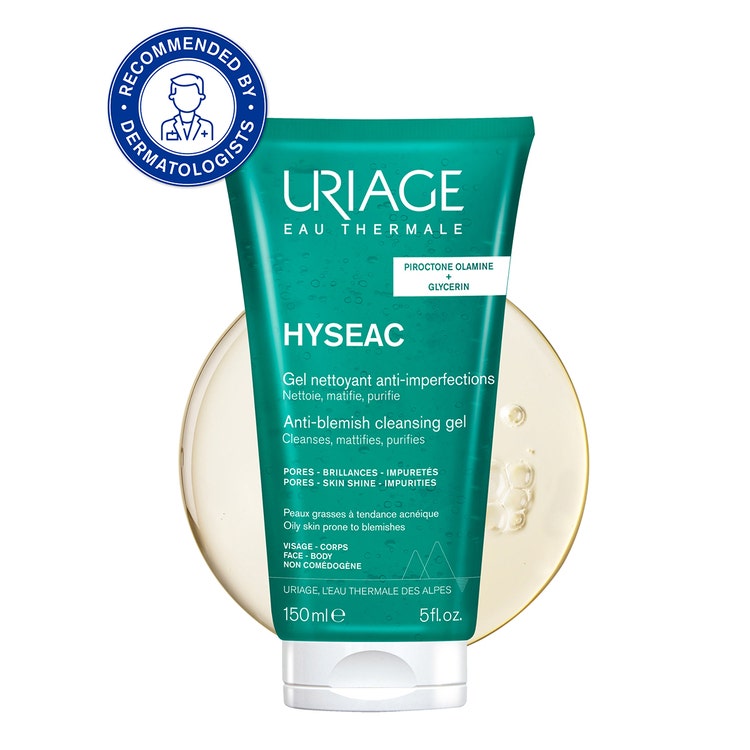
Uriage Hyseac Cleansing Gel 150ml

Uriage Hyseac Cleansing Gel 150ml
URIAGE
uriage-hyseac-cleansing-gel-150ml
Cleanse
10085023121701
Morning or Evening?
How often will you use this product?
Notes


Highlights
WHAT IS IT?
Cleansing gel, contains multiple ingredients
FEATURES
Ultra-gentle, soap-free, rinse off cleansing, eliminates impurities and excess sebum, regulates sebum, soothes skin
BEST FOR
combination
CHECKS
Paraben-Free,Preservative-Free
Who Is It For?
What Does It Help With?
Impurities Removal Excess Sebum Regulation Skin SoothingBudget
Mid-range ($30-$75)How To Use
Which routine should it be used in?
Instructions:
Key Information


What URIAGE Says
Product Description:
Hyseac gentle cleansing gel eliminates impurities and excess sebum, perfectly respecting the epidermis. It gently cleans and eliminates skin impurities, regulates skin sebum and soothes the skin.
About the Brand:
Ingredients Overview
Ingredients List
Aqua-Water-Eau,Sodium-Laureth-Sulfate,Peg-80-Glyceryl-Cocoate,Sodium-Cocoamphoacetate,Ppg-2-Hydroxyethyl-Cocamide,Coco-Glucoside,Glyceryl-Oleate,Sodium-Laureth-8-Sulfate,Sodium-Methyl-Cocoyl-Taurate,Glycine,Sodium-Chloride,Ppg-2-Hydroxyethyl-Coco-Isostearamide,Citric-Acid,Piroctone-Olamine,Sodium-Oleth-Sulfate,Magnesium-Laureth-Sulfate,Parfum-Fragrance,Magnesium-Laureth-8-Sulfate,Magnesium-Oleth-Sulfate,Epilobium-Angustifolium-Flower-Leaf-Stem-Extract,Phenoxyethanol,Sodium-Metabisulfite
Key Ingredients
Piroctone Olamine,Epilobium Angustifolium Flower/Leaf/Stem Extract
Ingredients Details
Coco-glucoside
Common Name(s): Coconut glucoside,apg c8-c16
CAS Number: 68515-73-1
DESCRIPTION
What It Does: Provides gentle, natural-origin cleansing with good foam from mixed coconut chain alkyl glucosides.
Why It's Used: Widely used natural surfactant for green beauty formulations requiring good foam performance with natural-origin and mild credentials.
How It Works: Mixed c8-c16 fatty alcohol chain lengths from coconut provide broader foam stability than single-chain glucosides. non-ionic glucoside headgroup provides mildness. better detergency and rinsing than individual chain-length apgs due to mixed chain distribution.
Typically Found In: Natural shampoos,body washes,facial cleansers
TECHNICAL DETAILS
Primary Category: Functional ingredient – coconut alkyl glucoside
Secondary Functions: Skin conditioning
Application Areas:

Facial Skincare
Body Care
Hair Care

Beard Care
Color Cosmetics (Makeup)
Dietary/Oral Supplements
Typical Concentration Range: 2%–20%
SOURCING & ETHICS
Vegan Status: Conditional - supplier confirmation required
Halal Status: Unverified - supplier confirmation required
Source Notes: Commercially produced for cosmetic use. verify vegan/halal status with supplier. [audit 2026-07-29 rev2: the record's own source_notes does not assert a non-animal origin, or instructs the reader to verify with the supplier; "yes" asserts knowledge the record does not hold. determination requires shariah-panel sign-off.]
SKIN COMPATIBILITY
Irritancy Rating: 1/5 – very low
Comedogenicity Rating: 0/5 – non-comedogenic
Sensitivity Concerns: Well-tolerated by most skin types.
Safe for Sensitive Skin: Yes
SAFETY & COMPATIBILITY
Safety Profile: Good safety profile at recommended concentrations. ewg score: 1–2.
Works Well With: Standard skincare actives
Avoid Combining With: No known significant incompatibilities
SCIENTIFIC NOTE
Coco-glucoside's natural chain length distribution (c8-c16) provides synergistic surfactant effects where different chain lengths optimize different properties: shorter chains provide initial foam burst, longer chains provide foam stability and soil removal, creating better overall performance than any single chain length alone.
Last Verified: 2026-03-12
Primary Sources: Cosing database,cir safety assessment
Glycine
Common Name(s): Aminoacetic acid,aminoethanoic acid,h-gly-oh
CAS Number: 56-40-6
DESCRIPTION
What It Does: Provides nmf amino acid skin conditioning and collagen-constituent support.
Why It's Used: The collagen amino acid — glycine is the most abundant amino acid in collagen (every third residue in the triple helix is glycine) making topical glycine the most physiologically relevant collagen-support amino acid.
How It Works: Nmf component via zwitterionic water retention. collagen triple helix requires gly-x-y repeat where glycine's small size allows close packing. wound healing via fibroblast glutathione synthesis support. anti-inflammatory via glycine-gated chloride channel activation (inhibitory neuromodulator).
Typically Found In: Skin conditioning products,wound healing,nmf moisturisers
TECHNICAL DETAILS
Primary Category: Active ingredient – simplest amino acid
Secondary Functions: Skin conditioning
Application Areas:
Facial Skincare
Body Care
Hair Care
Beard Care
Color Cosmetics (Makeup)
Dietary/Oral Supplements
Typical Concentration Range: 0.5%–5%
SOURCING & ETHICS
Vegan Status: Conditional - feedstock declaration required
Halal Status: Unverified - feedstock declaration required (plant, animal and petrochemical routes all exist)
Source Notes: Commercially produced for cosmetic use. verify vegan/halal status with supplier. [audit 2026-07-29 rev2: origin-dependent: the same inci exists in plant, animal and petrochemical versions and the name does not discriminate. determination requires shariah-panel sign-off.]
SKIN COMPATIBILITY
Irritancy Rating: 1/5 – very low
Comedogenicity Rating: 0/5 – non-comedogenic
Sensitivity Concerns: Well-tolerated by most skin types.
Safe for Sensitive Skin: Yes
SAFETY & COMPATIBILITY
Safety Profile: Good safety profile at recommended concentrations. ewg score: 1–2.
Works Well With: Standard skincare actives
Avoid Combining With: No known significant incompatibilities
SCIENTIFIC NOTE
Glycine's mandatory presence at every third position in collagen's triple helix (gly-x-y repeat) arises from its unique zero side-chain structure — only glycine is small enough to fit at the sterically restricted centre of the triple helix where the three polypeptide chains cross. no other amino acid can substitute for glycine in the collagen triple helix without disrupting the structure, making glycine irreplaceable in collagen biology.
Last Verified:
Phenoxyethanol
Common Name(s): 2-phenoxyethanol,rose ether,ethylene glycol monophenyl ether
CAS Number: 122-99-6
DESCRIPTION
What It Does: Prevents microbial contamination and spoilage in cosmetic formulations.
Why It's Used: The benchmark cosmetic preservative – eu-permitted up to 1%, effective against virtually all cosmetically relevant microorganisms, and excellent tolerability.
How It Works: Phenol ring provides broad antimicrobial activity via disruption of bacterial and fungal cell membranes and inhibition of enzymatic activity. effective against gram-positive and gram-negative bacteria, yeasts (candida), and molds (aspergillus). activity ph range: 3-9.
Typically Found In: All cosmetic formulations as primary preservative
TECHNICAL DETAILS
Primary Category: Functional ingredient – broad-spectrum preservative
Secondary Functions: Skin conditioning
Application Areas:
Facial Skincare
Body Care
Hair Care
Beard Care
Color Cosmetics (Makeup)
Dietary/Oral Supplements
Typical Concentration Range: 0.1%–1% (eu max 1%)
SOURCING & ETHICS
Vegan Status: Conditional - supplier confirmation required
Halal Status: Unverified - supplier confirmation required
Source Notes: Commercially produced for cosmetic use. verify vegan/halal status with supplier. [audit 2026-07-29 rev2: the record's own source_notes does not assert a non-animal origin, or instructs the reader to verify with the supplier; "yes" asserts knowledge the record does not hold. determination requires shariah-panel sign-off.]
SKIN COMPATIBILITY
Irritancy Rating: 1/5 – very low
Comedogenicity Rating: 0/5 – non-comedogenic
Sensitivity Concerns: Well-tolerated by most skin types.
Safe for Sensitive Skin: Yes
SAFETY & COMPATIBILITY
Safety Profile: Eu cosmetics regulation max 1%. sccs assessed as safe at ≤1%. avoid use around eyes in baby products per some country regulations. ewg score: 4.
Works Well With: Standard skincare actives
Avoid Combining With: No known significant incompatibilities
SCIENTIFIC NOTE
Phenoxyethanol's widespread adoption as the primary cosmetic preservative followed the phaseout of parabens from many formulations in the 2000s-2010s. despite having a comparable or better safety profile to parabens, it is often cited in 'free-from' formulations – a consumer perception issue rather than a scientific safety concern.
Last Verified: