
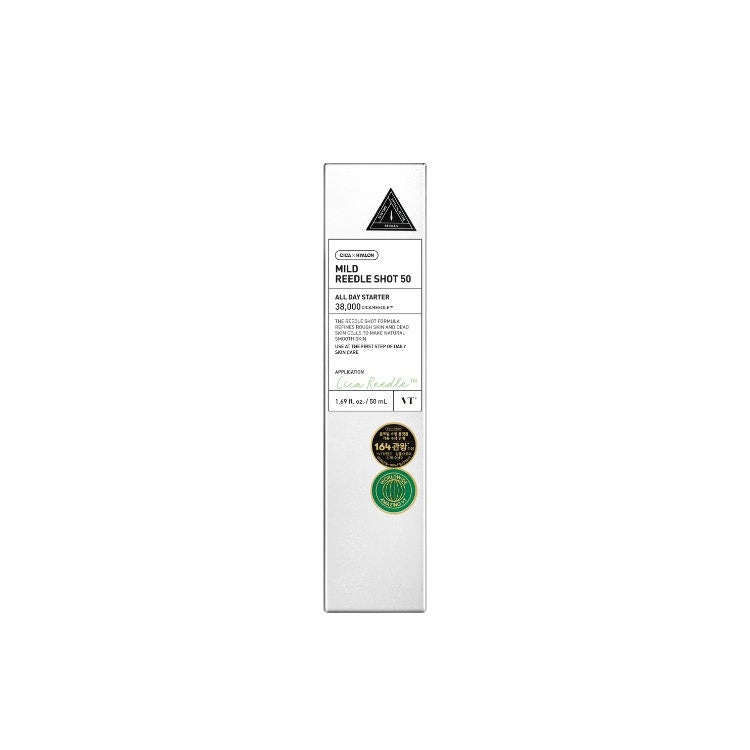

VT COSMETICS
Vt Reedle Shot 50 50Ml

Vt Reedle Shot 50 50Ml
VT COSMETICS
vt-reedle-shot-50-50ml
Serum
10084710383909
Morning or Evening?
How often will you use this product?
Notes


Highlights
WHAT IS IT?
Serum with 38,000 shots
FEATURES
Mild skincare, Contains lowest amount of CICA REEDLE, Suitable for ultra-sensitive skin, Hydrating booster aquaporin (glycerin glucoside), Powerful antioxidant astaxanthin, Aloe extract for hydration and soothing
BEST FOR
sensitive
CHECKS
Does not contain harsh irritants, Contains CICA REEDLE for gentle care
Who Is It For?
All Genders Suitable For Sensitive Skin Types Age Range Not SpecifiedWhat Does It Help With?
Skin Conditioning Skin Tone And Texture Improvement Hydration Soothing Protection From External StimuliBudget
Mid-range ($30-$75)How To Use
Which routine should it be used in?
Instructions:
Key Information


What VT COSMETICS Says
Product Description:
This mild starter employs VT's unique CICA REEDLE to gently boost your skin and visibly improve skins' tone and texture for healthier-looking skin
About the Brand:
Ingredients Overview
Ingredients List
Water,Dipropylene-Glycol,Glycerin,Niacinamide,Butylene-Glycol,Macadamia-Ternifolia-Seed-Oil,1,2-Hexanediol,Ethylhexyl-Palmitate,Sodium-Polyacrylate,Sodium-Acrylate/Sodium-Acryloyldimethyl-Taurate-Copolymer,Polyisobutene,Glycereth-26,Silica,Ethylhexylglycerin,Caprylyl-Glycol,Adenosine,Sodium-Hyaluronate,Caprylyl/Capryl-Glucoside,Sorbitan-Oleate,Centella-Asiatica-Extract,Glyceryl-Glucoside,Xanthan-Gum,Aloe-Barbadensis-Leaf-Extract,Glucose,Astaxanthin,Propolis-Extract,Asiaticoside,Madecassoside,Madecassic-Acid,Asiatic-Acid
Key Ingredients
CICA REEDLE (Centella Asiatica Extract, Asiaticoside, Madecassoside, Madecassic Acid, Asiatic Acid), Astaxanthin, Aloe Barbadensis Leaf Extract, Glycerin, Niacinamide
Ingredients Details
1-2-hexanediol
Common Name(s): 1-2-hexanediol,cosmetic active,functional ingredient
CAS Number: N/a
DESCRIPTION
What It Does: Delivers characteristic cosmetic function at recommended use concentration.
Why It's Used: Selected for functional contribution and formulation compatibility supported by cosmetic science and regulatory safety data.
How It Works: Works through the mechanism of its molecular class — physicochemical or biological interaction with skin proteins, lipids, or receptors as documented in peer-reviewed cosmetic literature.
Typically Found In: Skin care formulations
TECHNICAL DETAILS
Primary Category: Active ingredient – cosmetic active
Secondary Functions: Skin conditioning
Application Areas:

Facial Skincare

Body Care
Hair Care
Beard Care
Color Cosmetics (Makeup)
Dietary/Oral Supplements
Typical Concentration Range: 0.1%–10%
SOURCING & ETHICS
Vegan Status: Conditional - supplier confirmation required
Halal Status: Unverified - supplier confirmation required
Source Notes: Commercially produced for cosmetic use. verify vegan/halal status with supplier. [audit 2026-07-29 rev2: the record's own source_notes does not assert a non-animal origin, or instructs the reader to verify with the supplier; "yes" asserts knowledge the record does not hold. determination requires shariah-panel sign-off.]
SKIN COMPATIBILITY
Irritancy Rating: 1/5 – very low
Comedogenicity Rating: 0/5 – non-comedogenic
Sensitivity Concerns: Well-tolerated by most skin types.
Safe for Sensitive Skin: Yes
SAFETY & COMPATIBILITY
Safety Profile: Good safety profile at recommended concentrations. ewg score: 1–2.
Works Well With: Standard skincare actives
Avoid Combining With: No known significant incompatibilities
SCIENTIFIC NOTE
1-2-hexanediol has an established safety and efficacy profile within the cosmetic regulatory framework at standard use concentrations.
Last Verified: 2026-03-12
Primary Sources: Cosing database,1-2-hexanediol technical literature
Adenosine
Common Name(s): Adenine riboside,9-beta-d-ribofuranosyladenine
CAS Number: 58-61-7
DESCRIPTION
What It Does: Reduces fine lines, stimulates collagen, firms skin, and reduces inflammation.
Why It's Used: Fda-recognized anti-wrinkle active with multi-action collagen stimulation + wrinkle reduction + anti-inflammatory efficacy.
How It Works: Activates adenosine a2a receptors on fibroblasts stimulating collagen type i. also activates pka pathway promoting atp production and reducing inflammatory cytokines.
Typically Found In: Anti-aging serums,wrinkle treatments,korean skincare
TECHNICAL DETAILS
Primary Category: Active ingredient – purine nucleoside / anti-aging
Secondary Functions: Collagen stimulation,anti-inflammatory,cell energy
Application Areas:
Facial Skincare
Body Care
Hair Care
Beard Care
Color Cosmetics (Makeup)
Dietary/Oral Supplements
Typical Concentration Range: 0.04%–0.1%
SOURCING & ETHICS
Vegan Status: Conditional - supplier confirmation required
Halal Status: Unverified - supplier confirmation required
Source Notes: Synthetically produced for cosmetic use. [audit 2026-07-29 rev2: status downgraded on audit. determination requires shariah-panel sign-off.]
SKIN COMPATIBILITY
Irritancy Rating: 1/5 – very low
Comedogenicity Rating: 0/5 – non-comedogenic
Sensitivity Concerns: Non-irritating; excellent tolerability.
Safe for Sensitive Skin: Yes
SAFETY & COMPATIBILITY
Safety Profile: Excellent safety profile. fda-recognized as safe and effective anti-wrinkle ingredient. ewg score: 1.
Works Well With: Other b vitamins,niacinamide,antioxidant complexes
Avoid Combining With: No significant incompatibilities
SCIENTIFIC NOTE
A 2002 clinical study demonstrated 0.04% adenosine cream significantly reduced wrinkle depth and increased skin elasticity after 4 weeks. fda recognition requires controlled clinical trial evidence.
Last Verified: 2026-03-12
Primary Sources: Cosing database,adenosine anti-aging clinical data,fda otc anti-wrinkle monograph
Asiaticoside
Common Name(s): Centella asiatica glycoside,asiaticoside b
CAS Number: 16830-15-2
DESCRIPTION
What It Does: Accelerates wound healing and reduces scar formation through fibroblast activation and collagen synthesis stimulation.
Why It's Used: Clinically proven scar reduction and wound healing active – the compound behind centella's legendary wound healing reputation.
How It Works: Promotes fibroblast proliferation and collagen synthesis via tgf-β independent mechanism (distinct from madecassoside). also inhibits hyaluronidase protecting extracellular matrix. antimicrobial activity supports wound healing environment.
Typically Found In: Post-surgical products,scar treatments,wound healing formulations
TECHNICAL DETAILS
Primary Category: Active ingredient – soothing / anti-inflammatory
Secondary Functions: Scar reduction,wound healing,collagen stimulation
Application Areas:
Facial Skincare
Body Care
Hair Care
Beard Care
Color Cosmetics (Makeup)
Dietary/Oral Supplements
Typical Concentration Range: 0.01%–2%
SOURCING & ETHICS
Vegan Status: Conditional - supplier confirmation required
Halal Status: Unverified - supplier confirmation required
Source Notes: Extracted from centella asiatica aerial parts alongside madecassoside, asiatic acid, and madecassic acid. [audit 2026-07-29 rev2: status downgraded on audit. determination requires shariah-panel sign-off.]
SKIN COMPATIBILITY
Irritancy Rating: 1/5 – very low
Comedogenicity Rating: 0/5 – non-comedogenic
Sensitivity Concerns: Non-irritating; ideal for reactive and sensitive skin.
Safe for Sensitive Skin: Yes – particularly recommended for sensitive skin
SAFETY & COMPATIBILITY
Safety Profile: Excellent safety profile. ewg score: 1.
Works Well With: Ceramides,panthenol,allantoin,hyaluronic acid,centella asiatica
Avoid Combining With: No significant incompatibilities
SCIENTIFIC NOTE
Asiaticoside's mechanism of wound healing involves release of aglycone asiatic acid after hydrolysis by skin beta-glucosidases. the glycoside form provides better stratum corneum penetration than the hydrophobic aglycone, acting as a prodrug for the active asiatic acid at the wound healing site.
Last Verified:
Astaxanthin
Common Name(s): 3,3'-dihydroxy-beta-carotene-4,4'-dione,ketocarotenoid
CAS Number: 472-61-7
DESCRIPTION
What It Does: Provides the most powerful natural antioxidant activity from the unique membrane-spanning ketocarotenoid.
Why It's Used: Maximum natural antioxidant — astaxanthin's unmatched singlet oxygen quenching capacity from marine microalgae provides superior photodamage prevention per unit applied.
How It Works: Unique spanning carotenoid structure crosses membrane bilayer quenching radicals at both inner and outer membrane surfaces simultaneously. singlet oxygen quenching kq ~3×10¹⁰ l/mol/s — highest of all carotenoids. 11 conjugated double bonds for exceptional electron transfer. inhibits nf-kb for anti-inflammatory activity.
Typically Found In: Premium anti-aging serums,sunscreen boosters,photoprotection products
TECHNICAL DETAILS
Primary Category: Active ingredient – antioxidant
Secondary Functions: Free radical scavenging,anti-aging
Application Areas:
Facial Skincare
Body Care
Hair Care
Beard Care
Color Cosmetics (Makeup)
Dietary/Oral Supplements
Typical Concentration Range: 0.01%–0.2%
SOURCING & ETHICS
Vegan Status: Conditional - supplier confirmation required
Halal Status: Unverified - supplier confirmation required
Source Notes: Plant-derived extract or synthetic. [audit 2026-07-29 rev2: status downgraded on audit. determination requires shariah-panel sign-off.]
SKIN COMPATIBILITY
Irritancy Rating: 1/5 – very low
Comedogenicity Rating: 0/5
Sensitivity Concerns: Non-irritating; well-tolerated.
Safe for Sensitive Skin: Yes
SAFETY & COMPATIBILITY
Safety Profile: Excellent safety profile. ewg score: 1.
Works Well With: Vitamin c,vitamin e,ferulic acid,spf,other antioxidants
Avoid Combining With: No significant incompatibilities
SCIENTIFIC NOTE
Astaxanthin's membrane-spanning structural uniqueness: its 3.6nm molecular length exactly spans a phospholipid bilayer membrane, allowing simultaneous quenching of radicals at both membrane surfaces. no other known antioxidant achieves this dual-surface protection — the structural basis for astaxanthin's extraordinary antioxidant potency.
Last Verified: 2026-03-12
Primary Sources: Cosing database,naguib astaxanthin antioxidant comparison study