

Yes To
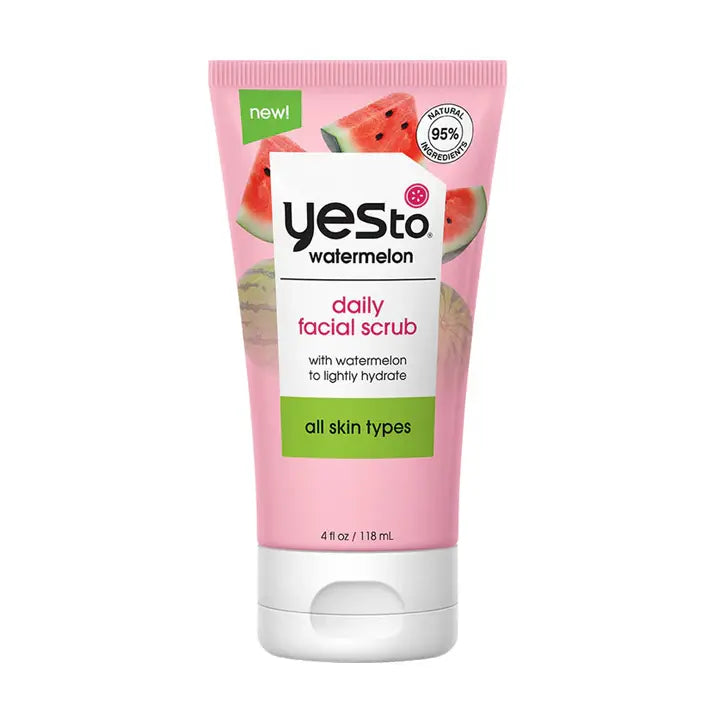
watermelon daily facial scrub with watermelon to lightly hydrate all skin types

watermelon daily facial scrub with watermelon to lightly hydrate all skin types
Yes To
watermelon-daily-facial-scrub-with-watermelon-to-lightly-hydrate-all-skin-types
Cleanse, Exfoliation
9706832363813
Morning or Evening?
How often will you use this product?
Notes


Highlights
WHAT IS IT?
Facial scrub
FEATURES
Hydrating, exfoliating, refreshing
BEST FOR
All skin types
CHECKS
Free of parabens, silicones, phthalates
Who Is It For?
Adults Women And MenWhat Does It Help With?
Hydration Unclogging Pores Smoothing SkinBudget
AffordableHow To Use
Which routine should it be used in?
Instructions:
Key Information


What Yes To Says
Product Description:
When in doubt, just add water(melon). Best day ever? Worst day known to womankind? Somewhere in-between? Give yourself the fresh start you and your gorgeous face deserve with our invigorating face scrub. Gently melt away makeup, unclog stubborn pores and lightly hydrate for smoother, radiant-looking skin. This refreshing, gel-textured formula does it all without stripping your skin of the moisture it needs to thrive—just like you. This exfoliating facial scrub is powered by thirst-quenching Watermelon Extract, brightening Vitamin C and gently exfoliating perlite, a natural mineral. Use day or night for a refreshed, hydrated, smoother-looking complexion.
About the Brand:
Ingredients Overview
Ingredients List
Water (Aqua), Propanediol, Hydroxypropyl Starch Phosphate, Sodium Cocoyl Glutamate, Perlite, Citrullus Lanatus (Watermelon) Fruit Extract, Sodium Ascorbyl Phosphate, Solanum Lycopersicum (Tomato) Fruit Extract, Glycerin, Dehydroxanthan Gum, Dipotassium Glycyrrhizate, Sodium Gluconate, Citric Acid, Caprylhydroxamic Acid, Sodium Benzoate, Potassium Sorbate, Phenoxyethanol, Fragrance (Parfum). Vitamin C
Key Ingredients
Watermelon Extract, Vitamin C, perlite
Ingredients Details
Dehydroxanthan Gum
Common Name(s): Modified xanthan gum,enhanced sensory biopolymer thickener,natural origin rheology modifier
CAS Number: N/a
DESCRIPTION
What It Does: Provides efficient aqueous thickening with improved sensory profile — less stringiness, smoother skin feel, better cold processability — versus native xanthan while retaining the electrolyte tolerance and natural origin.
Why It's Used: Modified xanthan solves native xanthan's main formulation limitation (draggy, stringy texture) without abandoning the biopolymer's core benefits — enabling natural-label formulations with premium sensory performance.
How It Works: Chemical modification alters xanthan double-helix conformation and inter-chain association. pyruvate removal (dehydroxanthan) reduces anionic side-chain repulsion producing shorter relaxation times and lower elasticity (less stringy); hydroxypropyl substitution disrupts crystalline ordering for improved cold-water dispersion.
Typically Found In: Premium natural skin care,cold-process formulas
TECHNICAL DETAILS
Primary Category: Active ingredient – cosmetic active
Secondary Functions: Skin conditioning
Application Areas:

Facial Skincare

Body Care
Hair Care
Beard Care
Color Cosmetics (Makeup)
Dietary/Oral Supplements
Typical Concentration Range: 0.1%–2%
SOURCING & ETHICS
Vegan Status: Conditional - supplier confirmation required
Halal Status: Unverified - supplier confirmation required
Source Notes: Commercially produced for cosmetic use. verify vegan/halal status with supplier. [audit 2026-07-29 rev2: the record's own source_notes does not assert a non-animal origin, or instructs the reader to verify with the supplier; "yes" asserts knowledge the record does not hold. determination requires shariah-panel sign-off.]
SKIN COMPATIBILITY
Irritancy Rating: 1/5 – very low
Comedogenicity Rating: 0/5 – non-comedogenic
Sensitivity Concerns: Well-tolerated by most skin types.
Safe for Sensitive Skin: Yes
SAFETY & COMPATIBILITY
Safety Profile: Good safety profile at recommended concentrations. ewg score: 1–2.
Works Well With: Standard skincare actives
Avoid Combining With: No known significant incompatibilities
SCIENTIFIC NOTE
Modified xanthan inci names signal specific modification chemistry to informed formulators — enabling rational selection based on target application: dehydroxanthan for spray applications; hydroxypropyl for cold-process natural-certified systems.
Last Verified: 2026-03-12
Primary Sources: Cosing database,dehydroxanthan gum modified xanthan sensory improvement review
Glycerin
Common Name(s): Glycerol,glycerine,1,2,3-propanetriol
CAS Number: 56-81-5
DESCRIPTION
What It Does: Glycerin pulls water from the environment and deeper skin layers into the outer skin layer (epidermis), boosting moisture levels and keeping skin soft, smooth, and plump.
Why It's Used: It is used in virtually every moisturizer, serum, and cleanser because it is highly effective at hydrating skin, is well-tolerated by all skin types, and enhances the texture and spreadability of formulations.
How It Works: As a humectant, glycerin forms hydrogen bonds with water molecules, trapping them in the skin. it also reinforces the skin barrier by integrating into lipid structures between skin cells.
Typically Found In: Moisturizers,serums,cleansers,toners,sheet masks,sunscreens,body lotions,shampoos,conditioners
TECHNICAL DETAILS
Primary Category: Humectant
Secondary Functions: Skin barrier support,emollient,solvent
Application Areas:
Facial Skincare
Body Care
Hair Care
Beard Care
Color Cosmetics (Makeup)
Dietary/Oral Supplements
Typical Concentration Range: 1%–30% (typical: 3–10%)
SOURCING & ETHICS
Vegan Status: Conditional - feedstock declaration required
Halal Status: Unverified - feedstock declaration required (plant, animal and petrochemical routes all exist)
Source Notes: Derived from plant oils via hydrolysis or saponification; synthetic versions also available. palm-derived glycerin carries sustainability concerns. [audit 2026-07-29 rev2: origin-dependent: the same inci exists in plant, animal and petrochemical versions and the name does not discriminate. determination requires shariah-panel sign-off.]
SKIN COMPATIBILITY
Irritancy Rating: 1/5 – very low; non-irritating at all standard concentrations
Comedogenicity Rating: 0/5 – non-comedogenic
Sensitivity Concerns: Extremely rare allergic reactions; generally safe for all skin types including sensitive and baby skin
Safe for Sensitive Skin: Yes
SAFETY & COMPATIBILITY
Safety Profile: Widely recognized as safe. ewg hazard score: 1. no significant concerns for irritation, sensitization, or toxicity at typical concentrations (up to 50%).
Works Well With: Hyaluronic acid,ceramides,niacinamide,panthenol,urea,peptides,retinol,ahas/bhas
Avoid Combining With: No known incompatibilities at standard concentrations
SCIENTIFIC NOTE
Glycerin is an endogenous skin component found naturally in the stratum corneum. aquaporin-3 channels in keratinocytes facilitate glycerin transport, making it integral to natural skin hydration pathways.
Last Verified: 2026-03-12
Primary Sources: Cosing database,cir safety assessment,ewg skin deep,inci decoder
Hydroxypropyl Starch Phosphate
Common Name(s): Natural or modified biopolymer thickener,rheology modifier,film-former
CAS Number: N/a
DESCRIPTION
What It Does: Builds aqueous viscosity through polymer chain entanglement above the overlap concentration, forms conditioning films on skin and hair, and stabilises suspensions through yield stress.
Why It's Used: Natural biopolymer thickeners provide elegant formulation sensory without the tight ph requirements of synthetic carbomers — preferred in shampoos and conditioners where broad ph tolerance and natural origin are both required.
How It Works: Polysaccharide chains above overlap concentration c* entangle forming a viscoelastic network — viscosity scales as c^4.7 above c*, providing steep concentration-viscosity dependence. chemical modification (hydroxypropyl, hydroxyethyl) increases water solubility and cold-processability of otherwise difficult-to-dissolve natural polysaccharides.
Typically Found In: Shampoos,conditioners,gels
TECHNICAL DETAILS
Primary Category: Active ingredient – cosmetic active
Secondary Functions: Skin conditioning
Application Areas:
Facial Skincare
Body Care
Hair Care
Beard Care
Color Cosmetics (Makeup)
Dietary/Oral Supplements
Typical Concentration Range: 0.1%–5%
SOURCING & ETHICS
Vegan Status: Conditional - supplier confirmation required
Halal Status: Unverified - supplier confirmation required
Source Notes: Commercially produced for cosmetic use. verify vegan/halal status with supplier. [audit 2026-07-29 rev2: the record's own source_notes does not assert a non-animal origin, or instructs the reader to verify with the supplier; "yes" asserts knowledge the record does not hold. determination requires shariah-panel sign-off.]
SKIN COMPATIBILITY
Irritancy Rating: 1/5 – very low
Comedogenicity Rating: 0/5 – non-comedogenic
Sensitivity Concerns: Well-tolerated by most skin types.
Safe for Sensitive Skin: Yes
SAFETY & COMPATIBILITY
Safety Profile: Good safety profile at recommended concentrations. ewg score: 1–2.
Works Well With: Standard skincare actives
Avoid Combining With: No known significant incompatibilities
SCIENTIFIC NOTE
Biopolymer thickeners are sensitive to electrolyte concentration — high salt levels screen polymer charge interactions reducing viscosity. formulation salt content must be accounted for when selecting polymer concentration for target viscosity.
Last Verified: 2026-03-12
Primary Sources: Cosing database,hydroxypropyl starch phosphate biopolymer thickener review
Perlite
Common Name(s): Expanded perlite,volcanic glass,obsidian powder
CAS Number: 93763-70-3
DESCRIPTION
What It Does: Provides ultra-lightweight texturizing and oil absorption from expanded volcanic glass.
Why It's Used: Lightest cosmetic powder — perlite's expansion (20× volume increase from volcanic glass heating) creates the lightest, most porous powder mineral available for ultra-lightweight mattifying formulations.
How It Works: Volcanic obsidian glass heated to 900°c expands to 20× original volume creating porous lightweight particles. very low bulk density (~100 g/l vs talc's 850 g/l) creates extremely lightweight powder feel. surface area provides sebum absorption. inert amorphous silica structure.
Typically Found In: Ultra-lightweight foundations,mattifying primers,setting powders
TECHNICAL DETAILS
Primary Category: Functional – volcanic glass additive
Secondary Functions: Skin conditioning
Application Areas:
Facial Skincare
Body Care
Hair Care
Beard Care
Color Cosmetics (Makeup)
Dietary/Oral Supplements
Typical Concentration Range: 1%–20%
SOURCING & ETHICS
Vegan Status: Conditional - supplier confirmation required
Halal Status: Unverified - supplier confirmation required
Source Notes: Commercially produced for cosmetic use. verify vegan/halal status with supplier. [audit 2026-07-29 rev2: the record's own source_notes does not assert a non-animal origin, or instructs the reader to verify with the supplier; "yes" asserts knowledge the record does not hold. determination requires shariah-panel sign-off.]
SKIN COMPATIBILITY
Irritancy Rating: 1/5 – very low
Comedogenicity Rating: 0/5 – non-comedogenic
Sensitivity Concerns: Well-tolerated by most skin types.
Safe for Sensitive Skin: Yes
SAFETY & COMPATIBILITY
Safety Profile: Good safety profile at recommended concentrations. ewg score: 1–2.
Works Well With: Standard skincare actives
Avoid Combining With: No known significant incompatibilities
SCIENTIFIC NOTE
Perlite's expansion mechanism is uniquely volcanic: obsidian contains 2-5% water trapped from submarine volcanic eruption. when rapidly heated, this trapped water vaporises and expands within the softened glass, creating foam-like structure with hundreds of sealed pores. this internal foaming from historic volcanic hydration is what gives cosmetic perlite its uniquely low density.
Last Verified: 2026-03-12
Primary Sources: Cosing database,cir safety assessment