

Korres
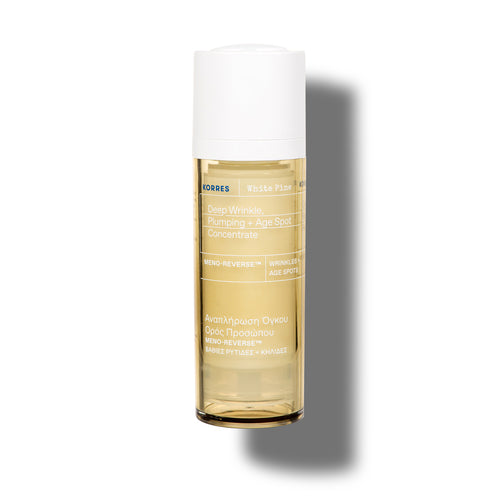
White Pine Meno-Reverse_x0099_ Deep Wrinkle, Plumping + Age Spot Concentrate

White Pine Meno-Reverse_x0099_ Deep Wrinkle, Plumping + Age Spot Concentrate
Korres
white-pine-meno-reverse-deep-wrinkle-plumping-age-spot-concentrate
Serum
9706860314917
Morning or Evening?
How often will you use this product?
Notes


Highlights
WHAT IS IT?
A targeted anti-aging serum
FEATURES
Reduces stubborn age spots, Reduces the deepest wrinkles, Reduces pore size
BEST FOR
Mature skin
CHECKS
Clean formulation, free of mineral oils, silicones, parabens, propylene glycol, phthalates, sulfates
Who Is It For?
Womenpost-menopausalWhat Does It Help With?
Stubborn Age Spots Deep Wrinkles Pore SizeBudget
PremiumHow To Use
Which routine should it be used in?
Instructions:
Key Information


What Korres Says
Product Description:
A targeted anti-aging treatment designed for post-menopausal skin changes in an ultra concentrated formula to reduce the appearance of stubborn age spots and deep wrinkles.
About the Brand:
Ingredients Overview
Ingredients List
Aqua/water/eau, Glycerin, Propanediol, Olus Oil/vegetableoil/huile Végétale, Caprylic/capric Triglyceride, Betaine, Pentylene Glycol, Arachidyl Alcohol, Arachidyl Glucoside, Avena Sativa (oat) Kernel Extract, Avena Strigosa Seed Extract, Behenyl Alcohol, Cellulose Gum, Citric Acid, Cynara Scolymus (artichoke) Leaf Extract, Dimethyl Isosorbide, Ethylhexylglycerin, Glyceryl Acrylate/acrylic Acid Copolymer, Hydrogenated Palm Glycerides, Hydrogenated Palm Kernel Glycerides, Hydrolyzed Soybean Fiber, Lactic Acid, Lecithin, Lonicera Caprifolium (honeysuckle) flower Extract, Lonicera Japonica (honeysuckle) Flower Extract, Microcrystalline Cellulose, Pancratium Maritimum Extract, Pinus Heldreichii Bark Extract, Sesamum Indicum (sesame) Seed Extract, Silica, Sodium Carboxymethyl Beta-glucan, Sodium Hyaluronate, Sodium Polyacrylate Starch, Tetrasodium Glutamate Diacetate, Tocopherol, Tocopheryl Acetate, Xanthan Gum, Phenoxyethanol, Potassium Sorbate,sodium Benzoate, Alpha-isomethyl Ionone, Benzyl Salicylate, Citronellol, Coumarin, Hexyl Cinnamal, Linalool, Parfum/fragrance.
Key Ingredients
White Pine Extract, Antioxidant Dill Extract, Mica
Ingredients Details
Arachidyl Alcohol
Common Name(s): Fatty alcohol,co-emulsifier thickener,emollient emulsion stabiliser
CAS Number: N/a
DESCRIPTION
What It Does: Thickens o/w emulsions by forming a lamellar crystal gel network with nonionic emulsifiers, provides co-emulsifier activity at the oil-water interface, and conditions skin from the c16-c18 chain's sc lipid compatibility.
Why It's Used: Fatty alcohols are irreplaceable in conventional o/w cream formulation — the lamellar gel network they form with peg emulsifiers provides the thick, stable cream texture that consumers expect, while delivering emolliency unavailable from wax-only structuring.
How It Works: Cetyl/stearyl alcohol packs into α-gel or β-gel crystal phases with peg surfactants (ceteareth-20, polysorbates) at 60–80°c, forming an ordered lamellar bilayer network on cooling. this network provides zero-shear viscosity (cream texture) and mechanical emulsion stability simultaneously — the fundamental mechanism of classical o/w cream formulation.
Typically Found In: Creams,lotions,o/w emulsions
TECHNICAL DETAILS
Primary Category: Functional ingredient – emollient
Secondary Functions: Barrier sealing,softening
Application Areas:

Facial Skincare
Body Care
Hair Care

Beard Care
Color Cosmetics (Makeup)
Dietary/Oral Supplements
Typical Concentration Range: 1%–15%
SOURCING & ETHICS
Vegan Status: Yes - standard ethanol routes are non-animal; confirm denaturant origin
Halal Status: Conditional - ethanol production route and residual concentration; jurisdiction-dependent, refer to certifier stance
Source Notes: Plant-derived, synthetic or animal-derived. verify source. [audit 2026-07-29 rev2: ethanol pathway; determination depends on route, on whether the plant also produces beverage alcohol, and on residual concentration. determination requires shariah-panel sign-off.]
SKIN COMPATIBILITY
Irritancy Rating: 1/5 – very low
Comedogenicity Rating: 1/5 – low; formulation-dependent
Sensitivity Concerns: Non-irritating.
Safe for Sensitive Skin: Yes
SAFETY & COMPATIBILITY
Safety Profile: Excellent safety profile. ewg score: 1.
Works Well With: Humectants,ceramides,actives as carrier
Avoid Combining With: No significant incompatibilities
SCIENTIFIC NOTE
The fatty alcohol + peg emulsifier ratio is critical: 1:3 (fatty alcohol:peg emulsifier by weight) typically provides optimal lamellar gel network formation and cream texture. deviating from this ratio shifts the phase structure from lamellar gel to micellar, reducing viscosity.
Last Verified: 2026-03-12
Primary Sources: Cosing database,fatty alcohol lamellar gel cream texture review
Arachidyl Glucoside
Common Name(s): C20 glucoside,arachidyl alkyl glucoside
CAS Number: N/a
DESCRIPTION
What It Does: Provides long-chain glucoside emulsification with premium skin feel for natural-certified products.
Why It's Used: Premium long-chain apg emulsifier providing superior skin feel and elegance compared to shorter-chain glucoside emulsifiers in natural-certified luxury formulations.
How It Works: C20 chain length provides effective o/w emulsification with rich emollient feel from long-chain fatty alcohol backbone. glucose head group provides natural-certification compatibility. better substantivity than shorter-chain glucoside emulsifiers. excellent skin tolerance.
Typically Found In: Premium natural cosmetics,luxury clean beauty
TECHNICAL DETAILS
Primary Category: Functional ingredient – long-chain glucoside emulsifier
Secondary Functions: Skin conditioning
Application Areas:
Facial Skincare
Body Care
Hair Care
Beard Care
Color Cosmetics (Makeup)
Dietary/Oral Supplements
Typical Concentration Range: 1%–5%
SOURCING & ETHICS
Vegan Status: Conditional - feedstock declaration required
Halal Status: Unverified - feedstock declaration required (plant, animal and petrochemical routes all exist)
Source Notes: Commercially produced for cosmetic use. verify vegan/halal status with supplier. [audit 2026-07-29 rev2: origin-dependent: the same inci exists in plant, animal and petrochemical versions and the name does not discriminate. determination requires shariah-panel sign-off.]
SKIN COMPATIBILITY
Irritancy Rating: 1/5 – very low
Comedogenicity Rating: 0/5 – non-comedogenic
Sensitivity Concerns: Well-tolerated by most skin types.
Safe for Sensitive Skin: Yes
SAFETY & COMPATIBILITY
Safety Profile: Good safety profile at recommended concentrations. ewg score: 1–2.
Works Well With: Standard skincare actives
Avoid Combining With: No known significant incompatibilities
SCIENTIFIC NOTE
The progression from c8 (caprylic) to c12 (lauryl) to c16 (cetyl) to c20 (arachidyl) in alkyl glucoside emulsifiers provides incrementally richer, more emollient skin feel from longer hydrophobic chain. c20 arachidyl glucoside provides the richest emollient character of common glucoside emulsifiers — positioning it for premium luxury formulations despite higher cost.
Last Verified: 2026-03-12
Primary Sources: Cosing database,cir safety assessment
Avena Sativa (oat) Kernel Extract
Common Name(s): Avena sativa (oat) kernel extract,botanical extract,phytochemical active
CAS Number: N/a
DESCRIPTION
What It Does: Provides antioxidant protection from reactive oxygen species, reduces inflammatory cytokine production in skin, and conditions skin surface through the plant's secondary metabolite complex.
Why It's Used: Chosen for its natural origin narrative, traditional use heritage, and multi-functional phytochemical profile that supports several concurrent skin care claims from one ingredient.
How It Works: Polyphenols, terpenoids, and alkaloids in the extract scavenge ros via hydrogen atom transfer, inhibit nf-kb or cox-2 inflammatory pathways, and interact with skin surface proteins for conditioning.
Typically Found In: Botanical skin care,natural products
TECHNICAL DETAILS
Primary Category: Active ingredient – antioxidant
Secondary Functions: Free radical scavenging,anti-aging
Application Areas:
Facial Skincare
Body Care
Hair Care
Beard Care
Color Cosmetics (Makeup)
Dietary/Oral Supplements
Typical Concentration Range: 0.1%–10%
SOURCING & ETHICS
Vegan Status: Yes
Halal Status: Yes
Source Notes: Plant-derived extract or synthetic.
SKIN COMPATIBILITY
Irritancy Rating: 1/5 – very low
Comedogenicity Rating: 0/5 – non-comedogenic
Sensitivity Concerns: Non-irritating; well-tolerated.
Safe for Sensitive Skin: Yes
SAFETY & COMPATIBILITY
Safety Profile: Excellent safety profile. ewg score: 1.
Works Well With: Vitamin c,vitamin e,ferulic acid,spf,other antioxidants
Avoid Combining With: No significant incompatibilities
SCIENTIFIC NOTE
Plant secondary metabolites evolved as uv photoprotectants and antimicrobial agents — mechanisms that directly translate to cosmetic antioxidant and anti-inflammatory activity in human skin.
Last Verified: 2026-03-12
Primary Sources: Cosing database,avena sativa (oat) kernel extract botanical review
Betaine
Common Name(s): Trimethylglycine,tmg,natural betaine
CAS Number: 107-43-7
DESCRIPTION
What It Does: Provides osmoprotective humectant conditioning with anti-irritant and mild foam-boosting activity.
Why It's Used: Natural-origin multifunctional osmolyte from sugar beet providing hydration, anti-irritancy, and conditioning in virtually every cosmetic category.
How It Works: Quaternary ammonium betaine provides zwitterionic character for water binding via ionic hydration. osmoprotective function at 100–500mm as compatible solute protecting cells from osmotic stress. reduces surfactant irritation by competing with sls for protein binding sites. mild foam enhancement.
Typically Found In: Virtually all categories — moisturisers, shampoos, cleansers
TECHNICAL DETAILS
Primary Category: Functional ingredient – humectant
Secondary Functions: Tewl reduction,skin plumping
Application Areas:
Facial Skincare
Body Care
Hair Care
Beard Care
Color Cosmetics (Makeup)
Dietary/Oral Supplements
Typical Concentration Range: 0.5%–10%
SOURCING & ETHICS
Vegan Status: Conditional - feedstock declaration required
Halal Status: Unverified - feedstock declaration required (plant, animal and petrochemical routes all exist)
Source Notes: Synthetic or naturally derived. excellent aqueous solubility. [audit 2026-07-29 rev2: origin-dependent: the same inci exists in plant, animal and petrochemical versions and the name does not discriminate. determination requires shariah-panel sign-off.]
SKIN COMPATIBILITY
Irritancy Rating: 1/5 – very low
Comedogenicity Rating: 0/5 – non-comedogenic
Sensitivity Concerns: Non-irritating; suitable for all skin types.
Safe for Sensitive Skin: Yes
SAFETY & COMPATIBILITY
Safety Profile: Excellent safety profile. ewg score: 1.
Works Well With: Ceramides,emollients,occlusives,glycerin,hyaluronic acid
Avoid Combining With: No significant incompatibilities
SCIENTIFIC NOTE
Betaine's anti-irritant mechanism for surfactant systems involves competitive protein protection: betaine at high concentrations preferentially interacts with skin proteins, occupying binding sites that would otherwise be occupied by surfactant molecules causing protein denaturation. this competition reduces available protein binding for irritating surfactants, explaining betaine's well-documented ability to reduce sls irritation when co-formulated.
Last Verified: 2026-03-12
Primary Sources: Cosing database,craig betaine osmoprotective review,cir safety assessment