
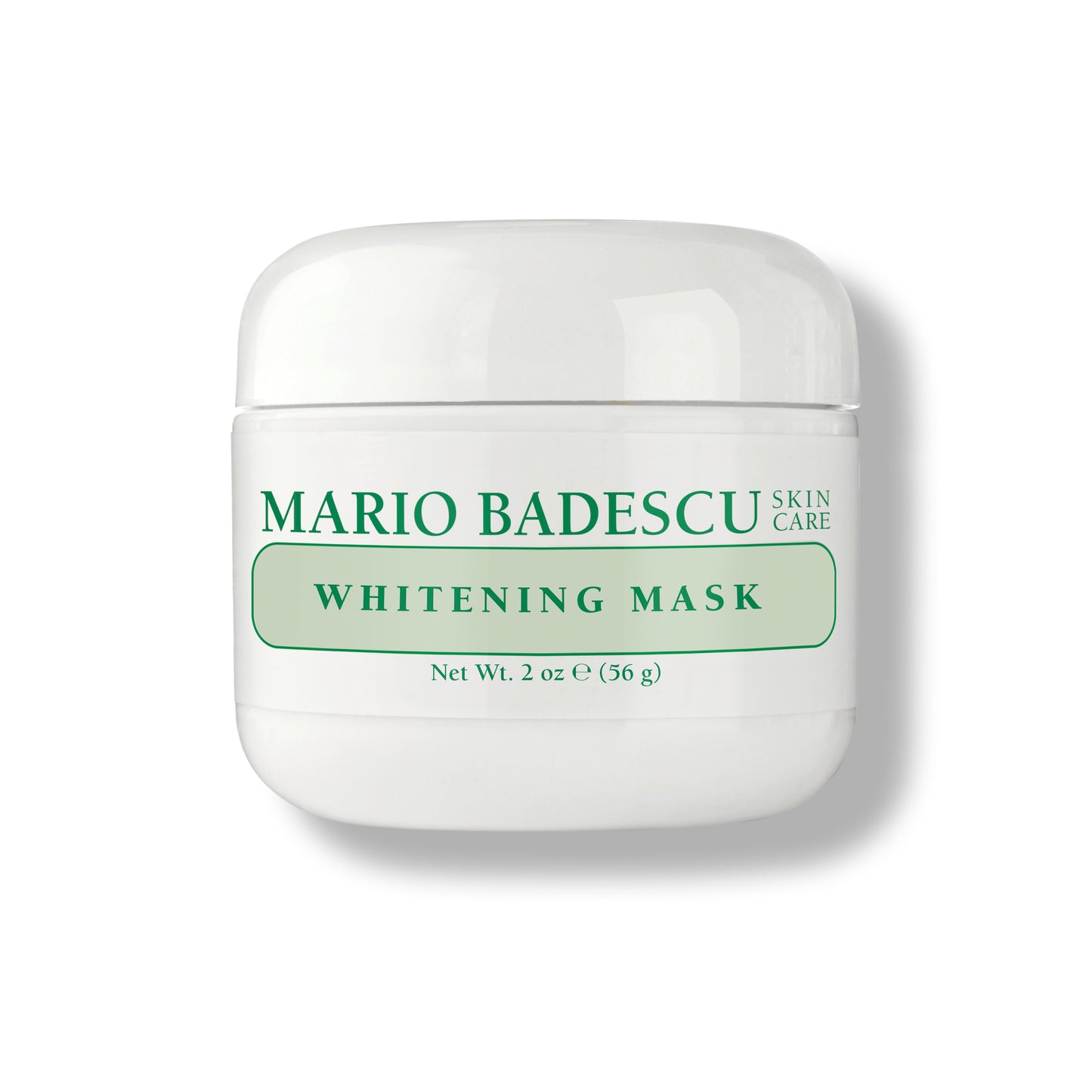

Mario Badescu
Whitening Mask

Whitening Mask
Mario Badescu
whitening-mask
Face Mask
9818362478885
Morning or Evening?
How often will you use this product?
Notes


Highlights
WHAT IS IT?
Brightening face mask with Kojic Acid
FEATURES
Hydrates dehydrated skin, brightens uneven skin tone, locks in moisture
BEST FOR
dry, combination
CHECKS
Free of sulfate, phthalate, alcohol
Who Is It For?
All Ages All GendersWhat Does It Help With?
Uneven Skin Tone Dehydration Dullness DiscolorationBudget
Affordable (under $30)How To Use
Which routine should it be used in?
Instructions:
Key Information

What Mario Badescu Says
Product Description:
Hydrate dehydrated skin and visibly brighten uneven skin tone with this brightening mask containing Kojic Acid, Grapeseed Oil, Beeswax, and Vitamin E. Kojic Acid and antioxidant-rich Licorice Root, Mulberry, and Grapeseed Oil help to brighten skin and visibly improve the look of uneven skin tone. Olive Leaf Extract, Vitamin E, and Beeswax lock in moisture and vitamins for hydrated, glowing skin.
About the Brand:
Ingredients Overview
Ingredients List
Aqua (Water, Eau), Kaolin, Triticum Vulgare (Wheat) Starch, Zinc Oxide, Titanium Dioxide, Dimethicone, Cera Microcristallina (Microcrystalline Wax, Cire Microcristalline), Sorbitol, Paraffinum Liquidum (Mineral Oil, Hulle Min‚rale), Propylene Glycol, Cera Alba (Beeswax, Cire dÉabeille), Cellulose Gum, Kojic Acid, Tocopherol, Glycyrrhiza Glabra (Licorice) Rhizome/Root, Morus Nigra Root, Scutellaria Galericulata Extract, Vitis Vinifera (Grape) Fruit Extract, Glycine Soja (Soybean) Oil, Polysorbate 80, Methylparaben, Oenothera Biennis (Evening Primrose) Seed Extract, Olea Europaea (Olive) Leaf Extract, Sodium Chloride, Parfum (Fragrance), Sorbitan Sesquioleate, Benzoic Acid, Magnesium Aspartate, Panthenol, Potassium Asparate, Potassium Hydroxide, Propylparaben, Sarcosine.
Key Ingredients
Kojic Acid, Grapeseed Oil, Beeswax, Vitamin E, Licorice Root, Mulberry, Olive Leaf Extract
Ingredients Details
Beeswax
Common Name(s): Cera alba (white),cera flava (yellow),apis mellifera wax
CAS Number: 8012-89-3
DESCRIPTION
What It Does: Provides natural wax structure and emolliency for cosmetic texture and lip balm applications.
Why It's Used: The original cosmetic wax – provides natural, hard-texture structure for lip balms, sticks, and creams with emollient skin conditioning.
How It Works: Complex mixture of esters (wax esters), hydrocarbons (hentriacontane), and fatty acids provides semi-crystalline structure. melting point 62-65°c enables stable solid products. emulsifying capacity from free cerotic acid content.
Typically Found In: Lip balms,cosmetic sticks,creams,natural cosmetics
TECHNICAL DETAILS
Primary Category: Functional ingredient – natural wax
Secondary Functions: Natural wax structure,occlusive conditioning
Application Areas:

Facial Skincare

Body Care
Hair Care
Beard Care
Color Cosmetics (Makeup)
Dietary/Oral Supplements
Typical Concentration Range: 2%–30%
SOURCING & ETHICS
Vegan Status: No – honeybee-derived
Halal Status: Conditional – animal-derived; verify halal certification
Source Notes: Plant-derived, synthetic or animal-derived. verify source.
SKIN COMPATIBILITY
Irritancy Rating: 1/5 – very low
Comedogenicity Rating: 1/5 – low; formulation-dependent
Sensitivity Concerns: Non-irritating.
Safe for Sensitive Skin: Yes
SAFETY & COMPATIBILITY
Safety Profile: Excellent safety profile. ewg score: 1.
Works Well With: Humectants,ceramides,actives as carrier
Avoid Combining With: No significant incompatibilities
SCIENTIFIC NOTE
Beeswax's multi-component wax ester composition (myricyl palmitate as primary component) provides a unique crystalline structure that gives lip balms and cosmetic sticks their characteristic 'dragée' glide – different from synthetic wax esters that lack this crystalline lattice diversity.
Last Verified: Cosing database,cir safety assessment
Primary Sources: 2026-03-12
Kaolin
Common Name(s): China clay,kaolinite,white cosmetic clay
CAS Number: 1332-58-7
DESCRIPTION
What It Does: Provides oil absorption and matting from the fine platelet clay structure.
Why It's Used: Most versatile cosmetic clay – gentle enough for sensitive skin while providing effective oil absorption, matting, and mineral conditioning.
How It Works: 1:1 layered silicate clay platelets absorb oils via capillary action in inter-platelet spaces. very mild ph (6-7). white colour from al-o-si lattice. fine particle size (0.5-4μm) provides gentle exfoliation and smooth texture. negative surface charge provides light skin conditioning.
Typically Found In: Masks,foundations,dry shampoo,mattifying products
TECHNICAL DETAILS
Primary Category: Functional ingredient – white clay mineral
Secondary Functions: Skin conditioning
Application Areas:
Facial Skincare
Body Care
Hair Care
Beard Care
Color Cosmetics (Makeup)
Dietary/Oral Supplements
Typical Concentration Range: 0.1%–50%
SOURCING & ETHICS
Vegan Status: Yes – natural mineral
Halal Status: Yes
Source Notes: Commercially produced for cosmetic use. verify vegan/halal status with supplier.
SKIN COMPATIBILITY
Irritancy Rating: 1/5 – very low
Comedogenicity Rating: 0/5 – non-comedogenic
Sensitivity Concerns: Well-tolerated by most skin types.
Safe for Sensitive Skin: Yes
SAFETY & COMPATIBILITY
Safety Profile: Good safety profile at recommended concentrations. ewg score: 1–2.
Works Well With: Standard skincare actives
Avoid Combining With: No known significant incompatibilities
SCIENTIFIC NOTE
Kaolin's oil absorption mechanism involves genuine capillary condensation of oils into the inter-platelet micropores between its layered silicate sheets. the surface area of cosmetic-grade kaolin (10-30 m²/g) provides thousands of square meters of oil-adsorbing surface per gram – explaining its exceptional mattifying efficacy despite its inert mineral composition.
Last Verified: Cosing database,cir safety assessment
Primary Sources: 2026-03-12
Kojic Acid
Common Name(s): 5-hydroxy-2-(hydroxymethyl)-4-pyranone,koji acid
CAS Number: 501-30-4
DESCRIPTION
What It Does: Provides potent copper-chelating tyrosinase inhibition for effective hyperpigmentation treatment.
Why It's Used: One of the most effective brightening agents — kojic acid's copper chelation directly blocks the tyrosinase active site providing stronger brightening than most naturally-derived alternatives.
How It Works: Chelates copper in the tyrosinase active site via the 3-hydroxy-4-pyranone chelating group (ic50 ~5μg/ml). without copper cofactor, tyrosinase cannot oxidise tyrosine to dopa or dopa to dopaquinone. inhibits both hydroxylation steps in eumelanin synthesis pathway.
Typically Found In: Brightening serums,hyperpigmentation treatments,anti-spot products
TECHNICAL DETAILS
Primary Category: Active ingredient – fungal brightening agent
Secondary Functions: Melanin inhibition,hyperpigmentation reduction
Application Areas:
Facial Skincare
Body Care
Hair Care
Beard Care
Color Cosmetics (Makeup)
Dietary/Oral Supplements
Typical Concentration Range: 0.5%–2%
SOURCING & ETHICS
Vegan Status: Yes – from aspergillus oryzae or acetobacter fermentation
Halal Status: Yes
Source Notes: Synthetic or plant-derived.
SKIN COMPATIBILITY
Irritancy Rating: 1/5 – very low
Comedogenicity Rating: 0/5 – non-comedogenic
Sensitivity Concerns: Non-irritating; well-tolerated.
Safe for Sensitive Skin: Yes
SAFETY & COMPATIBILITY
Safety Profile: Eu annex iii regulated: max 1% in face products. sensitiser potential — patch test for sensitive skin. photosensitive in formulation — requires stabilisation.
Works Well With: Niacinamide,vitamin c,alpha-arbutin,tranexamic acid,spf
Avoid Combining With: No significant incompatibilities
SCIENTIFIC NOTE
Kojic acid's copper chelation mechanism provides an unusually direct enzyme inhibition: rather than competing with tyrosine substrate (competitive inhibitor) or altering enzyme conformation (allosteric inhibitor), kojic acid simply removes the copper cofactor that is essential for tyrosinase catalytic activity — a metal-chelation mechanism that provides near-complete enzyme inhibition regardless of substrate concentration.
Last Verified: Cosing database,eu annex iii,cir safety assessment
Primary Sources: 2026-03-12
Licorice Root
Common Name(s): Licorice root extract,glabridin source,liquorice extract
CAS Number: 84775-66-6
DESCRIPTION
What It Does: Provides glabridin-based potent natural tyrosinase inhibition with anti-inflammatory co-activity.
Why It's Used: The most potent natural brightener — glabridin's ic50 for tyrosinase inhibition (0.4μg/ml) exceeds kojic acid and most other natural brighteners, making licorice root extract the gold standard natural brightening botanical.
How It Works: Glabridin (isoflavanone) inhibits tyrosinase with ic50 ~0.4μg/ml and also inhibits uvb-induced pigmentation. liquiritin disperses existing melanin granules within melanocytes. licochalcone a inhibits 5-lox for anti-inflammatory activity.
Typically Found In: Brightening serums,natural hyperpigmentation treatment
TECHNICAL DETAILS
Primary Category: Active ingredient – glabridin brightener
Secondary Functions: Melanin inhibition,hyperpigmentation reduction
Application Areas:
Facial Skincare
Body Care
Hair Care
Beard Care
Color Cosmetics (Makeup)
Dietary/Oral Supplements
Typical Concentration Range: 0.1%–3%
SOURCING & ETHICS
Vegan Status: Yes – from glycyrrhiza glabra root
Halal Status: Yes
Source Notes: Synthetic or plant-derived.
SKIN COMPATIBILITY
Irritancy Rating: 1/5 – very low
Comedogenicity Rating: 0/5 – non-comedogenic
Sensitivity Concerns: Non-irritating; well-tolerated.
Safe for Sensitive Skin: Yes
SAFETY & COMPATIBILITY
Safety Profile: Excellent safety profile. use with spf for maximum efficacy. ewg score: 1.
Works Well With: Niacinamide,vitamin c,alpha-arbutin,tranexamic acid,spf
Avoid Combining With: No significant incompatibilities
SCIENTIFIC NOTE
Glabridin's extraordinary natural tyrosinase inhibition potency (ic50 0.4μg/ml) arises from its isoflavanone ring system providing a phenolic oh group at exactly the geometry required to coordinate the tyrosinase copper active site while the adjacent methoxy group provides additional stabilising interaction — a structural template that has guided design of synthetic brightening pharmacophores.
Last Verified: Cosing database,yokota et al. glabridin tyrosinase study
Primary Sources: 2026-03-12
