
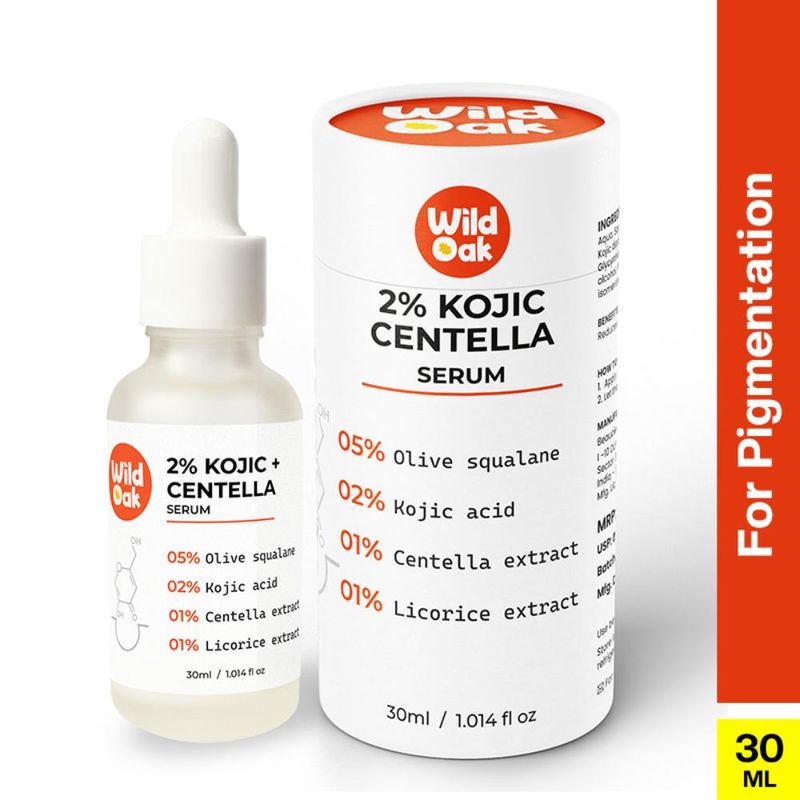

Wild Oak
Wild Oak 2% Kojic Centella Face Serum

Wild Oak 2% Kojic Centella Face Serum
Wild Oak
wild-oak-2-kojic-centella-face-serum
Serum
10085470044453
Morning or Evening?
How often will you use this product?
Notes


Highlights
WHAT IS IT?
Face Serum, 4 ingredients
FEATURES
Brightens dark spots, lightens hyperpigmentation, soothes irritation, reduces redness, promotes skin healing, hydrates skin, suitable for all skin types
BEST FOR
all skin types
CHECKS
Who Is It For?
What Does It Help With?
Dark Spots Hyperpigmentation Uneven Skin Tone Irritation Redness Sensitive And Stressed SkinBudget
Affordable (under $30)How To Use
Which routine should it be used in?
Instructions:
Key Information


What Wild Oak Says
Product Description:
Powerful Brightening Complex: Formulated with 2% Kojic Acid to effectively lighten dark spots, hyperpigmentation, and uneven skin tone, revealing a brighter, more luminous complexion. Soothing & Healing: Enriched with Centella Asiatica (Cica) to calm irritation, reduce redness, and promote skin healing, making it ideal for sensitive and stressed skin. Even Skin Tone: Kojic Acid helps inhibit melanin production while Centella Asiatica supports skin repair, leading to a more balanced and uniform skin tone. Hydrating Formula: Includes moisturizing agents to keep your skin hydrated and plump, ensuring a healthy glow without dryness. Suitable for All Skin Types: Gentle yet effective, this serum is appropriate for all skin types, including dry, oily, combination, and sensitive skin.
About the Brand:
Ingredients Overview
Ingredients List
olive-squalane,kojic-dipalmitate,centella-extract,licorice-extract
Key Ingredients
2% Kojic Acid, Centella Asiatica, Licorice Extract, Olive Squalane
Ingredients Details
Kojic Acid
Common Name(s): 5-hydroxy-2-(hydroxymethyl)-4-pyranone,koji acid
CAS Number: 501-30-4
DESCRIPTION
What It Does: Provides potent copper-chelating tyrosinase inhibition for effective hyperpigmentation treatment.
Why It's Used: One of the most effective brightening agents — kojic acid's copper chelation directly blocks the tyrosinase active site providing stronger brightening than most naturally-derived alternatives.
How It Works: Chelates copper in the tyrosinase active site via the 3-hydroxy-4-pyranone chelating group (ic50 ~5μg/ml). without copper cofactor, tyrosinase cannot oxidise tyrosine to dopa or dopa to dopaquinone. inhibits both hydroxylation steps in eumelanin synthesis pathway.
Typically Found In: Brightening serums,hyperpigmentation treatments,anti-spot products
TECHNICAL DETAILS
Primary Category: Active ingredient – fungal brightening agent
Secondary Functions: Melanin inhibition,hyperpigmentation reduction
Application Areas:

Facial Skincare

Body Care
Hair Care
Beard Care
Color Cosmetics (Makeup)
Dietary/Oral Supplements
Typical Concentration Range: 0.5%–2%
SOURCING & ETHICS
Vegan Status: Yes – from aspergillus oryzae or acetobacter fermentation
Halal Status: Yes
Source Notes: Synthetic or plant-derived.
SKIN COMPATIBILITY
Irritancy Rating: 1/5 – very low
Comedogenicity Rating: 0/5 – non-comedogenic
Sensitivity Concerns: Non-irritating; well-tolerated.
Safe for Sensitive Skin: Yes
SAFETY & COMPATIBILITY
Safety Profile: Eu annex iii regulated: max 1% in face products. sensitiser potential — patch test for sensitive skin. photosensitive in formulation — requires stabilisation.
Works Well With: Niacinamide,vitamin c,alpha-arbutin,tranexamic acid,spf
Avoid Combining With: No significant incompatibilities
SCIENTIFIC NOTE
Kojic acid's copper chelation mechanism provides an unusually direct enzyme inhibition: rather than competing with tyrosine substrate (competitive inhibitor) or altering enzyme conformation (allosteric inhibitor), kojic acid simply removes the copper cofactor that is essential for tyrosinase catalytic activity — a metal-chelation mechanism that provides near-complete enzyme inhibition regardless of substrate concentration.
Last Verified: ##########
Primary Sources: Cosing database,eu annex iii,cir safety assessment
Licorice Extract
Common Name(s): Licorice triterpenoid,glycyrrhetinic acid active,anti-inflammatory brightening
CAS Number: N/a
DESCRIPTION
What It Does: Reduces skin inflammation and redness through 11β-hsd inhibition (cortisol-amplifying mechanism), inhibits tyrosinase and melanogenesis for brightening, and provides antioxidant protection from the triterpenoid phenol system.
Why It's Used: One of few botanicals with documented cortisone-amplifying anti-inflammatory mechanism — 11β-hsd inhibition elevates local cortisol concentration in skin tissue, providing a pharmaceutical-level anti-inflammatory effect without direct corticosteroid application.
How It Works: Glycyrrhetinic acid inhibits 11β-hydroxysteroid dehydrogenase (11β-hsd) — the enzyme that converts active cortisol to inactive cortisone in peripheral tissues. inhibition elevates local skin cortisol, amplifying the glucocorticoid anti-inflammatory response. simultaneously, glabridin (a flavonoid in licorice) inhibits tyrosinase for brightening.
Typically Found In: Anti-inflammatory,soothing,brightening
TECHNICAL DETAILS
Primary Category: Active ingredient – antioxidant
Secondary Functions: Free radical scavenging,anti-aging
Application Areas:
Facial Skincare
Body Care
Hair Care
Beard Care
Color Cosmetics (Makeup)
Dietary/Oral Supplements
Typical Concentration Range: 0.01%–2%
SOURCING & ETHICS
Vegan Status: Yes
Halal Status: Yes
Source Notes: Plant-derived extract or synthetic.
SKIN COMPATIBILITY
Irritancy Rating: 1/5 – very low
Comedogenicity Rating: 0/5 – non-comedogenic
Sensitivity Concerns: Non-irritating; well-tolerated.
Safe for Sensitive Skin: Yes
SAFETY & COMPATIBILITY
Safety Profile: Excellent safety profile. ewg score: 1.
Works Well With: Vitamin c,vitamin e,ferulic acid,spf,other antioxidants
Avoid Combining With: No significant incompatibilities
SCIENTIFIC NOTE
11β-hsd inhibition by glycyrrhetinic acid was first documented in the context of licorice consumption causing pseudoaldosteronism — the same enzyme inhibition applied topically provides localised cortisol amplification for cosmetic anti-inflammatory activity without systemic effects.
Last Verified: 2026-03-12
Primary Sources: Cosing database,glycyrrhetinic acid 11β-hsd anti-inflammatory review
Olive Squalane
Common Name(s): Olive squalane,phytosqualane,certified plant squalane
CAS Number: 0111-01-03
DESCRIPTION
What It Does: Provides certified olive-origin skin-identical hydrocarbon emolliency with highest natural credentials.
Why It's Used: Premium credentialled squalane — olive squalane provides the most prestigious and verifiable squalane provenance from traditional mediterranean olive heritage, essential for brands requiring the highest supply chain transparency and natural origin documentation.
How It Works: Identical molecular formula to other plant squalane (c30h62) — chemically indistinguishable. origin verified via carbon-14 isotope analysis or supply chain documentation. extracted from olive oil deodoriser distillate then hydrogenated. traditional mediterranean sourcing from certified olive mills.
Typically Found In: Premium mediterranean skincare,certified natural products,verified sustainable beauty
TECHNICAL DETAILS
Primary Category: Functional ingredient – emollient
Secondary Functions: Barrier sealing,softening
Application Areas:
Facial Skincare
Body Care
Hair Care
Beard Care
Color Cosmetics (Makeup)
Dietary/Oral Supplements
Typical Concentration Range: 1%–100%
SOURCING & ETHICS
Vegan Status: Conditional - feedstock declaration required
Halal Status: Unverified - feedstock declaration required (plant, animal and petrochemical routes all exist)
Source Notes: Plant-derived, synthetic or animal-derived. verify source. [audit 2026-07-29 rev2: origin-dependent: the same inci exists in plant, animal and petrochemical versions and the name does not discriminate. determination requires shariah-panel sign-off.]
SKIN COMPATIBILITY
Irritancy Rating: 2026-01-05 00:00:00 -0800
Comedogenicity Rating: 0/5
Sensitivity Concerns: Non-irritating.
Safe for Sensitive Skin: Yes
SAFETY & COMPATIBILITY
Safety Profile: Excellent safety profile. ewg score: 1.
Works Well With: Humectants,ceramides,actives as carrier
Avoid Combining With: No significant incompatibilities
SCIENTIFIC NOTE
Olive squalane's origin verification via carbon-14 isotope dating (plant carbon has different ¹⁴c signature than petrochemical carbon which has no ¹⁴c from being geologically old) provides scientific authenticity validation — an absolute verification method distinguishing genuine plant-derived from petroleum-derived squalane that cannot be falsified by adulteration.
Last Verified: 2026-03-12
Primary Sources: Cosing database,cir safety assessment