

WishCare
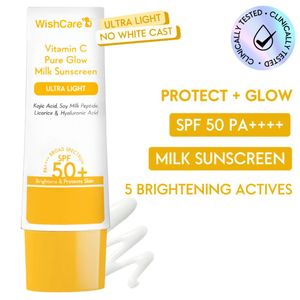
WishCare Vitamin C Pure Glow Face Sunscreen SPF 50 PA++++ -Broad Spectum Ultra Light & No White Cast

WishCare Vitamin C Pure Glow Face Sunscreen SPF 50 PA++++ -Broad Spectum Ultra Light & No White Cast
WishCare
wishcare-vitamin-c-pure-glow-face-sunscreen-spf-50-pa-broad-spectum-ultra-light-no-white-cast
Suncare
10084762583333
Morning or Evening?
How often will you use this product?
Notes


Highlights
WHAT IS IT?
Face Sunscreen with Vitamin C ingredient, 2 main ingredients shown
FEATURES
SPF 50 PA++++, Ultra light, No white cast, Easily absorbed, Moisturizes skin, Provides sun protection and brightening
BEST FOR
dry
CHECKS
Does not leave white cast, non-sticky, no dark cast, no comedogenic ingredients, non-greasy
Who Is It For?
All Genders Age Range Not SpecifiedWhat Does It Help With?
Sunburn Protection Tanning Skin Brightening HydrationBudget
Affordable (under $30)How To Use
Which routine should it be used in?
Instructions:
Key Information


What WishCare Says
Product Description:
Wishcare Pure Glow Vitamin C Milk Sunscreen is a power packed SPF50 PA++++.
About the Brand:
Ingredients Overview
Ingredients List
Aqua, Cyclopentasiloxane, Octyl Salicylate, Silica, Avobenzone, Octocrylene, Butylene Glycol, Glycerine, Homosalate, Octyldodecanol, Polysorbate-20, AMPS/HEMA Crosspolymer (and) C13-15 Alkane (and) Coco-Glucoside, Zinc Oxide, Titanium Dioxide, Cetearyl Olivate, Sorbitan Olivate, D-Panthenol, 3-O-Ethyl Ascorbic Acid, Coco- Glucoside, Soy Milk Peptide, Niacinamide, Kojic Acid, Xanthan Gum, Tocopherol Acetate, Licorice Extract, Ceramide AP, Ceramide NP, Ceramide EOS, Hyaluronic Acid, EthylhexylGlycerine, Phenoxyethanol, Citric Acid
Key Ingredients
Vitamin C, Niacinamide
Ingredients Details
3-o-ethyl Ascorbic Acid
Common Name(s): 3-o-ethyl ascorbic acid
DESCRIPTION
What It Does: Loosens corneocyte adhesion in the stratum corneum, accelerating cell turnover, refining skin texture, and improving radiance.
Why It's Used: Organic acids at cosmetic ph values provide controlled keratolytic exfoliation that improves skin texture, pore appearance, and radiance without mechanical irritation.
How It Works: At appropriate ph, the acid's undissociated form penetrates the stratum corneum and dissolves the ionic bonds between corneocyte desmosomes (calcium chelation mechanism), facilitating controlled desquamation and cell renewal.
Typically Found In: Toners,exfoliants,serums,peels,cleansers
TECHNICAL DETAILS
Primary Category: Exfoliants
Secondary Functions: Brightening,keratolytic
Application Areas:

Facial Skincare

Body Care
Hair Care
Beard Care
Color Cosmetics (Makeup)
Dietary/Oral Supplements
Typical Concentration Range: 0.5–20%
SOURCING & ETHICS
Vegan Status: Yes
Halal Status: Yes
Source Notes: Synthetic or plant-derived acid; no animal components.
SKIN COMPATIBILITY
Irritancy Rating: 2
Comedogenicity Rating: 0
Sensitivity Concerns: May cause irritation or stinging in sensitive or barrier-compromised skin at high concentrations; patch test recommended.
Safe for Sensitive Skin: Conditional
SAFETY & COMPATIBILITY
Safety Profile: Safe within recommended ph and concentration ranges. sensitization risk increases above 10% aha. patch test recommended for sensitive skin. mildly irritating to some individuals at typical cosmetic use concentrations.
Works Well With: Niacinamide,hyaluronic acid,ceramides,vitamin c
Avoid Combining With: High concentrations on sensitive/broken skin; avoid with physical exfoliants
SCIENTIFIC NOTE
Cosmetic acids function at the pka boundary: only the undissociated acid (rcooh) penetrates the stratum corneum lipid barrier, while the ionized carboxylate (rcoo⁻) does not. the henderson-hasselbalch equation governs the fraction of active species at formulation ph; typically 0.5–3.0% undissociated acid provides efficacy while minimizing irritation.
Last Verified: 2025-01-15
Primary Sources: Cosing eu database; pcpc cosmetic ingredient safety reviews; ingredient-specific safety and efficacy literature
Avobenzone
Common Name(s): Parsol 1789,avobenzone
DESCRIPTION
What It Does: Provides uva-i protection (340-400nm) critical for photoaging prevention — the only widely available chemical uva-i filter.
Why It's Used: The essential uva-i filter — avobenzone is the only commonly approved chemical filter providing protection in the photoaging-critical 340-400nm range essential for broad-spectrum sunscreen claims.
How It Works: Dibenzoylmethane chromophore absorbs uva-i (λmax 357nm, εmax ~36,000). photodegrades via photoisomerisation requiring photostabilisation (octocrylene, bemotrizinol) for durability.
Typically Found In: Broad-spectrum sunscreens,anti-aging spf products
TECHNICAL DETAILS
Primary Category: Active ingredient – chemical uva-i filter
Secondary Functions: Skin conditioning
Application Areas:
Facial Skincare
Body Care
Hair Care
Beard Care
Color Cosmetics (Makeup)
Dietary/Oral Supplements
Typical Concentration Range: Up to 5% (eu), 3% (us fda)
SOURCING & ETHICS
Vegan Status: Conditional - supplier confirmation required
Halal Status: Unverified - supplier confirmation required
Source Notes: Commercially produced for cosmetic use. verify vegan/halal status with supplier. [audit 2026-07-29 rev2: the record's own source_notes does not assert a non-animal origin, or instructs the reader to verify with the supplier; "yes" asserts knowledge the record does not hold. determination requires shariah-panel sign-off.]
SKIN COMPATIBILITY
Irritancy Rating: 1/5 – very low
Comedogenicity Rating: 0/5 – non-comedogenic
Sensitivity Concerns: Well-tolerated by most skin types.
Safe for Sensitive Skin: Yes
SAFETY & COMPATIBILITY
Safety Profile: Eu max 5%. fda: 3%. ewg score: 2. requires photostabilisation. photoallergy risk in some individuals.
Works Well With: Standard skincare actives
Avoid Combining With: No known significant incompatibilities
SCIENTIFIC NOTE
Avobenzone's photodegradation discovery drove development of photostabilisation technology — the period from avobenzone's 1978 introduction to development of effective photostabilisers in the 1990s was marked by sunscreens with inadequate uva durability. bemotrizinol (tinosorb s) development provided the most elegant solution by providing a photostable molecule with equivalent uva coverage.
Last Verified: 2026-03-12
Primary Sources: Cosing database,fda uv filter otc monograph,shaath sunscreen photostabilisation review
Butylene Glycol
Common Name(s): 1,3-butanediol,bg,1,3-butylene glycol
CAS Number: 107-88-0
DESCRIPTION
What It Does: Provides humectant hydration and active ingredient solubilization with excellent skin feel.
Why It's Used: Preferred glycol humectant in premium and k-beauty formulations for superior skin feel vs propylene glycol with equivalent functionality.
How It Works: Two hydroxyl groups at 1,3-positions provide water binding and solvent activity. better tolerated than propylene glycol with minimal sensitization risk. 4-carbon backbone provides slightly greater hydrophobic character enabling dissolution of less polar actives vs pg.
Typically Found In: Toners,essences,serums,k-beauty formulas
TECHNICAL DETAILS
Primary Category: Functional ingredient – glycol humectant
Secondary Functions: Tewl reduction,skin plumping
Application Areas:
Facial Skincare
Body Care
Hair Care
Beard Care
Color Cosmetics (Makeup)
Dietary/Oral Supplements
Typical Concentration Range: 1%–10%
SOURCING & ETHICS
Vegan Status: Yes – synthetic
Halal Status: Yes
Source Notes: Synthetic or naturally derived. excellent aqueous solubility.
SKIN COMPATIBILITY
Irritancy Rating: 1/5 – very low
Comedogenicity Rating: 0/5 – non-comedogenic
Sensitivity Concerns: Non-irritating; suitable for all skin types.
Safe for Sensitive Skin: Yes
SAFETY & COMPATIBILITY
Safety Profile: Excellent safety profile. ewg score: 1.
Works Well With: Ceramides,emollients,occlusives,glycerin,hyaluronic acid
Avoid Combining With: No significant incompatibilities
SCIENTIFIC NOTE
K-beauty's preference for butylene glycol over propylene glycol is driven by two factors: bg's superior skin feel (less tacky than pg's higher viscosity) and its lower sensitization potential (1,3-bg has better spatial distribution of hydroxyl groups that reduces protein interaction vs pg's 1,2-position oh groups).
Last Verified: 2026-03-12
Primary Sources: Cosing database,cir safety assessment
Ceramide Ap
Common Name(s): Ceramide 6 ii,n-(2-hydroxy)-stearoyl phytosphingosine,alpha-hydroxy ceramide
CAS Number: 100403-19-8
DESCRIPTION
What It Does: Provides alpha-hydroxy ceramide for complementary barrier repair alongside ceramide np and eop.
Why It's Used: Essential barrier ceramide trio component — ceramide ap's alpha-hydroxy fatty acid provides the specific lamellar body formation chemistry needed for complete barrier restoration with ceramide np and ceramide eop.
How It Works: N-(2-hydroxyfatty acid) phytosphingosine: 2-hydroxylation of fatty acid is critical for optimal packing of ceramide ap in lamellar lipid bilayers. the alpha-hydroxy group creates stronger intermolecular hydrogen bonding between ceramide ap molecules than non-hydroxylated ceramides. used in combination with ceramide np and ceramide eop for comprehensive barrier repair.
Typically Found In: Complete barrier repair formulas,triple ceramide systems,eczema treatment
TECHNICAL DETAILS
Primary Category: Active ingredient – alpha-hydroxy ceramide
Secondary Functions: Skin conditioning
Application Areas:
Facial Skincare
Body Care
Hair Care
Beard Care
Color Cosmetics (Makeup)
Dietary/Oral Supplements
Typical Concentration Range: 0.01%–1%
SOURCING & ETHICS
Vegan Status: Conditional - feedstock declaration required
Halal Status: Unverified - feedstock declaration required (plant, animal and petrochemical routes all exist)
Source Notes: Commercially produced for cosmetic use. verify vegan/halal status with supplier. [audit 2026-07-29 rev2: origin-dependent: the same inci exists in plant, animal and petrochemical versions and the name does not discriminate. determination requires shariah-panel sign-off.]
SKIN COMPATIBILITY
Irritancy Rating: 1/5 – very low
Comedogenicity Rating: 0/5 – non-comedogenic
Sensitivity Concerns: Well-tolerated by most skin types.
Safe for Sensitive Skin: Yes
SAFETY & COMPATIBILITY
Safety Profile: Good safety profile at recommended concentrations. ewg score: 1–2.
Works Well With: Standard skincare actives
Avoid Combining With: No known significant incompatibilities
SCIENTIFIC NOTE
The ceramide np + ceramide ap + ceramide eop triple combination mimics the natural ratio of ceramide classes in healthy stratum corneum (approximately 1:0.5:0.3 ratio). clinical studies comparing single ceramide vs triple ceramide barrier repair show significantly greater tewl reduction with triple ceramide combinations — the complementary molecular packing geometries of different ceramide classes creating a more complete lamellar bilayer than any single ceramide can provide.
Last Verified: 2026-03-12
Primary Sources: Cosing database,elias & feingold barrier ceramide review