

WOW
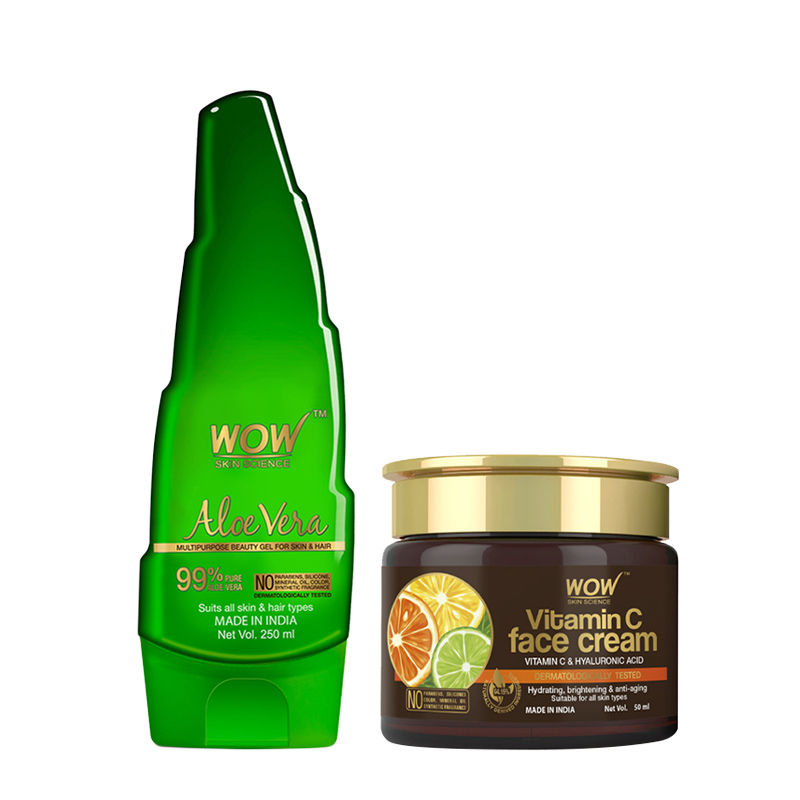
WOW Skin Science Aloe Vera Gel & Vitamin C Face Cream

WOW Skin Science Aloe Vera Gel & Vitamin C Face Cream
WOW
wow-skin-science-aloe-vera-gel-vitamin-c-face-cream
Moisturize
10085489574181
Morning or Evening?
How often will you use this product?
Notes


Highlights
WHAT IS IT?
Pure Aloe Vera Gel and Vitamin C Face Cream combo
FEATURES
99% pure aloe vera gel, moisturizes skin, reduces acne, soothes inflammation, boosts immunity, aids healing, anti-aging, infection protection, hair & scalp nourishment, free from parabens, mineral oils, silicones, color, synthetic fragrances
BEST FOR
all skin types
CHECKS
parabens,mineral oils,silicones,color,synthetic fragrances
Who Is It For?
What Does It Help With?
Dryness Acne Inflammation Aging Skin Infections Dandruff Itchy Scalp Wound HealingBudget
Mid-range ($30-$75)How To Use
Which routine should it be used in?
Instructions:
Key Information


What WOW Says
Product Description:
WOW Skin Science Aloe Vera Gel is 99% pure Aloe Vera, hygienically extracted & carefully packaged to retain its natural healing & rejuvenating benefits. It is a multipurpose beauty care product designed for healthy skin, hair & scalp care. The product moisturizes skin to prevent dryness, keeps pores tight to reduce acne, and soothes inflammations. It boosts immunity & aids faster healing of wounds. Free of parabens, mineral oils, silicones, color & synthetic fragrances. It provides anti-aging effects, helps neutralize infection-causing germs, softens hair, reduces dryness, checks dandruff & itchy scalp, and heals bacterial & fungal infections.
About the Brand:
Ingredients Overview
Ingredients List
aloe-vera-juice,xanthan-gum,sodium-benzoate,potassium-sorbate,citric-acid
Key Ingredients
aloe vera juice, xanthan gum, sodium benzoate, potassium sorbate, citric acid
Ingredients Details
Citric Acid
Common Name(s): Lemon acid,2-hydroxypropane-1,2,3-tricarboxylic acid
CAS Number: 77-92-9
DESCRIPTION
What It Does: Adjusts ph to optimal ranges, chelates destabilizing metal ions, provides mild exfoliation at higher concentrations.
Why It's Used: Universal cosmetic ph adjuster and chelating agent. aha exfoliant activity is secondary.
How It Works: As ph adjuster, donates protons. as chelating agent, three carboxylic groups bind divalent metals (ca²⁺, mg²⁺, fe²⁺) preventing oxidative degradation.
Typically Found In: Nearly all cosmetic formulations,brightening products,exfoliants
TECHNICAL DETAILS
Primary Category: Active ingredient – alpha hydroxy acid (aha)
Secondary Functions: Chelating agent,ph adjustment,preservation enhancement
Application Areas:

Facial Skincare
Body Care
Hair Care

Beard Care
Color Cosmetics (Makeup)
Dietary/Oral Supplements
Typical Concentration Range: 0.1%–10%
SOURCING & ETHICS
Vegan Status: Yes – synthetic or fermentation-derived
Halal Status: Yes
Source Notes: Produced by fermentation of sugars by aspergillus niger. gras (e330). most abundant organic acid in citrus.
SKIN COMPATIBILITY
Irritancy Rating: 1/5 – very low at low concentrations; 2/5 at exfoliant concentrations
Comedogenicity Rating: 0/5 – non-comedogenic
Sensitivity Concerns: Photosensitizing – mandatory spf use. start at low frequency.
Safe for Sensitive Skin: Use with caution – spf required
SAFETY & COMPATIBILITY
Safety Profile: Safe at otc concentrations. eu: ≤10% leave-on at ph ≥3.5. mandatory spf advisory.
Works Well With: Niacinamide,ceramides,hyaluronic acid,spf
Avoid Combining With: Retinol in same step; multiple exfoliants simultaneously
SCIENTIFIC NOTE
Three carboxylic acid groups provide multiple proton donation sites and stronger chelation than monocarboxylic ahas. this makes citric acid the preferred cosmetic chelating agent alongside edta.
Last Verified: 2026-03-12
Primary Sources: Cosing database,cir safety assessment,ewg skin deep
Potassium Sorbate
Common Name(s): Potassium e,2-hexenoate,sorbate of potash
CAS Number: 24634-61-5
DESCRIPTION
What It Does: Provides mould and yeast focused broad-spectrum preservation in a widely accepted food-grade preservative.
Why It's Used: Standard mould and yeast preservative — potassium sorbate is effective at slightly higher ph than sodium benzoate, making it the preferred sorbate preservative for formulations at ph 4.5-6.
How It Works: Inactive salt form — sorbic acid (free acid, pka 4.76) is active. more effective than benzoate at higher ph (pka 4.76 vs benzoate 4.2). active at ph up to ~6.0 (meaningful sorbic acid present). inhibits malassezia and candida at lower concentrations than bacteria. synergistic with sodium benzoate.
Typically Found In: Cosmetics ph 4-6,natural preservation systems,combined with sodium benzoate
TECHNICAL DETAILS
Primary Category: Functional ingredient – sorbate preservative
Secondary Functions: Skin conditioning
Application Areas:
Facial Skincare
Body Care
Hair Care
Beard Care
Color Cosmetics (Makeup)
Dietary/Oral Supplements
Typical Concentration Range: 0.1%–0.6%
SOURCING & ETHICS
Vegan Status: Conditional - supplier confirmation required
Halal Status: Unverified - supplier confirmation required
Source Notes: Commercially produced for cosmetic use. verify vegan/halal status with supplier. [audit 2026-07-29 rev2: the record's own source_notes does not assert a non-animal origin, or instructs the reader to verify with the supplier; "yes" asserts knowledge the record does not hold. determination requires shariah-panel sign-off.]
SKIN COMPATIBILITY
Irritancy Rating: 1/5 – very low
Comedogenicity Rating: 0/5 – non-comedogenic
Sensitivity Concerns: Well-tolerated by most skin types.
Safe for Sensitive Skin: Yes
SAFETY & COMPATIBILITY
Safety Profile: Eu max 0.6% cosmetics. fda gras. synergistic with sodium benzoate. oxidises to sorbaldehyde (yellow colouration) on uv exposure — protect from light.
Works Well With: Standard skincare actives
Avoid Combining With: No known significant incompatibilities
SCIENTIFIC NOTE
Potassium sorbate's antifungal mechanism (disruption of mitochondrial electron transport in fungi) is different from its antibacterial mechanism (cell membrane and enzyme disruption). this mechanistic bifunctionality provides broad spectrum from a single preservative, though the lower antifungal mic values mean mould and yeast protection is achieved at lower concentrations than bacterial protection.
Last Verified: 2026-03-12
Primary Sources: Cosing database,eu preservative annex v,fda gras,cir safety assessment
Sodium Benzoate
Common Name(s): Benzoic acid sodium salt,e211 food preservative
CAS Number: 532-32-1
DESCRIPTION
What It Does: Preserves acidic formulations against yeast and mold contamination.
Why It's Used: Natural-derived (from benzoic acid found in cranberries, cinnamon) preservative for acidic ph formulations where it provides excellent antimicrobial activity.
How It Works: Undissociated benzoic acid (active form, pka 4.2) penetrates microbial cell membranes and disrupts electron transport chain and ph homeostasis. at ph>5, mostly ionized (sodium salt) and inactive – requires acidic formulation ph for efficacy.
Typically Found In: Acidic serums,toners,low-ph formulations
TECHNICAL DETAILS
Primary Category: Functional ingredient – benzoate preservative
Secondary Functions: Skin conditioning
Application Areas:
Facial Skincare
Body Care
Hair Care
Beard Care
Color Cosmetics (Makeup)
Dietary/Oral Supplements
Typical Concentration Range: 0.1%–0.5%
SOURCING & ETHICS
Vegan Status: Conditional - supplier confirmation required
Halal Status: Unverified - supplier confirmation required
Source Notes: Commercially produced for cosmetic use. verify vegan/halal status with supplier. [audit 2026-07-29 rev2: the record's own source_notes does not assert a non-animal origin, or instructs the reader to verify with the supplier; "yes" asserts knowledge the record does not hold. determination requires shariah-panel sign-off.]
SKIN COMPATIBILITY
Irritancy Rating: 1/5 – very low
Comedogenicity Rating: 0/5 – non-comedogenic
Sensitivity Concerns: Well-tolerated by most skin types.
Safe for Sensitive Skin: Yes
SAFETY & COMPATIBILITY
Safety Profile: Eu max 0.5%. gras food additive. ewg score: 3 (benzene formation concern with vitamin c at >80°c – normal use temperatures do not form benzene).
Works Well With: Standard skincare actives
Avoid Combining With: No known significant incompatibilities
SCIENTIFIC NOTE
Sodium benzoate's strict ph dependency (90% inactive at ph>5.5) makes its preservative activity dramatically sensitive to formulation ph. a serum formulated at ph 4.0 is fully preserved by benzoate; the same formula adjusted to ph 5.5 has <10% of the preservative activity. this ph dependency must be considered in any benzoate-preserved formulation.
Last Verified: 2026-03-12
Primary Sources: Cosing database,siegert & frieling benzoate review,cir safety assessment
Xanthan Gum
Common Name(s): Corn sugar gum,xanthomonas campestris gum
CAS Number: 11138-66-2
DESCRIPTION
What It Does: Provides pseudoplastic thickening and emulsion/suspension stabilization across broad ph and salt conditions.
Why It's Used: The most versatile cosmetic thickener – pseudoplastic behavior (shear-thinning) provides ideal pump dispensing while maintaining in-use viscosity, stable across ph 2-12 and in high-salt formulations.
How It Works: Helix-coil conformational transitions provide pseudoplastic (shear-thinning) rheology. electrostatic repulsion between negatively charged chains provides thickening without cross-linking. stable across ph 2-12 and at nacl concentrations up to saturation.
Typically Found In: Virtually all aqueous cosmetic products requiring viscosity control
TECHNICAL DETAILS
Primary Category: Functional ingredient – microbial polysaccharide thickener
Secondary Functions: Tewl reduction,skin plumping
Application Areas:
Facial Skincare
Body Care
Hair Care
Beard Care
Color Cosmetics (Makeup)
Dietary/Oral Supplements
Typical Concentration Range: 0.1%–2%
SOURCING & ETHICS
Vegan Status: Yes – microbial fermentation (xanthomonas campestris)
Halal Status: Yes
Source Notes: Synthetic or naturally derived. excellent aqueous solubility.
SKIN COMPATIBILITY
Irritancy Rating: 1/5 – very low
Comedogenicity Rating: 0/5 – non-comedogenic
Sensitivity Concerns: Non-irritating; suitable for all skin types.
Safe for Sensitive Skin: Yes
SAFETY & COMPATIBILITY
Safety Profile: Excellent safety profile. ewg score: 1.
Works Well With: Ceramides,emollients,occlusives,glycerin,hyaluronic acid
Avoid Combining With: No significant incompatibilities
SCIENTIFIC NOTE
Xanthan gum's pseudoplastic behavior arises from helix alignment under shear (reducing viscosity) that recovers to random coil entanglement at rest (restoring viscosity). the 100-1000× viscosity reduction during pumping vs at rest makes xanthan the ideal pump-dispensing thickener – providing both easy dispensing and in-use viscosity that neither purely viscous nor elastic thickeners can achieve simultaneously.
Last Verified: 2026-03-12
Primary Sources: Cosing database,cir safety assessment,fda gras