

ZENUE
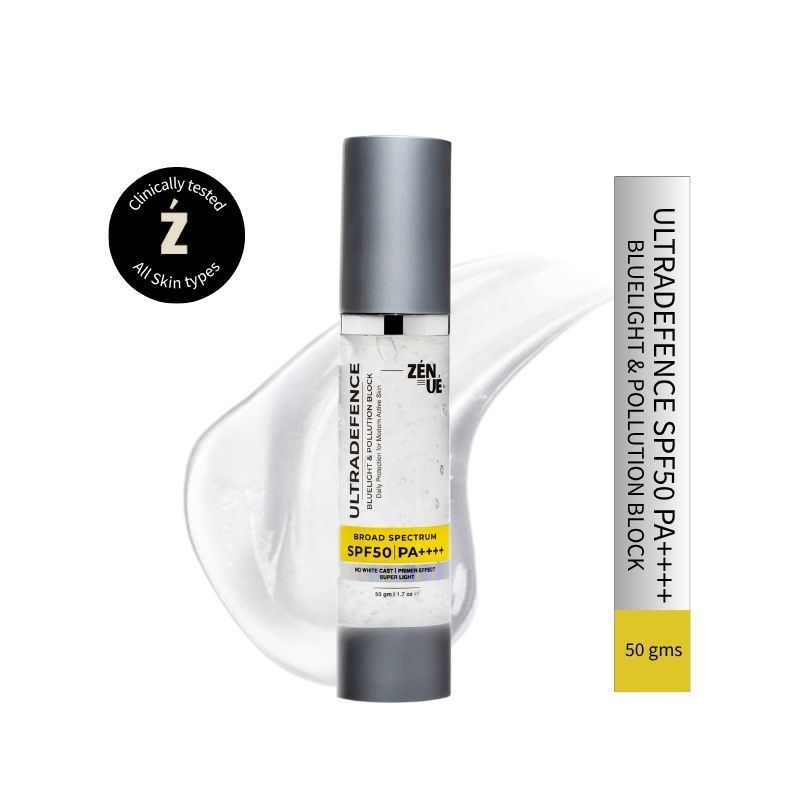
ZENUE Ultradefence SPF50 PA++++ Bluelight & Pollution Block

ZENUE Ultradefence SPF50 PA++++ Bluelight & Pollution Block
ZENUE
zenue-ultradefence-spf50-pa-bluelight-pollution-block
Suncare
10085031412005
Morning or Evening?
How often will you use this product?
Notes


Highlights
WHAT IS IT?
Sunscreen with multiple actives including UV, blue light, and pollution protection (8 key actives)
FEATURES
Clinically tested SPF 50+ PA++++ with blue light and infrared protection, Advanced hybrid UV filters, 5% niacinamide for barrier repair and brightening, Lutein for blue light defence, Spirulina for pollution protection, Carrot seed oil for antioxidant UV-boosting, Hyaluronic acid for hydration, Jelly-serum texture with velvet-matte finish
BEST FOR
sensitive
CHECKS
Free from oxybenzone, octinoxate, parabens, mineral oil, synthetic dyes
Who Is It For?
All Genders Suitable For All Skin TypesWhat Does It Help With?
Protection From Uva Uvb Blue Light Infrared Radiation Urban Pollution; Hydration; Skin Barrier Strengthening; Brightening; Antioxidant ProtectionBudget
Premium ($76-$150)How To Use
Which routine should it be used in?
Instructions:
Key Information


What ZENUE Says
Product Description:
Zenue Ultradefence SPF 50 PA++++ is a cutting-edge hybrid sunscreen formulated to protect modern urban skin from a wide range of environmental aggressors. Offering broad-spectrum defense against UVA and UVB rays, harmful blue light from screens, infrared radiation, and urban pollution, it goes beyond sun protection. Its innovative jelly-serum texture is lightweight, non-greasy, and leaves no white cast, making it perfect for daily wear and layering under makeup. Enriched with skin-loving ingredients like niacinamide, lutein, spirulina, carrot seed oil, and hyaluronic acid, it hydrates, soothes, and strengthens the skin barrier.
About the Brand:
Ingredients Overview
Ingredients List
Cyclopentasiloxane,Dimethicone/Vinyl-Dimethicone-Crosspolymer,Caprylic/Capric-Triglyceride,Isododecane,Niacinamide,Lutein,UV-Phytocare,Bis-Ethylhexyloxyphenol-Methoxyphenyl-Triazine-(Tinosorb-S),Olive-Squalene,PA-Pollution-(Pollustop),Sodium-Hyaluronate,Green-Tea-Oil,Grape-Seed-Oil,Carrot-Seed-Oil,Diethylamino-Hydroxybenzoyl-Hexyl-Benzoate-(Uvinul-A-Plus),Spirulina-Platensis-Extract,Cactus-Flower-Extract,Sodium-PCA,Tocopheryl-Acetate,Camellia-Sinensis-Leaf-Extract,Cucumber-Extract,Perfume
Key Ingredients
Tinosorb S,Uvinul A Plus,Niacinamide,Lutein,Pollustop,Hyaluronic Acid,Spirulina Extract,Carrot Seed Oil,Olive Squalene
Ingredients Details
Cyclopentasiloxane
Common Name(s): Cyclopentasiloxane,cyclic volatile silicone,dry-touch carrier solvent
CAS Number: N/a
DESCRIPTION
What It Does: Provides a dry, weightless application vehicle that evaporates cleanly leaving actives and non-volatile silicones deposited on skin — eliminating the residual heaviness of conventional liquid carrier solvents.
Why It's Used: Cyclosiloxanes are the unique volatile silicone solvents that dissolve non-volatile silicones (dimethicone, cyclomethicone), organic uv filters, and lipophilic actives, providing the sensory-superior dry-touch application experience in premium formulations.
How It Works: Cyclosiloxane vapour pressure (d5 cyclopentasiloxane ~0.3 mmhg at 25°c) provides clean evaporation at body temperature. the cyclic ring structure provides lower boiling point than equivalent linear dimethicone, enabling faster evaporation while the ring conformation maintains the silicone's low surface energy for smooth application.
Typically Found In: Primers,antiperspirants,sunscreens
TECHNICAL DETAILS
Primary Category: Functional ingredient – emollient
Secondary Functions: Barrier sealing,softening
Application Areas:

Facial Skincare
Body Care
Hair Care

Beard Care
Color Cosmetics (Makeup)
Dietary/Oral Supplements
Typical Concentration Range: 1%–50%
SOURCING & ETHICS
Vegan Status: Yes
Halal Status: Yes
Source Notes: Plant-derived, synthetic or animal-derived. verify source.
SKIN COMPATIBILITY
Irritancy Rating: 1/5 – very low
Comedogenicity Rating: 1/5 – low; formulation-dependent
Sensitivity Concerns: Non-irritating.
Safe for Sensitive Skin: Yes
SAFETY & COMPATIBILITY
Safety Profile: Excellent safety profile. ewg score: 1.
Works Well With: Humectants,ceramides,actives as carrier
Avoid Combining With: No significant incompatibilities
SCIENTIFIC NOTE
Cyclopentasiloxane (d5) and cyclohexasiloxane (d6) are under eu regulatory review for potential environmental persistence (pbt assessment) — formulators should monitor eu regulation 2018/35 implementation for restrictions in wash-off products.
Last Verified: Cosing database,eu cyclosiloxane regulatory review
Primary Sources: 2026-03-12
Isododecane
Common Name(s): Permethyl 99a,c12 isoparaffin,volatile hydrocarbon
CAS Number: 31807-55-3
DESCRIPTION
What It Does: Provides quick-dry volatile hydrocarbon carrier for colour cosmetics with complete evaporation and no residue.
Why It's Used: Primary colour cosmetic carrier — isododecane's volatility and excellent pigment dispersion combined with complete evaporation make it the standard carrier for long-wear foundations and colour cosmetics.
How It Works: Volatile isoparaffin (bp 177-188°c) evaporates from skin within 10-20 minutes. excellent pigment dispersion for colour cosmetics. spreading enhancement from low surface tension. no residue after evaporation provides clean, long-wear finish.
Typically Found In: Long-wear foundations,colour cosmetics,primers,sunscreens
TECHNICAL DETAILS
Primary Category: Functional ingredient – volatile hydrocarbon
Secondary Functions: Barrier sealing,softening
Application Areas:
Facial Skincare
Body Care
Hair Care
Beard Care
Color Cosmetics (Makeup)
Dietary/Oral Supplements
Typical Concentration Range: 5%–60%
SOURCING & ETHICS
Vegan Status: Yes – synthetic
Halal Status: Yes
Source Notes: Plant-derived, synthetic or animal-derived. verify source.
SKIN COMPATIBILITY
Irritancy Rating: 1/5 – very low
Comedogenicity Rating: 1/5 – low; formulation-dependent
Sensitivity Concerns: Non-irritating.
Safe for Sensitive Skin: Yes
SAFETY & COMPATIBILITY
Safety Profile: Excellent safety profile. ewg score: 1.
Works Well With: Humectants,ceramides,actives as carrier
Avoid Combining With: No significant incompatibilities
SCIENTIFIC NOTE
Isododecane's position as the preferred colour cosmetic carrier arises from a unique combination of properties that no other solvent provides simultaneously: volatility (complete evaporation for clean finish), pigment dispersion (superior to water or alcohols), compatibility with silicones (unlike many solvents), and skin safety (inert hydrocarbon without irritation potential of polar solvents).
Last Verified: Cosing database,cir safety assessment
Primary Sources: 2026-03-12
Lutein
Common Name(s): Xanthophyll,beta-carotene-3,3'-diol
CAS Number: 127-40-2
DESCRIPTION
What It Does: Filters hev blue light and quenches singlet oxygen for combined skin and eye photoprotective antioxidant defense.
Why It's Used: Dual skin+eye benefit antioxidant providing hev/blue light filtering increasingly relevant in screen-exposed individuals.
How It Works: Xanthophyll structure with two polar hydroxyl groups positions lutein in the outer regions of membrane bilayers for optimal singlet oxygen quenching and hev absorption. absorbs blue light (450-490nm) providing physical filtering.
Typically Found In: Anti-aging serums,blue light defense products,eye creams
TECHNICAL DETAILS
Primary Category: Active ingredient – xanthophyll carotenoid
Secondary Functions: Hev blue light filtering,singlet oxygen quenching
Application Areas:
Facial Skincare
Body Care
Hair Care
Beard Care
Color Cosmetics (Makeup)
Dietary/Oral Supplements
Typical Concentration Range: 0.01%–0.5%
SOURCING & ETHICS
Vegan Status: Yes – from tagetes erecta marigold petals
Halal Status: Yes
Source Notes: Extracted from marigold (tagetes erecta) flowers. naturally esterified form requires saponification for free lutein.
SKIN COMPATIBILITY
Irritancy Rating: 1/5 – very low
Comedogenicity Rating: 0/5 – non-comedogenic
Sensitivity Concerns: Non-irritating; well-tolerated.
Safe for Sensitive Skin: Yes
SAFETY & COMPATIBILITY
Safety Profile: Excellent safety profile. ewg score: 1.
Works Well With: Vitamin c,vitamin e,ferulic acid,spf,other antioxidants
Avoid Combining With: No significant incompatibilities
SCIENTIFIC NOTE
Lutein and zeaxanthin form the macular pigment in the retina that protects photoreceptors from hev/blue light damage. the same protective mechanism operates in skin, where lutein accumulates after topical application and provides measurable blue light absorption.
Last Verified: Cosing database,chitchumroonchokchai & failla lutein review,cir safety assessment
Primary Sources: 2026-03-12
Niacinamide
Common Name(s): Vitamin b3,nicotinamide,pyridine-3-carboxamide
CAS Number: 98-92-0
DESCRIPTION
What It Does: Niacinamide strengthens the skin barrier, reduces visible pore size, regulates sebum production, fades dark spots, and improves skin texture and tone.
Why It's Used: It is used because it addresses multiple skin concerns at once without irritation, making it suitable for all skin types. it is stable in formulations and pairs well with most other actives.
How It Works: Niacinamide inhibits the transfer of melanosomes (pigment packets) to skin cells, reducing hyperpigmentation. it also stimulates ceramide synthesis to strengthen the skin barrier and reduces inflammation by modulating cytokine activity.
Typically Found In: Serums,moisturizers,toners,cleansers,eye creams,sunscreens,primers
TECHNICAL DETAILS
Primary Category: Active ingredient – vitamin
Secondary Functions: Barrier repair,brightening,anti-inflammatory
Application Areas:
Facial Skincare
Body Care
Hair Care
Beard Care
Color Cosmetics (Makeup)
Dietary/Oral Supplements
Typical Concentration Range: 2%–10% (typical: 5%; higher concentrations may cause flushing in some individuals)
SOURCING & ETHICS
Vegan Status: Yes – synthetically produced
Halal Status: Yes – synthetic origin
Source Notes: Commercially produced via synthesis from nicotinic acid or 3-cyanopyridine. no animal-derived sources used in cosmetic-grade niacinamide.
SKIN COMPATIBILITY
Irritancy Rating: 1/5 – very low; concentrations above 10% may cause temporary flushing in sensitive individuals
Comedogenicity Rating: 0/5 – non-comedogenic
Sensitivity Concerns: At concentrations >10%, some users experience niacin flush (transient redness/tingling). generally very well-tolerated.
Safe for Sensitive Skin: Yes – one of the best-tolerated actives for sensitive skin
SAFETY & COMPATIBILITY
Safety Profile: Extensively studied and considered very safe. ewg hazard score: 1. no significant systemic toxicity concerns at topical concentrations.
Works Well With: Retinol,peptides,ahas/bhas,hyaluronic acid,ceramides,zinc,vitamin c,spf
Avoid Combining With: High concentrations of vitamin c (ascorbic acid) may theoretically convert to niacin – use at different times if using pure l-ascorbic acid above 15%
SCIENTIFIC NOTE
Niacinamide is a precursor to nad+ and nadp+, coenzymes vital to cellular energy metabolism. its benefits for dna repair and mitochondrial function make it a key ingredient in anti-aging strategies.
Last Verified: Cosing database,cir safety assessment,ewg skin deep,pubmed clinical studies
Primary Sources: 2026-03-12
